This post is inspired by the collaborative conceptualization of a workshop on African feminist AI held at ETHOS Lab in May 2025. It is deeply indebted to the ideas shared by the workshop organizers and participants.
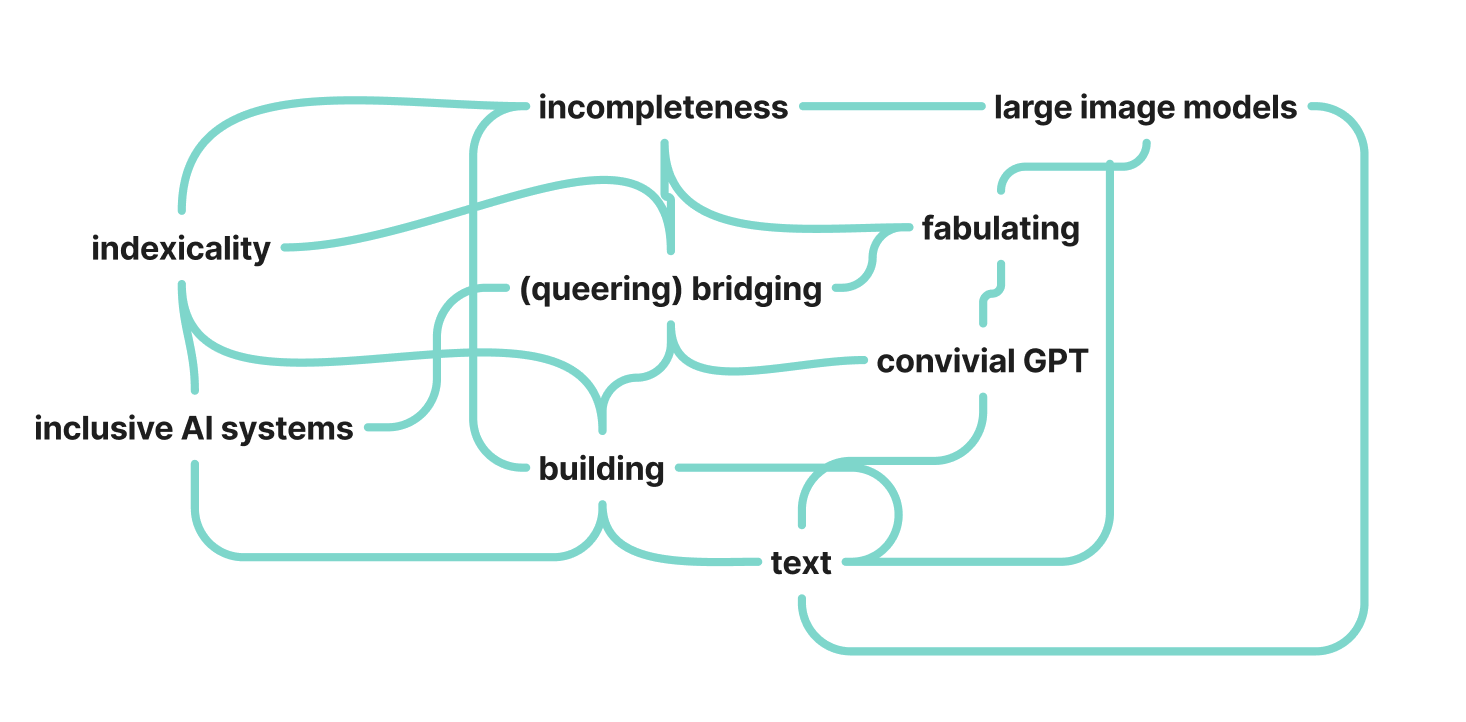
An anonymized and edited artefact from the virtual workshop. Image created by Multimodal Contributing Editor Christine Kim using Figma, in collaboration with post author Alena Thiel.
Recent debates have exposed the multiple structures of contemporary AI systems that continue to deny African existences. Among them, Anwar and Graham (2022) denounce the exploitative nature of digital labor on the continent that sustains the global AI boom. Similarly, Couldry and Mejias’ critique of “data colonialism” has by now attained a somewhat canonical status in its rejection of “the continuous extraction of economic value from human life through data” (Couldry and Mejias 2023: 787). Similarly, scholars have pointed to colonial continuities in computational and data infrastructure (Jahajeeah 2024) as well as perpetual under-regulation and resulting lack of protection of African data subjects (Hassan 2023) – while echoing pressing concerns around algorithmic racism (Noble 2018).
In this CASTAC blog series, we hope to add to these crucial debates a perspective from a decidedly feminist African Studies position, which resonates the call to amplify alternative tech visions that value care and plurality. While our commitments align with the aforementioned critiques of AI in Africa, we observe that the expansion of digital technologies across the African continent has yielded unequal effects across gender, class and ability more generally, complicating therefore analytical lenses that center around universalizing logics of “data colonialism” or global “digital divides”. In our view, an Africanist perspective through its commitment to reflexive interdisciplinarity (Hammar 2021) opens up the debate to questions of gender, language, and normativity that evade containment in broad conceptualizations of African AI. We believe we are at a critical crossroads for such a conversation, because, despite agreement that digital inclusion is necessary, we need to recenter the complexities, frictions and shifting commitments that are often eclipsed in essentialized ideas about agency and vulnerability at the centre of the debate around postcolonial knowledge structures. For example, recent scholarship on Africa in the 4th Industrial Revolution emphasizes the embrace of authentically “African” concerns, rearticulating notions of distance and otherness. As de Vries (2024) articulates with references to Francis Nyamnjoh’s (2017) notion of “incompleteness”, such “Cartesian dualisms that divide the world into categories like African and Western, modern and traditional, human and non-human [are] the same dualisms that drove the colonial conquest” (de Vries 2024: 5).
Conversely, following Nanjala Nyabola’s (2024) observation of the plurality of African digital feminisms, this blog series takes the variety of experiences, critical perspectives and responses to digital developments as a starting point to interrogate the intersection of power and technology in the contemporary moment of big tech creeping into African digital (public) infrastructure. An African feminist perspective, we argue, is particularly valuable. As Lamoureaux and Rottenburg (2021) remark with reference to the rich body of African feminist literature, “gender norms figure within the tropes of both modernity and tradition, and intersect with related patterns” including “recent neoliberal capitalist and development paradigms” in digital infrastructuring.
In view of these foundations, the blog posts in this series emphasize the potential of epistemic humility, connection and mutuality in their promise to create new opportunities for understanding, critique and transformation (de Vries 2024). In other words, a focus on African digital feminisms as networked, intersectional and decolonial promises to counter dominant, masculinist conceptions or African digital innovations and politics with their developmentalist (often neoliberal) undertones, and foreground political alternatives that “include the desire for the wellbeing of others” (Nyabola 2024: 105).
What connects the posts in this series, then, is their call for a shift in engagement with African techno-ethics and feminist AI that foreground incompleteness and conviviality (Nyamnjoh 2017) to generate new, inclusive political imaginaries.
Mpho Primus and Siri Lamoureaux discuss how Large Language Models flatten the relational and essentially context-dependent nature of African languages, and advocate for a multimodal and community-centered approach to AI that integrates local epistemologies and prioritizes relational ethics over universal frameworks. For the two authors, incompleteness, rather than striving for totalizing linguistic capture, emerges thus as a central ethical stance.
Nicole Ahoya, in turn, describes how the notion of a global “justice gap” has paved the way for a new, “people-centered” justice approach that intersects with techno-optimism as AI and digital tools are deployed to address systemic inefficiencies. The resulting legal data infrastructures influence normative ideas of justice, as critics warn, risk imposing external normative frameworks. Ahoya calls for locally imagined futures that prioritize creativity, uncertainty, and plural epistemologies.
Catherina Wilson contributes a view from technologically-mediated, collaborative ethnography in contexts of political turmoil. Wilson provides a compelling picture of digitally mediated collaborative work that leads us beyond the methodological opportunities offered by digital tools, to “critically reflect on their limitations and ethical implications”, especially in situations of political turmoil and internet shut down.
This blog series emerged from a workshop held at ETHOS Lab, IT University Copenhagen in May 2025. Participants were asked to bring artefacts from their research work that speak to feminist ethics of African AI. During the workshop, we traced how these artefacts creep into each other, cast shadows onto each other, possibly sharing structures and meaning-generating forces. Proposing a convivial qualitative analysis, we hoped, would open new categories of talking/writing about AI in Africa and scope out the potential for (feminist) counter-moves in these categorical shifts. The image accompanying this blog is an anonymized and edited artefact from the virtual workshop.
This post was edited by Multimodal Contributing Editor Christine Kim and reviewed by Contributing Editor Volney Friedrich.
References
Amrute, S. 2019. “Of Techno-Ethics and Techno-Affects.” Feminist Review 123 (1): 56-73.
Anwar, M.A. and M. Graham. 2022. The Digital Continent: Placing Africa in Planetary Networks of Work. Oxford: Oxford University Press.
Couldry, N. and U.A. Mejias. 2023. “The Decolonial Turn in Data and Technology Research: What is at Stake and Where is it Heading?” Information, Communication & Society 26 (4): 786-802.
De Vries, J. 2024. “Centering Africa as Context and Driver for Global Health Ethics: Incompleteness, Conviviality and the Limits of Ubuntu.” Open Letter, available online: https://doi.org/10.12688/wellcomeopenres.22508.1
Hammar, A. 2021. “Why African Studies Matters.” Nordic Journal of African Studies 30 (3): 1-8.
Hassan, Y. 2023. “Governing Algorithms from the South: A Case Study of AI Development in Africa.” AI & Society 38 (3): 1429-1442.
Jahajeeah, J.A. 2024. “Hydro-de-Colonialism and the Cables Around the Cape.” In Regional Drift: Remapping Africa’s Southern Oceans, edited by Pamila Gupta and Caio Simões de Araújo. Routledge.
Lamoureaux, S. and R. Rottenburg. 2021. “Doing Postcolonial Gender: An Approach to Justifying Rights, Resources, and Recognition.” Tapuya: Latin American Science, Technology and Society 4 (1): Article: 1984040.
Noble, S.U. 2018. Algorithms of Oppression: How Search Engines Reinforce Racism. New York: New York University Press.
Nyabola, N. 2024. “African Feminisms as Method: A Methodology for African Feminisms in the Digital Age.” Feminist Africa 5 (2): 94-112. https://www.jstor.org/stable/48799337
Nyamnjoh, F. 2017. “Incompleteness: Frontier Africa and the Currency of Conviviality.” Journal of Asian and African Studies 52 (3): 253-270.
Oyěwùmí, O. 2002. “Conceptualizing Gender: The Euro-Centric Foundations of Feminist Concepts and the Challenge of African Epistemologies.” Jenda: A Journal of Culture and African Women Studies 2 (1): 1-9.
