In 2021, Chinese telecom giant Huawei formally handed over the Konza Ubunifu data center to the Kenyan government. The data center is the infrastructural core of the “city brain” for Kenya’s first smart city, the Konza Technopolis, a new town built from scratch on the outskirts of Nairobi. After nearly two decades of making and remaking, and as a flagship project of Kenya Vision 2030, Konza has yet to deliver on its promises. The launch of the Ubunifu data center marks a watershed moment for the smart city as it asserts its pivotal role in the country’s digital landscape.
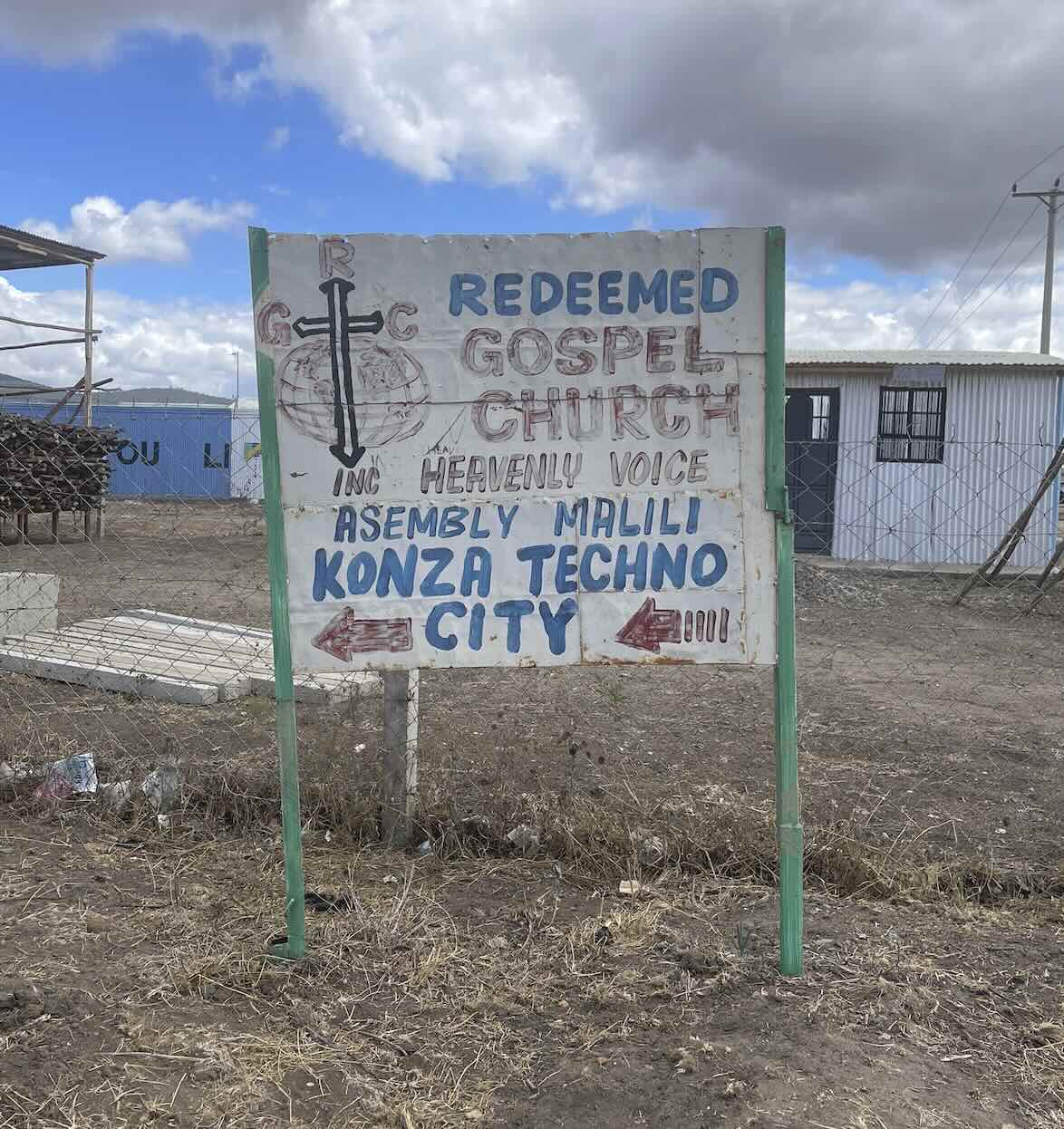
Signpost for the “heavenly voice” of a gospel church near Konza. Image by author.
Rampant technological speculation entered the Kenyan market under the strain of the 2007-8 global financial crisis. For aspirational Kenyan technocrats, the smart city would accommodate a wide range of cutting-edge technological imaginations, infrastructure configurations, and “smart” solutions. This experimental temporality of technoscientific progress also foretells a politics of redundancy and compatibility inherent in data center design and development. Classified as a Tier III data center by the Uptime Institute, the data center can achieve 99.982% operational availability and hosts an array of public e-government and private commercial data. By now, it has already reached its storage capacity, with expansion and upgrades actively pursued to align with the new “smart” imagination injected by the new hypes of AI.
How, then, do we approach a data center that arrives as new only to immediately recede into obsolescence, demanding perpetual repair, adaptation, and expansion to absorb shifts in the technological landscape unimagined at its inception? How might the (up)time that this data center affords help us rethink the long aspiration for digitality and smartness in African techno-scientific imaginations?
During six months of fieldwork within the Ubunifu data center in 2025, I shadowed the maintenance crew to understand how technical proficiency and physical labor are structured by inherent material vulnerabilities of different mechanical systems—from (air) cooling units and emergency alarms to servers and hardware racks. The electrical technicians, IT officers, network specialists, and custodial workers I work with have a name: the “DC people” (S: watu wa DC), a moniker referring to their geographic peripheralization in the isolated, unostentatious facility alongside their pivotal role in sustaining the continuous circulation of the urban technological organism. Strict protocol from the development authority prevents me from representing the data center visually. Yet, immersed in the routines of repairing, maintaining, and caring for machines, another sensory register comes to the fore: its sonic presence, particularly the sounds generated by its loaded machines.
The piece presented here is a sonic ethnography derived from my fieldwork in the Konza Ubunifu data center and its surrounding savannah land. Unlike its visual untouchability, the facility emits an unceasing, rhythmic hum that hovers over the surrounding landscape day and night. As I experiment in this sound piece, the soundtrack of machines and that of the surrounding environment—the buzzing of insects, bird calls, and wind sweeping across the trees toward tarmacked roads—are synchronized in rhythm: sometimes they interrupt one another, sometimes they converge into a harmonious whole.
Scientific practices are imbued with various forms of resonance (Messeri, 2017). As a form of “affective reasoning”, resonance draws discrete objects and places together, enabling the far to be sensed as close. Kenyan technicians stationed in the data center grasp the place’s potential through the hum of machines. They do not view the hum as an unsettling noise but as a signal of stable, consistent, and unblocked movement, something they, like many urban residents in Kenya, have long yearned for. Humming is a bodily technique of waiting and boredom that attempts to pacify the predictable intrusions of jarring uncertainties in everyday urban survival. It is a “noise” of conviviality pregnant with value potentials (Newell and Montaz, 2025). An ephemeral presence hosting a shared sensory archive of collective digital existence (Gurrumuruwuy and Miyarrka Media, 2019): a register through which concealed linkages and diverse currents materialize, allowing imperceptible signals to persist against erasure and obstruction. Immersed in the humming savannah—where humming machines mingle with humming birds, winds, insects, and the spiritual echoes of ancestors and god—I suggest sensing the data center and the broader digital landscape it conjures as a site of resonance (Mu, 2025). That is, it is part of the earthly capacity to hum out unexpected presences and possibilities.
Listen to the sound piece here
Instructions for Listening:
Humming is breathing. Close your eyes, breathe, and listen.
This post was reviewed by Multimodal Contributing Editor Chen Shen.
References
Gurrumuruwuy, P., Miyarrka Media, 2019. Phone & spear: a yut̲a anthropology. Goldsmith’s, The MIT Press, London, Cambridge, Massachusetts.
Messeri, L., 2017. Resonant worlds: Cultivating proximal encounters in planetary science. American Ethnologist 44, 131–142. https://doi.org/10.1111/amet.12431
Mu, J., 2025. How Not to Define the Smart City, in: The Smartification of Everything, Technoscience and Society. University of Toronto Press, pp. 83–94. https://doi.org/10.3138/9781487556723.008
Newell, S., Montaz, L., 2025. “I am the noise.” American Ethnologist 52, 284–297. https://doi.org/10.1111/amet.13440
