Rain came down hard as we sheltered beneath the layers of tarpaulin that formed the roof of a small jhopdi (a makeshift hut made from inexpensive or scrap materials like wood, metal sheets and plastic) in one of Bengaluru’s informal settlements. Bengaluru, the capital city of Karnataka in southern India, is home to numerous such settlements where migrant construction workers live and work. After days of oppressive heat in August, it finally rained, and within minutes rivulets formed along the mud pathways between the jhopdis. I was accompanied by Radha, a grassroots worker involved in housing and labour rights advocacy for migrant workers, who often assists me with translations in the field. We were visiting the settlement on a Sunday, a rajja day for our regular follow-up conversations. Rajja means a day off, and while rajja can be any designated day of the week depending on the workers’ schedules and employment arrangements, in this particular settlement Sunday served as rajja day. This settlement is one of the several field sites I continue to visit as part of my ongoing doctoral fieldwork with migrant construction workers in Bengaluru.
With some dismay, Radha and I watched as the path back to the main road disappeared beneath pools of muddy brown water. Resigned to waiting out the rain, Radha continued her work helping residents put together documents needed to apply for a social welfare scheme, while I sat down to take notes. Radha typically visits the settlement on rajja days when most workers are at home. Over cups of chai and conversation, she explains the benefits linked to the welfare scheme and the documents needed for the registration.
On that rainy day, however, the residents were distracted, worried about the water entering their homes and understandably hesitant to pull out their carefully stored documents in the rain. Still, a few residents, having prepared their documents following our conversations the previous week, waded through the muddy water to reach the jhopdi where we were sheltering. Lakshmi, in whose home we were sheltering, put a vessel on a stove over a small gas cylinder to make chai for everyone. Over the past couple of months of visiting the settlement, my presence had become less conspicuous. Conversations that once began with “you’re back with more questions?” now often looked like conversations over chai.
As the rain intensified, the response among the residents was immediate and practiced. The men who were lounging under the trees nearby and playing cards hurried to move their motorbikes to a shelter outside the settlement. Others inspected their tarpaulin roofs, while still others huddled at a nearby tea stall for a hot cup of chai. Usually, rajja days followed a familiar pattern in this settlement, and in many of the others across Bengaluru where migrant construction workers reside. After a week of physically demanding labour, the men sat in groups to play cards or slept in their homes or in shaded areas.
The women, who were also construction workers, meanwhile, remained occupied in a range of domestic chores, including washing clothes, scrubbing utensils, cooking food or sweeping the area around their homes. Earlier that morning, I had watched the women complete much of this work. Some had finally lain down to rest when the rain arrived. From Lakshmi’s place, I could see women in neighbouring homes spring back into action, hurriedly moving possessions away from damp patches and placing wooden boards at their doorways to prevent muddy water from entering. Any possibility of that afternoon nap disappeared.
Rajja is a much-cherished day off from construction work. Yet, over the course of my fieldwork examining how migrant construction workers experience and cope with climate risks in Bengaluru, I began to question the gendered nature of rest. What does rajja, or a day of rest, actually entail for women? Did they have time to rest and recover from a week of physically demanding labour? What did opportunities for rest look like under conditions of precarious work and housing? And how were these opportunities shaped by climate stresses like flooding, heat and water scarcity?
Rest has multiple dimensions. Alongside physiological recovery, leisure activities centered around sociability and self-expression can also create opportunities for recovery and wellbeing in places of migration (Mata-Codesal, Peperkamp & Tiesler, 2015; Sun, 2025). In this essay, however, I focus primarily on rest. I understand rest as not just the absence of paid work but as the recovery necessary to sustain bodies engaged in physically demanding labour like construction work, and the conditions that make such recovery possible. Drawing on ongoing fieldwork in Bengaluru, I examine how women describe their experiences of rest. The essay considers how opportunities for rest are unevenly distributed and shaped by gendered social relations, as well as a range of environmental and material conditions.
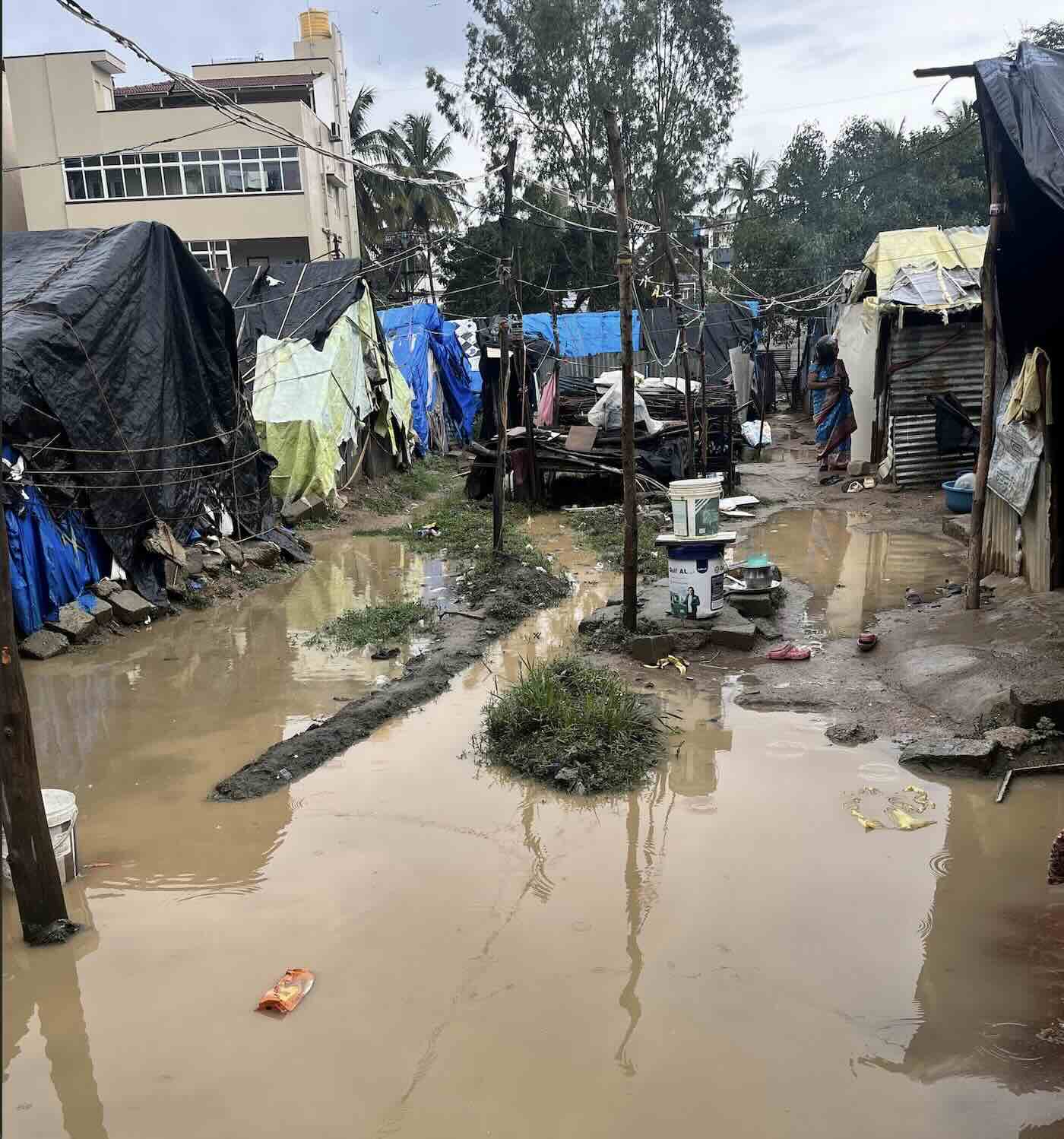
The settlement after the rain. Photo by author. 2026.
Migrant construction labourers
These questions emerged from observing the rhythms of construction labour itself. Many of the workers I meet have migrated from rural Karnataka, following agricultural distress and rainfall failures (Chu & Michael, 2019; Deccan Herald, 2025). This year, 2026, in particular, marked a historic rainfall deficit of almost 44%, prompting the state government to declare around 73% of Karnataka drought-affected – an unfolding situation that could potentially trigger many more cases of migration (Deccan Herald, 2026; Hindustan Times, 2026). Yet in Bengaluru, episodes of even moderate rainfall result in prolonged waterlogging in some of the settlements, where many migrant labourers reside. Burdened by debt and unable to afford formal housing, they often live in informal arrangements (Rathod & Ranganathan, 2025). Across sectors including construction, sanitation, and waste segregation, living spaces of migrant workers are frequently relegated to ecologically high-risk zones with limited or absent services, heightening their exposure to floods, heat, and water scarcity (Sathuluri, 2025).
This group of agricultural labourers from rural Karnataka, many of whom belong to historically marginalized caste communities, is typically categorized as unskilled labourers within the construction industry (Gupta & Olickal, 2024). Their tasks involve mixing cement and mortar, carrying bricks and construction materials between floors, and other physically demanding work that places considerable strain on the body. They work six days a week, provided illness does not prevent them from doing so, something that many workers reported happens with some frequency. Across settlements, regardless of age, construction work is consistently described as exhausting.
Whether they migrate on a short-term, seasonal basis or have spent decades in the city, many workers maintain strong ties to their home villages (ooru) (Shivanand, 2019). My interviews revealed that they continue to hold voter identification cards linked to their villages, access ration entitlements there, and return regularly to visit family and observe religious festivals. As a result, even those who have established relatively permanent lives in Bengaluru and long since left behind agricultural work continue to identify, and be identified, as migrants. Without local address proofs or electoral registration in Bengaluru, many migrant workers remain politically invisible in the city. As they do not constitute an electoral constituency for locally elected representatives, their concerns are often overlooked in local governance processes.
These intertwined conditions of migration, debt, precarious housing, environmental stresses, political neglect and physically demanding labour form the backdrop against which rest must be understood.
Work and Rest on Rajja Days
Over a cup of chai, I ask the women sheltering in Lakshmi’s home what they do on rajja day. How do they spend their free time?
They laugh: “What free time?”
They proceed to list the many chores awaiting them.
“It rained today, so that was extra work of cleaning out the muddy water when it enters inside”.
Through multiple interviews and time-use discussions, I gathered that for many female migrant construction workers, the workday begins between four and five in the morning. After attending to their sanitation needs at a pay-and-use toilet or open defecation site near their settlements, they prepare breakfast and pack lunches for themselves and their husbands, wash clothes, clean utensils, and fetch water, all before 8 AM, when they must leave for work. Construction sites demand punctuality, and arriving late results in wage deductions. After a day of labour, workers return home in the evening between 5 and 7 PM, when another round of domestic labour awaits.
“What do you do when you come home after work?”
“Cook again, wash utensils,” they reply. “It is almost 10 or 11 PM by the time we can sleep”.
Given the gruelling workday schedule, rest on rajja days is thus not only cherished but also imperative for recovery.
For men, evenings and Sundays can involve a wider range of possibilities, including undertaking additional wage labour for extra income, collecting water and fuelwood, helping with domestic work like cleaning, and social activities like playing cards, visiting tea shops or, as many women reported, consuming alcohol. Domestic responsibilities remain unevenly distributed. Moreover, although workers explained that men are assigned heavier and more physically intensive tasks, women remain underpaid for the same number of hours worked, often earning around ₹500 per day (5.42 USD) compared to around ₹800 (8.42 USD) earned by men as construction labourers. This is not to suggest that men’s work is not physically demanding or to discredit the intensity of the labour they perform. Rather, whereas men can often conclude their workday by evening unless compelled to seek additional employment, women’s labour begins earlier in the day and extends well beyond the construction site into the home through cooking, cleaning, childcare and other forms of social reproduction.
Furthermore, for long-term migrant communities seeking to secure housing and tenure rights in Bengaluru, rajja days are also when important community and political work takes place. Radha explains that most community meetings are organized on rajja days. Because workers are dispersed across construction sites throughout the city during the week, rajja days are often the only times when residents gather collectively to discuss common concerns and organize.
However, demonstrations and meetings with government officials need to take place on weekdays. For instance, demonstrations or protests at the Deputy Commissioner’s office, where showing up in large numbers is an important strategy for drawing attention and making visible the demands of otherwise politically invisible groups to state authorities. In such cases, workers must either shift their weekly rajja to a weekday or take an additional rajja day and forego a day’s wages to participate. As a result, rajja days become not only opportunities for rest and recovery, but also occasions for political participation and community organizing. For many migrant workers then, the time available for rest must also be negotiated alongside the pressing collective work of making claims in the city.
Yet rajja days are not entirely devoid of rest. When asked if they manage to take any time for themselves after their chores: “I sleep in,” Lakshmi tells me. “I wake up late, then I cook something nice – like chicken, mutton, and then I take a nap”.
An afternoon nap emerges as a cherished activity across multiple conversations across settlements, although it is not equally accessible to all women.
“She can cook and nap because her children are grown up and she can relax now,” another woman remarks. “I have to take care of the children, feed them, attend to them. It takes up all my time […] I still try and sleep for more hours.”
Material conditions of housing further shape the possibility of rest. While on rainy days families spend time preventing water from entering their homes, heat presents a different set of challenges. During periods of intense heat, sleep becomes difficult and uncomfortable as the tarpaulin roofing traps heat inside the jhopdi (Sharma & Orlene, 2024). This is one of the reasons why the men spend their rajja afternoons under the shade of trees or makeshift tents, playing cards. When the shaded spaces inside the settlements are occupied by men, women must find shade elsewhere.
On one hot and dry day, in another settlement, some women explained that they had been trying to sleep after completing some of their chores, but it was simply too hot. Fortunately, there is a public park with many trees nearby where it is considerably cooler. The park offered a publicly accessible and relatively safe environment in which women could rest during the hottest hours of the day. Several residents described routinely spending their rajja afternoons there to beat the heat.
Even in settlements without public parks nearby, women frequently mention trees: a neem tree, a guava tree, a small grove of coconut trees. If inadequate housing and climatic exposure undermine opportunities for recovery at home, shaded spaces like parks and trees provide alternative spaces for rest where bodies can find respite. Access to shaded public spaces becomes an important condition that helps make rest possible.
Heat also contributes to the deterioration of the housing itself. As I watched that rainy afternoon, one woman repeatedly emptied buckets of water collecting beneath leaks in the tarpaulin roof. When I asked what had happened, she explained that the heat from the recent heat wave had weakened the tarpaulin sheets, while rats chewed through some sections of the material, leaving the roof vulnerable to leaks. As such, heat and rain compound one another, testing the durability of housing and shaping the ability to rest within it.
In the absence of relief in their homes and elsewhere in the city, some women described temporarily returning to their villages during periods of prolonged rain. As many sleep on the ground, rainwater entering their homes means sleepless nights. In any case, rainy periods brought construction activity to a halt, meaning work was unavailable regardless of whether they stayed or left.
More recently, a state scheme introduced in 2023, making state-run buses free for women holding Karnataka identity cards, has made mobility significantly easier (Jana & Paul, 2026). Buses are not only used to leave the city during difficult periods, but also to visit religious sites, attend meetings and protests, and to stay with relatives elsewhere in Bengaluru. Radha similarly credits free bus travel with enabling her and her colleagues’ advocacy work across the city in multiple settlements.
Incidentally, migrant construction workers are also employed by the municipal government to maintain and expand the storm water drain network – an infrastructure that is central to Bengaluru’s flood management strategy. They are hired through contractors, informally, with minimal occupational protections, often at the lowest wages – particularly in the case of women (Deshingkar, 2019; Breman, 2019; Bowers, 2019; Subramanyam & Bouma, 2024). Maintaining drains involves removing accumulated waste, including animal remains and sewage-contaminated debris, with limited protective gear.
“It is such filthy work,” a woman describes during another interview, “ my hands blister, and it’s just disgusting”.
These conditions demonstrate how precarity persists in migrants’ lives, even after they migrate. Construction workers labour to build and maintain infrastructures central to Bengaluru’s resilience while remaining highly exposed and unable to access the benefits of the very same infrastructures (Rathod, 2024; Jennath & Singh, 2024). Under such conditions, opportunities for rest are precarious. When heat disrupts sleep or rain floods homes, workers lose valuable opportunities for physical recovery. Fatigue accumulates, the frequency of illnesses increases, and the resulting loss of workdays further undermines already precarious livelihoods.
Conditions for Rest
Returning to the questions that the essay began with, what does a day of rest actually mean for migrant construction workers? For many of the women I spoke with, rajja was rarely a day free of work. Rather, it was a day on which paid construction work gave way to unpaid domestic labour, community responsibilities, and collective political work. Not only must time for rest be negotiated between competing responsibilities, but material conditions further shape the possibility of rest. Sleeping in, an afternoon nap in a public park, meant precious moments of recovery.
As my fieldwork continues, I continue to gather stories from the everyday lives of migrant construction workers, particularly women, whose experiences reveal uneven geographies of climate vulnerability in Bengaluru. Migrant construction workers are indispensable to the construction and maintenance of the infrastructure that underpins the city’s growth and climate resilience. Yet, they are also among those most exposed to heat, flooding, water insecurity, and other hazards in both their workplaces and homes – representing a double injustice.
Despite their central role in the city, workers’ routine exposure to unsafe housing, precarious employment, and climate-related hazards remains largely absent from climate adaptation and disaster risk planning. At the same time, seemingly modest public provisions, such as access to public parks and shaded green spaces, and Karnataka’s free bus scheme for women have emerged as some of the few sources that create opportunities for rest and recovery in the face of these climate stresses. While many benefits remain exclusionary, planning responses might learn from and strengthen these everyday spaces and opportunities for rest.
Taken together, these accounts suggest that opportunities for rest are unevenly distributed and shaped by gendered social relations, as well as a range of environmental and material conditions. Understanding rest in this way shifts attention from individual coping strategies to larger conditions that make rest possible. It also reveals how the invisible costs of Bengaluru’s development and resilience-building efforts continue to be borne disproportionately by migrants, especially women, not only through their labour in the construction industry but also through the ongoing work of social reproduction required to sustain life in precarious settlements.
This post was curated by contributing editor Shreyasha Paudel, and reviewed by Sameeha Vardhan.
References
Breman, J. (2019). Capitalism, inequality and labour in India. Cambridge University Press.
Bowers, R. (2019). Navigating the City and the Workplace: Migrant Female Construction Workers and Urban (Im)Mobilities. Global Labour Journal, 10(1), 20. https://doi.org/10.15173/glj.v10i1.3406Chu, E., & Michael, K. (2019). Recognition in urban climate justice: marginality and exclusion of migrants in Indian cities. Environment and Urbanization, 31(1), 139–156. https://doi.org/10.1177/0956247818814449Deccan Herald (2026, September 29). Union Minister H D Kumaraswamy seeks Rs 3.705 crore central aid for Karnataka drought, crop losses. Deccan Herald. https://www.deccanherald.com/india/karnataka/union-minister-h-d-kumaraswamy-seeks-rs-3705-crore-central-aid-for-karnataka-drought-crop-losses-4164204Deshingkar, P. (2019). The making and unmaking of precarious, ideal subjects – migration brokerage in the Global South. Journal of Ethnic and Migration Studies, 45(14), 2638–2654. https://doi.org/10.1080/1369183X.2018.1528094Gupta, N., & Olickal, S. (2024, January, 02). India’s shift to low-carbon construction must not leave workers behind. WRI India Blog. https://www.wri.org/insights/india-just-transition-low-carbon-construction#:~:text=Alongside%20climate%20and%20resilience%20benefits,skilled%20workers%20in%20next%20decadeHindustan Times (2026, September 29). 3 teams from Center to assess drought situation in Karnataka. Hindustan Times. https://www.hindustantimes.com/india-news/centre-to-send-3-teams-to-assess-k-taka-drought-deputy-cm-101790623005702.htmlJana, M & Paul, J. (2026, January, 9). Fare play: How Karnataka’s shakti is changing women’s work [Essay]. International Growth Center: Notes from the Field. https://www.ideasforindia.in/topics/social-identity/fare-play-how-karnatakas-shakti-is-changing-womens-workJennath, A., & Singh, C. (2024, December 23). Bengaluru floods spotlight unequal risk on migrant settlements [Op-Ed]. Nature India. https://www.nature.com/articles/d44151-024-00209-1Joshi, B. (2025, August 24). 85% of migrant workers in Karnataka come from 6 states: Govt. Data. Deccan Herald. https://www.deccanherald.com/india/karnataka/85-of-migrant-workers-in-karnataka-come-from-6-states-govt-data-3694736Mata-Codesal, D., Peperkamp, E., & Tiesler, N.-C. (2015). Migration, migrants and leisure: meaningful leisure? Leisure Studies, 34(1), 1–4. https://doi.org/10.1080/02614367.2015.992620Rathod, S. (2025, November 10). How Bengaluru’s migrant workers pay with their lives for climate change and corruption [Op-Ed]. The News Minute. https://www.thenewsminute.com/karnataka/how-bengalurus-migrant-workers-pay-with-their-lives-for-climate-change-and-corruptionSathuluri, D. (2025). Invisible deaths: How India’s climate crisis abandons its sanitation workers. Down to Earth. https://www.downtoearth.org.in/climate-change/invisible-deaths-how-indias-climate-crisis-abandons-its-sanitation-workersSharma, P. & Orlene, J. (2024, May 22). Heat Stress: how soaring temperatures are taking their toll on migrant workers in India’s garden city [Essay]. The Guardian. https://www.theguardian.com/global-development/article/2024/may/22/india-bengaluru-heatwaves-climate-inequalities-cities-planning-informal-workersShivanand, S. (2019). ‘Feet in Both Places’: Affective Spaces of Circular Migration. Urbanisation (Online), 4(2), 94–108. https://doi.org/10.1177/2455747119892346Subramanyam, N. & Bouma, D. (2024). Migrating injustices in the small city: drought-impacted interstate migrant workers’ experiences in Tiruppur’s sanitation sector. Climate and Development, DOI: 10.1080/17565529.2024.2330978Sun, Y. (2025). The beauty mirage: affective labour and precarious leisure of China’s rural-to-urban migrant women. Leisure Studies, 1–19. https://doi.org/10.1080/02614367.2025.2558578
