As a PhD student at Stanford, I often get confused looks from colleagues when I say I’m “working at the Farm,” which is a nickname for Stanford University itself (that I personally don’t use, as I find it quite cheesy). I mean Stanford’s Educational Farm, which is where, for the past few years, I’ve been learning how to grow and process fibers from plants as part of my dissertation research on the turn-of-the-twentieth century history of Korean indentured labor trafficking to the agave fiber plantations of Mexico’s Yucatán Peninsula.[1]
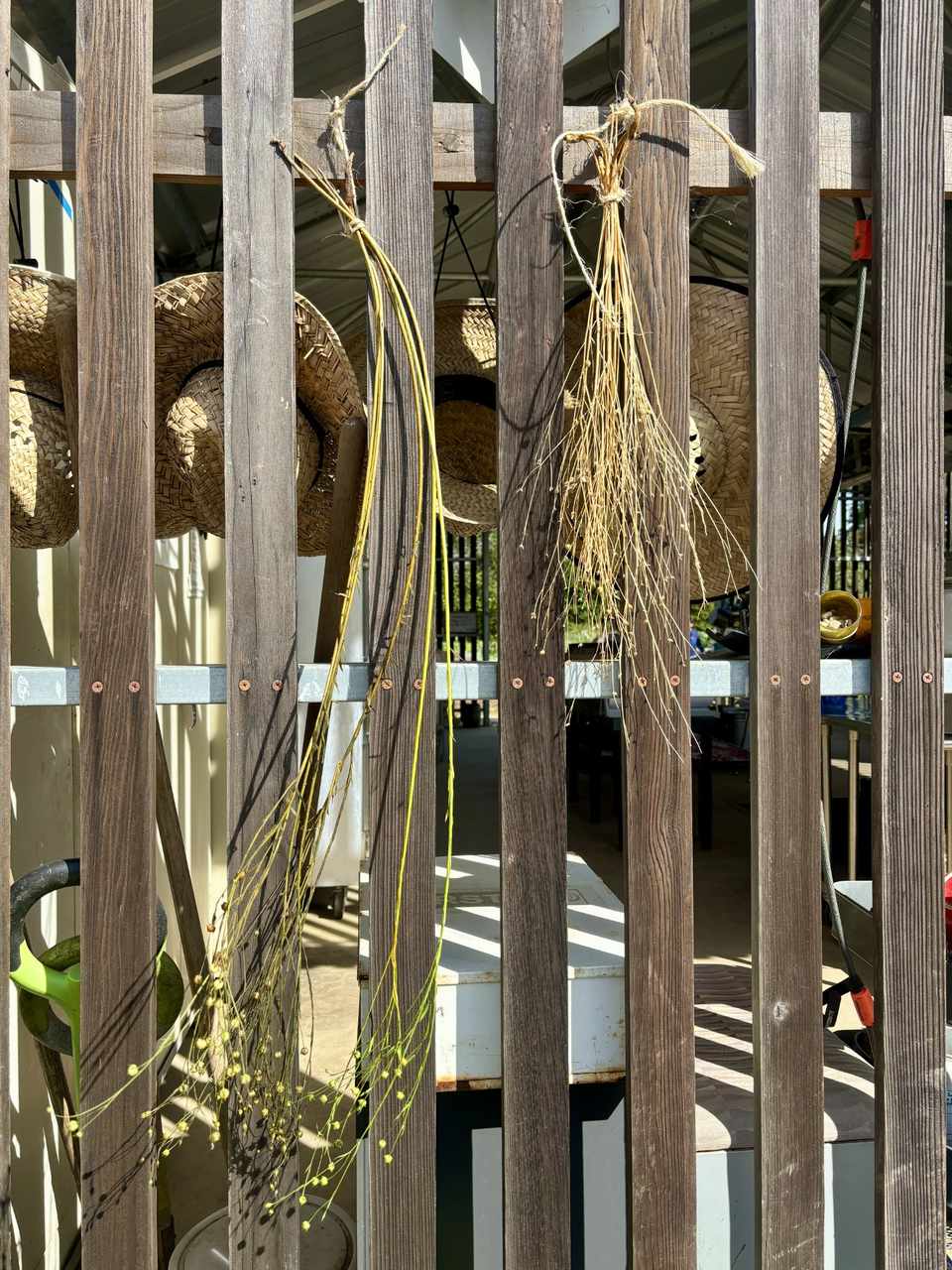
Photo showing exemplars of different Linum usitatissimum cultivars grown on experimental plots at the Stanford Educational Farm: left is a fiber cultivar, right is an ornamental cultivar.
Video footage of experimental fiber flax plot on Stanford’s Educational Farm from April 2024, which was meant to document how much of the stalks had turned yellow, as some studies note that the optimal time to harvest is when the bottom 1/3 has changed color.[2]
Human Environments
The connection between diaspora studies and farming may not be immediately obvious, but in the case of the 1905 Korea-Mexico migration, historical narratives often feature the “agricultural” as a central character. The Museum of Korean Emigration History in Incheon, South Korea, for example, displays a historic henequén decorticating machine and bagasse cart imported from Mexico in connection with its Korea-Mexico exhibit, which describes these artifacts as both “tangible evidence of Mexico’s industrial success” and “a symbol of the harsh life that the early Korean immigrants had to endure.” Visual storytellers have utilized images of the thorned “henequén” plant—generally understood as Agave fourcroydes but sometimes confused for a type of “cactus” in the Opuntia genus—to both evoke the pain Korean workers suffered in the fields as well as “botanize” their resilience, a move that risks entrenching ethnonationalist understandings of identity while pathologizing human mobility.[3] Assumptions about the plantation commodity also color academic scholarship on the diaspora history, leading some researchers to mistakenly assert European maritime imperialism as the “pull factor” for Asian labor recruitment to the region, likely by misinterpreting references to the “hemp” trade as fibers from the Cannabis sativa plant (“true hemp”). Environmental historians have written extensively on how Yucatán’s gilded age was imbricated with the U.S.-led development of agricultural harvesting equipment that relied on binder twine, for which henequén (sometimes called “agave hemp” or “sisal hemp”) served as a primary input. This example illustrates how, indeed, “all-too-human communities” are inseparable from “more-than-human worlds,” from which follows that a siloed approach to researching either necessarily contributes to their mutual impoverishment.[4]
Farming is not “Mere” Labor
My education on the “Farm”—specifically, my training in farming and fibrecraft coupled with science and technology studies (STS)—has critically transformed the lens through which I examine this migration history, which had been primarily shaped by my previous experience in immigration and refugee law. Throughout my research journey analyzing the colonial dimensions of Koreans’ integration into the racialized labor regime of the Yucatecan plantation-industrial complex, I’ve been struck by how the value of my practice-based legal knowledge has always been assumed, while my lack of familiarity with how agriculture actually “works” was never questioned.
Video footage of greenhouse-sprouted flax seedling transplantation process from April 2023—before I learned that, unlike many other plants grown on the Farm, flax does not respond well to being transplanted.[5]
Based on how much I have learned even after just a few years of experimenting with agricultural techniques—a truly humbling experience, as I’ll describe in further detail below—I’ve begun to understand the dismissal of farmwork as an intellectually unserious practice to be symptomatic of what anthropologist Liisa Malkki has described in her ethnography of international humanitarianism as the politics of the “mere,” or “that which is “appropriately” ignored,” within the normative structures of formal academia.[6]
In this work, Liisa problematized the devaluation of the “domestic” in academic research—in both the local and familial sense, but also “domestic” crafts such as sewing and knitting—to make visible implicitly gendered forms of thinking that color hierarchies of academic legitimacy. These themes were explored further in Liisa’s “Multimodal Ethnography” course in Spring 2024—the last she taught before retiring from Stanford—which was built around hands-on workshops featuring a form of knowledge commonly “disqualified” in the university setting that too often celebrates the “life of the mind” disconnected from, and elevated over, that of the “body.” I first learned how to crochet in Liisa’s course while reflecting on the fact of our “deskilling” as consumers of mass-manufactured products and materials, as our daily lives are far removed from “quotidian” ways of making and knowing. That many of us don’t know how to make or mend our own clothes, among other everyday items, connects easily with familiar STS topics such as the politics of fast fashion and the maintenance and repair of both infrastructure and environments, digital or otherwise.
Anthropologist Tim Ingold has pointed out the assumption that “things can be ‘theorised’ in isolation from what is going on in the world around us, and that the results of this theorising furnish hypotheses to be applied in the attempt to make sense of it” as a common conceit in academic scholarship.[7] Our failure to take seriously farming in general, and fiber production in particular, denigrating these practices as “mere” labor exerted to produce raw materials—a category of things for which the prefix “mere” is often silent—itself reflects agriculture’s intensified “subjugation to the thinning regime of modern science,” as historian of science and technology Tiago Saraiva articulated in his study of pig, wheat, and sheep breeding and coffee, rubber, and cotton farming under authoritarian regimes.[8] Cultivating reflexivity around how our material worlds are not only built by industrial processes, but also the fact that these processes of simplification—monocropping, mechanization—in turn profoundly reduce our own material, scientific, and environmental literacy to correlate with the industrial logic of scale, profit, and uniformity demands that we do more than simply “touch grass.” I wonder if it might behoove all researchers to undergo training in the literal “field,” or “farm.”
Video footage of author conducting a “sound test” on retted flax to determine whether the stalks are ready to be dried in preparation for breaking as the first step in mechanical decortication, taken in July 2024.[9]
Field Experiments
I’ve been incredibly fortunate to have had the chance to conduct farming experiments throughout my doctoral training with the support of Stanford’s Educational Farm; the Stanford Humanities Center, which provided seed funding for a multi-year research workshop dedicated to exploring these themes; and the project’s inaugural faculty co-chairs, Liisa and historian of technology Tom Mullaney, who christened the group “Fiber Optics” as a nod to the technological features of the fibers we take for granted, and the generative potential of attending to them closely.
And it’s been humbling to get schooled in agricultural techniques. Despite beginning with flax, considered the first to have been used by humans in textile production and a low maintenance, beginner-friendly plant, I made grave mistakes—for example, purchasing seeds for an ornamental versus fiber cultivar, ignorant of the fact that the species name Linum usitatissimum alone does not capture the incredible morphological diversity expressed among plants within this grouping that arise from selective breeding practices (which historian of agricultural science and technology Helen Curry spoke to us about last year in relation to her forthcoming “Seed Scenius” edited volume). At a more basic level, I learned from the Educational Farm’s skilled production coordinators Allison Jane Bauer and William Chen that even properly preparing beds and sowing seeds were far from “mindless” activities; these required trained, embodied judgment around a multitude of factors, from optimal depth and spacing to the “compactness” of the soil. I was also dispelled of my bucolic fantasy of farming when a gopher attack took out half the agaves we imported from Kenya as part of our collaboration with the Plant Pad Consortium thanks to our partnership with Anton Molina, then-PhD Candidate in Materials Science and lead author of an important study on Agave sisalana, a species relevant to my dissertation research. This led me to modify my pacifist stance on gophers, in recognition of how my output-oriented agenda turned my relationship with them adversarial in nature.
Finally, the Educational Farm has served as an invaluable teaching space on the “Farm” for core interlocutors to share knowledge and skills that have too often been excluded from formal classroom settings within the university. For example, artist Edi Dai, Program Manager in the Office of the Vice President for the Arts, is cultivating experimental plots of colored cotton and leading workshops on cotton ginning, carding, and weaving; and it was book conservator Kimberly Kwan, a specialist on the Preservation team at Stanford University Libraries, who taught me how to spin the flax we were growing during her invited lecture in environmental archaeologist Yahui He’s “Archaeobotany” course last year.
Video recording of Allison teaching proper technique for installing cinch gopher traps, from May 2023.[10]
Laboratory Life
In his seminal article “Give Me a Laboratory and I will Raise the World,” Bruno Latour presented Pasteur’s “lab” as a lever that, displacing the farm, strengthened the relationship between “science” and “society” by taking up microbes while pushing out vaccines.[11] Such laboratory language has also been deployed by many an artist and researcher to describe their experimental approach to craft as well as disciplinary modes of data collection and analysis.[12] Along these lines, I suggest we imagine the experiential community forming around Fiber Optics activities at the Educational Farm as a kind of “wet lab” comprised of “wetware” and “living” environments—taking seriously the fact of the researchers’ bodies as instruments while recovering a humanistic vision of both the “natural” and “worthwhile,” one plot at a time.[13]
Notes
[1] Written without the use of AI tools. I am grateful for the Mellon/ACLS Dissertation Innovation Fellowship, which allowed me to lean into my Educational Farm activities and articulate this work as a statement of method.
[2] Alt-text: Video pans across a field of tall, slender, green flax plants with small light blue flowers and maturing seed pods, then focuses on the yellowing lower part of the stem closest to the roots; the Stanford Educational Farm’s barn is out of focus in the background.
[3] See Liisa Malkki, “National Geographic: The Rooting of Peoples and the Territorialization of National Identity Among Scholars and Refugees” in Cultural Anthropology Vol. 7, Iss. 1 (Feb. 1992): 24-44, 34. Available at: https://anthrosource.onlinelibrary.wiley.com/doi/10.1525/can.1992.7.1.02a00030.
[4] Michelle N. Huang & Carlos Alonso Nugent, “Solidarity in Incommensurability: Ethnic Studies and the Environmental Humanities” in American Quarterly Vol. 77, No. 1 (Mar. 2025): 133-144, 138. Available at: https://muse.jhu.edu/article/953022. See also Anna Tsing, Mushroom at the End of the World: On the Possibility of Life in Capitalist Ruins (Duke University Press, 2015); Donna Haraway, Staying with the Trouble: Making Kin in the Chthulucene (Duke University Press, 2016).
[5] Alt-text: Video focuses on author’s hands as they use a wooden plant marker to unearth sprouted seedlings from a black plastic tray, separate each seedling from each other by gently pulling their entangled roots apart, and replant them in individual cells so they can continue maturing.
[6] Liisa Malkki, The Need to Help: The Domestic Arts of International Humanitarianism (Duke University Press, 2015), 15, 20.
[7] Tim Ingold, Making: Anthropology, Archaeology, Art and Architecture (Routledge, 2013), 4.
[8] Tiago Saraiva, Fascist Pigs: Technoscientific Organisms and the History of Fascism (MIT Press, 2018), 237.
[9] Alt-text: Video focuses on author’s hands as they twirl a long, yellow-brown flax stem around their finger, which makes a snapping noise; a kiddy pool full of flax stems submerged in clear water comes in and out of focus in the background.
[10] Alt-text: Video focuses on Allison’s hands as she holds, describes, and demonstrates the release mechanisms of a metal device with a flat angular surface and attached rods and spring, then places it near a hole in the ground created by a gopher, which collapses in the process; camera then follows Allison’s hands and pans to another spot on the farm plot with a small mound of dirt, which Allison identifies as another potential gopher hole.
[11] See Bruno Latour, “Give Me a Laboratory and I will Raise the World” in Science Observed: Perspectives on the Social Study of Science, Karin D. Knorr-Cetina & Michael Mulkay, eds. (SAGE Publications, 1983), 154.
[12] See, e.g., Darren Wershler, Lori Emerson, and Jussi Parikka (eds.), The Lab Book: Situated Practices in Media Studies (University of Minnesota Press, 2022).
[13] See Marcel Mauss, “Techniques of the Body” in Economy and Society Vol. 2, No. 1 (1973): 70-88.
This post was curated by Multimodal Contributing Editor Chen Shen and reviewed by Contributing Editor Kanikka Sersia.
