The Akai Music Production Center (MPC, formerly known as the MIDI Production Center) is a series of sequencers/samplers/interfaces first designed by Roger Linn and released in 1988 to critical acclaim. The MPC series soon became one of the most influential technologies in modern music production. The flagship model, the MPC60, included many features that made it an immediate hit with artists: a 4 by 4 layout of comfortable pressure sensitive pads, 16 voice polyphony, 13.1 seconds of sampling, frequency response of 18kHz, and MIDI (an acronym for musical instrument digital interface, a protocol that allows electronic instruments to communicate with each other). These feature allowed for easy connectivity to other MIDI devices found in studios at the time like synthesizers and other samplers, high quality sampling and playback, and an instrument that feels good to play.
These features and more led to the MPC to becoming a workhorse for many professional music recording studios. These spaces, which were almost exclusively white-owned and ran, were filled with millions of dollars of digital and analog equipment, which the MPC was able to connect with or sample seamlessly. This connectivity gave MPC users the ability to trigger other electronic instruments from the MPC itself, which positioned the MPC as not only an instrument but a control hub for a studio.
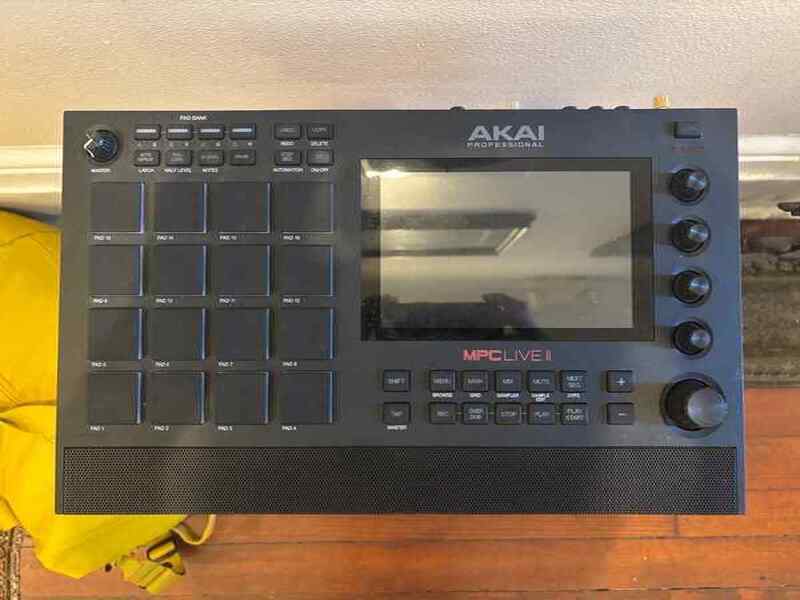
Jonathan Givan’s personal MPC Live II. Captured by the author on February 22, 2026.
The MPC was also being used by many who were not exclusively working on music in multi-million-dollar recording spaces. The MPC gained popularity amongst Black American Hip Hop producers, a group of musicians and technologists who often produced beats in their personal home studios. Within the context of Hip Hop music, “producer” refers to the individual or group of people who use their knowledge of musical instruments, electronic hardware, and digital software to create the musical backing track that is then rapped or sung over by an artist(s) or group[1]. Black Hip Hop producers were using the MPC as an instrument in a very different way from their white counterparts. As Linn himself told me during a conversation we had, the MPC was not being used as simply an “on-off switch”, but as an “instrument.” This application was both directly in line with his vision for the MPC and wildly outside of the scope of his imagination during the design phase, and this implementation proved to be so influential that the MPC is now seen by many Hip Hop producers as deeply entangled with the genre.
Black American musical practice thus expanded MPC usage to transform it from a sampler/sequencer for general musical use into an iconic and influential instrument of Hip Hop.
Musical Practice as a Source of Knowledge through Discourse
The MPC exists in a unique techno-cultural space. The device itself is a digital sampler and sequencer that came with many features that are still standard within digital music equipment, but the machine is deeply “analog” in its design (Gearspace 2013; Hassan 2022), meaning the MPC reflects the aesthetic preferences of its users in spite of its underlying technology. It is a digital computer with specific functionality, but the MPC is known for a warm, analog sound associated with vinyl records. In reality, the MPC recreates this aesthetic through a chain of audio processing hardware devices, often resampling music from noisy original sources such as vinyl or tape. This tension has left the MPC in a digital/analog media limbo. Even though the MPC is a digital sampler, the mediums by which sound is sampled (like vinyl records) evoke an analog warmth. This practice of taking sound from an analog source like vinyl and converting it into a digital object turns the MPC into a technology of recovery and of digital archiving (Gallon 2016). Although not a typical digital platform like social media, the MPC’s digital nature and its use as a platform for spatiotemporal discourse turns it into a digital platform for creative and libidinal expression (Brock 2020). Hip Hop producers used the MPC as a technology of spatiotemporal discourse as they were drawing on musical samples from different artists who worked in different genres in different locations at different points of their lives. This discourse occurs between musicians and sound sources from varied time periods and spatial geographies. A Hip Hop producer can place Brazilian funk from the 1980s over a drum loop made by a United States rock band that was released during the 1960s. This framing of Hip Hop practice builds on the incredible work within Hip Hop studies that explores discourse within Hip Hop music primarily through rap lyrics (Williams 2010, Holt 2019). Hip Hop is often analyzed through a political activist lens using rhetorical analysis to explore lyrics, but through examination of the MPC as a platform for Black expression, Black being is viewed not through a lens of specific political action towards a specific political goal (socio-economic stability, police abolition, etc.) but rather through a politic of being Black and being able to express whatever it is you are feeling in that moment through the MPC. This analysis moves away from exploring Hip Hop as a particular Black political action taking sonic form and towards an ontology of Black American Hip Hop production. This shift is valuable because the sonic underpinning of the beat is what contextualizes and informs the lyrical production done in real time by the emcee during the process of writing and recording their lyrics. In doing this contextualizing work, Hip Hop music producers redeployed the sampler as not just a musical instrument but as a platform on which new forms of dialogue were able to blossom (Fouche 2006).
I argue that Hip Hop’s relationship with the sampler, while not the first example of sampled audio being used to create music, connected Black culture across space and time through technological means at a scale that was previously unrivaled. Songs like Common’s The Light could not exist without this spatiotemporal discourse. Producer J Dilla , using the MPC, put blue-eyed soul singer Bobby Caldwell’s 1980 love song Open Your Eyes in conversation with the 70s R&B group Detroit Emeralds (originally from Little Rock Arkansas) and their song You’re Getting a Little Too Smart in a way that inspired Chicago native Common to articulate a deep love for his partner at the time, fellow musician Erykah Badu. The sonic relationship between the two artists that were sampled delivered inspiration and made space for the particular emotions that Common was feeling in that moment.
How Community Informs Cultural Practice
My framing of the sampler as a platform of spatiotemporal discourse is something that emerged from ethnographic interviews I conducted for my current project. For example, in my interview with producer, audio engineer, and music historian Brian Lassiter, he notes that the sampler allowed musicians to bring together elements from culturally and musically significant songs and create something greater than the sum of its parts. He notes:
“We go back to sample these little parts of these songs,… as we’re making records. Now you can tell, I can tell if a guy rips off [British funk group] Cymande’s cowbell part, I can tell they take the snare from this record on the foot pedal from that record, because we’ve heard it for so many years, and now when we go back to sample it, we’re taking snippets from this, a horn blast from here, the foot pedal from there. These are the records that become…the paint…the colors.”
Here Lassiter talks about how the sampler is not only the platform to place different samples in conversation with one another, but it is also a platform to paint a musical picture using sonic moments that are important to a specific listening audience. These parts are not only important because they make a general listening audience groove, but they are evidence to musical interlocutors that you possess the knowledge and skill to tastefully use foundational sonic texts in a novel and engaging way. In doing this, the discourse extends beyond the sampled artists and draws the listener in as a part of the conversation.
My Final Thoughts
The Light serves as just one of many examples of the boundary dissolving capacities that the sampler enabled. Black American musical culture is built on communicating shared experiences to peers in the past, present, and future. The sampler is thus adopted as a medium for this communication, the platform upon which the spatiotemporal discourse can be held. The Hip Hop producer acts as the moderator, contextualizing it within the current social framework through sonic manipulation.
This post was curated by Contributing Editor Misria Shaik Ali and reviewed by Contributing Editor Aaron Neiman”.
Notes
[1] This definition is distinct from music producers such as Clive Davis or Rick Rubin, who served as decision makers, managers, and/or promoters within the music industry.
References
Brock Jr, André. 2020. Distributed Blackness: African American Cybercultures. New York University Press.
Fouché, Rayvon. 2006. “Say It Loud, I’m Black and I’m Proud: African Americans, American Artifactual Culture, and Black Vernacular Technological Creativity.” American Quarterly 58 (3): 639–61. https://doi.org/10.1353/aq.2006.0059.
Gallon, Kim. 2016. “Making a Case for the Black Digital Humanities,” In Debates in the Digital Humanities, edited by Matthew K. Gold and Lauren F. Klein. Minneapolis: University of Minnesota Press.
Gearspace. 2015. “Which MPC Is the Best for Analogue, Warm Sound?” Gearspace Web Forum, September 3. Access on May 27, 2025. Retrieved from https://gearspace.com/board/rap-hip-hop-engineering-and-production/1028928-mpc-best-analogue-warm-sound.html
Hassan, Robert. 2022. Analog. Cambridge, MA: MIT Press.
Holt, Kevin C. 2020. “Emcee Ethnographies: A Brief Sketch of U.S. Hip-Hop Ethnography.” Current Musicology 105 (March). https://doi.org/10.7916/cm.v0i105.5400.
Williams, Justin. A. 2010. “The Construction of Jazz Rap as High Art in Hiphop Music.” Journal of Musicology 27(4): 435-459. https://doi.org/10.1525/jm.2010.27.4.435.

1 Comment
As a producer that learned production in the late 90’s this is a spot on discourse about the Spatiotemporal connectivity of Musical Production from a variety of disparate sources. Sound brings back memory, pieces of movies, random quotes, and a deep audio archive of hits, spits, James Brown and Clyde Stubblefield, the Amen Brothers break that became the undertone of Jungle in the UK, Reggae and Rock samples. De La Souls album as well as WuTang grabbing kungfu movies near and dear to our hearts rhythm. I would love to see a visual component or ongoing talk on this.
– Sincerely,
Asukaya Bailey
Luminous Velocity LLC 2026