By the time panic buttons were installed in buses, taxis, and autorickshaws starting in 2012, their deployment in Delhi’s public transit vehicles had already been under discussion for some time. Policymakers and engineers had considered them as one among many measures available to address anxieties that movement through the public spaces of the city by these means was inherently and increasingly fraught with danger. In the case of autorickshaws, panic buttons where integrated directly into their fare meters as part of a new meter format introduced in 2012 – the Integrated Electronic Fare Meter (IEFM) – which sought to address broader suspicions about the commercial honesty and social morality of autorickshaw operators. The IEFM incorporated GPS receivers and SIM cards which allowed for the identification and transmission of locational data, with each IEFM linked to a centrally administered software platform to track and monitor each vehicle.
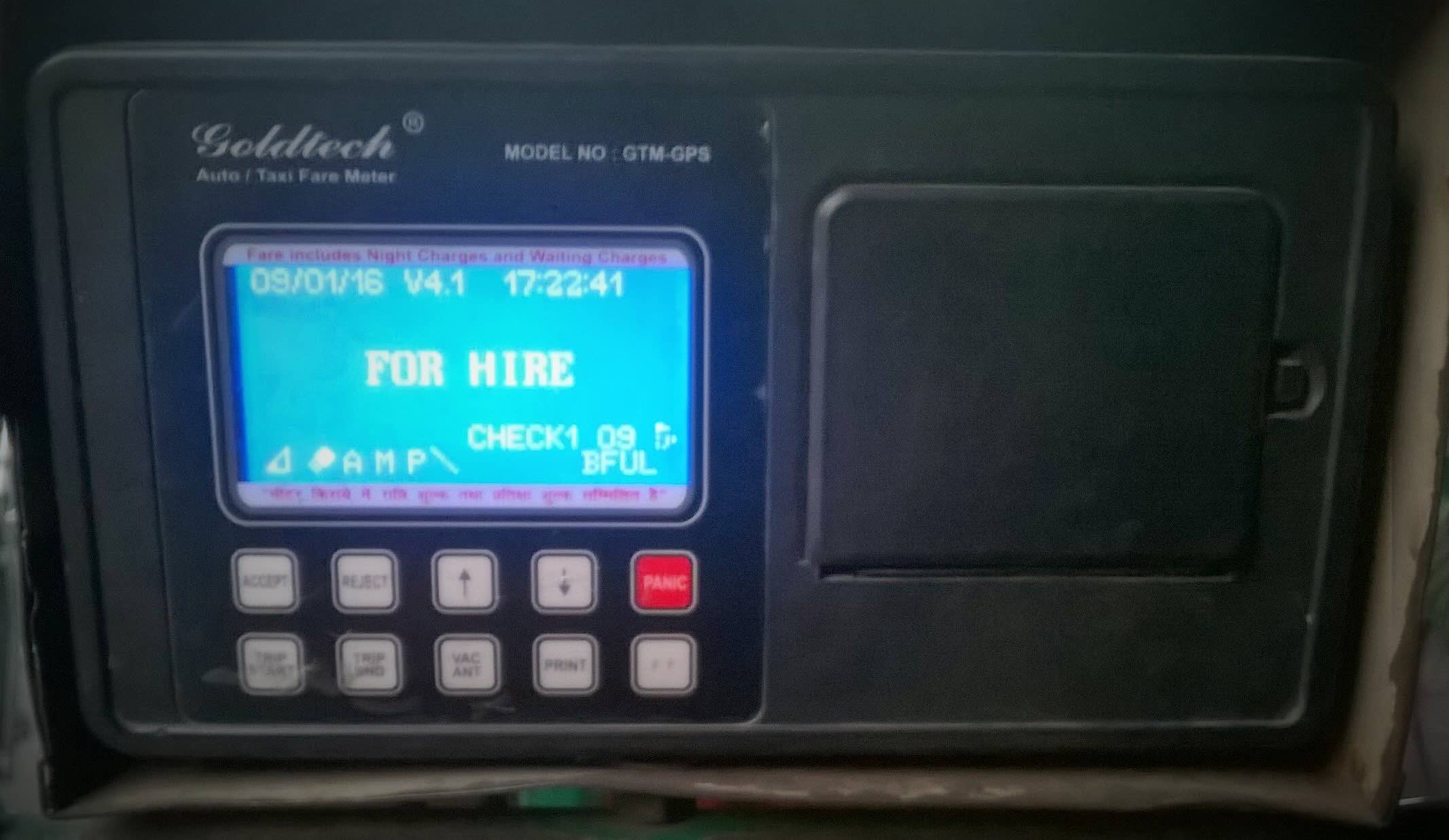
Panic buttons were installed in Delhi’s autorickshaws following a high-profile assault of a bus passenger in 2012. Photo by author, taken in 2015.
The panic button is designed to register the location of danger through a uniquely communicative logic: It must be activated by the person in the autorickshaw, functioning as a form of petition, provisioning security as a public good upon individual request. When the button is pressed, police are meant to arrive and prevent, interrupt, or redress the crisis event the panic button announces. The message the panic button relays is therefore two-fold: I am in danger here; someone is in danger there. A transport engineer who had worked on this system explained to me that the fully developed interface was meant to involve coordination through distributed, mobile police patrol vans, forming an architecture of constant proximity. Vans would be fitted with their own GPS/SIM systems and on-board computers, so that when a panic button was pressed, the nearest patrol van would be alerted, giving officers access to situation and vehicle information, allowing them to immediately converge on that location and intervene. Their response would never be too late because this distance would always be within their capability to bridge in a timely manner.
However, as a system which depends on the coordination of complex technologies and infrastructures of communication, commerce, and bureaucracy, the panic button is exposed to a wide range of potential failure points: infelicities of design, institutional indifference, as well as normal technical and human error. But this multiplicity of discrete possible sources of failure is itself superseded by the fact that the panic button comes into being as a public technology within an operational environment already defined by failure.
Failure as Environment and Event: The City
According to interlocutors involved in the development of the panic button system, its implementation was ultimately catalyzed by a specific instance of public violence, where a young woman and her male friend were attacked on a chartered bus. The woman was brutally assaulted by a group of men who left her to die from her injuries. It was this event and its propagation as media spectacle that marked public mobility in the city as excessively dangerous, conflating an assessment of danger based on the frequency of attacks with the transgressive ferocity of a particular episode. The circulation of this moment of violation as an event of public outrage was made possible by rendering the individual victim a generic icon – Nirbhaya, a woman whose struggle evidenced a “fearless” courage.
Her anonymization, initially required by law, generalized her struggle, expanding it to include every woman; and, through the architecture of the panic button, everyone and anyone. Here, the panic button stands as a promise that there will never be another “Nirbhaya” in the form of a statement of fact that there is no place where failures to protect will occur because the intent to protect is constant. There may very well be more attacks, but there will be no more tragedies. Any attack will always evidence the administrative continuity of a common resolve because there is no discernible location where failure to prevent a tragedy could occur. Thus the tragedy of Nirbhaya is sequestered in a time prior to the activation of this resolve and the repetition of tragedy is sequestered within the duration of that resolve.
It is through such an “operational solidarity” (de Abreu 2019, 658) between the panic button as technological artefact and the urban milieu that failure is received and rendered as a spatial and temporal medium. And it is in this context that a curious “architectural fact” (Fujita 2022) intervenes, structuring how failure is scaled spatially and temporally as an event and evaluation.
Failure as Interruption of Elicitation: The Box
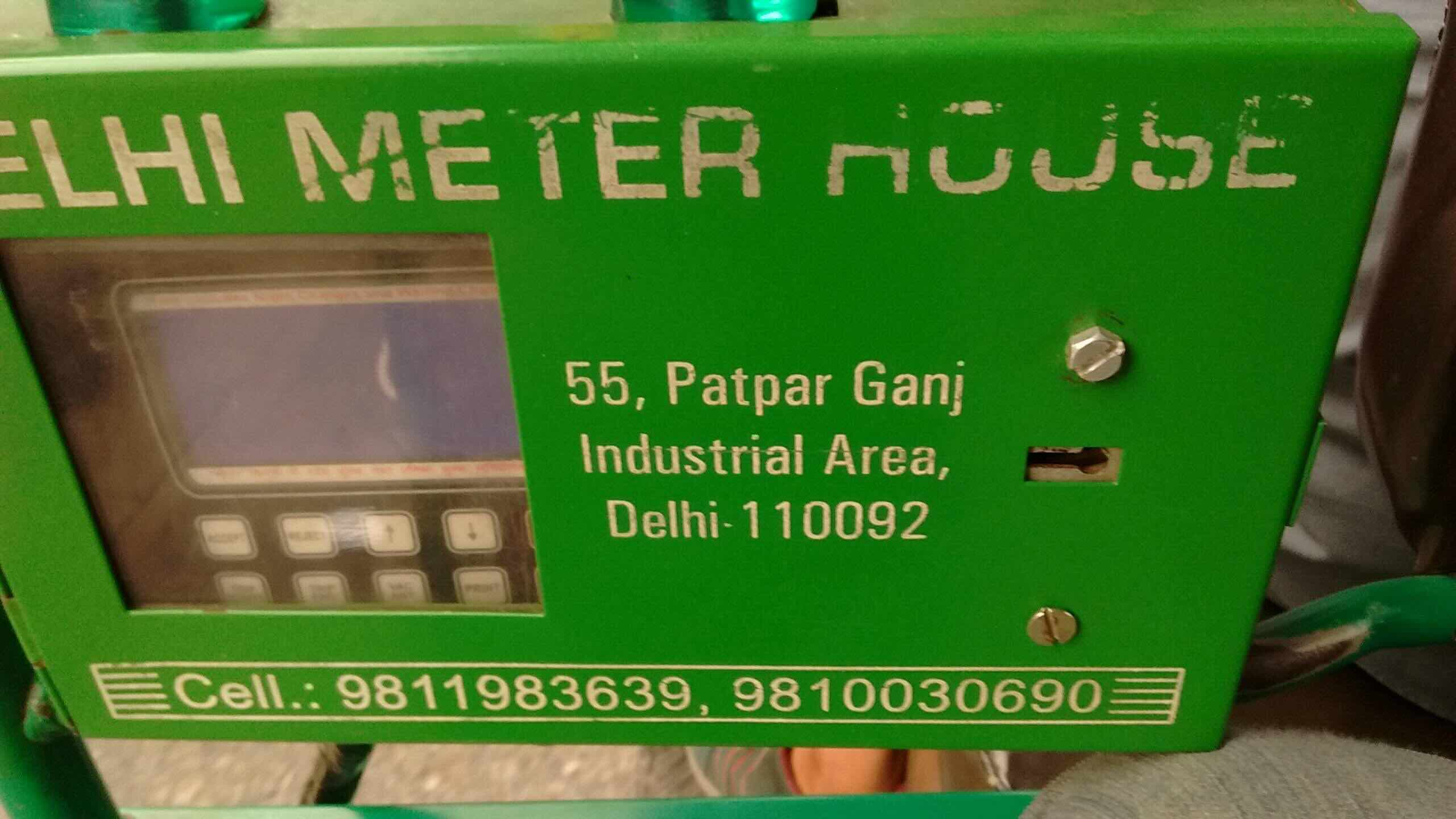
The enclosure of the panic button in a metal box creates a conspicuous barrier for users. Photo by author, taken in 2015.
Nearly all autorickshaw meters in which panic buttons are integrated are enclosed within some type of metal box. Some boxes enclose the meter with an opening over the meter’s face which is often smaller than the face itself. Some boxes enclose the face as well, covering it with a small door that can be latched shut and locked. The protective boxes are fitted both by those who sell vehicles and by those who service meters and are prevalent due to the costliness of these meters and their vulnerability to theft or damage. As one might expect, these boxes make it difficult to access the panic button, obstructing both its visibility as well as physical access needed to press it, often effectively blocking access completely.
Thus, while location of the vehicle within the city can be tracked, if the person cannot press the panic button because it is blocked by the box, then the autorickshaw cannot be identified as a place where a person is in danger. This could be understood as ‘failure’ of the petitioner’s request that is caused by the box. However, the failure in question ultimately attaches to the authorities, as it is ultimately their response that is disrupted by the box. In a manner of speaking, interruption of the petitioner’s signal by the box prevents authorities from ‘seeing’ inside the autorickshaw through the panic button in order to locate the person in danger: the person cannot make their presence inside the autorickshaw known and the authorities cannot find them inside the vehicle.
This reframes the petitioner’s role. A failure of authorities to respond to a request is now co-articulated with a failure that is traceable to the petitioner, but not as interruption of the signal originating with them. Rather, the petitioner ostensibly fails to elicit an effective response from authorities.
Failure as Indeterminate Agency: The Petitioner
While differentiating a failure to respond due to interruption of a petitioner’s signal from a failure of the petitioner to elicit a response, the latter would still appear to be conditioned on the petitioner initiating a signal – or would it?
From the perspective of the responding authorities, the petitioner that activates the panic button is signified as a location rather than as a person, though it is ostensibly the petitioner as “person” that activates the panic button. But where the box projects an indeterminate relation between the origination of the signal and its receipt by disrupting the petitioner’s locatability, the location of the “petitioner” and the event of “petition” no longer jointly anchor the “person” as the agent of petition. The box’s disruption of locatability introduces a disassociation between the functional agency of “petitioner” and the “person” as petitioning agent. Or rather, the “person” as a figurative co-articulation of the event of danger (place) and the event of petition (act) is disrupted. The significance of the “person” as a circuit that establishes a temporal relationship between the event of danger and the subsequent event of petition is displaced.
The function of the petition, on the other hand, is to distinguish an individual event of danger from the background environment of failure in which the panic button operates. When authorities are always already responding in their resolve to forestall the repetition of tragedy (Nirbhaya), this fact of individuation is the realization of the protection afforded by the panic button. But the box renders the petitioner a floating functionality; the infrastructural condition of location, which both anchors the person as agentive formatting of the petitioner and the petition as index of an event attached to a person, is itself rendered indeterminate. When we say that the petitioner fails to elicit a response, it is not that an identifiable “petitioner” fails in any discrete sense but rather that the efficacy of a relation has become indeterminate.
This is admittedly confusing, but it is partly so because it is an attempt to read the technical logic at work here in terms which cannot describe it. The “failure” of a petitioner to “elicit” a response is a placeholder for a cascade of indeterminate distinctions – between a signal interrupted and a signal never sent, between a signal never sent and an event that never happened. Where the ability to determine location is ambiguous, both presence and absence of a person is moot. And if the person is rendered irrelevant in satisfying the promise of protection, what could failure (or success) mean?

The box around the meter obscures relations in the city. Photo by author, taken in 2015.
Failure Like Any Other: The Promise
The box localizes what Gilbert Simondon (2012, 17) describes as a “margin of indeterminacy” – a structure whereby technical objects dynamically adjust to their environment in order to maintain their functional coherence as operational artefacts, participating in that environment as open interfaces which are neither deterministic nor homeostatic. What the box does is to functionalize and functionally integrate the petition afforded by the panic button into the panic button’s operational engagement with an absolute failure that precedes and contextualizes it.
The box’s infrastructural provision of indeterminacy is the mechanism through which an urban spatiality without discernible locations is produced as the condition of possibility of the promise of security, expressing security as a unique form of urban temporality. Through its enclosure of events of danger, threat, and attack within an undefined field of indeterminate indeterminations, the box allows the panic button to remain open to the milieu of failure in which it operates without collapsing under the paradox of an impossible promise of absolute protection.
The box, then, can be read as integral to the panic button as a technology that “precludes the possibility of a traumatic encounter” between persons and danger, maintaining the double sequester of Nirbhaya as tragedy, enclosing the city as a space purified of locations and thus outside of time. Here, failure returns – as event and evaluation, as a newly valorized milieu that “in being like no other, is like any other.” (Choudhury 2020, 153-158)
References
Choudhury, Soumyabrata. 2020. Now It’s Comes to Distances: Notes on Shaheen Bagh and Coronovirus, Association and Isolation. New Delhi: Navayana.
de Abreu, Maria José A. 2019. “Medium Theory; or, ‘The War of the Worlds’ at Regular Intervals.” Current Anthropology, 60, 5: 656-673. https://doi.org/10.1086/705345Fujita, Takanari. 2022. “Hanoi’s Built Materiality and the Scales of Anthropology: Toward A Theory of ‘Architectural Facts’.” Social Analysis: The International Journal of Anthropology. 66, 1: 108-32. https://doi.org/10.3167/sa.2022.6601OF3
