When governments declare a climate “emergency,” they rarely name the real emergency at play – colonialism. Crisis-oriented language transforms centuries of dispossession, extraction, and ecological destruction into a sudden problem of “urgency” rather than one of accountability. In doing so, it risks reproducing the very logic that produced such consequences in the first place.
For Indigenous nations, this environmental devastation is not sudden but rather a lived condition obscured by crisis epistemology (Whyte, 2020). Long before climate change hit global headlines, Indigenous lands were being flooded, mined, clear-cut, and poisoned in the name of progress – progress that prioritizes capitalist expansion and economic investment at the expense of life. Climate change is not an external shock; it is the cumulative outcome of a colonial world order built on framing the earth as a resource to be extracted with Black, Indigenous and racialized peoples as labour to be exploited.
I have learned this firsthand through academic scholarship and solidarity work with at-risk land and water defenders from Wet’suwet’en First Nation, Six Nations of the Grand River, the Sarayaku and Shuar Kichwa in the Amazonian region of Ecuador, the Maya Q’eqchi’ in Guatemala, Indigenous and Afro-descendant groups across Colombia, and the Lenca in Honduras. Climate action must be accountable not just to policy timelines or emissions targets, but to the land, water, and non-human relations that sustain all life. If action is to be just and effective, we must reframe the conversation.
Why Crisis Discourse Fails
“Crisis” does more than describe climate change; it shapes state responses. Emergencies compress time, prioritize efficiency over sustainability, and justify extraordinary measures in the name of necessity. As political theorists have long warned, emergency governance centralizes authority, sidelines deliberation and suspends rights (Feltes & Stacey, 2020). In climate politics, this often means neglecting the role of Indigenous jurisdiction. In an article titled Crisis, Colonialism and Constitutional Habits by Emma Feltes and Jocelyn Stacey (2020). In Canada, emergency powers routinely reassert Crown authority during moments of “crisis,” even when Indigenous communities are best positioned to respond.
The authors describe this as a “constitutional habit,” a reflexive return to colonial administration under the façade of crisis management. Their focus on the Tŝilhqot’in Nation’s response to the 2017 wildfires as a case study illustrates these power dynamics. Despite exercising traditional land-based knowledge informed self-governance through kinship networks and community decision-making protocol, federal and provincial government interventions repeatedly disregarded their rights – treating First Nations leadership as an obstacle rather than the manual for effective response.
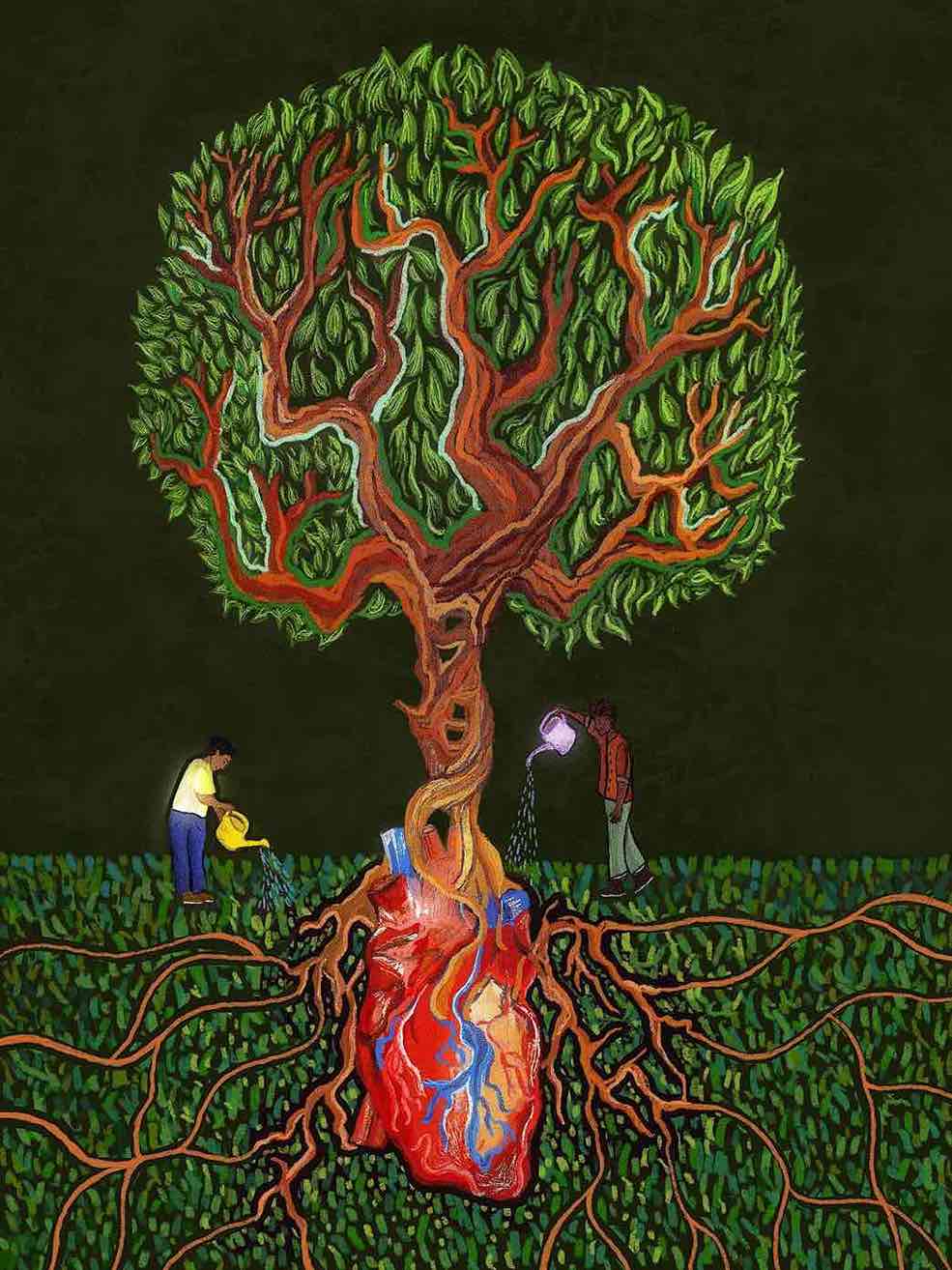
Digital Illustration: “Rooted in Our Heart – Human Rights, Community Care, and Reciprocity” By: Rachel Lim, March 2024.
Crisis framing also influences climate storytelling. As Potawatomi philosopher Kyle Whyte (2018) argues, dominant narratives rely on future-oriented dystopias, portraying climate change as unprecedented and speculative. My former course instructor, an Anishinaabe Kwe from Georgina Island First Nation, shared a similar note – that horror, apocalyptic, and science-fiction genres romanticize existential threat. Both emphasize that Indigenous peoples have long endured “end-of-the-world” conditions. Yet these narratives center settler fear and anxiety, erasing intergenerational trauma and resistance.
Colonialism as Ecological Violence
Settler colonialism is a material force that has drastically disrupted ecosystems, climates, and relations of life itself. Colonial expansion in the Americas was violent not only to Indigenous peoples through genocide, the transatlantic slave trade, and disenfranchisement, but also to plants, animals, waters, and soils (Davis & Todd, 2017; Whyte, 2017). Tiffany Lethabo King’s book Black Shoals (2019) attests to these deep intersections arguing for coalitions between Black and Indigenous communities who have been historically displaced by the colonial masters using white supremacist ideology to justify conquest and racial capitalism. To be apathetic or colour blind to the context in which our world operates is to be complicit in the ongoing demonization and attribution of racist tropes which continue to frame our governance systems. This calls for decentering anthropocentric views which deny the intertwined relationship between human rights and well-being to environmental health. The genocide-ecocide nexus, a concept I focus on in my research, is not a problem isolated to the past. It transcends temporal and spatial landscapes through extractive industry economies, abusing land and life as disposable tools in a game of capital accumulation.
I often think of settler colonialism as an invasive parasitic species: never designed to live in balance with the land or people, only to consume, deprive, and transform. This is no symbiotic, harmonious relationship with mutual benefits and equal trade-offs. Fossil fuel extraction, industrial agricultural, and
large-scale mining projects continue this agenda. Even the “green transition” risks reproducing the same colonial violence when speed and scale trump consent and Indigenous sovereignty.
Some would term these initiatives as “neocolonial” in nature, but the only thing that is new about them are advanced technologies, equipment, and science. Lithium mines, hydroelectric dams, and carbon offsets imposed on Indigenous territories under the guise of sustainable development for a just transition simply extend the same old colonial logic but with a slightly different aesthetic.
Urgency Without Justice is Not Progress
Proponents of crisis language often argue that fear is necessary to mobilize action. However, urgency alone does not bring justice. Rushed interventions can deepen extraction on Indigenous lands while branding dispossession as an unfortunate but necessary sacrifice for the “greater good.”
This is evident in current climate-economic discourse. Calls to accelerate fossil fuel production or energy intensive technologies are claimed in the name of escalating geopolitical tensions. Particularly, Prime Minister Mark Carney, who spoke at the 2026 World Economic Forum in Davos, Switzerland, affirmed a strong commitment to building Canada’s economic autonomy against American hegemony with some concerning strategies: increasing investments in resource extraction and AI. The data centres that hold AI servers create immense electronic waste. From extreme water consumption to reliance on critical minerals and rare elements which are often mined unethically and unsustainably, the amount of energy used to operate these systems produce catastrophic environmental impacts (UNEP, 2025).While many see the threat of American imperialism as a priority issue in global security contexts, the reactions which praise Carney’s assertion of Canadian sovereignty expose just how fast climate talk collapses into an afterthought.
Indigenous lands and livelihoods are deemed expendable in service of national and corporate interests because profit will always come before the planet (and people). The continued disregard for traditional ecological knowledge (TEK) needs to stop. Approaches rooted in relationality, reciprocity, and responsibility are not barriers; they are pivotal to driving action. Climate change cannot be separated from the colonial institutions that created it, nor can solutions come from the same structures of oppression.
Beyond Panic and Toward Responsibility
If climate action is to be truly transformative, we must adapt how we speak about it. Media narratives and policymakers need to move beyond fear-driven emergency rhetoric and toward frameworks informed by history, accountability, and relation. This requires recognizing and accepting Indigenous jurisdiction, integrating traditional knowledge, and confronting colonialism as a root cause.
The crisis is not new. What is new is the discomfort of those who can no longer ignore it. Climate justice will not arise from panic, but from listening to the land, to Indigenous nations, and to the histories that crisis language seeks to erase. Only then can climate action become something more than another emergency response.
This post was curated by Multimodal Contributing Editor Seon Shim
References
Carney, M. (2026, January 20). Mark Carney’s full speech at the World Economic Forum in Davos [Video]. YouTube. https://www.youtube.com/watch?v=btqHDhO4h10
Davis, H., & Todd, Z. (2017). On the importance of a date, or decolonizing the Anthropocene. ACME: An International Journal for Critical Geographies, 16(4), 761–780.
Feltes, E., & Stacey, D. (2020). Crisis, colonialism and constitutional habits: Indigenous jurisdiction in Canada. Canadian Journal of Law and Society, 35(2), 1–20.
Watts, V. (2013). Indigenous place-thought and agency amongst humans and non-humans. Decolonization: Indigeneity, Education & Society, 2(1), 20–34.
Whyte, K. (2017). Indigenous climate change studies: Indigenizing futures, decolonizing the Anthropocene. English Language Notes, 55(1–2), 153–162.
Whyte, K. (2018). Indigenous science (fiction) for the Anthropocene: Ancestral dystopias and fantasies of climate change crises. Environment and Planning E: Nature and Space, 1(1–2), 224–242.
Whyte, K. (2020). Against crisis epistemology. In Routledge handbook of critical Indigenous studies (pp. 52–64). Routledge.
