An aerial view of the Strait of Gibraltar shows something that resembles order. Container ships move in two disciplined lanes, their wakes parallel lines across the surface. Between them, a single patrol vessel sits like a traffic cop at an intersection. Smaller ships move differently: ferries on fixed schedules, fishing boats angling across the grain, following lines invisible from above. The Strait, fourteen kilometers at its narrowest, appears split down the middle, dividing Morocco from Spain, Africa from Europe. Deleuze and Guattari (1987) described the sea as the exemplary smooth space—fluid, directionless, resistant to the grid—but also as the first place to be striated, ruled into navigable geometry by technologies of longitude and open-water navigation. From above, the striae of the strait are clear. The question is what that striation conceals.
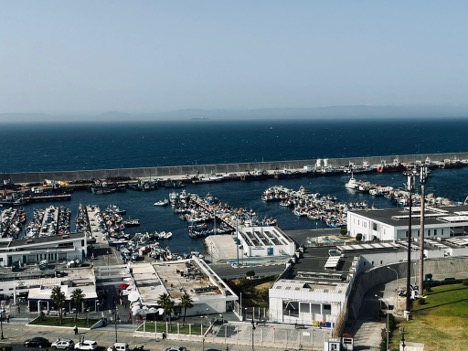
Elevated view of the Tanger-Ville fishing port. Port facilities and docks are enclosed by a sea wall. Beyond the shoreline is a container ship sailing through the Strait of Gibraltar. The Spanish coast is visible in the distance. Photo taken by the author.
Sovereignty at sea does not work the way maps suggest. The Strait of Gibraltar is not a line, it is a volume with depth, surface, and air. Its currents run in opposite directions, seasonal winds close it to small vessels for months, and fish migrations predate any legal framework by millennia. Governing this space means governing something that territorial thinking, built on the premise of fixed, bounded, and mappable surfaces, was never designed to handle. A “wet ontologies” approach takes the sea seriously as a materially turbulent medium, its phase-shifting properties resistant to the epistemologies through which governance ordinarily operates (Steinberg and Peters 2015). Following this approach, I treat sovereignty not as the legal authority of a state over a delimited territory but as a site of ongoing struggle and multiplication (Mezzadra and Neilson 2013): assembled through infrastructure, ecological knowledge, and the labor of enforcement, and therefore always incomplete and conditioned by the environments through which it operates. For the small-scale fishers of Tanger-Ville, navigating overlapping jurisdictions, security regimes, and ecological uncertainty, this is not an abstraction. What follows traces three registers of this assemblage—fish migrations, tidal rhythms, and electromagnetic sensing—arguing that borders at sea are not lines projected onto a passive surface but emergent effects of a volume that refuses to hold still.
Following the Fish
Every fisher working in the strait knows a version of the same saying: the border is always just beyond where the fish are. Fish do not observe Exclusive Economic Zones. Bluefin tuna, swordfish, sardines, and anchovies move through the strait following thermal gradients, prey distributions, and seasonal cues that are indifferent to the jurisdictional geographies imposed on the water around them. The EU-Morocco fisheries agreements regulating access to these species must chase a moving target. What counts as Moroccan waters, Spanish waters, or international waters is legally fixed; what swims through them is not.
The jurisdictional complexity this produces is not incidental; it is constitutive of how sovereignty works in this space. The expansion of maritime sovereign claims, formalized through instruments like the United Nations Convention on the Law of the Sea and the Straddling Stocks Fish Agreement, represent an attempt to extend territorial logic into a space that fundamentally resists it (Billé 2020). This dynamic is visible in the governance of species like bluefin tuna, whose migrations are managed by the International Commission for the Conservation of Atlantic Tunas (ICCAT). As Jennifer Telesca (2020) has shown, such regulatory bodies do not simply conserve fish, they transform them into commodities whose management reproduces the sovereign claims of member states. Morocco and the EU are among ICCAT’s major players, and the tuna’s indifference to the jurisdictions claimed over it is precisely what makes its governance politically charged. The fish keep moving, the treaty tries to follow. Sovereignty in the Strait is always partly a fiction, asserted over a space whose key inhabitants decline to respect it.
This becomes clear in practices of cross-border ecological knowledge that informal fisher networks sustain. Both Moroccan and Spanish fishers informally share information about the movement of orca pods through the waters. When orcas appear, they herd prey fish into predictable compressed schools—a behavior that reorganizes where productive fishing is possible. This information circulates in Spanish, regardless of the nationality of the fisher transmitting or receiving it: the word ballena, whale, is the signal. Here, a piece of multispecies ecological knowledge reorganizes where human actors go, how they move, and how they relate to one another across a political boundary. The orca’s hunting behavior is more sovereign than any legal framework in determining the distribution of labor across the Strait. “Intersecting mobilities” (Ticktin and Youatt 2022), the entanglement of human, nonhuman, and infrastructural movements producing political space, finds a near-perfect instantiation here: the fish, the orca, the fisher, the radio call, all move together through a space imperfectly tracked by authorities.
This same difficulty of tracking—of distinguishing fishing vessels from other small craft moving askew to the Strait’s main traffic flows—is precisely what makes the Strait a site of intensive security infrastructure. Morocco is deeply implicated in policing irregular migration across the Strait through cooperation agreements with the EU and Spain: effectively outsourcing border enforcement southward. From the perspective of radar and aerial surveillance, the small fishing boat and the migrant vessel are almost indistinguishable. The security apparatus that watches the perimeter at the Tanger-Ville fishing port is not organized around fishing, but rather organized around the larger politics of mobility across this corridor. Fishers are simultaneously laborers, suspects, and unwilling proxies for the surveillance of others.
The border in this register is not a line but a chase. Sovereignty over fisheries is perpetually in motion, following the fish it claims to govern. The flat cartographic logic of territorial waters cannot account for this pursuit; it can only assert jurisdiction after the fact, over spaces that ecological life has already reorganized.
![The perimeter fence of the Tanger-Ville port. On the fence is a sign reading “fishing and swimming forbiden [sic] in the port” in Arabic, French, and English.](http://blog.castac.org/wp-content/uploads/sites/2/2026/04/Picture2.jpg)
The perimeter fence of the Tanger-Ville port. Official signage reads “fishing and swimming forbiden [sic] in the port” in Arabic, French, and English. Photo taken by the author.
Where the Fence Meets the Tide
The Strait’s hydrological character is not a passive backdrop. The tidal regime is semi-diurnal, producing two high-tide cycles each day with swings of up to two meters. Powerful counter-currents run through the Bay of Tangier and strong winds alternate with the season. They structure when enforcement is possible, when fishing is feasible, when the border can be crossed and when it cannot.
The infrastructure of the port perimeter at Tanger-Ville makes this evident. A fence of three meters topped with razor wire runs the length of the fishing port; at the jetty’s edge, additional razor wire cascades into the water to prevent approach along the rocks below. Signs posted by the Agence Nationale des Ports (ANP) prohibit fishing and swimming. The gate is guarded and requires a badge for entry. At sunset, a police van takes position at the base of the corniche, not watching the sea, the swimmers, or the young men fishing off the rocks, but facing the fence, watching its vulnerable points as the tide changes and the light fades. Surveillance is timed to the sea. Enforcement concentrates at specific moments in the diurnal and tidal cycle, and at specific points in the port’s architecture, where the sea’s own dynamics create opportunities that the fence cannot fully enclose.
Theorizations of volumetric power describe this extension of sovereign authority across depth and vertical strata (Weizman 2007; Elden 2013). But in the maritime case, the volume is not simply a space to be filled by state infrastructure. The currents and tides are agents in the assemblage, determining when the barbed wire matters and when the water itself serves as obstacle or passage. Forensic analyses of migrant deaths in the Mediterranean describe “elastic” sovereignty (Heller and Pezzani 2017): states expanding or contracting jurisdictional claims to assert or evade responsibility, exploiting the sea’s fluidity as an instrument of governance. In the Strait, this elasticity is literal—the border stretches and contracts with the tide. The encounter between tidal rhythm and enforcement infrastructure produces a border that operates not continuously but in pulses: dense at certain hours, thin at others. Fishers who navigate it are not simply evading the state. They are reading the sea as a political text, calibrating their movements to a sovereignty that is itself rhythmic, and therefore legible to those who know how to listen to the water.
Signal and Noise
From the deck of a ferry crossing to Spain, the Strait’s surveillance logic becomes briefly legible: container ships in their lanes, a patrol vessel stationed between them, and somewhere beyond the radar’s record, the fishing boats that cannot be traced. Above the surface, sovereignty extends upward into the electromagnetic spectrum. Radar arrays on both shores, operated by the Spanish Guardia Civil, Morocco’s Gendarmerie Royale, and the EU Frontex, sweep the water continuously, producing a “socio-technical seascape” (Heller and Pezzani 2017), a space made legible not through the eye but through electromagnetic waves that detect, sort, and classify movement. Large commercial vessels are required to broadcast their position continuously via Automatic Identification System (AIS) transponders; their movements can be tracked in near-real time by anyone with an internet connection.
Fishing vessels, by contrast, leave no trace. The publicly available records for Tanger-Ville port log arrivals and departures only for larger vessels. Fishing boats are monitored differently, through Vessel Monitoring Systems (VMS) accessible only to regulatory authorities, and frequently are not monitored at all. The result is a systematic asymmetry of visibility built into the architecture of maritime surveillance: some mobilities are rendered continuously legible, others are deliberately obscured. To be invisible to the monitoring apparatus is to occupy a different legal and political position in the Strait, more precarious, more subject to arbitrary enforcement, but also more mobile in ways the system cannot easily track.
The winds complicate even this informational layer. Smaller vessels unable to handle rough seas, are regularly delayed when the Strait’s notorious winds make crossing impossible. These conditions have historically governed the movements of fishing boats, smugglers, and migrants. The geophysical environment is not a neutral backdrop for political action but an active force, a “geopower” that is partially harnessed by states and which partially exceeds their control (Walters, Heller, and Pezzani 2022). The electromagnetic seascape is interrupted by the same atmospheric conditions that have organized maritime life in this corridor for centuries. Sovereignty is conditional upon the air and the water.
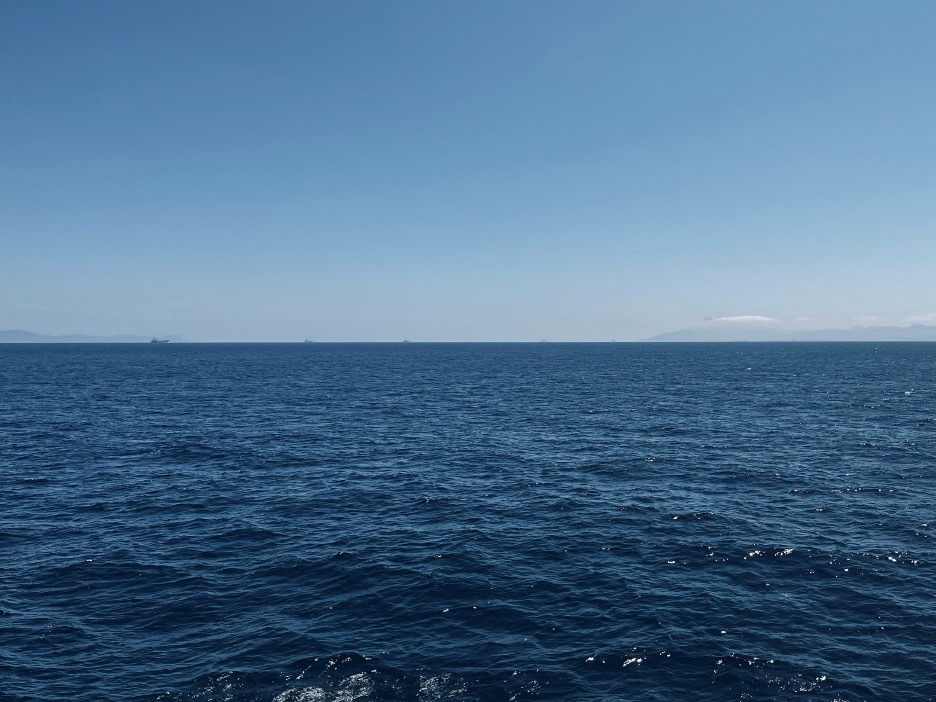
Sea-level view of the Strait of Gibraltar from the deck of a fishing boat. To the left, Spain, to the right, Morocco. Small shapes of container ships dot the horizon. Photo taken by the author.
Conclusion: Against the Flat Line
“It’s not about fishing,” a local news editor, covering the Gibraltar dispute, was once quoted as saying. “It’s about jurisdiction” (Frayer 2014). The statement assumes that jurisdiction and fishing can be cleanly separated: that the legal framework of territorial waters is the real political question, and the fish are merely its occasion. The Strait suggests, however, that these cannot be disentangled. Jurisdiction over the sea is inseparable from the ecological, tidal, and atmospheric dynamics that constitute what the sea is. To govern a maritime space is to govern something that migrates, surges, seasonally changes, and generates counter-pressures against any attempt at enclosure. For the fishers working out of Tanger-Ville, this is not a theoretical proposition. It is the daily texture of labor on a sea that refuses to be governed. The border they navigate is not a line, it is a depth.
This post was curated by contributing editor Eva Rose Steinberg, with help from Shreyasha Paudel.
References
Billé, Franck, ed. 2020. Voluminous States: Sovereignty, Materiality, and the Territorial Imagination. Duke University Press.
Deleuze, Gilles, and Félix Guattari. 1987. A Thousand Plateaus: Capitalism and Schizophrenia. Translated by Brian Massumi. University of Minnesota Press.
Elden, Stuart. 2013. “Secure the Volume: Vertical Geopolitics and the Depth of Power.” Political Geography 34 (1): 35-51.
Frayer, Lauren. 2014. “The Squabble that Never Ends: Britain and Spain Duel over Gibraltar.” NPR, May 11. https://www.npr.org/sections/parallels/2014/05/11/306861136/the-squabble-that-never-ends-britain-and-spain-duel-over-gibraltar
Heller, Charles, and Lorenzo Pezzani. 2017. “Liquid Traces: Investigating the Deaths of Migrants at the EU’s Maritime Frontier.” In The Borders of “Europe,” edited by Nicholas De Genova. Duke University Press.
Mezzadra, Sandro, and Brett Neilson. 2013. Border as Method, or, the Multiplication of Labor. Duke University Press.
Steinberg, Philip E., and Kimberley Peters. 2015. “Wet Ontologies, Fluid Space: Giving Depth to Volume through Oceanic Thinking.” Environment and Planning D: Society and Space 33 (2): 247-264.
Telesca, Jennifer E. 2020. Red Gold: The Managed Extinction of the Giant Bluefin Tuna. University of Minnesota Press.
Ticktin, Miriam, and Rafi Youatt. 2022. “Intersecting Mobilities: Beyond the Autonomy of Movement and Power of Place.” Borderlands 21 (1): 1-17.
Walters, William, Charles Heller, and Lorenzo Pezzani, eds. 2022. Viapolitics: Borders, Migration, and the Power of Locomotion. Duke University Press.
Weizman, Eyal. 2007. Hollow Land: Israel’s Architecture of Occupation. Verso.
