Anthropology is widely recognized as a fragmented, precarious discipline: short-term contracts, insecure funding, and the pressure to publish on institutional time threaten our ability to do sustained, accountable work with communities. At the same time, anthropology is called upon to imagine more inclusive, equitable worlds in a polarized global order, a tension that raises a pressing question: how can we pursue meaningful collaboration, equity, and inclusion from within such a precarious, short-term, and unequal academic landscape?
This question refers not only to anthropology’s well-known colonial entanglements but also to a sense that the discipline is, to borrow Audre Lorde’s words, structurally incapable of escaping the master’s house in which it was built. Yet there is another way to inhabit this trouble: instead of seeing anthropology as either completely broken or something that needs to be restored, I like to imagine assembling its different parts and moments in ways that Aihwa Ong (2016) calls the work of situated futures. Disability anthropology is one such reassembly, drawing together early action anthropology, legacies of Indigenous anthropology, and crip [1] time as a practice of moving at rhythms society does not usually expect or allow. Crip time emerges from disability communities and disability studies as a concept that names how disabled and chronically ill people experience time differently than able-bodied people. In its most straightforward definition, crip time means both “a flexible standard for punctuality” and “the extra time needed to arrive or accomplish something” (Kafer, 2013, p. 26).
In this sense, disability anthropology is centrally concerned with what Alison Kafer calls crip futurity: not a distant utopia, but a way of making and inhabiting futures organized around disabled people’s temporalities, needs, and desires (Ginsburg & Rapp, 2024). In discussing crip futurity, disability scholar Josh Guberman emphasizes that “seeking out and staying with uncomfortable disjunctures between marginalized experiences and institutionalized discourses can result in research and design that works towards more liberatory futures” (2022, p. 38:24), a commitment that disability anthropology takes up by lingering in those disjunctures rather than smoothing them over. As disability anthropologist Alana Ackerman writes, “Cripistemology questions able-bodied and able-minded ways of producing knowledge, while simultaneously recognizing the fluidity and instability of what constitutes a d/Disabled—or nondisabled—bodymind” (2025, p. 43). This reframing does not redeem anthropology’s past but rather works alongside that past—its methods, its ambitions, its persistent problems—into the work that is oriented by disabled people, Indigenous communities, queer people, and all those anthropology has rendered and is still rendering temporally and spatially out of place.
Disability Anthropology and its Colonial Legacy
To understand disability anthropology as a decolonial project requires first historicizing how anthropology as a discipline organized time and space in service of imperial power (Asad 1973; Gough 1968; Trouillot 1991). In Anthropology and the Colonial Encounter, Talal Asad makes clear that anthropology did not simply happen to operate in colonial settings; rather, its very methods were developed in and for imperial governance (1973, p. 17). In the British context, functionalist research offered comprehensive descriptions of social structures that could be utilized to comprehend and govern colonized populations, while access to the field was contingent upon colonial administrators, and research inquiries assumed the legitimacy of imperial rule. Kathleen Gough (1968) extends this analysis into the postwar era, tracking how U.S. and European funding, framed through development and security concerns, continued to shape what anthropologists studied and which critiques were permissible. For both scholars, anthropology’s emergence as a discipline is inseparable from these structures of power.
Dell Hymes (1999) pushes this critique further, describing anthropology’s institutions as survival structures of a violent era, where departments, canons, and methodological norms reproduce hierarchies established when anthropologists routinely studied colonized peoples under conditions of stark inequality. The most generative critique for understanding disability anthropology comes from Johannes Fabian’s (1983) analysis of allochronism—the practice by which anthropologists wrote about interlocutors in the ethnographic present, effectively locating “the other” in a different temporal frame. Even when the anthropologist and interlocutor were coeval– living in the same historical moment, ethnographic texts positioned the latter as remnants of an earlier stage of human development. Time, in Fabian’s account, is not neutral but a means by which anthropology made its object: peoples in Africa, Oceania, or the Americas became “traditional” or “primitive” by being written as timeless.
Fabian’s crucial move—one that shapes the framework of disability anthropology—is his resistance to rejecting earlier scholarship through the lens of a “correct” present. He argues that declaring contemporary anthropology fully free of allochronism risks reproducing a different kind of temporal arrogance—homochronism, the illusion that there is now a single, correct modern time we all inhabit equally. For disability anthropology, this is not simply a methodological preference but a decolonial intervention: the field’s critique of normative temporalities emerges directly from anthropology’s colonial past, in which temporal difference was a key technology for producing racialized and ableist hierarchies. Instead, Fabian urges anthropologists to read prior works “as written in their time,” acknowledging both their historical conditions and the critical openings they created for rethinking how anthropology organizes time. This practice of historical reading becomes central to disability anthropology’s decolonial project: not to purify the discipline of its compromised past by deeming it “outdated,” but to inhabit its contradictions and build on them, recognizing that the temporal hierarchies embedded in classic anthropology have not disappeared but have instead been reconfigured in contemporary forms. The same principle applies to space: just as temporal frameworks must be understood on their own terms, the spatial dimensions of kinship, welfare, and policymaking require similar contextual sensitivity. Disability anthropologist Cassandra Hartblay (2025, p. 38) illustrates this dynamic seen in her research field with deaf communities, showing how non-Western cultures navigating Western disability frameworks produce fragmented results that remain opaque without attention to local spatial logics.
Disability Anthropology and Crip Time
One of methodolgical ways of thinking that helps disability scholars and practitioners avoid such allochronism in studying different time and space is crip time. The need for extra time might result from a slower gait, dependency on attendants, malfunctioning equipment, a bus driver who refuses to stop for a disabled passenger, or an ableist encounter with a stranger that throws one off schedule. Yet crip time is not merely about slowness; it is about structural ableism shaping the conditions under which disabled people move through the world. This represents a fundamental reorientation of temporality, one that challenges the assumption that there is a single, universal time that all should conform to.
Applied to anthropology, crip time exposes that the discipline has long assumed a non-disabled researcher who can move freely, stay indefinitely, maintain stable productivity, and conform to linear fieldwork schedules and academic timelines. Disabled people are cast as temporally out of place—permanently “behind” developmentally, trapped in what disability scholar Lawrence Carter-Long (2022) calls a “foreign country” that non-disabled people occasionally visit. Crip time refuses these temporal traps by proposing alternative durational logics. Disability anthropologists aim for the decolonization of the field to operate on crip time: projects might involve extended pauses, asynchronous collaboration, remote participation, variable pacing, and research that shifts in scope as disabled participants’ lives change, without treating those shifts as failures.
Disability anthropology, conceived as an action-oriented, decolonial, and Indigenous-inspired project, is organized around crip time as a practice of taking up space where and how it is not expected. Faye Ginsburg and Rayna Rapp’s concept of “disability worlds” is central here: a disability world that centers disabled people’s ingenuity and demands, refusing narratives that imagine disability only as tragedy, cure, or inspiration. Crip temporalities draw attention to non-linear life paths, varying talents, and types of interdependence and reciprocal care that go beyond typical production measurements or developmental dates.
These commitments to intervention and community-defined futures find important precedents in action anthropology, articulated by Sol Tax (1975) as an attempt to reorient anthropological method toward problems and futures set by the communities themselves. Rather than treating the field as a neutral space for detached observation, Tax argued that anthropologists always intervene—that this influence should be openly acknowledged and organized around goals set by the people with whom they work. For Tax, the anthropologist held two coequal commitments: to help a community pursue its own course of action and to learn from that process, refusing to subordinate one to the other.
This formulation already unsettled older models in which researchers extracted data, anonymized communities, and then disappeared. Tax’s insistence that reporting be participatory and practically useful prefigures contemporary demands in Indigenous, media, and disability anthropology that research outputs circulate back into the worlds that make them possible. Yet action anthropology also remained limited. It reconfigured the anthropologist from distant expert to collaborative actor, but it did not fully confront how race, disability, and institutional power shape whose speech is taken as theory or whose problems are deemed worth studying. From a critical and anticolonial perspective, action anthropology marks an opening but not yet a reorientation toward disabled and Indigenous epistemologies as coequal sources of theory.
Disability anthropology inherits action anthropology’s commitments, but it gains bigger meanings when the terms of action are actively being renegotiated by the communities it’s working with and for: who gets to name problems, define help, and shape outcomes. Reading through crip time and crip futurity, action anthropology becomes less a model of efficient intervention and more a practice of staying with slow, contingent, often interrupted processes that reflect disabled lives and community organizing realities. Delays, cancellations, flare-ups, crises of care, and shifts in capacity are not obstacles to “proper” research but temporal infrastructures that shape what collaboration, consent, and continuity can look like. This is not inefficiency disguised as justice; instead, it acknowledges that communities do not operate on institutional or academic timelines, and anthropology that fails to recognize this reality serves the institution rather than the community.
Another side of disability anthropology comes from the Indigenous anthropology. Indigenous intellectual traditions reconfigure anthropology by insisting that communities themselves theorize history, kinship, and power through their categories and frameworks. Indigenous scholar Charles Menzies’s (2013) work from and with Gitxaala perspectives shows how Indigenous frameworks classify newcomers according to their own social and moral categories, thereby inverting the anthropological gaze. In these accounts, it is often the colonial agents who fail at relations—disrupting obligations to land, kin, and non-human beings—rather than Indigenous communities who are traditionally deemed “deficient” in modernity by anthropologists. Recognizing such frameworks requires anthropologists to relinquish their monopoly on theory and acknowledge that Indigenous communities have long produced sophisticated analyses that exceed Euro-American concepts.
Recent work on Indigenous media already models the kind of collaborative, access‑oriented disability anthropology that scholars such as Erin L. Durban, Miranda Joseph, Sumi Colligan, and Anna Jaysane‑Darr (2025) envision in their collaborative publication The Disabled Anthropologist. Diné media maker and social scientist Teresa Montoya and her collaborators describe Indigenous filmmakers and media makers who embed community temporalities, histories of dispossession, and ongoing struggles in visual form, and who treat media protocols and circulation decisions as sites of ethical and political deliberation rather than technical afterthoughts. These films are not raw material for anthropological interpretation but modes of theory that contest allochronic portrayals and challenge both state and anthropological narratives about Indigeneity (Montoya et al. 2023).
Collaboration in Disability Anthropology
Extending this disability anthropological reorientation, Durban, Joseph, Colligan, and Jaysane‑Darr call for reimagining ethnographic work through explicit attention to collaboration, access, and redistribution. For them, collaboration operates as a strategy for confronting hierarchies and cultivating shared responsibility—a practice that, while “difficult, time‑consuming, and disorienting,” becomes profoundly enabling when undertaken collectively and with care (Durban et al., 2023, p. 98). Kim Fernandes’s chapter “Mad Laughter: On Finding and Forming Graduate Communities through Memes,” in Mad Scholars: Reclaiming and Reimagining the Neurodiverse Academy, offers one such account, tracing how disabled and marginalized graduate students turn to online meme spaces to build infrastructures of care when institutional mental‑health programming remains individualized and punitive. Fernandes notes that “these communities emerged from Facebook groups and Instagram pages for graduate students, in particular those that were focused on sharing memes about the graduate experience” (2024, p. 321), and that “our affirmation that we might never have found each other ‘in real life’ further emphasizes how university programming around mental health is often centered around remedying the presumed deficits in the individual bodying rather than around acknowledging that these identities are also a source of pride and the basis for forming Mad communities” (2024, p. 323). At the same time, there is “an unequivocal sense of understanding that sharing our embodied experiences, even if through various characters that were not ourselves, was a difficult and fraught thing to do for the ways in which it signified (in)formal disclosure” (Fernandes, 2024, p. 325), underscoring how meme‑based community‑building is both protective and risky.
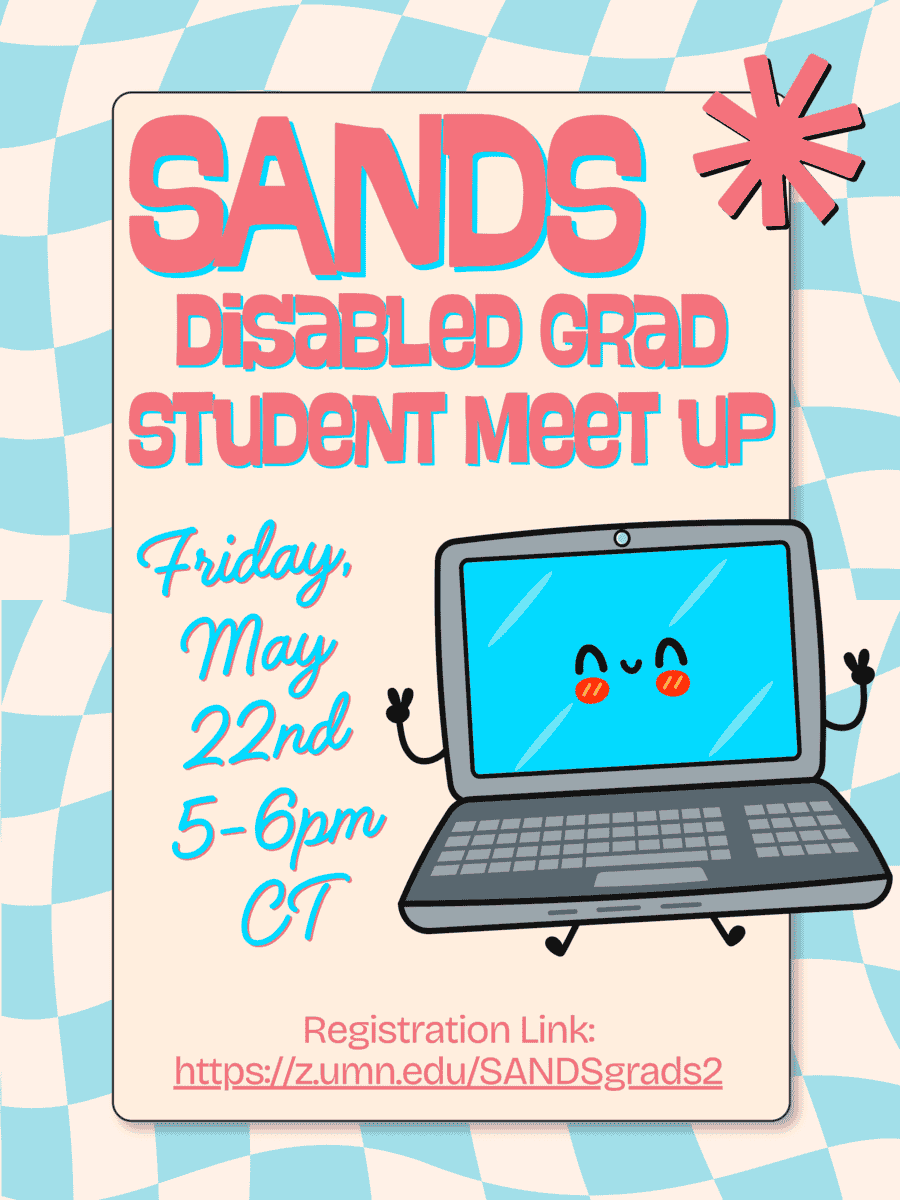
SANDS Disabled Grad Student Meet Up flyer for an online gathering of disabled and neurodivergent graduate students and recent graduates, organized as a low‑pressure space for connection, strategy‑sharing, and community‑building. Image courtesy of Samantha Schwartz and Erin L. Durban.
The SANDS Disabled Grad Student meet‑up flyer embedded here can be read as one node in this broader crip meme‑ and media‑based world‑making: a low‑pressure online gathering that formalizes the kinds of mutual recognition, mad pride, and careful disclosure that Fernandes documents in digital spaces, bringing them into synchronous, access‑oriented community practice. This constellation of practices reframes disability not only as a lived experience but as a methodological vantage point from which to critique and transform ethnographic practice. Centering the voices of disabled anthropologists and interlocutors, they argue, can guide more accountable research and restructure the field along lines of access and mutual enablement: “how the act of showing up for one another is manifest in the work of disabled anthropologists or how disabled anthropologists have envisioned and conducted their scholarly endeavors” (Colligan et al., 2025, p. 3). This commitment resonates with Indigenous media ethics, where those most affected by colonial and ableist institutions, as a community, shape how research, representation, and circulation unfold (Montoya et al., 2023).
Disability media activism and the “criperati”—disabled filmmakers, writers, and artists involved in disability culture—show how crip time and showing up are enacted through creative practice (Linton, 2015). Disability film festivals, online platforms, and community screenings frequently re-time events around access needs, incorporate rest periods, and provide captioning, audio description, and remote participation, thereby reorganizing the temporal and spatial norms of public gathering. These media spaces embody a form of crip occupation: disabled creators place their bodies, narratives, and aesthetics in venues that have historically excluded them, contesting both representational and material exclusion.
For disability anthropology, these media practices are not supplementary illustrations but sites where method and theory are reinvented. Doing anthropology with and through crip media means taking seriously how disabled creators choreograph cameras, edits, and exhibition venues to stage different temporalities than those assumed by mainstream narrative arcs or university calendars. It means recognizing that disabled people are already anthropologists of their worlds, producing sophisticated analyses of how power, time, space, and interdependence are organized. It means collaborating on projects organized on crip time, where the pace of work reflects disabled bodies and minds rather than institutional demands, and where crip futurity is practiced as an everyday commitment to making more livable, disability-centered worlds.
Disability anthropologist E. Mara Green (2024), in her work with a deaf community On Making Sense, explains her ethnography as follows:
I appear quite a lot, and I often appear unsure, hesitant, caught up in the process of sense-making rather than necessarily holding out something definitive that I have already made sense of for you, the reader. This is especially apparent when I offer you the uncertainty contained in my fieldnotes or a series of possible interpretations of something that happened. (p. 23)
Disability anthropology, then, is less a settled subfield than an ongoing experiment in crip time, crip futurity, and taking-up-space: an anthropology that arrives late, moves slowly, lingers in unexpected spaces, and refuses to leave when told its presence is excessive or impossible. It is an anthropology that takes seriously the broken temporalities of disabled life, the spatial refusals of occupations, the media and archival work of criperati and Indigenous filmmakers, and the collective wisdom of communities who have always known how to live otherwise: “global disability studies, therefore, is not only a consideration of disabled experiences transnationally, but a tool in the toolkit of critiques of global capitalism that seek to theorize complex workings of power” (Hartblay, 2025, p. 148). This is not a redemption narrative but an invitation to inhabit anthropology’s contradictions differently—to stay with trouble, bend the clock, and take up space where and how it is not expected, in order to cultivate the crip futures disabled people and their communities are already imagining and building.
Notes
[1] Definition of ‘crip’ in Keywords for Disability Studies: https://keywords.nyupress.org/disability-studies/essay/crip/
This post was reviewed by Multimodal Contributing Editor Kayah Nicholas de Souza.
References
Asad, Talal. 1973. Anthropology & the Colonial Encounter.
Ackerman, Alana. 2025. “Cripping Ethnography.” In The Disabled Anthropologist, 40–57. https://doi.org/10.4324/9781003476726-3.
Carter-Long, Lawrence. 2022. “Disability Cinema’s Next Wave.” Film Quarterly 76 (2): 55–60. https://doi.org/10.1525/fq.2022.76.2.55.
Colligan, Sumi, and Anna Jaysane-Darr. 2025. “Introduction.” In The Disabled Anthropologist, 1–20. https://doi.org/10.4324/9781003476726-1.
Durban, Erin L., and Miranda Joseph. 2025. “Reimagining Ethnographic Research for Collective Access through (Crip) Collaboration.” In The Disabled Anthropologist, 96–116. https://doi.org/10.4324/9781003476726-6.
Fabian, Johannes. 1983. Time and the Other: How Anthropology Makes Its Object.
Fernandes, Kim. “Mad Laughter: On Finding and Forming Graduate Communities through Memes.” In Mad Scholars: Reclaiming and Reimagining the Neurodiverse Academy, edited by Melanie Jones and Shayda Kafai, 319–330. Syracuse, NY: Syracuse University Press, 2024.
Ginsburg, Faye, and Rayna Rapp. 2024. Disability Worlds. Duke University Press.
Gough, Kathleen. 1968. “Anthropology and Imperialism.” Monthly Review 19 (11): 12. https://doi.org/10.14452/mr-019-11-1968-04_2.
Green, E. Mara. 2024. Making Sense: Language, Ethics, and Understanding in Deaf Nepal. Univ of California Press.
Guberman, Josh. 2022. “#ActuallyAutistic Twitter as a Site for Epistemic Resistance and Crip Futurity.” ACM Transactions on Computer-Human Interaction 30 (3): 1–34. https://doi.org/10.1145/3569891.
Hartblay, Cassandra. 2025. Access Vernaculars: Disability and Accessible Design in Contemporary Russia. Cornell University Press.
Haraway, Donna J. 2013. When Species Meet. U of Minnesota Press.
Hymes, Dell H. 1999. Reinventing Anthropology.
Kafer, Alison. Feminist, Queer, Crip. Indiana University Press, 2013. http://www.jstor.org/stable/j.ctt16gz79x.
Linton, Simi. 2015. “Cultural territories of disability.” In L. Harwell (Ed.), Disability, Dance, Artistry, 13–51. Dance NYC. https://www.dance.nyc/uploads/DanceNYC_DisabilityDanceArtistry_Online.pdf.
Lorde, Audre. 1984. Sister Outsider: Essays and Speeches.
Menzies, Charles R. 2013. “Standing on the Shore With Saaban: An Anthropological Rapprochement With an Indigenous Intellectual Tradition.” Collaborative Anthropologies 6 (1): 171–99. https://doi.org/10.1353/cla.2013.0011.
Montoya, Teresa, Angelo Baca, Teresa Martinez‐Chavez, and Ikaika Ramones. 2023. “Producing Indigenous Media.” Visual Anthropology Review 39 (1): 128–43. https://doi.org/10.1111/var.12294.
Ong, Aihwa. 2016. Fungible Life: Experiment in the Asian City of Life. Duke University Press.
Tax, Sol. 1975. “Action Anthropology.” Current Anthropology 16 (4): 514–17. https://doi.org/10.1086/201616.
Trouillot, Michel-Rolph. 2003a. “Anthropology and the Savage Slot: The Poetics and Politics of Otherness.” In Palgrave Macmillan US eBooks, 7–28. https://doi.org/10.1007/978-1-137-04144-9_2.
