In 2024, members of the Cargill Tenants Union launched two months-long rent strikes in response to deteriorating conditions at their buildings, culminating in a year-long rent freeze, comprehensive lead inspections, air-quality inspections, mold abatements, lease renewals, and state and federal intervention in their support. Tenants in this struggle could indeed avoid putting themselves at risk of eviction if they were to mind their own business and pay their own rent, but instead chose to act together to improve conditions for all tenants and, in so doing, pursue transformative change. Their victory concluded one particularly fiery and successful campaign in the history of the Connecticut Tenants Union, sending waves across the country: this is what militant and well-organized tenants can accomplish.
The protagonists of this struggle included another group: members of the New Haven chapter of Science for the People (SftP), who worked alongside the CTU throughout this struggle. Scientists in this struggle refused to see themselves as most useful in advisory roles due to their specialized training, nor were they satisfied being representatives speaking to academic and political elites on behalf of tenants. Instead, the members of the New Haven SftP chapter performed data analysis to surface high-priority units for organizers to engage with and participated in the resulting organizing work alongside tenants in the Cargill Tenants Union. This not only meant that these scientists disavowed hegemonic understandings of expertise, but reconstructed their identity as experts to align with the needs and expertise of tenant organizers, and finally used this to articulate how existing state-led data practices profoundly failed tenants. Members of the New Haven SFTP saw their work as solidifying the project as a “socialist” one, deepening a collective political analysis and expanding the union’s capacity to undergo the militant work of organizing. As three of the SftP members wrote, this required them to invest in “development as agents in class struggle first, and as scientists second”.
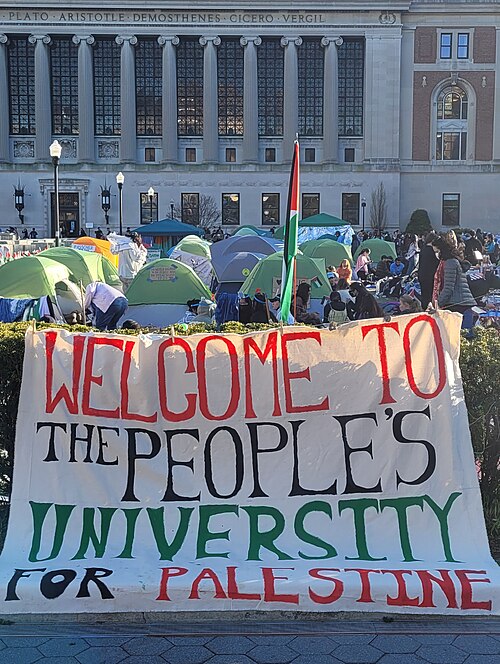
At the reinstated Gaza Solidarity Encampment at Columbia University. CC0 1.0 Universal by Abbad Diraneyya.
In this piece, we seek to reinterpret and extend the strategies of the New Haven SftP to the context of technological production and design. What roles exist for designers in the class struggle? If, as the authors describe, these kinds of battles can be waged in the name of class struggle science, what new kinds of struggles can be opened in the name of class struggle design? What can we gain by rejecting any normative idea of expertise as it relates to technology, by appropriating skills and resources for profit generation and by transforming them into assets in a struggle against the power of capital?
Why Class?
We find this set of questions particularly important given the unfolding crises of our present conjuncture and the startling lack of class consciousness among technologists in the United States, where we write from. Today, the tech industry is indisputably the leading edge of state violence and global capitalist dispossession. ICE employs advanced technology provided by Palantir to track and target immigrants amidst a cruel immigration enforcement effort that has murdered at least 76 people. The Israeli and US militaries use AI to generate targets for air attacks on schools, hospitals, and homes. Silicon Valley elites court the good graces of the new anti-globalization wave. And we can hardly say any of this is new, either; as recent works like Malcolm Harris’ Palo Alto and Erin McElroy’s Silicon Valley Imperialism have explored in detail, tech’s most recent emboldening follows four hundred years of dispossession in technology that fueled the development of capitalism. Despite the occasional (though significant) example to the contrary, US-based technologists and academics share an overwhelmingly bourgeois consciousness and broadly are unable to recognize the objective alignment of our labor with the interests of the global working class. Our piece can be read as a call from within and to this audience, to join the struggle of millions in the global working class against capitalism and transform all resources at our disposal to do so.
An adequate response to this mess would involve both a clear analysis – which we argue here is best advanced through the lens of class – and a path to action that emerges from that analysis, which we argue must be an intervention into class struggle. By class, we refer to the relations individuals bear to the ownership over the means of production. This, most famously, takes the form of a select few (the bourgeois) that are able to purchase others’ labor power and become richer by appropriating surplus value produced by that labor, and millions more of us (the proletariat) who are compelled to sell our labor to them in order to survive. Under capitalism, dispossession arises through those class relations: to put it crudely, some get richer precisely because others are exploited through their labor or because their resources held in common are commodified for private gain.
This analysis has three benefits for strategy. First, it helps us locate the specific mechanisms that cause harm, by understanding exploitation as a relation between classes. In contrast, technological interventions without such an analysis, at best, can improve conditions while simultaneously avoiding the overtly political recognition that one group of “stakeholders” may be exploiting or marginalizing another. As Joan Greenbaum has urged in her call for HCI to examine the political economy of labor, this depoliticized narrative of design masks the prerogatives of one group towards the exploitation of others. While technologists and designers often recognize that power shapes design, class helps to specifically describe the mechanism of how power causes harm and entrenches itself (a similar argument is made by Qin and Cheon). By disrupting and overthrowing those class relations, we can end the sources of harm.
Second, an attention to class not only directs our attention to the sources of harm, but also surfaces the basic points of leverage we have to overthrow them. The working class is indeed disempowered and exploited as a result of our class position, but our class position also affords us our own kind of leverage: our labor and our wealth held in common are integral to the continuation and expansion of capitalism, and taking that away from capital could be immensely destructive in our favor.
Finally, a class analysis can help emphasize how technologists and users can share similar class positions as members of the proletariat, even as we nonetheless share vastly different material circumstances. We must sell our time and capacity to labor in order to survive and can thus each materially benefit from the overthrow of existing class relations. We– technologists, academic workers, software engineers, users, and all other members of the proletariat–therefore share a commitment to each other and each have a role to play in the struggle against capital. Whether we like it or not, this choice is already constantly being made in the workplace: individual academic workers may weigh the costs and benefits of accepting funding from corporate or military sources; software engineers may choose to participate or not participate in their union in the face of AI automation and layoffs; and workers can choose to stay quiet or speak up against companies selling their work to the military. Designers are not classless intellectual subjects whose role is simply to design products, as capital benefits from us believing, but are most often waged laborers like anyone else and members of the proletariat writ large. They can recognize their potential complicity in furthering environmentally destructive and violent projects, those that are inherently at odds with collective well-being and solidarity with the working class.
Class Analysis in Practice
Such an analysis can inform how we might transform our skills and resources developed for capitalist production of technology into assets for the class struggle, the pursuit of which we may call class struggle design. We briefly trace a possible series of steps for class struggle design in the remainder of this piece, drawing from our own experiences as technologists and researchers, already existing practices of other designers, and theories of class struggle and organizing.
Design processes typically begin with a problem statement or a set of needs, which motivate research and intervention. Even at this stage, the conceptualization of the problem can be transformed in pursuit of the class struggle. As opposed to searching for the minimum-cost fix, a designer could ask: what are the imperatives that different parties are compelled to serve that have led to this friction and need? What other conflicts do those underlying antagonisms result in? In other words, class struggle challenges the designer to work towards transformative interventions that build towards an end goal of a socialized society and the end of racial capitalism. In the context of labor, this means democratizing the workplace so that workers have meaningful control over their working conditions and impacts of their work; the Lucas plan is an example of how worker-controlled design aims for socially just outcomes.
A project might then progress by recruiting participants for a research study and a participatory design workshop. Recruitment in the narrowest sense can be seen as a contract like any other under capitalism, where an exchange of labor is performed for payment. At its most capacious, participant recruitment can be seen as an organizing project, bringing together those in similar class positions who can wage struggle together and allowing them to develop analysis and relationships through the workshop that may persist long after the workshop ends. Rather than a one-way extraction of knowledge and opinions from participants to designers, workshops could be reoriented as a collective analysis formed in collaboration by the designer and participants to identify the mechanisms by which participants’ concerns arise.
Carrying out the intervention can be conceptualized similarly. Rather than any ameliorative solution, design’s most powerful role may lie in building a method to bring together members of the proletariat to wage struggle together. For example, Evictorbook, created by the Anti-Eviction Mapping Project, surfaces buildings and landlords that may be potential organizing targets for tenant organizers so that organizers can then build relationships with tenants at those buildings in order to strengthen tenant power against the exploitation of landlords.
As the New Haven SftP organizers demonstrate, this act of solidarity can also take place outside of the product itself. Disavowing the separations capital has enforced upon us can include both transforming our skills in pursuit of the class struggle and advancing organizing work the way any other member of the proletariat must. Whitney et. al, in describing their experiences contributing to coalitional work in San Diego to influence smart city policy, demonstrate that a commitment to class struggle requires a wide range of tactics beyond the traditional workshop-and-prototype repertoire. Canvassing and phone-banking, holding one-on-one conversations, note-taking, and executing structure tests can be tools alongside prototyping, facilitating design workshops, and writing code.
A traditional design process might conclude with the release and post-release feedback surveys. In the most reductive cases, a design intervention ends when a designer delivers a product to stakeholders they may never meet again. But overthrowing capitalist class relations, of course, is a far bigger task than a single project can manage. A project of class struggle design is from this view never truly finished, as long our society falls short of a utopian communist society where all needs can be met. A practice of class struggle design could thus commit to continuing to build relationships for the long run, continuing to organize and design with others in the class struggle long after the release of a single intervention.
The construction of relationships and a commitment to this extended horizon of change are crucial for the sustainability of designing for the class struggle, an immensely challenging project to pursue. A designer may be a worker and a member of the proletariat, but still carry frames and biases from institutional contexts and a livelihood that may be vastly different from those they design with. Although we advocate for orienting class struggle to overcome these divides and view our differences as distinct roles in a shared struggle, that process is always incomplete, and enforcing norms learned in another context can still cause conflict and harm. And even if a designer tries to embrace a capacious vision of class struggle design and organize alongside participants, such a role can be perceived as profoundly unnatural and invasive. A conscious investment to build relationships over the long term is therefore necessary to concretely align our interests, realizing in practice an alignment that would otherwise remain only in theory.
A practice of designing for the class struggle thus carries a doubly open-ended nature, in both the horizon of change it pursues and in the wide range of tactics available to it. Beyond the conflicts mentioned in the preceding paragraph, the varied forms of violence and repression used to quell unrest today also compel us to pursue a range of tactics; we must constantly maneuver to survive and win. We therefore should refuse any absolute commitment to any single method (workshops, interviews, ethnographies), and instead reorient the entirety of design towards engagement with the class struggle.
So too do we seek to reorient the central aims of HCI as a disciplinary field with design theories. Rather than view a theorization of class struggle as one of many possible theories for better scholarship or products, we seek instead to understand the many possible theories of scholarship as one possible component of a shared struggle. Long live the class struggle!
This post was curated by Multimodal Contributing Editor Tiên Dung Hà and reviewed by Contributing Editor Iván Flores.
References
Bodker, S., & Kyng, M. (2018). Participatory Design that Matters—Facing the Big Issues. ACM Transactions on Computer-Human Interaction (TOCHI), 25(1), 4:1-4:31. https://doi.org/10.1145/3152421
De Luce, D., Lubold, G., Collier, K., & Perlo, J. (2026, March 11). U.S. military is using AI to help plan Iran air attacks, sources say, as lawmakers call for oversight. NBC News. https://www.nbcnews.com/tech/tech-news/us-military-using-ai-help-plan-iran-air-attacks-sources-say-lawmakers-rcna262150
Fraser, N. (2016). Expropriation and Exploitation in Racialized Capitalism: A Reply to Michael Dawson. Critical Historical Studies, 3(1), 163–178. https://doi.org/10.1086/685814
Greenbaum, J. (1996). Back to labor: Returning to labor process discussions in the study of work. Proceedings of the 1996 ACM Conference on Computer Supported Cooperative Work, CSCW ’96, 229–237. https://doi.org/10.1145/240080.240259
Hubbard, S. (2025, August 21). ICE to Use ImmigrationOS by Palantir, a New AI System, to Track Immigrants’ Movements. American Immigration Council. https://www.americanimmigrationcouncil.org/blog/ice-immigrationos-palantir-ai-track-immigrants/
Iraqi, A. (2024, April 3). ‘Lavender’: The AI machine directing Israel’s bombing spree in Gaza. +972 Magazine. https://www.972mag.com/lavender-ai-israeli-army-gaza/
Mc Loughlin, K. (2017). Socially useful production in the defence industry: The Lucas Aerospace combine committee and the Labour government, 1974–1979. Contemporary British History, 31(4), 524–545. https://doi.org/10.1080/13619462.2017.1401470
NewsGuild of New York, Local 31003, CWA. (2024, November 4). New York Times Tech Guild Walks Off the Job. https://nyguild.org/post/new-york-times-tech-guild-walks-off-the-job
Nick Pokorzynski, Emily Sutton, & Katy Slininger. (2024, May 11). Practicing Science as Class Struggle. Science for the People Magazine. https://magazine.scienceforthepeople.org/online/practicing-science-as-class-struggle/
Qin, Y., & Cheon, E. (2026). Labor, Capital, and Machine: Toward a Labor Process Theory for HCI. Proceedings of the 2026 CHI Conference on Human Factors in Computing Systems, 1–20. https://doi.org/10.1145/3772318.3791147
Sato, M. (2025, October 2). Kickstarter workers are on strike. The Verge. https://www.theverge.com/news/790713/kickstarter-workers-are-on-strike
Whitney, C. D., Naval, T., Quepons, E., Singh, S., Rick, S. R., & Irani, L. (2021). HCI Tactics for Politics from Below: Meeting the Challenges of Smart Cities. Proceedings of the 2021 CHI Conference on Human Factors in Computing Systems, CHI ’21, 1–15. https://doi.org/10.1145/3411764.3445314
Wimbish, W. C. (2026, January 29). A Running Count of How Many People ICE Has Killed and Injured. The American Prospect. https://prospect.org/2026/01/29/ice-trump-killed-injured-list-dhs-cbp-border-patrol-renee-good-alex-pretti/
