‘chickens take care of themselves, they live all around, withstanding by themselves’; they know how to ‘eat lizards, crickets, just to withstand and stay around here’ — João Karitiana, apud Vander Velden (2025)
Among the Karitiana, a people from the southwestern Brazilian Amazon, there is a specific way of referring to certain animals raised in large numbers. Translated as “to grow,” kerep designates, among others, chickens, animals that do not need to be cared for directly by humans, managing on their own to find food. Even in domestic backyards, someone feeds them, which does not prevent them from finding earthworms and other things around them. But survive they do. In rural Brazil, chickens are raised free-range, fed corn or cracked corn, scratching freely around the yard. As Vander Velden explains, drawing on João Karitiana’s words, chickens take care of themselves, regulate their own rhythms and maintain a relatively independent existence. They “withstand on their own” and remain, in a way, apart from the human community they live in.
Well, not all of them. Broiler chickens are different. When incorporated into industrial production, even people with extensive domestic experience face something else entirely, due to changes in the animals’ life cycle and their ability to respond to an artificial environment. Unlike free-range chickens, industrial broilers need to be stimulated to eat and sleep, and may even die from small changes in their usual conditions. An episode about lighting management in a broiler house shows how even supposedly innate behaviors become elements of organization within agribusiness.
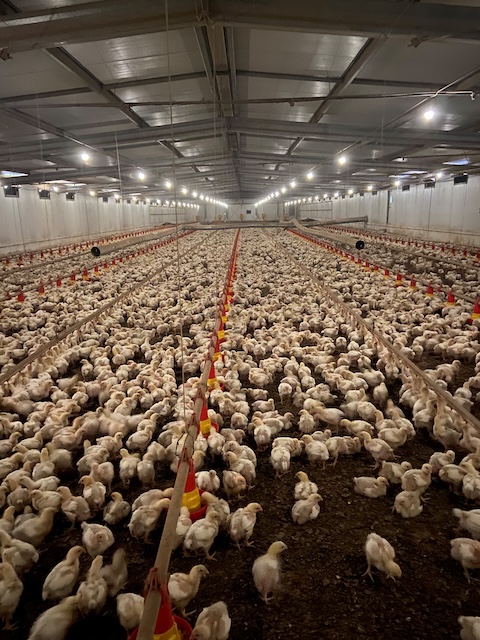
Chickens in a broiler house. Photo by author.
To achieve the expected productive efficiency, in seven days the animals must gain 300% of their initial body weight. During the first phase, they eat and drink nonstop. Only on the eighth day do they begin sleeping longer, but first, the lights are turned off for one hour a day so they get used to resting. In the family’s first flock, the poultry workers overlooked this detail and, after a full night in the dark, when the lights came back on the next morning, nearly 300 birds (out of 34,000) died from fright.
This episode shows the degree of dependence produced there. It is precisely this capacity to “fend for themselves” and to survive without permanent human intervention that seems to disappear in industrial production. Through decades of genetic selection and raised under controlled conditions, broilers have become extremely sensitive and dependent. It is as if they were “de-animalized,” but instead of becoming more independent, forms of life are being remade in ways that put poultry workers increasingly to work. What at first seems instinctive is modified by industrial conditions, and workers themselves must become ambiguously instinctive: they learn to perceive, through the body, what the bird can no longer regulate on its own, and this learning is stimulated by the industry until it takes the form of an almost immediate, “instinctive” reaction.
This dependence begins very early. In the case of broilers, the poultry house functions as a large incubator, in which temperature, light brightness, pressure, and humidity must be strictly controlled to ensure their survival. Under non-industrial conditions, newly hatched chicks depend on the mother hen for warmth, food, protection, and learning. In the first hours of life, peeping communicates these needs, and it is by following the mother hen that they learn vital behaviors such as foraging, grouping themselves, and finding safe places to perch. In the poultry house, some of these functions are shared between human labor and technical infrastructure. Poultry workers need to stimulate the chicks to eat and drink, control their spatial distribution, observe their behavior and development, among other functions that used to be carried out through bodily proximity and the mother’s guidance. In a certain sense, the poultry workers become their mother hens.
Thermoregulation is one of the most evident dimensions of this replacement. Newly hatched chicks have a limited capacity to regulate their own temperature, so during the first days they need to gather under the mother hen or around artificial heat sources, exhaust fans, foggers and environmental control systems, but none of this works without the constant vigilance of poultry workers. The infrastructure does not replace the mother hen on its own; the poultry worker’s body also enters the circuit of regulation. To keep an adequate temperature, especially in winter, the wood-burning furnace remains lit 24 hours, requiring vigilance even during the night. Although the house is only a few meters away, many poultry workers, tired of repeatedly getting up, take turns sleeping in the poultry house, on a mattress beside the furnace. From there, they get up, check the temperature, and feed the fire, in the same space where rest and work overlap.
In this context, they develop techniques and use their own bodies as measuring instruments. Italiano, for example, always enters the poultry house wearing shorts, trying to feel the temperature close to the floor. They also pick up the birds, place their hands under their wings to check for body heat, and remain highly attentive to any change in behavior: whether they spread their wings too much, cluster in the corners, peep too much, or peep too little. It goes so far that some, afraid that the broilers might die, walk barefoot over the poultry litter — made up of industrial by-products, crop residues, and bird feces — exposing themselves to bacteria, high concentrations of ammonia, and other substances. This is what happened to Neia, a poultry worker with a record of good results, who continued caring for the broilers while her feet got raw. Poultry workers like her need to substitute part of this maternal care through labor, technique, and their own forms of perception, intimacy, and care. This is not, of course, a direct equivalence, but the worker’s body becomes part of the infrastructure that keeps the animals alive.
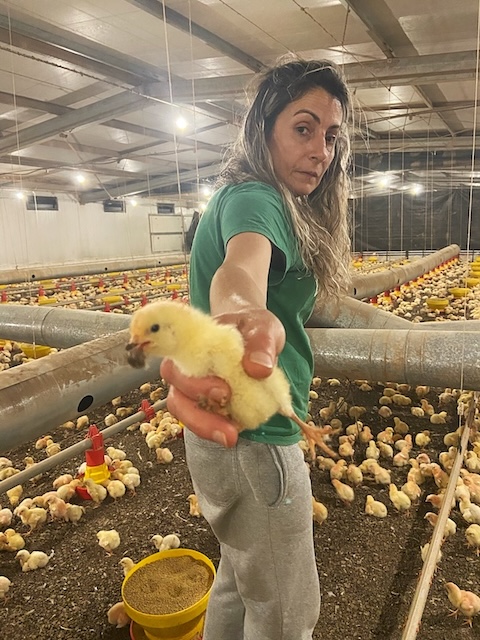
Neia at work. Photo by author.
This applies even to what we cannot see or feel directly, such as the formation of the microbiota that makes an animal more or less susceptible to colonization by pathogens. During the World’s Poultry Congress, in Toronto, in July 2026, the veterinarian Billy Hargis brought observations that allowed me to add another example. Reconstructing the history of research on Salmonella in poultry, Hargis revisited the concept of “competitive exclusion” and mentioned a classic experiment from 1973. The study tries to understand why newly hatched chicks are so easily colonized by Salmonella and arrived at the microbiota: in chicks, it is still only weakly established, while in adult birds, a more complex intestinal community makes colonization more difficult. The researchers gave the chicks a preparation containing microbiota from adult hens and found that they became much more resistant, since an already established intestinal community makes it harder for an “invading pathogen” to find the space and conditions it needs to proliferate. From then on, Hargis made an interesting observation: if we look at broody hens, when the chicks leave the nest, one of the first things the mother does is eliminate cecal contents retained for days. It is a dark green material with an extremely strong smell, with which the chicks immediately come into contact. From this, he began to wonder: could this be a natural way of inoculating the microbiota?
Alongside the example of heating, this case shows how separation reaches even a microscopic scale, but this is no ordinary excretion: the cecum concentrates the greatest microbial diversity in a ird’s body, which means that chicks produced in commercial hatcheries, hatching without this initial contact, lose access to the richest source of protection that exists in the mother’s body. It is something more complex than replacing the hen’s heating function with another source, an entire set of relations that used to happen through the mother hen’s body and behavior must be technically reconstructed. Heat is one of them, but there are also rhythms, forms of learning, and even the acquisition of microorganisms.
This experiment soon became a commercial technology, with decades of use and various products incorporated by the poultry industry. We might be tempted to frame this practice as “post-Pasteurian,” for betting on microbial diversity as a form of protection, but the industry actually places in technical-scientific means the expectation of solving problems it has itself created, putting this diversity in the service of its own project of control. It is not a matter of eliminating all microbes, but of replacing the wild, unpredictable, and “dirty” ones with domesticated, standardized, brand-name microbes, made in the laboratory, packaged as “safe” and “reliable.” The irony in this story is striking: while the industry separates the chick from the hen and from the relations that once constituted its body, a highly sophisticated science discovers that it needs to artificially reintroduce what contact with adult birds once provide. Hatcheries that are sanitarily “controlled,” with strict biosecurity protocols, are created, and afterward chicks must be given back the bacterial communities that used to come from their mothers.
This is what happens when a chick is taken from its mother: part of its references to the world come to an end. When the two species meet in confinement, they become something else: the animals lose the ability to distinguish day from night, and poultry workers are trained like sniffer dogs, even though their sense of smell is compromised by the overstimulation of the odors of production. The curious thing is that, when we talk about animal confinement, we forget that broilers are not raised alone — there are always some humans confined with them. My ethnography in poultry houses in southern Brazil shows that, while workers form bonds and new forms of closeness and care, they also end up involved in other kinds of violence. They need to be clinically detached in order to kill when necessary, but they must not detach themselves too much, because certain feelings make them more rigorous in their work. Wilson’s case is paradigmatic: he refused to kill a chick that had not grown enough and could not reach the drinkers, and started offering it water in a small plastic cup. Over time, he said he was able to identify it among thirty thousand others. Later, the chick developed and followed the majority to slaughter. Wilson may have interrupted or postponed an early death, but both remained involved in sustaining a production that would, at some point, slaughter them. People and animals grow close because they are both subjected to the same system of exploitation and intensive labor, which generates unexpected intimate relationships. Among poultry workers, I frequently heard that the chicken is similar to us, “almost like a human” — sometimes close, sometimes so distant, especially in the face of an agribusiness that cared about neither of them.
From the macro universe of global food production — in the country that is the world’s largest exporter of chicken — we arrive at microscopic differences. It is with her feet raw that, the next morning, Neia returns to the poultry house. Even as she argues with her bosses and voices her frustrations, she insisted that, if necessary, she would go barefoot again to feel the temperature of the chickens. Even with a serious foot problem and a medical prohibition, she understood this not only as a job requirement, but as a life mission: keeping the chickens alive. And ours? It has been feeding on them, with a mixture, in every bite, of genetics, welfare, disease control, biosecurity, intensive labor, undisciplined microorganisms, along with the fresh breath, the injured feet, and the watchful eyes of the workers. In this world, chickens no longer grow on their own, they do almost nothing by themselves: they neither control themselves nor, much less, take care of themselves — it takes many other bodies working and transforming alongside them.
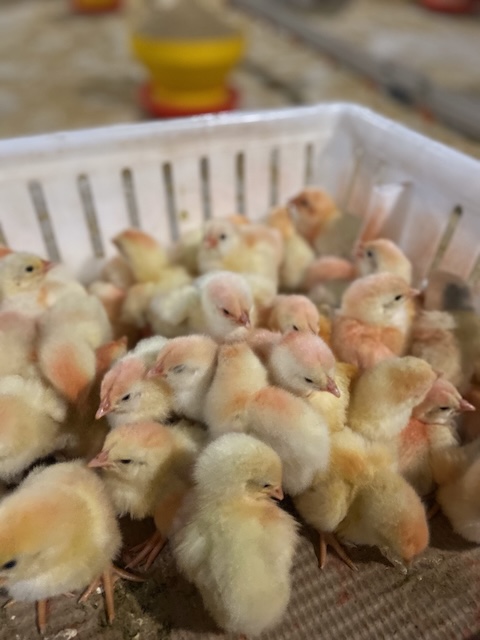
Baby chicks. Photo by author.
This post was curated by Contributing Editor Melina Campos Ortiz and reviewed by Contributing Editor Victor Secco.
Reference
Vander Velden, Felipe. “Pets and Domesticated Animals in Lowland South America.” In The Lowland South American World, edited by Casey High and Luiz Costa, 429–446. London: Routledge, 2024.
