This post is the fourth in a series about stuckness in science and technology. Read the introduction to the series here.
The gut. For my interlocutors living with chronic illness, the gut has come to signify a symptom of the past and a sensor of the present and future. The gut pushes them towards reckoning with broken ecology; inside and outside in the everyday. With the gut’s requirement of ongoing attunement and care, it is also experienced by them as chronically stuck. During my interviews with urban upper-middle class interlocutors, who also happen to be upwardly mobile, guts get stuck with chronic illnesses such as Irritable Bowel Syndrome, Gastroesophageal Reflux Disease, or as strange (at least in India) as Lyme disease. In this post, I explore stuckness and movement in the gut in relation to the human body. Metaphorically, transposing gut pipelines with water pipelines, I base this exploration on Nikhil Anand’s theorization of water infrastructure “not as a fixed set of material things that are functioning in the background until they break down in visible ways” (Anand 2017, pg. 13). In similar vein, when the human body stays in place, the movements in the gut seem to work as usual, hence remains invisible. But when the human body moves across places, the previously invisible movements in the gut become visible or felt through its erratic functioning. I ask: how is it that the human body, when stuck in place, movements in the gut remain imperceptible; but when a body is in movement, stuckness in the gut becomes perceptible?
Paradoxically, for many of my interlocutors, stuckness seems to result due to bodily movements away from the attuned and often taken for granted nexus of care because of work, education, or family, among other reasons. A nexus of care is the care that emanates from familiar and expected routines of the everyday, propped up by a rhizomic network of people, places, practices, more-than human and non-human objects and beings, sensorium, events, rituals, rhythms of time, and multiple ways of healing. So much so that it remains imperceptible until movement unsettles something within. To understand care in the context of a stuck gut, I substantiate the nexus of care with theorization of “ecologies of support.” Duclos and Criado (2019) propose “ecologies of support […] that don’t merely sustain but pass through bodies,” and “inspire aspirational, drifting movements.” (p. 155, emphasis in original). The authors emphasize that “ecologies of support are not to be mistaken for all-encompassing environments.” According to them, “care […] in relation with broader ecologies is composed of a vast range of techniques, entities and deities, spaces, and artificial atmospheres—that provide transitory protective effects” (p.155) [Emphasis added]. I find this theorization productive in the context of stuck guts in relation to moving bodies. Further, ecologies of support may not always be equated with positive experiences or warmth in essentialist terms. Instead, it is likely to be processually shaped by internal and external forces, whether a person is spatiotemporally stuck or in movement.
This study of stuckness in the gut is an analytic byproduct of my dissertation research on gut microbiome testing and interpretations at a biotech company and among Indians who have taken the test in Bengaluru, across and beyond India. As gut microbiome testing is commercialized, interpreted and diffused in urban India, it mediates scientific and vernacular articulations among urban Indian test-takers and microbes/microbiome. Gut microbiome testing, enabled through metagenomic sequencing, is a novel biotech intervention[1] that my interlocutors came in contact with during years of dealing with chronic conditions – what an interlocutor elegantly (and painfully) termed as “chronic (st)illness”. I analyze this in the context of constipated guts.
Chronically Stuck Gut
Recently, when my 75-year-old mother-in-law underwent an endoscopy and a colonoscopy after years of suffering from chronic digestive disturbances, her gastroenterologist attributed gut imbalances to the cumulative effects of contemporary urban living. These included daily exposure to traffic, polluted air and water, frequent consumption of restaurant food, declining nutritional value of fruits, vegetables, dairy, and meat, and long and inconsistent working hours. Seeking to comfort her, he remarked that she was at least facing these challenges later in life. He then observed that irritable bowel syndrome was increasingly prevalent among younger adults, particularly IT workers, many of whom opted for work from home as a way of managing the constant trips to the toilet brought on by persistent gastrointestinal distress. After an interview with an IT professional in his 40s on the terrace of his upscale apartment in south Bengaluru, he shared a December 2024 India Today cover story, titled “The Gut Alarm” (Figure 1). It detailed the “alarming” state of the gut among urban Indians due to many of the factors described above, bundled into “unhealthy lifestyle.”
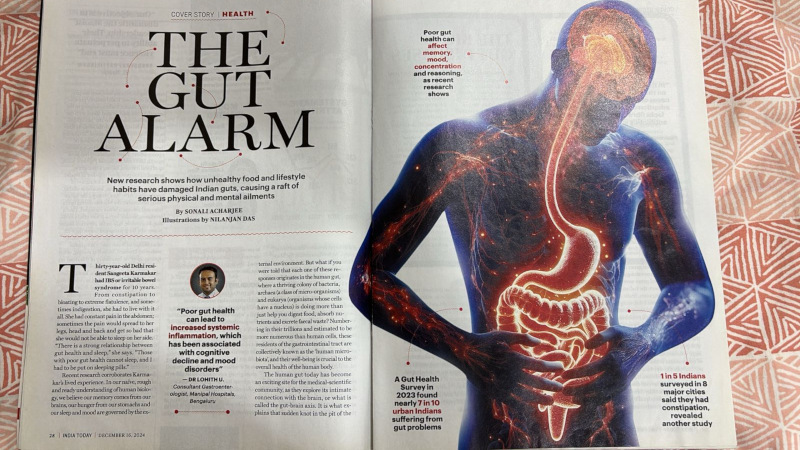
Figure 1. A cover story from a popular magazine India Today, shared by a gut-microbiome test taker with an image showing increasing evidence of poor gut health among urban Indians (Aacharjee, 2024). Image taken by author.
Materially, stuckness comes into being through tangible and intangible earthly matter: produced and/or trapped air, excess or lack of water, and other (in)edible things and microbial beings. Stuck in the tight pipeline that the gut is generally described as, parts of them get moved, absorbed or digested, and expelled. Here, stuckness becomes a chronically visible state of a constipated gut, a gut with a reduced form of motility (what is biomedically understood as peristalsis), or simply put, a lack of movement. The resultant chronic illness—or “chronic (st)illness”—drives my interlocutors to consistently (re)shape the everyday ecologies of support and pushes them to pursue a range of interventions.
Metaconditions for Interventions
Socioeconomic mobility or migration from one’s place of origin is what Mark Nichter (2001) situates in the larger forces of industrialization, globalization, and modernity, implicating the political ecology of an individual’s health in India. Since the turn of the millennium when he analyzed indigestion “as a sign and symptom of defective modernization,” it has continued to disrupt the everyday rhythms of urban Indians. Invigorated by these metaconditions, movement across places—a new normal among Indians—makes the stuckness in the gut intensely felt. Subsequently, eating and thinking about eating becomes entangled when the gut takes center stage in the lives of my interlocutors.
Annmarie Mol problematizes the importance given to thinking as opposed to routine activity such as eating in her empirical philosophical account Eating in Theory (2021) by critiquing Hannah Arendt’s hierarchical model of “the human” in her book The Human Condition.[2] She emphatically chooses not to follow established norms and hierarchies in western philosophical writings, instead offering empirical philosophical thought by focusing on materialities of the human body. I engage with Mol’s analytical framework of knowing, doing, relating, and being as I complicate eating in the context of evacuating. For among my chronically stuck interlocutors, I observe, eating is organized around managing the stuckness in the gut; thus, evacuating drives the thinking and doing around eating. In sum, when the gut gets stuck, I argue, evacuating takes precedence over eating.
(Re)constructing the Ecologies of Support for the Gut
However, evacuating in practice amounts to iterative reevaluating and re-constructing the ecologies of support. Unmaking stuckness in the gut requires dynamic sense-making and attuning through the spatiotemporally available ecologies of support. Consider this:
Mridula narrates her constipated gut through one aim: “Adhu yennai vittu poganum” [It (the fecal matter) should leave me]. With an emphasis on “leave,” Mridula, a 54-year-old bowel cancer survivor, shares her constant efforts to alleviate constipation. While in the United Kingdom, she talked to me over Zoom about the everyday affective labor (Berlant, 2011) involved in attuning into her gut. Through Tamil, with dashes of English, I see her pain (and embarrassment) in the reddening of her face as she shares the day-to-day management of her constipation. While biomedicine saved her life, her day-to-day life for the past eleven years is entangled with chronic stuckness. It manifests itself through what she calls “bad gas and bloating” caused by “bad bacterias” that she infers are a result of migration:
When I am in India, I feel very good but once I come here, I feel bloating. Here also they couldn’t find (out) what’s the reason. Maybe I got more bacteria in my tummy?”
Upon asking about her time in India 30 years back, before she moved to Singapore and then to the UK with her husband, she smiles with reminiscence. “I was pretty healthy, I was a state hockey player. Even after marriage, I used to play tennis with my kids.” Paradoxically, while her ecologies of support may have changed, her idealized version remained stuck in time in her memory.
When asked about the timings of evacuating her bowels now, she exhales:
Now I go right after I wake up.[3] Now it has changed like that (for good). Before, oh that is a long story, dear! Right after my surgery…they call it aatu puzhukai (goat droppings), do you know? A goat’s droppings would be of this size (shows sharpie pen with her thumb sliding about an inch down from the top)…small ones.
Before I farted for fifty times, now it has decreased to thirty or twenty. But my focus is to reduce it further. But it is like that only until I evacuate. Once I evacuate, I will be ok.
For Mridula, eating shapes her being, knowing, doing, and relating (Mol, 2021) with a single goal: evacuating. During mealtimes, she ensures that eating is in tune with her gut’s movement and away from stuckness. Thus, evacualting takes precedence over the pleasures of eating. Both get substantiated with knowing that eating something like chicken at lunch will result in (fermented) farts that smell of the chicken a few hours later. So, this knowing guides Mridula’s eating and prepares her for the fact that later in the day she will be faced with bloating and farts when her food reaches the large intestine. Thus, follows doing:
After six o’clock, if I didn’t clear my poo(p), I will take it out (through enema). If I have to attend a poojai (a religious function), and if I know I have to be there for three or four hours, if farting starts during those times, I don’t feel (well). My face will redden, oh it’s coming, that disturbance kills me a lot. If I take enema and go (to the religious function), I am very free… out of danger, out of stress.
In her effort to live normally, she sought advice from her carefully selected friends and friends-like relatives in the UK and in India, rebuilding her ecologies of support. The friends and a cousin suggested some products such as over-the-counter probiotic pills and psyllium husk [4], which she gradually began incorporating to undo the stuckness in her gut. Gut microbiome testing was one of the latest interventions that she encountered through a friend in India, in order to gain insight into her ongoing stuckness. Interestingly, along with such a novel intervention, she has also started eating pazhaya saadham (old rice, if translated literally): fermented rice soaked overnight that is eaten the next morning. An age-old practice in typically poorer Tamil households, pazhaya saadham is now appearing among the privileged urban Indians and also high-end hotels in India.
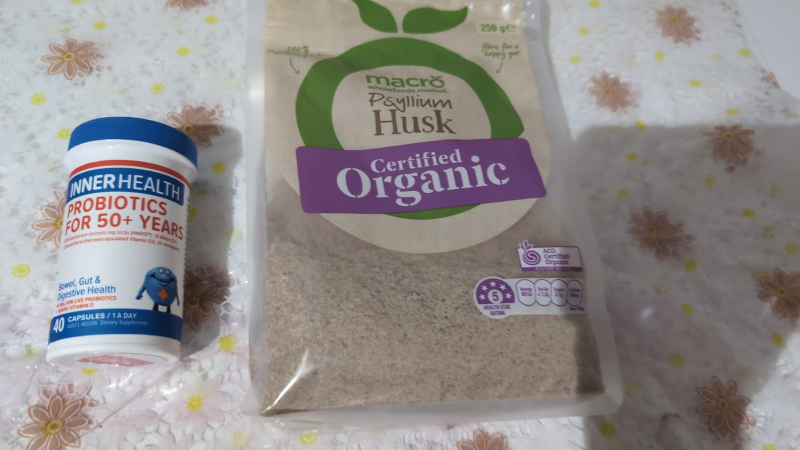
Figure 2. Mridula shared two of the solutions to the earthly matter trapped in her gut: probiotic pills and psyllium husk, suggested by friends.
(Un)settling with the Paradox
Movement heralds gut troubles among my interlocutors who move for work, education, or family, as they travel outside their villages or towns to cosmopolitan cities or out of the country. For Mridula and several other interlocuters, stuckness (and movement) is multivalent. When they are stuck in place, movement in the gut remains imperceptible and uneventful; but when in movement, stuckness in the gut becomes perceptible. For Mridula, stuckness in the gut is unmade through dynamic sense-making of the earthly matter that is continuously enacted by microbial beings. She does this by attuning herself into her gut and reconstituting her ecologies of support across time and space. After having survived bowel cancer for five years, Mridula gradually became confident about her chance of life. However, her chronic journey of eating and evacuating (and everything in between) is rendered through her acute experiences with stuckness, followed by a series of ongoing interventions to ease the acuity and embrace the chronicity. However, this chronicity—marked with an acute past—is affectively charged and forever becoming which is intimately and intensely felt in the ordinary and mundane. Among my interlocutors, the stuckness in the gut seems to reflect the broader state of depleting ecologies (of support) expressed through the social and the microbial ecologies.
Notes
[1] As claimed by systems biology experts, microbiome science-backed gut microbiome testing visualizes, categorizes, and measures microbes within human guts by using what is known as metagenomic sequencing technology. One can book a test online and a kit is sent to the home. Once the stool sample is collected, it is picked up from the home. Gut microbiome tests are analyzed from the fecal samples of humans and based on the microbial composition residing in the gut (primarily large intestine); diet and supplement recommendations are shared along with future likelihood of diseases. This report consultation is typically done over the internet. Indeed, such a test and subsequent nutritional and supplemental regimen demands financial and other care-based investments.
[2] Mol critiques the flattening of categories and subsequent power differences and inequalities, and distilling them in one monolith—“the human”—that I acknowledge this post too doesn’t delve deeper into.
[3] Understood among Indian lifeworlds as the ideal time to evacuate.
[4] A locally grown (esp. in Northwest India) Isabgol or Psyllium husk is an age-old plant-based solution for adding soluble fiber to move the matter in the gut. It is now available in grocery stores in most of the developed world. Born and raised in Saurashtra, Gujarat, I have prepared a nighttime drink for my grandmother by dissolving psyllium husk in warm water or milk for many years. I see its recent accessibility across and outside India and its popularity intriguing for further scholarly analysis.
This post was curated by Contributing Editor Michelle Venetucci and Shoko Yamada, and edited with the help of Contributing Editor Aisha Chughtai.
References
Aacharjee, S. (2024, December 16). The Gut Alarm. India Today.
Anand, N. (2017). Hydraulic City. Durham, NC: Duke University Press.
Berlant, L. G. (2011). Cruel Optimism (Vol. 822351110). Durham, NC: Duke University Press.
Duclos, V., & Criado, T. S. (2020). Care in Trouble: Ecologies of Support From Below and Beyond. Medical Anthropology Quarterly, 34(2), 153-173.
Mol, A. (2021). Eating in theory. Duke University Press.
Nichter, M. (2001). The Political Ecology of Health in India: Indigestion as Sign and Symptom of Defective Modernization. Healing Powers and Modernity: Traditional Medicine, Shamanism, and Science in Asian Societies, 85-106.
