In recent years in Argentina, feminist studies have been part of the green wave that brought to the forefront the inequalities faced by women and LGBTQ+ people. As academics, we have expanded our opportunities to develop research projects, launched specialized postgraduate programs, built networks against violence in universities, created an association that unites us, forged relationships with political and social organizations to build knowledge, promoted protocols in our workplaces, and participated in the struggles for new laws that expanded rights. Our transformative power has provided us with some tools to sustain ourselves in the face of the attacks imposed by the current government. Since taking office in December 2023, Javier Milei has established a neoliberal, far-right regime. His measures to reduce public spending have focused on budget cuts affecting the healthcare, education and pension systems.
Argentina is facing a scientificide, the national government has set out to eradicate sovereign scientific development. Just a few weeks ago, the National Scientific and Technical Research Council (CONICET) published official data that illustrates the situation: in 2026 there are only 480 funded research projects, compared to 3,179 in 2022 (CONICET 2026) Doctoral fellowship stipends are below the poverty line. More than 1,000 people who have won their competitions to enter the research career are waiting for their appointments, many for three years. And resignations are multiplying in tandem with the erosion of purchasing power of salaries.
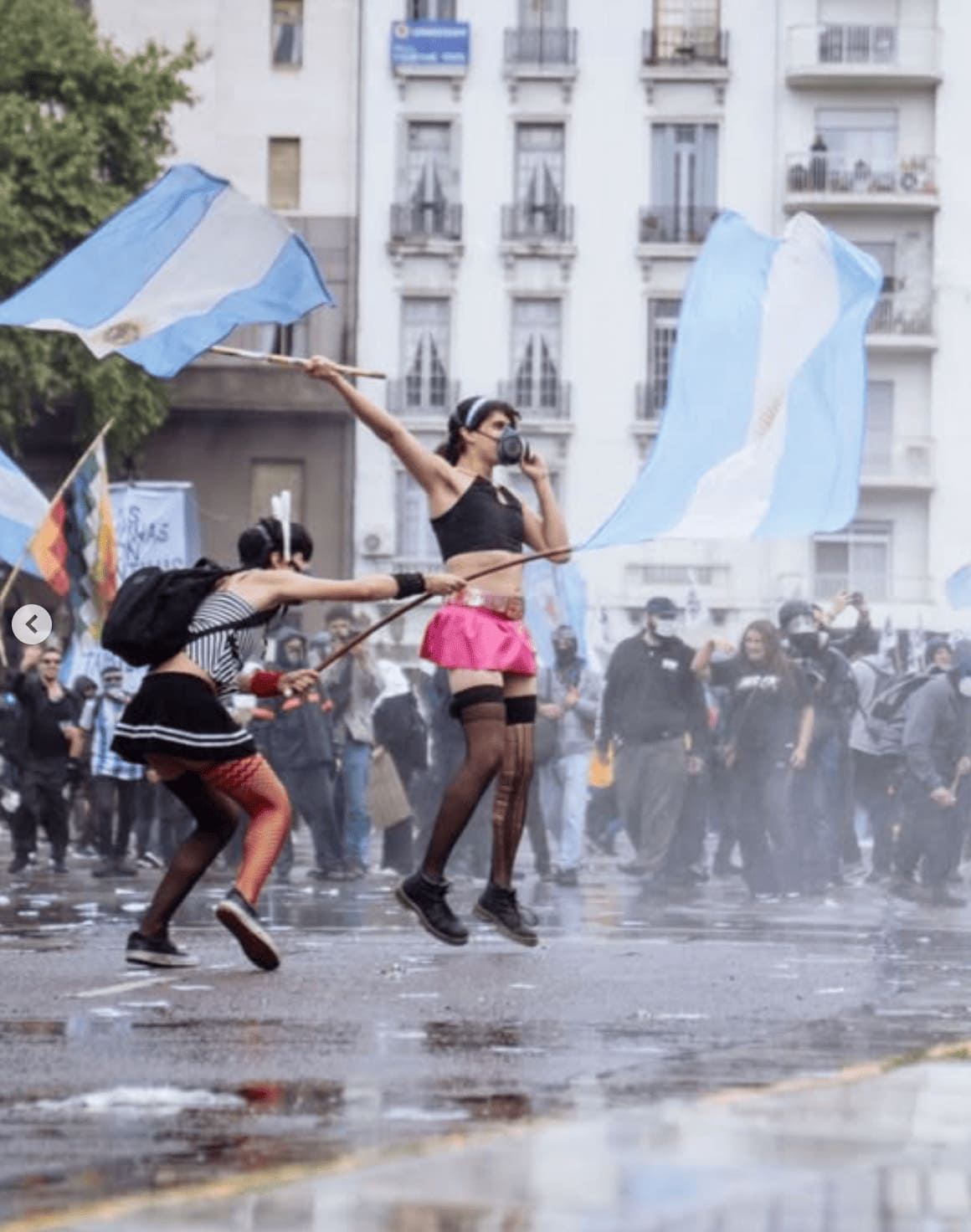
Women protesting in Argentina. Photograph by Colectivo Triada , used with permission (https://www.instagram.com/colectivo.triada/)
The Underfunding of the Scientific Research System
Our task is to create problems, elicit powerful responses to devastating events, calm turbulent waters, and rebuild peaceful places.
Donna Haraway, 2021
The social sciences, and especially gender studies, have been at the center of the national government’s hate speech. In early 2025, in the French media Le Point, Javier Milei explained that his plans for the sector are “”That science be science, let’s say, that it not be political propaganda.” “What do you mean by that?” the journalist asked again, and he replied:
I don’t like applications to anything related to social sciences. All it does is favor parasites who write in favor of the State and against the people to maintain a standard of living that has no market counterpart. How do these pamphlets improve people’s lives, like studying Batman’s dilated anus? (…)
I want science to promote cutting-edge technology. In fact, all our nuclear developments are based on research conducted by scientists. Some work for the government and others in the private sector.
Beyond the president’s and his social media bots’ frequent obsession with superheroes’ sexuality, more than 1,000 days into his administration, we know that the destruction and defunding of public institutions were not limited to any one area. In addition to what we’ve already mentioned regarding CONICET (National Scientific and Technical Research Council), they withheld $54 million from the Inter-American Development Bank and the World Bank earmarked for research, halted projects related to nuclear and space development, and closed branches of the National Institute of Industrial Technology (INTI) and the National Institute of Agricultural Technology (INTA).
Responses, and a Muffled Dialogue
What did we in the scientific community do? The Network of Authorities of Science and Technology Institutes (RAICYT) acted as amicus curiae in a criminal complaint for the restitution of international funds and issued public statements and letters. Data on the catastrophe was produced by research groups specializing in science policy. The Periferia website, the X account “Let’s Defend Argentine Science,” journalist Nora Bar, and scientist Jorge Aliaga are some of the platforms from which efforts are being made to challenge narratives in the media and on social networks. Scientific associations also published statements and participated in the parliamentary debate on the Science and Technology Emergency Law.
The result: a muffled dialogue. Unions and associations representing scientists argue their complaints by alluding to the relevance of science and technology for the country’s growth and development… they mention satellites, vaccines, and nuclear reactors… they promise to combat dengue fever or cure cancer… and the government babbles about Batman’s anus or the politicized nature of the social sciences. At CONICET, some papers on sexuality were removed from the repository, and at INTA, those in charge of communications were urged not to mention topics like agroecology… to protect “the brand.” The victims of censorship are silenced and terrified.
Then a problem arises: Who defends the young researcher studying representations of sexuality in comics? Who dares to argue for the usefulness of research on WhatsApp mommy-groups? Where are we, feminists? Our colleagues (almost always men) in the exact and natural sciences who tend to participate in the media express ideas about science very close to what we might call “positivist” or “Mertonian.” They think of it as an activity separate from common sense, and of scientists as selfless and altruistic, motivated by a thirst for knowledge and part of international communities that are always ready to send letters of solidarity to defeat fascism. Meanwhile, for those of us who work in the social sciences, the threats multiply, and we are gripped by bewilderment. Therefore, we feel it is important to go out and explain what we do, what topics we work on, and why. We build our stands at the science fairs we organize to protest, and we fall into the trap: we make it clear that we don’t do fun experiments for children, that we can’t join the private sector, that we don’t collaborate with capitalist expansion, that we have proof that current policies will increase poverty, that we support the struggles of excluded people, that we hadn’t realized the right wing was going to win, that we denounce the environmental impact of the hegemonic agricultural technology package, that we collaborate to ensure the genocidal perpetrators of the last dictatorship are imprisoned, that our science is absolutely ideological… but, we also say that the strength of our arguments comes from rigorous methodology, from blind peer review, from the disinterestedness that drives us, and that we trust our work leads to scientific progress. And we raise the banners of Mertonian ideology, after some five decades of STS (science, technology, and society) studies that refute it… Is this perhaps a strategic legitimization strategy, as the British sociologist Michel Mulkay (1976) warned? What place do we give to the critical sociology of science? Is it possible for us to recover some of its findings? What if we embrace Argentine mathematician Oscar Varsavsky’s (1969) challenge and abandon scientific colonialism and the productivist logic that measures our success in the number of papers? What if we raise the banners of feminist critique of science? What if we abandon the tools of the master? What if we dare to make visible that our objectivity and impartiality in the production of knowledge is our strength?
Hopelessness is Not an Option for Us
Perhaps it’s time to reclaim the knowledge that STS studies provided us decades ago. With Donna Haraway (1991) and Sharon Traweek (1988), we learned that objectivity is nothing more than a point of view, “the culture of non-culture,” or the perspective of Western European gentlemen stripped of their origins. And we also came to understand how the construction of that objectivity was interwoven with the production of sexual difference. That objective gaze could only be held by certain men, who could act as “modest witnesses,” disinterested, independent, and reasonable (not sentimental). It’s no surprise, then, that the gaze of women, but also that of workers, slaves, foreigners… of the subaltern… is labeled as biased, marked by feelings, ideologies, and positions.
We learned from our feminist epistemologists that this “usual” or “traditional” way of defining science is androcentric and ethnocentric. So why do we defend ourselves by replicating a position that perpetrates violence against other forms of knowledge and defines neutrality as a perspective devoid of culture and ideology? Why don’t we abandon the strategy of thinking of ourselves as an autonomous activity that cannot be questioned or criticized? Why do we expect solidarity from those who make science a business? Why do we want to defend ourselves, once again, using the master’s tools?
Should science only generate economic value? What is the value of building scientific knowledge? What kind of scientific culture is being built when private capital funds research that studies production models harmful to people and the environment? Is it possible to get the agrochemical industry to fund studies on farming communities affected by pesticide spraying? Will we ever get digital wallets to let us see family debt data? Is it necessary to train our social science and humanities students to be able to sell their knowledge on the market? What kinds of goods could they sell there?
As we have already stated within the Argentine Association for Research in Women’s History and Gender Studies (AAIHMEG, 2024), if we embrace our feminist epistemologies, we can assert that science does not have to be productive in market terms. There are problems that require a slow, deliberate science, one that reflects without haste and prioritizes the quality of its conclusions over the quantity of papers. A science that makes visible the need for a feminist science that challenges, that seeks to democratize the production of and access to scientific knowledge. A science to reflect on our reality, expose power relations, and propose other possible worlds. Because, as our feminist academics Angela Davis (2026), Mara Viveros Vigoya (RIOS 2023), and Dora Barrancos (2025) say: hopelessness is not an option for us.
We have a difficult but unwavering task: to develop, as activists, the most creative resistance strategy we can imagine. We must absolutely reverse this state of “outside-of-itself” in which right-wing forces place the populations, and restore to them a sense of the “for-itself”, a hopeful vision that recovering dignity, autonomy, and political agency implies rejecting the most reprehensible state, that of “voluntary servitude.”
Dora Barrancos, 2025.
This post was curated by Contributing Editor Clarissa Reche and reviewed by Contributing Editor Misria Shaik Ali
References
AAIHMEG – Argentine Association for Research in Women’s History and Gender Studies. Contributions (non-economic) to considering the productivity of science. Es Nota newspaper. May 31, 2024. https://www.esnotadiario.com/2024/05/31/aportes-no-economicos-para-pensar-la-productividad-de-las-ciencias/
Angela Davis. Abolition, Feminism, Now! A Masterful Dialogue. VI International Book Fair of University Students. National Autonomous University of Mexico. September 2026. https://www.youtube.com/watch?v=rs6SAo7vwnw
CONICET – Consejo Nacional de Investigaciones Científicas y Técnicas. Datos Confiables y de Calidad Que Permiten Proyectar y Fortalecer las Políticas de Gestión en Ciencia y Tecnología. 2026. https://cifras.conicet.gov.ar/publica/
Donna Haraway. Testigo_Modesto@Segundo_Milenio.HombreHembre©_Conoce_Oncoratón®. Feminism and technoscience. Buenos Aires. Rara Avis. Part Twoand “Testigo_Modesto@Segundo_Milenio”. 2021.
Dora Barrancos. Facing the anti-rights crossroads, the duty of resistance. In “Re-existing the present: urgent thoughts, actions and debates.” Catholics for the Right to Decide Argentina. 2025. pp. 37-40. https://catolicas.org.ar/publicacion/reexistir-el-presente-pensamientos-acciones-y-debates-urgentes-2025/
Flavia Ríos. Repoliticizing intersectionality to maintain hope. An interview with Mara Viveros. Tramas y Redes Journal, CLACSO. no. 4, 2023, June, pp. 317-330 DOI: https://doi.org/10.54871/cl4c400u
Michael Mulkay. Norms and Ideology in Science. Social Science Information. Vol. 15. Nº 4. 1976. Pp. 637-656. https://doi.org/10.1177/053901847601500406
Oscar Varsavsky. Science, politics and scientism. Buenos Aires. CEAL. 1969.
Sharon Traweek. Beamtimes and Lifetimes: The World of High Energy Physicists. Cambridge. Harvard University Press. 1988.
