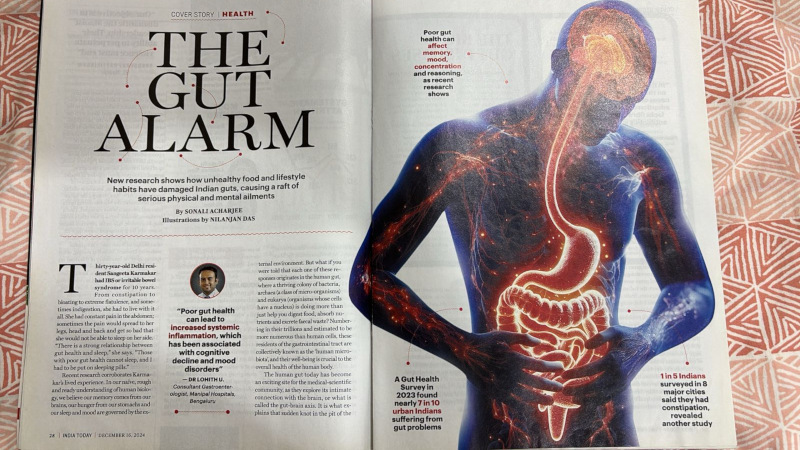
A Paradox of Stuckness and Movement in the Gut
This post is the fourth in a series about stuckness in science and technology. Read the introduction to the series here. The gut. For my interlocutors living with chronic illness, the gut has come to signify a symptom of the past and a sensor of the present and future. The gut pushes them towards reckoning with broken ecology; inside and outside in the everyday. With the gut’s requirement of ongoing attunement and care, it is also experienced by them as chronically stuck. During my interviews with urban upper-middle class interlocutors, who also happen to be upwardly mobile, guts get stuck with chronic illnesses such as Irritable Bowel Syndrome, Gastroesophageal Reflux Disease, or as strange (at least in India) as Lyme disease. In this post, I explore stuckness and movement in the gut in relation to the human body. Metaphorically, transposing gut pipelines with water pipelines, I base this exploration on Nikhil Anand’s theorization of water infrastructure “not as a fixed set of material things that are functioning in the background until they break down in visible ways” (Anand 2017, pg. 13). In similar vein, when the human body stays in place, the movements in the gut seem to work as usual, hence remains invisible. But when the human body moves across places, the previously invisible movements in the gut become visible or felt through its erratic functioning. I ask: how is it that the human body, when stuck in place, movements in the gut remain imperceptible; but when a body is in movement, stuckness in the gut becomes perceptible? (read more...)
