It was an early crisp morning in late April 2023, I climbed into the back seat of the Hilux with the other field scientists, heading to the day’s sampling site on the north coast of Belgium. We sat in silence in the car, part of the early-morning mood and a sign of how tired and overworked we felt most days for the last month. Outside the car’s window urban and green fields landscapes alternate on our way. As we reached closer to our destination the song “A horse with no name” by George Martin started playing on the radio. Slowly the lead-scientist in the field started humming the song and then singing along quietly, as we all followed her humming, the mood inside the car completely changed. We were ready for another long day out in the elements—thorny bushes, light rain, cold wind—collecting soil, sand, water and air in search of microbes with no name.
For the past three years, as part of the HealthXCross project, I have been doing ethnographic fieldwork at a European center for the biosciences, following its recent turn toward environmental microbiome research. I joined the laboratory’s scientists both as an anthropologist and as a volunteer on their sampling expeditions along the coastlines, an effort to map the microbiomes of Europe between land and sea. What has struck me most, being part of the expedition up close, is how much manual, embodied, and frankly unglamorous work it takes to produce an environmental sample—and how easily that work disappears once the sample becomes data.
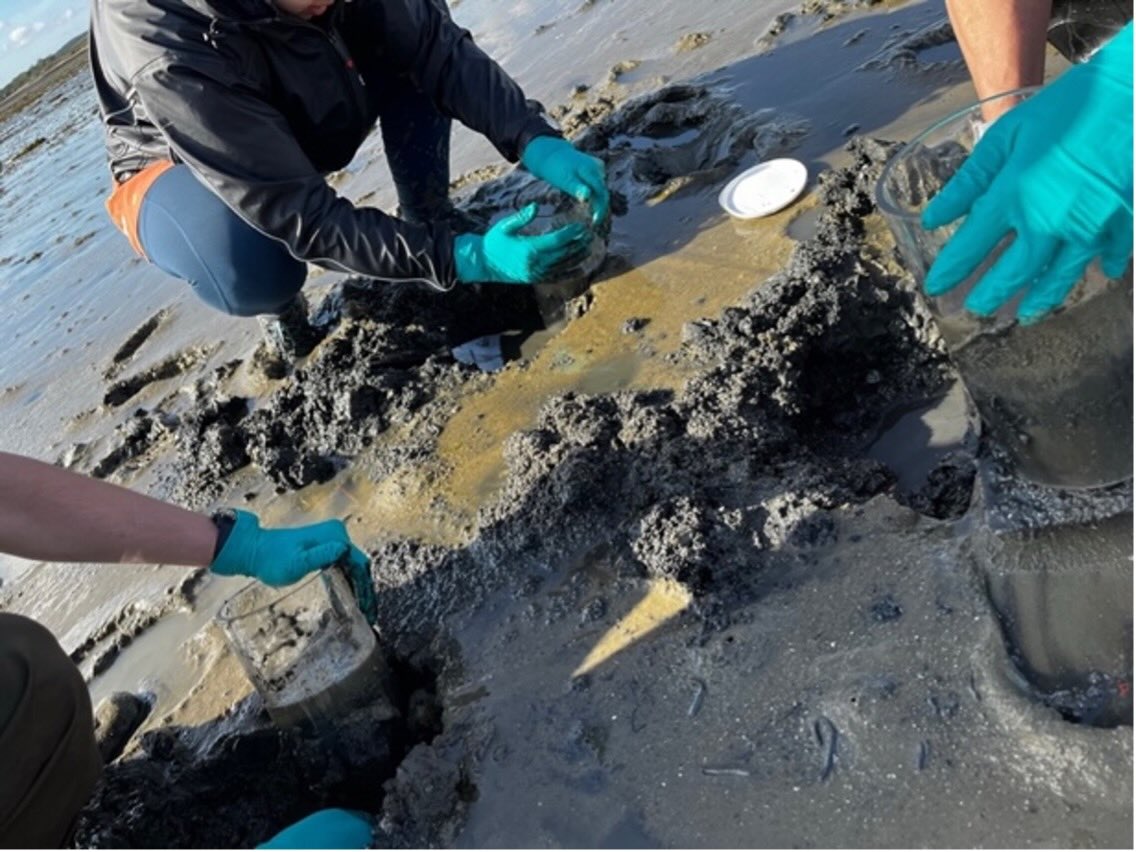
The muddy work of environmental sampling. (Photo by the author)
The value that circulates so freely in bioinformatics is created earlier, by hand, in the cold and the wind. Environmental sampling is manual labor, it is the often-invisible first step of the data journey whose visible, celebrated, value-generating end is digital data (Leonelli and Tempini 2020). And the more biology becomes a computational practice, the easier it is to forget that there are no new empirical data without samples, and no samples without people sampling. Even remote sensing technologies, in which people are involved indirectly in the collection process, is nonetheless dependent on human labour in various forms (Walford 2017).
Microbiome science is moving fast. Metagenomic techniques now let scientists identify microbes that have never been seen in the lab—the vast majority of microorganisms, which cannot be grown in culture (Rappé and Giovannoni 2003). Technicians extract microbial DNA in samples collected from contexts (bodies and environments) normally far away from the lab, which is then rendered into digital form by sequencer machines, and bioinformatically isolated and compared against large genomic databases (Raffaetà 2023). Researchers are only beginning to map the diversity of microbial life on the planet and to understand its role in environmental systems (Solden et al. 2016; Kim et al. 2026).
Much of the work at the base of this kind of science depends on PhD students and early career postdocs going out to “the field” to collect bits of environments—samples—that will become the DNA and data for microbiome science. It is through careful and attentive work in the field that valuable samples are created: making the decisions of where to sample, how, when, making sure labels are done correctly, storing it in precise ways, transporting it along the chain. Labels and barcodes are particularly important in this value chain—without the proper identification a sample is just a handful of soil, a cup of water, a bag of sand. It cannot speak to any of the comparative questions about molecular processes, global warming, antimicrobial resistance, or anthropogenic pollution that justify the whole expedition. Somewhere in a busy fridge, an unlabeled tube is a small but real source of anxiety for whoever finds it.
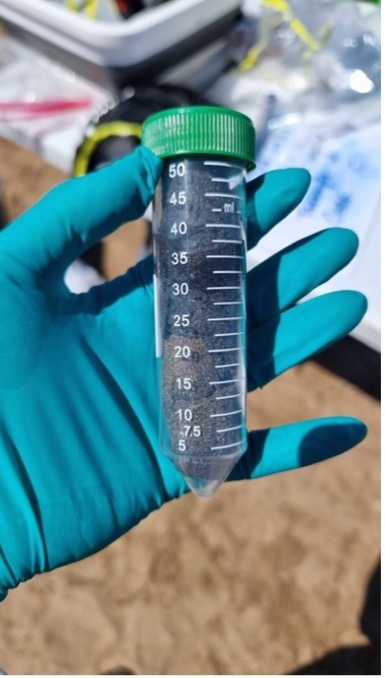
A sample/handful of soil. (Photo by author)
If a sample’s scientific value depends heavily on its label, its economic value is far harder to pin down. Travel and equipment can be costed—easily hundreds of euros per sample—but the expertise, planning, and time that a sampling expedition demands resist conversion into clean economic terms. A sample is also the product of many things that don’t appear on any invoice: personal trajectories, institutional infrastructures, theoretical histories. All of it hangs on the seemingly simple act of getting the right label onto the right tube.
This is where the labor of sampling becomes analytically interesting. The work that creates value here is the work that is least visible and least credited. It is manual, repetitive, weather-beaten, and social—and it produces the standardized, traceable objects on which an entire downstream economy of sequencing, databasing, and bioinformatic analysis depends. Value is generated at the muddy, cold-handed end of the chain and realized at the clean, computational one. The label is the hinge: the point where embodied labor is converted into something digital infrastructures can pick up and circulate (Latour 1999).
There is one more thing the ethnography of the expedition makes obvious that the data does not represent: sampling runs on sociality. The silence in the car, the shared exhaustion, the lead scientist’s humming that turned a tired group into a working team—these are not incidental to the science. They are part of what makes the long days possible, and therefore part of what makes the creation of data possible. The emotional and social labor of holding a collection expedition together is as load bearing as the pipetting (Fortun 2023).
As biology molecularizes and digitalizes, the materiality of samples and sampler’s labor recedes from view (Bangham et al. 2022; Shapin 1989). We are encouraged to imagine microbiome science as a fundamentally informatic practice—a matter of sequences, pipelines, and large-scale models. But the data journey begins in a back seat at dawn, with cold hands and a barcode that has to survive the wind. What becomes of samples and samplers in this informatic regime? What counts as scientific work and who gets the credits and scientific capital (Küçük 2023)? How are scientific matter and labor reconfigured by the digitalization of science?
Nick Seaver (2026), and many others, have been pointing to the human labor behind AI training, similarly, I suggest a stronger attention to sampling labor and samples’ materiality could open up new avenues for thinking about what is considered scientific work and workspaces, as well as situate the increasing digitalization of everything in human labor.
This post was curated by Contributing Editor Victor Secco and reviewed by Contributing Editor Pradip Sarkar.
References
Bangham, Jenny, Xan Chacko, and Judith Kaplan. 2022. Invisible Labour in Modern Science. London: Rowman & Littlefield.
Kim, Chan Yeong, Daniel Podlesny, Jonas Schiller, et al. 2026. ‘Planetary Microbiome Structure and Generalist-Driven Gene Flow across Disparate Habitats’. Cell, February, S0092867425015004. https://doi.org/10.1016/j.cell.2025.12.051.
Küçük, Harun. 2023. ‘Scientific Capital and Scientific Labor’. Isis 114 (4): 827–33. https://doi.org/10.1086/727682.
Latour, Bruno. 1999. ‘Circulating Reference: Sampling the Soil in the Amazon Forest’. In Pandora’s Hope: Essays on the Reality of Science Studies. Cambridge, Massachusetts: Harvard University Press.
Leonelli, Sabina, and Niccolò Tempini, eds. 2020. Data Journeys in the Sciences. Cham: Springer. https://doi.org/10.1007/978-3-030-37177-7.
Raffaetà, Roberta. 2023. Metagenomic Futures: How Microbiome Research Is Reconfiguring Health and What It Means to Be Human. London: Routledge. https://doi.org/10.4324/9781003222965.
Rappé, Michael S., and Stephen J. Giovannoni. 2003. ‘The Uncultured Microbial Majority’. Annual Review of Microbiology 57 (1): 369–94. https://doi.org/10.1146/annurev.micro.57.030502.090759.
Seaver, Nick. 2026. ‘On Recognizing the Handiwork of AI’. American Ethnologist 53 (2): 142–47. https://doi.org/10.1111/amet.70062.
Shapin, Steven. 1989. ‘The Invisible Technician’. American Scientist 77 (6): 554–63.
Solden, Lindsey, Karen Lloyd, and Kelly Wrighton. 2016. ‘The Bright Side of Microbial Dark Matter: Lessons Learned from the Uncultivated Majority’. Current Opinion in Microbiology 31 (June): 217–26. https://doi.org/10.1016/j.mib.2016.04.020.
Walford, Antonia. 2017. ‘Raw Data: Making Relations Matter’. Social Analysis 61 (2). https://doi.org/10.3167/sa.2017.610205.

2 Comments
Thank you for emphasizing the human factors contributing to scientific discovery. These wetware forces are as equally important to innovation as the hardware tools used, which is nicely pointed out in this unique article.
I especially relate to the observation about social and emotional labor holding scientific endeavors together. People are people wherever one goes.
Really enjoyed reading this. I will definitely come back for more updates. Your blog is now bookmarked.