Small drops form on my forehead. Slowly, they make their way down along my temples. The weather app on my phone shows a red alert. For days, I have been caught in the so-called heat wave that swept across Europe in June of this year. Unfortunately, what slowly drips from the edge of my chin is neither refreshing rain nor cool water – it’s my own sweat. Yet, I am not the only one struggling under the weight of the heat. The servers and chips inside the data centers are suffering, too.
At temperatures above 40 degrees Celsius, even the most advanced and expensive cooling systems in data centers begin to struggle. Designed to keep constantly overheating servers at comfortable room temperature, cooling is pushed to its limits during extreme heat. This is because cooling consumes too much energy. During the 2022 heat wave, two data centers of US companies Google and Oracle in the UK failed completely (Google, 2022). Now, similar disruptions were occurring during the current heat wave. In Germany, the data center of Cologne’s public transport system was among those that broke down (Deutz & Köplin, 2026), while in the US, a major outage at Amazon Web Services caused Zoom, Venmo, WhatsApp, and numerous banking applications to stop working for hours (BornCity, 2026). What is more, network overloads and power outages occurred all over the world due to the high electricity consumption caused by air conditioning systems. In response, US Secretary of Energy, Chris Wright, called on the national grid operator to require data centers to switch to their backup systems during periods of extreme heat in order to protect the stability of the power grid (Penn & Howard, 2026). However, this proposal bears its own severe effects. Data centers’ backup systems run on diesel or gas, releasing particulate matter and nitrogen oxides into the atmosphere. These pollutants harm local ecosystems and human health while also contributing to the formation of ozone. In other words, Wright’s solutions for dealing with the heat is heating up the planet even more.

Servers in data centers need cooling (CC-BY-SA by Taylor Vick, via Unsplash)
“Sweat permeates our human lives, yet it is a bodily reality whose functions and meanings we are often conditioned to avoid, minimize, or hide” writes Hannah Della Bosca (2024). While I am rather grateful for my dilated blood vessels and sweat as a somewhat unpleasant, but undoubtedly essential, body technique, overheated data centers do not seem to regulate themselves quite well as I do. Instead, they require artificial cooling systems that demand considerable energy, involve many uncertainties, and bring unforeseen consequences. In this contribution, I explore the meaning and implications of data centers’ artificial cooling and ask whether a data center can, in its own way, learn how to sweat.
Data Center Hot and Cold
In Understanding Media: The Extensions of Man (1964), Marshall McLuhan introduced a provocative distinction for the emerging field of Media Studies: the distinction between hot and cold media.[1] According to McLuhan, media such as books and cinema films were hot because they would fully engage the senses and leave little room for user participation. By contrast, cold media would invite greater involvement, requiring users to fill in gaps, interact, and actively participate. McLuhan placed media such as the telephone, and later forms of electronic communication, including the internet, within the category of cold media. Whether McLuhan, who died in 1980, would still consider today’s internet an activating medium, given the rise of the attention economy and the addictive potential of social media, will remain unanswered.[2] What is certain is that McLuhan (perhaps not unusually for an early media and communication theorist) paid relatively little attention to the material conditions that make media, and people’s interaction with media, possible. Had he done so, he might have discovered that the internet is not cold but hot.
Since “the turn to electricity as a medium of computation” (Pasek, 2023), the history of computing is a history of heat. Or, more precisely, of the continuous struggle to remove it. This history began with the ENIAC (Electronic Numerical Integrator and Computer), the first programmable electronic computer, developed with US Army funding and unveiled to the public in 1946. From the ENIAC’s thousands of vacuum tubes to today’s computer chips, electronic computation has relied on the movement and control of electrons, with electrical resistance converting energy into heat. In modern computer chips, billions of silicon transistors switch on and off through microscopic conductive pathways, generating heat that must be continuously managed. The more transistors a chip contains, the more heat it generates. Yet, this heat is not merely an inconvenient byproduct as it slows the movement of electrons through semiconductor pathways, reduces computing performance, causes signal interference, and can ultimately lead to a system’s breakdown. Computers would therefore quickly destroy themselves if heat was not continuously removed. Put simply: computers need artificial cooling to continue working.

Electronic components on a circuit board produce heat (CC-BY-SA by Umberto, via Unsplash)
Artificial Cooling
Many things are artificially cooled, and eventually frozen, to preserve them for near or distant futures: food, plant seeds, egg cells, and even humans (Alpsancar, 2017; Friedrich, 2020; Friedrich & Höhne, 2016; Parry, 2004). Less widely recognized is that the long-term preservation of data likewise depends on the careful regulation of temperature and humidity.
“Without expansive cooling infrastructures to offset the massive amounts of heat generated by digital systems—and to reduce thermal entanglement—information would be incorrectly registered or not registered at all. Hard drives would burn out and processors would overheat. Data centers would cease to function and internet traffic would come to a halt”, writes media scholar Nicole Starosielski in Media Hot and Cold (2021).
For Starosielski, the preservation of media is therefore always “thermopolitical”, and put more specifically, it is also always “cryopolitical” (Radin & Kowal, 2017).
Returning to the ENIAC in the 1940s, artificial cooling was still a relatively straightforward affair: a large number of industrial fans were used to dissipate the 140 kW of heat generated by ENIAC’s 18.000 vacuum tubes (Chu et al., 2004). Today, however, there are hardly any data centers left that rely on room cooling with fans. Instead, data centers are cooled by an assemblage of cooling components produced by a flourishing cooling industry. During my visit to the large “Tech Show” expo in Frankfurt, many booths were dedicated exclusively to cooling innovations for data centers. Some showcased the industry’s latest developments: tiny tubes of water flowing directly to the chip, eliminating the detour through room- or server-level cooling systems (direct-to-chip cooling), and translucent, shimmering liquids into which entire servers are submerged, reducing thermal resistance (immersion cooling). Many companies had specialized in only a single component of the artificial cooling economy: one produced chillers, another developed specialized coolants, and yet another manufactured the metal plates positioned beneath container-sized coolant tanks, patiently waiting to catch the tanks’ inevitable leaks.
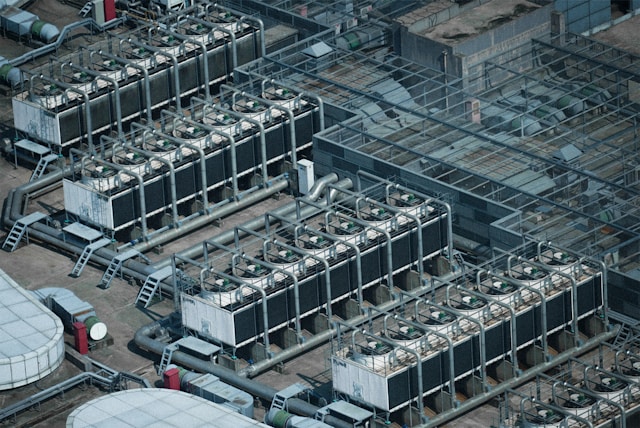
Artificial cooling units that could be installed on the roof of a data center (CC-BY-SA by ün LIU, via Unsplash)
But not everything can be caught or compensated for. The cooling of AI data centers has become increasingly associated with extraordinary water consumption. Data centers in the US reportedly consume 628 million gallons of water annually, equivalent to approximately 2.4 billion liters (Shehabi et al., 2016). Beyond cooling technologies already well-documented electricity demands, which account for more than 30 percent of a data center’s total energy consumption (Zhang et al., 2021), they also rely on greenhouse gases as coolants and require additional resources for the production of their many cooling components. The consequences are not merely environmental, and therefore not only a concern for future generations. Signs are already emerging that leaked coolants from data centers contaminate surrounding agricultural areas (Şimşek & Yasar, 2025). The expansion of Big Tech’s data centers into the Global South, for example, into Andhra Pradesh in India, where environmental and building regulations may be less stringent, is also deeply cryopolitical. Direct-to-chip liquid cooling or immersion cooling are no longer dependent on cool outside air and instead allow data centers to be built in places where energy is cheap and people are supposedly powerless – until they are not (TBS Report, 2026).
Sweaty Data Centers
In More and More and More, environmental historian Jean-Baptiste Fressoz (2025) argues that the “energy transition” has never existed. Rather than leaving old energy sources behind, we have simply added new ones to the pile: today, more coal and gas are burned than ever before, while energy from the sun, wind, and water joins the ever-growing stack. We may not yet speak of a “cooling transition” but artificial cooling, too, seems to be piling up: the hotter our technological world becomes, the more and more and more we depend on keeping it cold. The supposedly more efficient and sustainable cooling of today still relies on the extraction of energy, water, and chemicals, the undergirding system remains untouched.
So what if data centers could regulate themselves, and, thus, learn to sweat? Sweating regulates the body’s microbiome and energy balance (Beregow, 2025), but it also “directs and politicises attention to these embodied and emotional realities of climate disruption” (Della Bosca, 2024). This is true in at least two senses. First, sweating exposes uneven access to thermal comfort: those who sweat are often those without access to climatically controlled buildings or other forms of artificial cooling. Second, the Earth sweats too: “Atmospheric humidity can be understood as analogous to human sweat, produced through the evaporation of surface water that cools the planet’s surface” (ibid.) Yet just as planetary warming intensifies humidity, highly saturated air also diminishes sweat’s capacity to evaporate and cool the body. When bodies and atmospheres sweat together, human sweating ceases to function (ibid.).
By contrast, little attention has been paid to what it might mean for buildings to sweat. Buildings, of course, are not living organisms, and perhaps the analogy should not be taken too literally. However, I believe that the figure of the sweaty building opens a productive way of thinking about infrastructures. There is a normalized and quite mundane expectation that data centers are spaces that must remain cool. Thinking instead through the figure of the sweaty data center unsettles this assumption. Rather than treating cooling as the unquestioned objective, sweating suggests an alternative thermal imaginary: one that does not seek perfect climatic control but inhabits the threshold of almost-overheating, and one that might shift attention to the material realities of the cloud and the embodied experience of climate disruption. To imagine a sweaty data center, then, is to question the resource-intensive imperative of constant cooling and to ask what other forms of thermal adaptation, thermal (dis)comfort, and alternative architectures might become imaginable.
Not More but Otherwise
Around 4.000 years ago, dome-shaped buildings made from sāruj mortar, a mixture of clay, sand, lime, egg white, and ash, emerged in the desert regions of present-day Iran and Afghanistan. Known as yakhchāls, these buildings were designed primarily for preserving ice, and yakhchāl remains the common word for refrigerator in Dari and Farsi today. With walls up to two meters thick, yakhchāls shielded their interiors from the intense desert heat during the day. Underground water channels, known as qanats, brought cool air and moisture from below, helping to regulate the temperature inside. At the same time, warm air, naturally rising, escaped through wind towers on the ceiling called bādgīrs. Most remarkably, their porous walls allowed water to slowly evaporate, releasing heat in the process. In other words, the yakhchāls could sweat.

Yakhchāl in Yazd, Iran (CC-BY-SA by Julia Maudlin, via Flickr)
Could a data center be built like a yakhchāl? Of course, it remains uncertain whether such architectures could be adapted to manage the vast quantities of heat produced by contemporary data centers. At least one study suggests that the principles behind the yakhchāl could still be relevant for contemporary indoor cooling (Pochee et al., 2017). And there is something deeply comforting about imagining that the supposedly futuristic infrastructure humming behind my computer could be built from clay, and eggshells, materials that my Afghani ancestors might have used to cool.
There are increasing reasons for hope that AI can incorporate not only clay but also mud, bacteria, and other materials. At the Critical Infrastructure Lab in Amsterdam, researchers are collaborating with artist Sunjoo Lee on so-called “electric gardens” and “mud batteries”, where electricity is produced by anaerobic bacteria in wet soil through natural metabolic processes. The EMM Lab in Ontario, Canada, is likewise experimenting with approaches to low-carbon computing, such as a “desk-sized carbon dioxide removal machine”. What we need more and more and more of are exactly such imaginations of how computing could be otherwise – including, perhaps, how data centers could learn to sweat.
Feverish Outlook
When I suddenly developed a high fever, I had to stop writing this article. For the first time in my life, I witnessed my body’s reaction to a body temperature of over 40 degrees Celsius. My brain began to behave strangely. I hallucinated a little, drifted in and out of fever dreams, and processed the world around me with surprising slowness. And I wondered: could an AI experience something similar when the movement of electrons through its transistors slows down under the pressure of overheating?
What kinds of texts and images would an overheated AI produce? Would the internet, and perhaps my students’ assignments too, become filled with feverish, distorted, but strangely fascinating hallucinations? How long would it take to open my browser, log into the AI platform of my choice, enter a prompt, and sent it into the machine? And how long before the answer came back?
Do you want to find out?
Notes
[1] McLuhan was not the first to work with metaphors of heat. In La Pensée sauvage (1962), the anthropologist Claude Lévi-Strauss distinguished between “hot and cold societies”: the latter develop institutions such as rituals, myths, and traditions to preserve continuity and stability, while the former are characterized by a “voracious appetite for change” (ibid.) and drive processes of transformation and development. According to a Wikipedia article, McLuhan’s choice of metaphors was not based on Lévi-Strauss but rather drew on the distinction between “Hot Jazz” and “Cool Jazz”.
[2] Today, McLuhan’s distinction between hot and cold media is considered less an empirically grounded theory in media studies, but it continues to be taken up and discussed, also in Starosielski (2021).
This post was curated by Contributing Editor Andra Sonia Petrutiu, reviewed by Contributing Editor Sook Lin Toh, and translated into German by Miriam Fahimi.
Acknowledgements
Funded by the European Union. Views and opinions expressed are however those of the author(s) only and do not necessarily reflect those of the European Union or the European Research Council. Neither the European Union nor the granting authority can be held responsible for them (Grant 101118625).
References
Alpsancar, S. (2017). Von der Cultura zur Option: Wie Samenbanken als Sicherungstechniken Realwerte in Optionswerte verwandeln. In A. Friedrich, P. Gehring, A. Kaminski, A. Nordmann, & C. Hubig (Eds), Technisches Nichtwissen (pp. 425–444). Nomos.
Beregow, E. (2025). Thermische Intrasubjektivität. Eine Soziologie des Schwitzens. Berliner Journal für Soziologie, 35(2), 243–265.
BornCity. (2026, July 3). IT-Pannen: AWS-Ausfall legt 11 Millionen Menschen lahm. BornCity. https://borncity.com/news/it-pannen-aws-ausfall-legt-11-millionen-menschen-lahm/
Chu, R. C., Simons, R. E., Ellsworth, M. J., Schmidt, R. R., & Cozzolino, V. (2004). Review of cooling technologies for computer products. IEEE Transactions on Device and Materials Reliability, 4(4), 568–585.
Della Bosca, H. (2024). Sweat speaks: Stories of embodiment, emotion, and erasure on a heating planet. Emotion, Space and Society, 53, 101051.
Deutz, W., & Köplin, V. (2026, June 20). Die Hitze war Schuld: Störung bei der KVB in Köln wieder behoben. https://www1.wdr.de/nrw/koeln/kvb-technische-stoerung-anzeigetafeln-bus-bahn-fahrplanauskunft-100.html
Fressoz, J.-B. (2025). More and more and more: An all-consuming history. Penguin Books.
Friedrich, A. (2020). A Cold Yield. Cryopreserved Oocytes of “Social Freezing” Customers as Potential Option Values for Biomedical Research. New Genetics and Society, 39(3), 327–351. https://doi.org/10.1080/14636778.2020.1755637
Friedrich, A., & Höhne, S. (2016). Regimes of freshness: Biopolitics in the age of cryogenic culture. Medicine Anthropology Theory, 3(3).
Google. (2022). Google Cloud Service Health. Multiple Cloud products experiencing elevated error rates, latencies or service unavailability in europe-west2. https://status.cloud.google.com/incidents/fmEL9i2fArADKawkZAa2
McLuhan, M. (1964). Understanding Media. The Extensions of Man. McGraw-Hill. http://archive.org/details/ETC0624
Parry, B. (2004). Technologies of Immortality: The Brain on Ice. Studies in History and Philosophy of Science Part C: Studies in History and Philosophy of Biological and Biomedical Sciences, 35(2), 391–413.
Pasek, A. (2023). From Atoms to Electrons: An Energy History and Future of Computing. In J. B. Kinder, Z. G. T.
Cooper, C. K. Lin, & A. Pasek, Digital Energetics (pp. 15–42). University of Minnesota Press. https://muse.jhu.edu/pub/23/edited_volume/book/111778
Penn, I., & Howard, H. (2026, July 2). Energy Dept. Orders Data Centers to Tap Backup Power. The New York Times. https://www.nytimes.com/2026/07/02/business/energy-environment/electric-grid-data-centers-pjm.html
Pochee, H., Gunstone, J., & Wilton, O. (2017). New insight on passive ice making and seasonal storage of the Iranian Yakhchal and their potential for contemporary applications. Plea Edinburgh.
Radin, J., & Kowal, E. (Eds). (2017). Cryopolitics: Frozen life in a melting world. The MIT Press.
Shehabi, A., Smith, S., Sartor, D., Brown, R., Herrlin, M., Koomey, J., Masanet, E., Horner, N., Azevedo, I., & Lintner, W. (2016). United States Data Center Energy Usage Report (LBNL–1005775, 1372902; p. LBNL–1005775, 1372902).
Şimşek, C., & Yasar, A. G. (2025). From Rejection to Regulation: Mapping the Landscape of AI Resistance (SSRN Scholarly Paper No. 5287068). Social Science Research Network. https://doi.org/10.2139/ssrn.5287068
Starosielski, N. (2021). Media Hot and Cold. Duke University Press.
TBS Report. (2026, June 1). Giant data centre over land belonging to Dalits sparking protests in Andhra Pradesh. The Business Standard. https://www.tbsnews.net/world/south-asia/giant-data-centre-over-land-belonging-dalits-sparking-protests-andhra-pradesh
Zhang, Q., Meng, Z., Hong, X., Zhan, Y., Liu, J., Dong, J., Bai, T., Niu, J., & Deen, M. J. (2021). A survey on data center cooling systems: Technology, power consumption modeling and control strategy optimization. Journal of Systems Architecture, 119, 102253.
