At six o’clock, the only light that remains in Montreal is the streetlamp reflecting off the undisturbed snow on the side of the road. I am happy to be inside now, and I absentmindedly brush off the cool snowflakes melting into my hair before I find my seat, take out my laptop, and open the notebook dedicated to our writing group before the meeting begins. Littered across the long café tables are books on the history of women’s health, the menstrual cycle, and reproductive politics, along with scrap paper and pencils. As I join the other members of the writing group, the coordinator, Anya, rushes over to us excitedly, sprinkling stickers across the long table. “We just got them printed!”, Anya says, by now at the other end of the table. I pick one up, feeling the hard edge of the sticker: I look at the cartoon tampon clad in a cowboy hat and winking at me (the string is a lasso, of course). Another is a reusable menstrual cup, refashioned as a dirty martini. Everyone smiles, taking a few to decorate their notebooks.

A Monthly Dignity branded sticker. Used with permission from Monthly Dignity.
Montréal-based menstrual equity group, Monthly Dignity, is the first of its kind in Québec. They offer evidence-based workshops on all stages of menstrual health, distribute hundreds of thousands of menstrual products around the city to community-based organizations in need, and advocate for stronger menstrual equity policy strategy at municipal, provincial, and federal levels of government
As I began working with Monthly Dignity (first as a volunteer in their writing group and later as a part-time job), menstrual technologies (like pads, tampons, and cups) and the reproductive system were often sites of creative, playful representation: Anya, for example, was often seen wearing a costume of the female reproductive system, complete with a crab-like plush pink and red uterus body, fallopian tube arms, and ovary hands. A drag performer at the organization’s annual gala arrived dressed in a fur coat with tassels shaped as tampons hanging below the hem, all covered in hundreds of glittering red rhinestones.
Within the sphere of Monthly Dignity, menstrual products, the menstruating body, and menstruation itself are the substance of educational workshops, community distribution, and everyday work emails. They offered space to discuss the nuances of the menstruating body, comparing cycle stages, self-tracking methods, the feel of different products, and ‘texture-talk’ were immediately normalized in work meetings and empowered in volunteer groups.
This rather idyllic atmosphere is, unfortunately, an exception making the rule. Outside of Monthly Dignity and the menstrual equity activist space, it is difficult to avoid an encounter with taboo and the toxic in discussions of menstruation. Indeed, the menstruating body is a longstanding field of the abject and overall unclean in classical anthropological work (see Kristeva 1980; Douglas 1966). Recent scholarship across medical anthropology (including a wonderfully informative, prescient blog post by Anna Wood) concurs with menstruation’s ‘leakiness’ against classical cultural binaries (Sanabria 2011). This narrative of the ‘toxic’ is is further nuanced by research critically examining reproductive technologies, namely the presence of heavy metals in tampons (Shearston et al. 2024) and mixed messaging regarding the negative side effects of hormonal birth control (Tronson 2024; Pfender et al. 2025)
While much attention has been paid to the ways in which menstruation is considered taboo, I want to (at least briefly) reflect on the ways in which different stakeholders in menstrual tech eschew these longstanding conceptions. I begin with a brief discussion of the notion of “charismatic technology”, followed by a reflection on its compatibility with histories of feminist self help. This is an essential thread providing much of the vocabulary and historicity of the current landscape of “FemTech”: the robust sector dedicated to technological solutions to women’s health (Ridout et al. 2026).
I contrast the use of ‘charisma’ in menstrual products emerging from two different sources of distribution: First, I look towards the FemTech side of charismatic menstrual technologies with a specific focus on period tracking apps. I contrast FemTech’s use of charisma with the work of Monthly Dignity and menstrual equity activists writ large, with the aim of making the case for charismatic technology as an effective tool for reproductive health advocacy.
Making Tech Charismatic
“Charismatic tech,” as put forth by STS scholar Morgan Ames, refers to the assignment of an alluring, often-mythological appeal within certain technologies. This quality, to Ames, is exemplified by the One Laptop per Child (OLPC) initiative from the late 2000s to the mid 2010s. OLPC quickly harnessed intrigue and invested interest from the international development sector, not so much for its design nor its practical feasibility; Rather, OLPC generated interest and influence by means of utopic, unsubstantiated promises of “children teaching themselves English and their parents to read, of impromptu laptop-enabled classrooms under trees, and of laptop screens being the only light source in a village” (Ames 2019: 16).
The emptiness of these promises (as well as their reliance on essentialist stereotypes) is of little importance to OLPC’s charismatic weight; As Ames writes, ”a charismatic object derives its power experientially and symbolically through the possibility or promise of action: what is important is not what the object is but what it promises to do” (2015: 110). Part of this promise is generated by the reproduction or confirmation of existing ideological norms as natural, inevitable, and unchanging (Ames 2019).
Beyond OLPC, analyzing objects and technologies through the notion of charisma– a term connoting the Weberian notion of near-religious, magic genre of power– presents us a vocabulary to render more clearly the ways how different technologies generate affective power, existential weight, and social ties, notwithstanding the technology’s ‘true’ function or any flaws therein (Ames 2019).
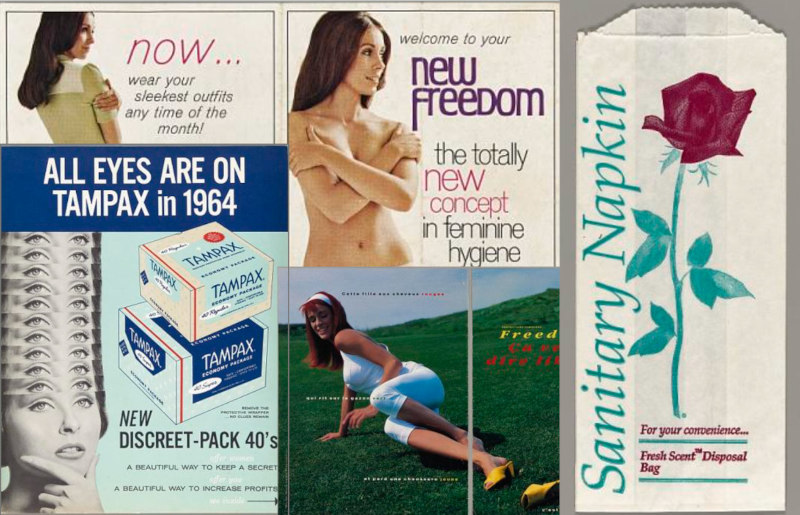
Photo credits (clockwise from bottom left): All Eyes on Tampax in 1964 (Tampax 1964: ID NMAH.AC.1586_ref549); New Freedom (Kimberly-Clark Corporation n.d.; ID NMAH.AC.1586_ref202); Sanitary Napkin Bag (n.d.: ID # NMAH.AC.1586_ref212); Confetti Pads (1988: ID # NMAH.AC.1586_ref443). All archival materials retrieved from The Smithsonian National Museum for American History: Museum of Menstruation Collection.
While Ames frames charismatic tech as ideologically conservative, she nuances this argument: “Charisma… can provide direction and conviction, smoothing away uncertainties and helping us handle contradictions and adversities” (2019: 24). Such a quality is particularly salient in markets saturated with (mis)information, contradicting claims, and affective charge. Take technologies in the orbit of reproductive health. The feminist self-help movement, for example, has arguably long engaged with the use of charisma in reproductive technologies.
These technologies– the consciousness-raising pamphlets, the suction-based Menstrual Extraction kit (used often for performing early-term abortions), and the speculum used to perform vaginal self-examinations in group settings– became affectively charged with feminist political potential and agency through self-help groups (Murphy, 2020). While Murphy’s work on the subject predates Ames’ work on charisma, the resonance here is clear: the technologies distributed through feminist self-help channels were often imperfect[1] , but what they promised generated an affective pull and a feminist practice oriented around a self-help “protocol”: the assemblage of “technologies, subjects, exchanges, affects, processes, and so on that make up a moment of health care practices” (2020: 25-26).
In so doing, these technological choreographies of feminist self-help– shipped and photocopied across the United States and Canada– channeled the ‘pull’ of charismatic tech, promising new ways of sharing and practicing an engaged feminist politic by means of new and reappropriated technologies, from the simple pamphlet and hand mirror to the more complex Menstrual Extractor.
Turning Feelings Into Evidence: Menstrual Tracking Apps and Menstrual Perfectability
Picking up the threads left loose by feminist self-help, FemTech offers scalable, context-responsive, technological solutions to the underfunded and underresearched domain of women’s health (Ridout et al. 2026). In this way, FemTech gestures what Murphy (2012: 2) might call a “counter-conduct” within an increasingly fraught reproductive health landscape, wherein access to medical technologies, essential procedures, and even evidence-based information is not guaranteed (see Brown 2024; John et al. 2025; Nethrey et al. 2025). While FemTech pioneers a plethora of wearable devices, digital health services, and testing kits, half of the FemTech market (projected to scale to US$60 billion by 2027) lies in menstrual tracking apps (Felsburger 2025).
Clue, one of the earlier menstrual tracking apps available to the public, among other attractive claims, vows to “anticipate symptoms before they show up”, and to “turn gut feelings into evidence” through their sophisticated in-app features, including multiple trackers for periods, fertility, perimenopause, a host of articles, and wearable device integration. Importantly, most of these features are only accessible through a paid “premium” tier.
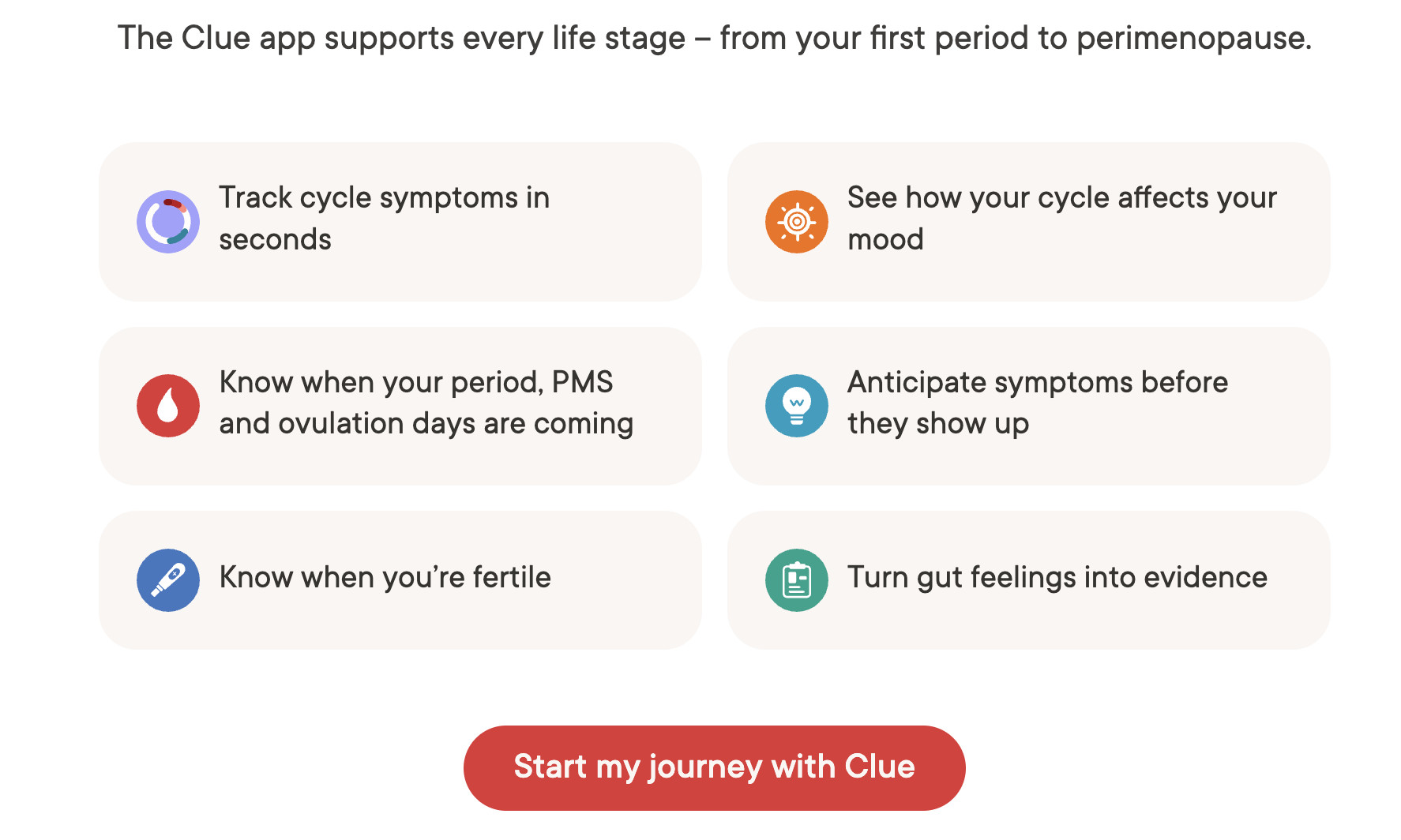
Screenshot from the Clue website. Screenshot by the author (2026).
While apps like Clue are built upon the pressure points leftover from feminist self-help, important here is a critique against the optimization or perfectibility of menstruation. Emily Martin has long made the prescient argument regarding the vision of the female reproductive system as a productive one (1991), later writing of the ways in which dominant metaphors of flexibility converge with ideals of both the healthy body and the productive worker under liberal individualism (1994). To return to the criteria of charisma from Ames (2015; 2019), these menstrual technologies rely on familiar metaphors of productivity, self-mastery, and perfectability.
Likewise, contemporary ethnographic work examines different menstrual technologies as an instrument of surveillant self-management (Ford et al. 2021) and as offering the possibility to momentarily “forget” the experience of active menstruation in organizational settings, namely work (Owen 2022). As Pichon et al. (2022) write of the “messy gaps” in their multidisciplinary review of menstrual tracking apps, much of FemTech inherits computational and moral orientations toward menstrual regularity, normativity, and concealment. In the case of Clue, as with similar menstrual tracking apps, much of the technologies’ charismatic appeal responds, with calculated friendly intimacy, to the urge to ‘take control’ of one’s cycle (and thus, one’s life) in the face of growing uncertainties, bodily or otherwise.
This use of charisma not only helps individual apps appeal to a wide consumer base despite market saturation, but it also helps smooth the jagged edge of data privacy concerns. According to a landmark report by Stephanie Felburger at the University of Cambridge, the data entered into menstrual tracking apps is not always treated as medical data and is thus not protected by existing legislation that safeguards it from sale and transfer. According to Felsburger, not only can this data be used by third-party companies for advertising purposes, but it can further be used to prosecute increasingly criminalized pregnancy termination in places like the United States (2025). Indeed, ‘gut feelings’ are turned into evidence[2] .
Charisma As Counterpoint: Charismatic Tech as a Potential Activist Tool
Within menstrual equity activism, charisma is in circulation, but differently. The menstrual technologies they distribute (including pads (disposable and reusable), tampons, discs, cups, and period underwear) take on a charismatic quality through both the ‘cuteness’ of a crochet vulva or a cowboy tampon (there is an emerging field examining the affective and political power of the ‘cute’, see Abidin 2016; Darwish 2023), but further through the quality of community—building capacity located in DIY menstrual pads. In other words, rather than vertically concentrating charisma in a single consumer product, charisma is ‘stretched’ across the products they are able to make available, using ‘cuteness’, creative representation, and community engagement.
One workshop, offered in connection with another Montreal-based menstrual equity group, offered guided instruction to making one’s own reusable pads, using leftover absorbent fabric– from old tablecloths, curtains, and the like– brought by participants.
The social media post advertising the event read as such:
Learn how to make your own reusable menstrual pad, share experiences in a welcoming space, and leave with a handmade, eco-friendly product, zero waste, zero cost.
What you’ll do:
Sew your own reusable menstrual pad
Learn how to live your period in a more sustainable and healthy way
Share your experiences in a warm, open conversation
In this short promotional text for the event, the technology (the reusable pad) is held in conjunction with the atmosphere (one welcoming, warm, and open) and the values (handmade, sustainable, and cost-effective) it espouses. Similarly to menstrual tracking apps or histories of feminist self-help, this workshop insists upon the importance of learning about one’s menstrual cycle (or how to “live your period”) as a function of the technology in question. That said, where this workshop differs is in a) the scale of charismatic promises and b) the emphasis on cultivating connection to a broader community.
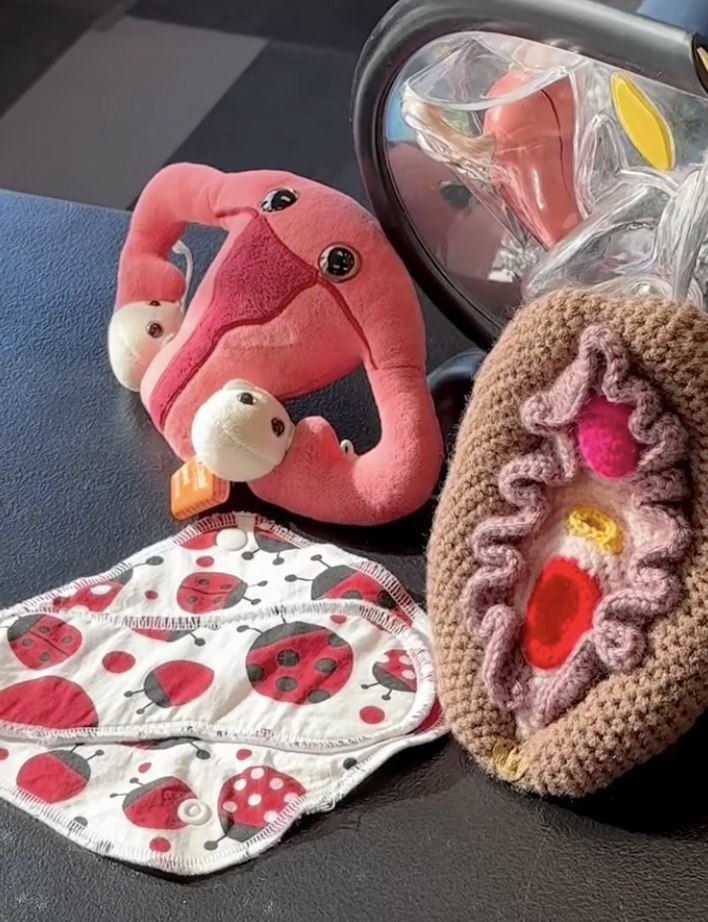
A typical Monthly Dignity workshop display, complete with (clockwise from left) a plush reproductive system, a plastic display of the reproductive system, a crochet vulva, and a reusable pad. Photo credit Monthly Dignity, used with permission
The products they distribute through workshops and community partnerships– including tampons, reusable pads, and menstrual cups– toy with charisma in what Ames (2015) names as a ‘smoothing’ of contradictions that exist within the fraught landscape of reproductive and menstrual health (mis)information (John et al. 2025) that colour activists’ experiences working with the public. Such a move exists in a complex, difficult mission to simultaneously address root causes of period poverty and intervene with evidence-based education, while acknowledging that period products are needed from one day to the next.
While this is an intentional ethical stance on the part of menstrual equity activists, it is a pragmatic one as well: When working in menstrual equity, there are never enough of the right products at the right place and the right time, despite endless efforts to make it so. In this way, menstrual equity’s own “messy gaps” (Pichon et al. 2022) of material or logistical constraints do not so much contrast the experience of menstruation, but they rather mirror its irregularity, messiness, and leakiness. Charisma emerges in their activist work both out of a) concerted effort to make “playful” a diversity of available products and b) as a byproduct of welcoming, collective atmospheres where menstrual technologies are shared, questioned, and materially produced.
By harnessing charismatic power (through anthropomorphized design or calculated intimate messaging, for example) distributors of menstrual technologies (both market-based and activist) aim to cut through the layers of misinformation or market saturation that have come to define the reproductive tech landscape. While Monthly Dignity engages in charisma-making to navigate the discursive noise of online misinformation, taboo, and educational gaps, they move away from ultra-personalized and productive arrangement of menstrual technologies within the isolated, ideal menstrual cycle found in the market-driven domain of FemTech. Rather, they move towards building active engagement with reproductive health research, the political stakes of menstrual equity, and the fact of one’s own menstrual cycle, by way of a reusable pad made or a sticker shared
Notes
[1] The risks of this data classification are already manifesting among consumer publics: Flo, a popular menstrual tracking app, was sued in a class-action lawsuit for sharing user data– including information about periods, pregnancy, and miscarriages – with companies like Facebook (now Meta) and Google. While Flo, Google, and Meta maintain no fault, they settled with the Federal Trade Commission for a combined USD$56 million in 2025 (Stempel 2025).
[2] The Menstrual Extractor, for example, could only assist in very early-term abortions, and they required a number of persons with training to administer the procedure (Murphy 2020).
This post was curated by Contributing Editor Clarissa Reche and reviewed by Contributing Editor Danielle Dilkes
References
Abidin, Crystal. “Agentic cute (^.^): Pastiching East Asian cute in influencer commerce.” East Asian Journal of Popular Culture 2, no. 1 (2016): 33-47.
Ames, Morgan G. “Charismatic technology.” In Proceedings of the fifth decennial Aarhus Conference on Critical Alternatives, pp. 109-120. 2015.
_______. The Charisma Machine: The Life, Death, and Legacy of One Laptop Per Child. MIT Press, 2019.
Darwish, Maria. “Fascism, nature and communication: A discursive-affective analysis of cuteness in ecofascist propaganda.” Feminist Media Studies 25, no. 2 (2025): 443-463.
Felsburger, Stephanie. The High Stakes of Tracking Menstruation. Minderoo Centre for Technology and Democracy, 2025. https://www.mctd.ac.uk/wp-content/uploads/2025/06/The-High-Stakes-of-Tracking-Menstruation.pdf
Ford, Andrea, Giulia De Togni, and Livia Miller. “Hormonal health: Period tracking apps, wellness, and self-management in the era of surveillance capitalism.” Engaging Science, Technology, and Society 7, no. 1 (2021): 48.
John, Jennifer N., Sara Gorman, David Scales, and Jack Gorman. “Online misleading information about women’s reproductive health: a narrative review.” Journal of General Internal Medicine 40, no. 5 (2025): 1123-1131.
Martin, Emily. “The egg and the sperm: How science has constructed a romance based on stereotypical male-female roles.” Signs: journal of women in culture and society 16, no. 3 (1991): 485-501.
_______. Flexible Bodies. Beacon Press, 1995.
Murphy, Michelle. (2020). Seizing the Means of Reproduction: Entanglements of feminism, health, and technoscience. Duke University Press.
Owen, Lara. Stigma, sustainability, and capitals: A case study on the menstrual cup. Gender, Work & Organization 29, no. 4 (2022): 1095–1112.
Pfender, Emily J., Kate Tsiandoulas, Stephanie R. Morain, and Leah R. Fowler. “Hormonal contraceptive side effects and nonhormonal alternatives on TikTok: A content analysis.” Health promotion practice 26, no. 3 (2025): 407-411.
Pichon, Adrienne, Kasey B. Jackman, Inga T. Winkler, Chris Bobel, and Noémie Elhadad. “The messiness of the menstruator: assessing personas and functionalities of menstrual tracking apps.” Journal of the American Medical Informatics Association 29, no. 2 (2022): 385-399.
Ridout, Alexandra E., Andrew Shennan, and Eugene Oteng-Ntim. “FemTech and the future of women’s health: from innovation to equity.” The Lancet Obstetrics, Gynaecology, & Women’s Health 2, no. 1 (2026): e70-e74.
Sanabria, Emilia. “The body inside out: menstrual management and gynecological practice in Brazil.” Social Analysis 55, no. 1 (2011): 94-112.
Shearston, Jenni A., Kristen Upson, Milo Gordon, Vivian Do, Olgica Balac, Khue Nguyen, Beizhan Yan, Marianthi-Anna Kioumourtzoglou, and Kathrin Schilling. “Tampons as a source of exposure to metal (loid) s.” Environment international 190 (2024): 108849.
Stempel , Jonathan. “Google, Flo Health to pay $56 million in period tracking app privacy case.” Reuters, 25 September 2025. https://www.reuters.com/sustainability/boards-policy-regulation/google-flo-health-pay-56-million-period-tracking-app-privacy-case-2025-09-25/
