“The Grid. A digital frontier. I tried to picture clusters of information as they moved through the computer. What did they look like? Ships? Motorcycles? Were the circuits like freeways? I kept dreaming of a world I thought I’d never see. And then, one day I got in…” Kevin Flynn, Tron Legacy
In Autumn 2008, while studying in Athens, I happened to attend an event called Error Code. The event’s poster lured me in as it depicted a Nintendo Game Boy connected to another electronic device and a keyboard. During the event, the three performers played their chiptunes – compositions which they had created live on Game Boy. Although the overall umbrella term for chiptunes would be electronic music, they all had very distinct styles, ranging from noise to electropop.
After the event, talking to Bubblyfish and Tonylight, the two main performers (Sally Zero had to return home soon after his performance as he was underage!) I was introduced to chipmusic and its scene: online communities, netlabels, visual performers, musicians and sound artists, a whole network of creatives which would often physically materialize in events across the world, such as Error Code. That night I returned home and went straight online on my computer to catch a glimpse of the chipscene: 8-bit graphics and sounds flooded my brain and I started wondering what does the chipscene world look like – both online and offline. Years later, I recognized the feeling of wanting to explore the digital social in Flynn’s words: what does the chipscene ‘grid’ look like and how can I get in?
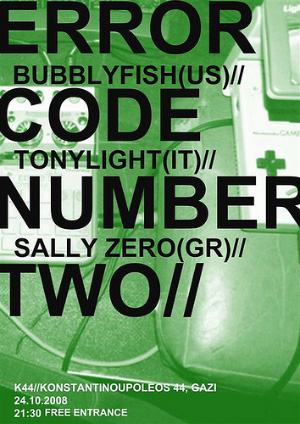
Events like Error Code allowed me to get into the world of chiptune. Image from representative flyer collected by the author.
Fast forward a year later, I found myself pursuing a DPhil, which is what a PhD is called at the University of Oxford with the aim to research chipmusic and its scene. My focus was on creativity as shaped by technological processes, such as the use of specific technologies for the production, consumption, and promotion of music, as well as networked processes, for example, feedback through the chipscene network and collaboration across geographical boundaries facilitated by online communities and netlabels. The work of Brinner (2009) on musicians’ networks across borders, Born (2005) on mediation, Gell (1998) on agency, Crossley et al. (2014) on social network analysis and music worlds, and Miller and Slater (2000) on ethnographic approaches of the internet were pivotal for my methodological steps.
Entering the Grid
The chipscene is a highly dynamic network of composers engaged in the making of musical artifacts using predominantly 1980s platforms such as the Commodore 64, Atari ST, Amiga, and the Nintendo Game Boy or their digitally simulated soundchips on modern computers. The scene is characterized by a DIY ideology whereby sharing knowledge and practice is central and facilitated by internet technologies. The aim of composers is to manipulate and hack (physically or metaphorically exploit functions) technologically limited devices to create music. Know-how is shared in online communities, YouTube videos, and offline workshops, as well as in mutual exchanges between composers.
The chipscene is a participatory culture comprised of prosumers. Composers share their chiptunes for free in online communities such as chipmusic.org, micromusic.net, and until its demise, 8bitcollective.org. It is expected that the audience, comprised of other composers and fans, will reciprocate by offering feedback on the music creations. This is seen as an act of balanced reciprocity, offering composers ‘chipscene credibility’ by boosting the number of comments on their profile and showing that the audience is engaged in a discussion, as well as valuable expert feedback to improve one’s skills and musical output.
Chiptunes are distributed objects for two reasons: firstly, they can be altered by other composers in different temporalities and spatialities by means of remixing, editing and sampling (particularly if these are shared as .mod files that can be directly manipulated). The collective action for the production of a chiptune is not reducible to individual creativity as it presupposes interaction, stimulation, and influence that comes from various social agents. Re-using another creator’s work, whether it is an audio sample or an entire composition, is an accepted practise in chipscene, provided the original creator is credited. This stems from the free/ open source ideology shared in the demoscene, the hobbyist computer subculture which emerged in the 1980s from which the chipscene branched off. Within the chipscene there is internal policing and obligation to publicly report any incidents that go against habitus and re-use previous creations without seeking permission or crediting the original work. There are dedicated sections called ‘Hall of Shame’ in online communities that aim at identifying the original work and the amount of plagiarism in the new version by another artist Goto80’s post on his Chipflip blog illustrates a few examples. The collective action for the production of a chiptune is not reducible to individual creativity as it presupposes interaction, stimulation, and influence that comes from various social agents.
Secondly, chiptunes’ agency generates new social and affective connections. Chiptunes, as distributed objects, are an extension of personhood, connected to a multitude of affective meanings as Koskela et al. (2025) have showed, ranging from personal nostalgia e.g. childhood memories, to cultural ‘ersatz’ nostalgia, lived experiences, personal impact, situated contexts and traditions, among others. In this sense, chiptunes function as vehicles of meanings that manifest differently from person to person depending on their lived experiences.
The chipscene grid is therefore, a vast network of prosumers, digital artifacts, knowledge, exchange, and social connections. There are various data sources that can provide insight into where chipmusicians are with various degrees of accuracy. For example, Micromusic.net, the oldest online community and netlabel in the chipscene, features a user-generated map since its early days of existence in 2000. Although this depicts dense concentration in Europe and North America, there are a few cases of trolling with users placing their location on Antarctica or other inhabited areas on the planet. Similarly, Erin McQuisten of Chiptune Wins created a Google Map showing any known chip artists in the world, which was certainly a more accurate map, but did not include any up-and-coming artists who were lesser known.
So, how do we depict the anthropological field of the chipscene – this vast online and transnational network of human and non-human agents, chiptune agency, meanings, and interactions?
Visualizing the Field
My fieldwork consisted of multi-sited research online and offline to enable me to delve into composers’ discourses and understand the patterns of meaning embedded and entrenched in the chipscene. Burrell (2009) sees the fieldsite as a network and in her research she found that observing customer interactions through the Internet Café in Accra was not enough to understand the role of the internet in everyday life. As I discovered later, focusing on either the digital or physical field would mean that the chipscene story would be partial.
During physical fieldwork, I followed a group of film-makers who were shooting a documentary on the European chipscene, Europe in 8 bits in France, Spain, and Germany. Snowballing brought me to other European countries: England, Belgium, the Netherlands, Italy, Sweden, and Greece. While in the physical field, I was involved in canonical ethnographic activities such as participant observation and deep hanging-out, assisting the filming crew of Europe in 8 bits, learning how to make chiptunes in workshops, and interviewing my interlocutors. Fieldwork in Europe helped me develop the knowledge of which local scenes were actively influential in the chipscene, and I was later able to follow this discourse when I communicated with composers in other local scenes in the world, such as Malaysia, Japan, and the USA.
Digital fieldwork consisted of following chipmusic networks as manifested in social media and four online communities: micromusic.net, chipmusic.org, noisechannel.org, μCollective.org. I engaged in discussions and interviewed my digital interlocutors, thus discovering themes such as intellectual property issues, aesthetic ideologies, the creative process, and the sense of belonging in the scene. I further collected quantitative data such as number of chiptune releases by netlabel and composer, events, and activity on Twitter (now X) using #chiptune, #chipmusic, #chiptunes, #fakebit, #8-bit music, #micromusic, which where the most commonly used hashtags at the time. Finally, I used databases created by others, such as Videogame Musicians, Chipartists and Visualists (2013) compiled by Chiptunes=WIN, the chipmusician database from Europe in 8 bits, and the Chiptune world database moderated by composer Sycamore Drive. These sources offered accurate information regarding composers’ geographical location.
My overarching aim was to develop a holistic understanding of the chipscene, visualise my field, and depict information flows. Where ethnography unveiled the micro-structure of the chipscene, social network analysis unfolded the cross-cultural macro-structure. The primary challenge was to merge the two perspectives to create a mixed methods approach. I employed two processes to help with this: (a) the quantification of ethnographic data by creating a method for statistical analysis of the chipscene and (b) qualitative work on refining quantitative data that were seemingly inaccurate (such as trolling on maps, or zero online activity in specific locations).
Location was the one constant that allowed for a macro-view of the chipscene network, and this was translated into specific countries in which chipscene had digital or physical manifestations e.g. online composers’ releases or online / local events. As such, countries became nodes to the one-mode chipscene network I visualized, and edges depicted relational phenomena – the information flows of chipscene agency. A link to the interactive chipscene network is here.
Concluding Thoughts
Similarly to many of my interlocutors I was born in the 1980s and grew up in an extended middle class family that was able to afford the luxury of videogames. My aunt bought me my first Nintendo Game Boy with a Tetris cartridge while my parents and grandparents gifted me various games in the years that followed. At the same time, I was engrossed by music and engaged in learning musical theory as well as playing the piano. Game Boy aesthetics and sound appealed to me as they were highly futuristic – a link to the future. I was deeply enchanted by its technology and experienced Game Boy as a vehicle of futuristic meaning which showed the potential of technology: in Flynn’s terms, a new digital frontier where technology, play, and sound are all at the core of the DMG-CPU (Sharp LR35902), the 8-bit processor used in the original Game Boy.
This idea remained the same when I encountered the chipscene in 2008 with one slight change: chipmusic-making revealed the affordances of now-obsolete technology and the potential of creativity when presented with technological limitations. Further to this, it appeared that 8-bit aesthetics seem to belong in the past, present, and the future as through chiptunes they become timeless and relevant, a distributed object in time and space. These theoretical ideas as well as the passion of the composers about 8-bit rawness, experimentation, and community building where the reasons why I embarked on this research journey.
The chipscene network visualization was a snapshot of the chipscene grid, this digital frontier that I entered for the period of time of fieldwork. Data reflected the period between October 2011 and November 2013 and demonstrated the interaction and influence of local chipscene hubs in driving chipmusic consumption. The chipscene, however, ebbs and flows depending on the interest and motivation of its prosumers. It would be certainly interesting to understand what drives or hinders this activity.
This post was curated by Contributing Editor Iván Flores and revised by Clarissa Reche.
References
Born, Georgina. 2005. “On musical mediation: Ontology, technology and creativity.” Twentieth-century music 2, no. 1: 7-36.
Brinner, Benjamin. 2009. Playing Across a Divide: Israeli-Palestinian Musical Encounters. Oxford University Press.
Burrell, Jenna. 2009. “The Field Site as a Network: A Strategy for Locating Ethnographic Research”. Field Methods, 21(2), 181-199.
Crossley, Nick, McAndrew, Siobhan, Widdop, Paul. 2014. Social Networks and Music Worlds. Routledge.
Gell, Alfred. 1998. Art and Agency. Oxford University Press.
Koskela, Oskari, Kai Tuuri, and Jukka Vahlo. 2025. “Aesthetics of Fondly Reminisced Chiptunes.” Journal of Sound and Music in Games 6.4: 41-73.
Miller, Daniel and Slater, Don. 2000. The Internet: An Ethnographic Approach. Routledge.
