In spring of 2024, when green buds had already begun to appear even though light flurries were still falling in Rochester NY, I was slumped in the folding chair in my apartment, surrounded by dissertation books, the pigment tests, maquettes, and preliminary drawings for an upcoming exhibition in Beijing that October. Ever since I started graduate school, the gentle dilemma of being both an artist and a scholar has colored my days, as a tension that persists but always in the happiest ways. The room was quiet, the light soft, and my attention drifted between thinking, reading, and the pull of artwork I had not yet begun. Almost without intention, my finger moved across my phone, again, returning to the familiar drift of scrolling that has become an ordinary part of contemporary life. I opened Xiaohongshu (Red Note, the Chinese social media App) and typed four characters, sculpture factory (雕塑工厂, diaosugongchang), into the search bar, looking for workshops near Beijing and the adjacent city of Yanjiao in Hebei Province, hoping to locate production sites and people who might help accelerate the work for the exhibition when I returned in the summer.
Short clips appeared, showing hands mixing resin, lifting molds, striking metal with hammers, or polishing the 3D printed surface. I scrolled slowly, tapping the small red hearts as if acknowledging each gesture, or the star icons as if marking possible contacts for later. What I assumed would be a simple search for fabrication sites became the beginning of something else, a digital path that extended from my living room in upstate New York into factories I had never visited in China.
As more videos surfaced, I realized that the platform’s algorithm was also shaping this path, bringing more clips of sculpture factories even when I drifted to unrelated content in beauty tutorials or political news. The recommended sculpture factory videos shared some familiar patterns, similar to other types of feeds (for example cooking tutorials, clothing try-ons, and home DIY videos) where clips with higher engagement are replicated across accounts, forming clusters of similar but not identical scenes. For instance, some sculpture factory clips followed a patterned shooting sequence. The factory owner introduced the workshop as if selling a product, then shifted to a single sculpture and described its waterproof or weather resistant properties, and finally explained its commercial function. Throughout these clips, sculptural workers continued their tasks in the background.
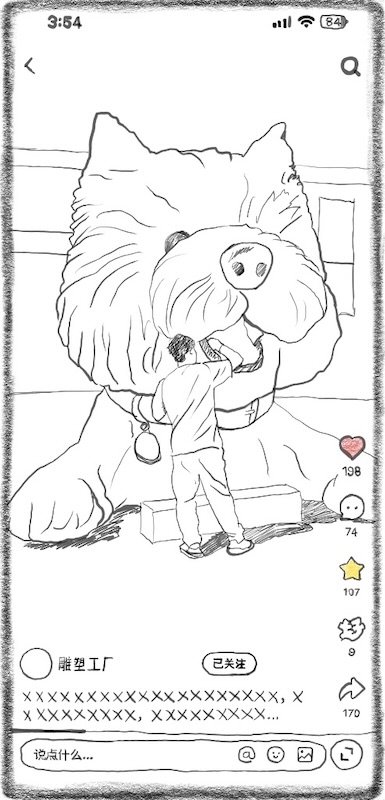
A drawing by the author based on a Xiaohongshu screenshot of a sculpture factory scene, in which an anonymous worker applies pigment to the tongue of a dog sculpture, 2025. Image by author.
China has been considered the “factory of the world” since the 1980s (Lee 1998; Pun 2016). As contemporary Chinese art and real estate speculation have emerged as domestic and global phenomena, the employment of migrant workers, craftspeople, and fabricators to produce monumental artworks on the shop floor has become widespread (Yao 2008). Until the early 2010s, sculptural labor in China remained largely tactile: artists and workers shaped clay by hand, carved stone with chisels, and welded metal using power tools. But, as in many other fields, advances in digital technology soon transformed the workflow, with more artists and workshops adopting 3D scanning, 3D printing, and modeling software such as Rhino or ZBrush to collaborate with or partially replace traditional sculptural processes.
Since the launch of the “Made in China 2025” national policy, which aims to upgrade China’s manufacturing sector through automation, digitalization, and advanced materials, 3D printing and digital fabrication have been identified as key areas of intelligent manufacturing (PRC State Council 2022). As these technologies gained strategic importance, tools such as modeling softwares, scanners, and computer numerical control (CNC) machines began to significantly reshape sculpture production and other forms of aesthetic fabrication, fields that sit at the margins of these technological initiatives. Owners of sculpture factories, as well as the workers themselves, have also begun producing online videos on various social media platforms to promote their art-making businesses, a phenomenon that aligns with what media scholar Lin Zhang calls “internet-based entrepreneurial reinvention” (Zhang 2023).
What these clips revealed was not simply information about fabrication sites but a glimpse into how migrant labor becomes both visible and obscured in contemporary sculpture making. The workers who appear in these videos often remain unnamed, folded into the generalized figure of the “craftsperson,” even when their gestures anchor the production itself. This erasure is reinforced by the logic of the creative economy, in which promotional videos foreground technical virtuosity as the factory’s selling point, granting subjectivity to the machines and workflows rather than to the people who operate them. This dynamic forms part of what I call the stratified digitality of making, in which different layers of mediation shape how the factory becomes perceptible in digital space.
By stratified digitality in the context of sculpture production, I refer to the layered ways digital technologies and platforms organize visibility: the tactile act of scrolling that frames the viewer’s access, the scripted self-presentations factories craft for online circulation, and the increasingly standardized digital workflows, from modeling software to computer numerical control (CNC) machines, that structure production behind the scenes. These layers do not operate separately. They fold into one another, shaping how the factory and its workers come into view long before one ever steps inside the physical factories. In doing so, these mediations redefine what sculpture production means for artists, factory producers, and potential clients, as touch, vision, and labor move across screens and shop floors.[1]
To illustrate what I mean by the porosity of these layers, I begin with the interface closest to my own body as I watched these videos. By porosity, I refer to the way these layers of digital mediation bleed into one another rather than remaining distinct. The first point at which digitality became perceptible was the surface of the touch screen, the interface that met my index finger before any worker, tool, or material did. For me as an artist, rather than the resistive tactile nature of working clay or stone, the initial contact was with a smooth, friction-managed surface designed for browsing. For a sculptor’s hand this contact carries a particular dissonance. In Chinese, the term sculpting (雕塑 diaosu) joins diao (雕) the subtractive gesture of carving material away, with su (塑), the additive gesture of building form. These terms name a way of knowing that is grounded in pressure, resistance, and gradual transformation at the surface of matter. Although my hand was no longer performing diao or su, the embodied knowledge these gestures carry still shaped how I watched the videos. What had once been a tactile understanding of sculpting became, in this context, an evaluative framework, a way of judging whether a factory might serve as a viable collaborator or vendor.
A second layer of digitality emerged in the factories’ self-produced promotional videos. These clips follow a recognizable platform logic. They emphasize efficiency, scale, and technical capability, while workers appear only partially or peripherally. Keywords such as “3D print,” “fiberglass,” “monumentality,” “solidity,” “texture,” and “accuracy” circulate insistently, framing sculpture making as an optimized workflow rather than a haptic craft. Such optimization is a rhetorical strategy. By presenting sculpture making as a seamless sequence with no hesitation, error, or material resistance, these videos flatten the contingencies that normally accompany artistic work, from failed experiments to the need to redo or revise. Hours of labor are compressed into a minute-long montage in which all possible failure is edited out, producing the flawless flow characteristic of contemporary platform aesthetics. These videos also stage sculpture for the viewer, drawing attention to the object’s technical perfection while pushing workers to the margins of the frame. For potential clients, including viewers like myself, this visual smoothing conveys the sense that the factory’s capabilities exceed those of individual artists, making the factory appear not only reliable but technologically superior, and therefore economically desirable as a collaborator.
A third layer emerged only as I engaged more fully with the aesthetic and technical staging that underpins the sculpting workflow, something I could discern through my long experience in artmaking. As production shifts from manual processes to digital ones, the transformation remains uneven but unmistakable. In this changing terrain, workerly skill is often obscured by the enduring figure of the “genius-artist” and the structures of authorship that organize artistic labor (Barthes 1977; Bourdieu 1987, 1993; Foucault [1969] 1998), intensifying patterns of deskilling and reskilling under technological change. Embodied craftsmanship becomes displaced by interface-based control, including computer-aided design (CAD) modeling, computer numerical control (CNC) machining, scanning, and touchscreen manipulation.
Digital technologies also introduce new forms of fragmentation across networks of specialized workshops. A large sculpture might begin as a clay maquette shaped directly by the artist, then be scanned and converted into a digital file at a modeling studio, sent to another workshop for CNC milling, and later transported again for surface finishing, assembly, or painting. While the artist’s hand might remain central in the initial shaping of clay, subsequent stages rely heavily on technicians and digital operators whose sensory and creative decisions guide the work through a chain of machine mediated processes.
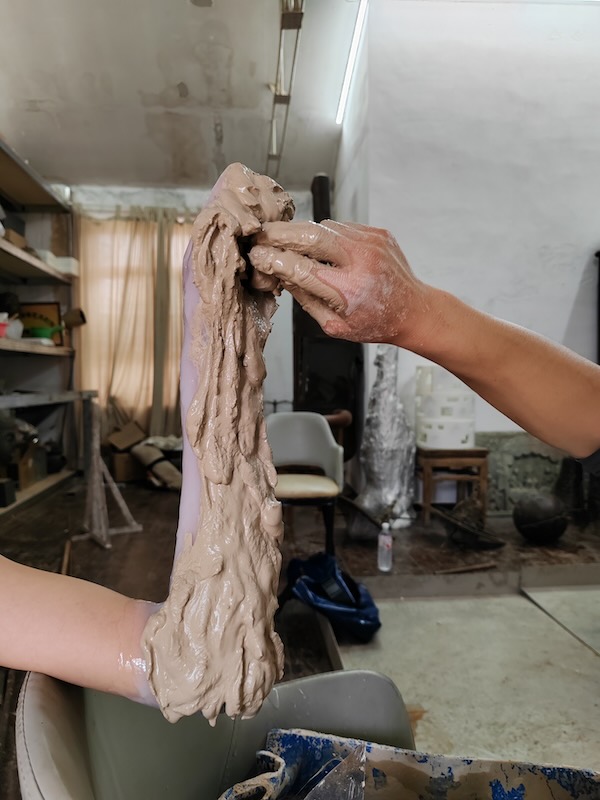
The process of making a mold of my left hand in a casting workshop in Beijing, 2024, Image courtesy of the author.
Yet despite the abstraction introduced by these workflows, the body never disappears. Workers calibrate machines through touch, correct surfaces through repeated sanding, and attune themselves to the sound, texture, and smell of materials. This became especially palpable when I arrived at a factory on the outskirts of Beijing in July 2024 and needed to cast my arm and hand for my sculpture Sweet Temptation at Your Fingertips. In midsummer in a wax room beyond the Sixth Ring Road in the northeastern periphery of Beijing, surrounded by heat and mosquitoes, I sat still while a wax worker Wu swept thin coats of translucent silicone onto my arm. The thought flashed that it might irritate my skin, yet the brush had already reached my arm before I could get a question out. Wu then applied lumps of plaster one by one to build a shell, so that a mother mold could be made, and later used to make wax models and casted into bronze. As the layers hardened, my arm grew heavy, and my fingers could no longer lift themselves. The factory before me echoed the digital scenes I had scrolled through, yet it also diverged from them in ways the platform could not anticipate. My finger path became the movement of my entire body, and my index finger itself was fixed into material, no longer scrolling but immobilized within the mold.
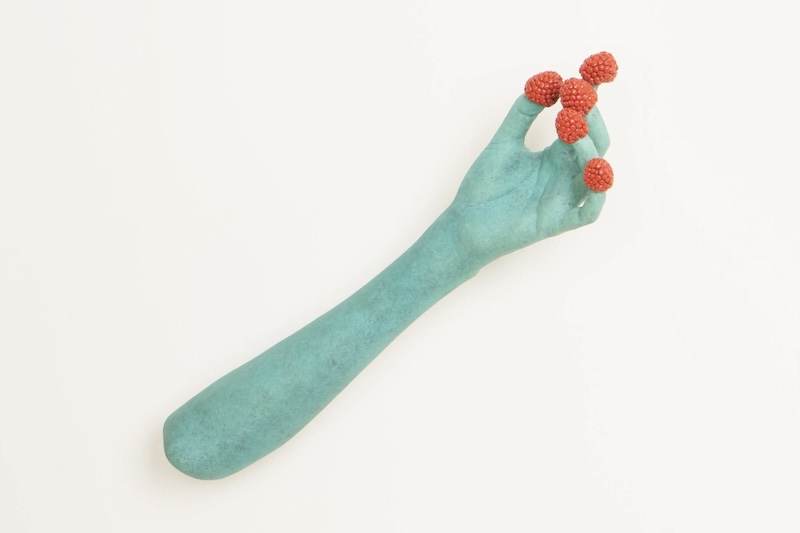
*Sweet Temptation at Your Fingertips*, 2024, bronze with hand coloring and electroplating, 16.9 × 4.3 × 5.5 in, edition of 3+1AP, Image courtesy of the author, Renee Yu Jin
As an artist-ethnographer who maintains a sensibility toward material practices and actively cocreates sculptures with workers, I straddle the roles of researcher and participant, observer and maker, and writer and subject. As an ethnographer, I first encountered the factory through a digital field, meeting workers, tools, and workflows through the small screen long before I met them in person. As a visual culture scholar, I read these circulating images through the lens of platformization and its entanglement with touch. And as an artist, I imagined the digital representations while also preparing to rely on hand skills, sensory judgments, and at times my own body to bring a sculpture into being.
Long before I stepped into any workshop, the factory had already appeared to me as a layered digital formation. The weeks of scrolling, searching, and watching did not precede the ethnographic encounter so much as constitute one of its sites, shaping what counted as the factory and how it could be known. Yet once I entered the physical spaces, the sensations of heat, weight, material resistance, and collaborative making returned with force. My index finger that had initiated this search through scrolling became something else entirely, no longer a vehicle of digital access but a part of the sculpture’s material process. Only there, in the workshop, could my hand truly make, even as the digital impressions that preceded it continued to frame what I saw.
This post was curated by Contributing Editor Wanqing Iris Zhou.
Notes
[1] The sensory dimensions of sculpture making extend across a complex division of labor, with different workers encountering different tactile, auditory, and thermal registers. Platform videos collapse these heterogeneous sensations into a single visual surface optimized for clarity and speed. This flattening resembles what STS scholars describe as vision-centered objectivity, in which visual representation substitutes for the embodied, multi-sensory labor that produces it.
References
Barthes, Roland. 1977. “The Death of the Author.” In Image-Music-Text, translated by Stephen Heath. Fontana Press.
Bourdieu, Pierre. 1987. Distinction: A Social Critique of the Judgement of Taste. Harvard University Press.
Bourdieu, Pierre. 1993. The Field of Cultural Production: Essays on Art and Literature. Columbia University Press.
Foucault, Michel. (1969) 1998. “What Is an Author?” In Aesthetics, Method, and Epistemology, edited by James D. Faubion, translated by Robert Hurley and Others. The New Press.
Lee, Ching Kwan. 1998. Gender and the South China Miracle: Two Worlds of Factory Women. University of California Press.
PRC State Council. 2022. Made in China 2025 (English Translation). Translated by Etcetera Language Group, Inc. Center for Security and Emerging Technology. https://cset.georgetown.edu/wp-content/uploads/t0432_made_in_china_2025_EN.pdf.
Pun, Ngai. 2016. Migrant Labor in China. Polity Press.
Yao, Pauline J. 2008. In Production Mode: Contemporary Art in China. Timezone 8.
Zhang, Lin. 2023. The Labor of Reinvention: Entrepreneurship in the New Chinese Digital Economy. Columbia University Press. https://doi.org/10.7312/zhan19530.
