In January of 2026, I found myself as an instructional assistant in a fifth-grade English Language Arts class, where I would work with small groups to improve students’ writing. I developed a system where I would reward my students with one piece of candy in exchange for one essay. The system worked out great, but it soon reached a point where students would ask me for candy in the halls without an essay. One day, Kay[1] , a strong yet uninterested writer, asked me for a Jolly Rancher. I asked if she had an essay for me. Kay giggled and asked, “Can I use ChatGPT to write it?” Her tone conveyed sarcasm, implying that if she used ChatGPT to write the essay, she would not have to do the work to get the reward. By telling this joke, she already knew what my answer would be. I was taken aback. How does a fifth grader already know about ChatGPT and its social problems? It seems obvious now, but at the time, I just said “no, you are not allowed to use AI to write your essays.” Kay giggled and skipped away, confirming that she knew using ChatGPT was never an option in the first place.
After that moment, I began to pick up on how the students at my school talked about generative AI. They would call obvious computer-generated art “AI slop.” They would use the same phrase to insult each other over less-than-intelligent thoughts. For example, Robert was chastised by his peers for suggesting they copy each other’s essays to save time. Calvin called the idea “AI slop” because it was low-effort and unimaginative. These students even went so far as to reject the use of AI in the classroom, insisting that they don’t need it. I have already observed the deep disdain of this technology. During a lesson on Dr. King’s “I Have A Dream” speech, I was helping students formulate their thoughts for the activity. They had a rainbow of construction paper strips, and they had to write dreams that they had for themselves, their families, their friends, and their community. One of the most recurrent dreams was that they dreamt of a future without AI and without data centers in their community. Out of curiosity, I asked my students why they wrote this. Many stated that AI was taking up our water. Others said that AI made people stupid. My first thought was that they were repeating what they have heard from the adults in their lives. But I caught myself and realized something important: there is growing tension between children as passive recipients and children as capable agents.
Around the same time this activity took place, there was a growing movement within San Marcos against data centers. It was a social issue that seemed to capture the whole town. Because of the town’s proximity to the San Marcos River, a hallmark of the town, AI companies began to eye open lots for a data center. Many residents were outraged, eventually leading to a mass protest against any construction related to data centers. The Data Center Action Coalition worked to get San Marcos City Council to pass a law banning data centers within city limits. This law was passed citing the cost of resource loss in the community (Ma, 2026). The attitude that pushed for a ban on data centers in San Marcos also extended to the town’s youth, raising awareness of the consequences of AI.
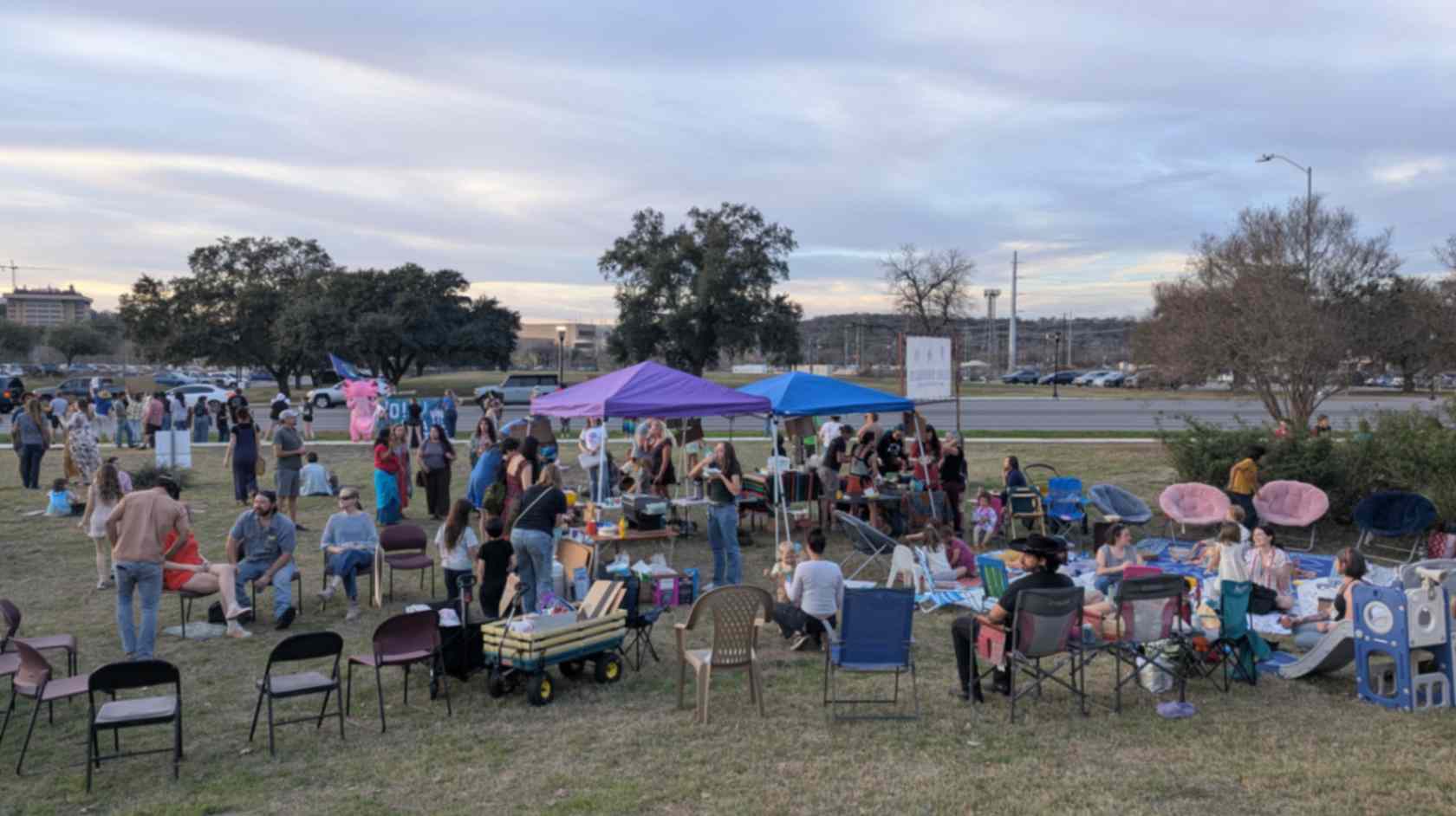
A community gathering in San Marcos brings residents together around the local data center debate, while a local mom group hosts activities for young children in the background. The gathering illustrates how debates over data center development extend into everyday community life. Photo taken by author.
Young students reject AI as culture-making, instead portraying the technology as something cringy or even lazy. When the AI narrative is framed as the only gateway to a perfect future, how are children positioned in the conversation of the AI future? Students being so critical of AI contradict the messaging many AI companies deploy. For example, Dario Amodei of Anthropic claims that AI will reshape the future of governance and education as its use will be integrated into every aspect of social life (Amodei, 2026). Sam Altman of OpenAI claims that “children today will never be as intelligent as AI” (Abram, 2025). In my own fieldwork while researching AI philosophies among entrepreneurs, I was consistently met with narratives of sociotechnical imaginaries (Jasanoff & Kim, 2009) meant to benefit the “future generations”, such as biomedical advancements beyond our current capabilities or space colonization to expand humanity’s reach (Naser, 2025). Yet these grand narratives rarely pause to ask what children themselves make of the futures being imagined on their behalf. Corsaro (2012) argues that children actively contribute to cultural production, change, and peer cultures while being constrained by existing social structures. This is what he calls interpretive reproduction. The main problem with these frameworks is that children are not viewed as autonomous decision-makers but rather as dependent beneficiaries of an AI future.
Han et al. (2024) observed that student agency among children ages 8-12 diminishes when using generative AI as a writing tool. Students lose interest and copy-and-paste the output into their Word document. As a result, there were concerns over the implementation of AI tools in the classroom. But we already see this in action. This year, the Salamanca City Central School District (a rural district in western New York located on the Seneca Nation reservation) announced plans to introduce a humanoid AI robot named Sally. Sally was developed by Realbotix and meant to be integrated into classrooms this fall, alongside a companion AI teacher’s assistant program and an AI-powered at-home tutoring tool. The robot was intended to support students and teachers in STEM classes rather than take over instruction (Manno, 2026). However, the backlash against this implementation was swift and brutal. State officials, teachers, and local residents all raised concerns, especially over Realbotix’s production of hyper-realistic sex bots. There were additional concerns over student data and privacy. In response, the district paused the rollout to work through the potential downsides. Teachers argued the initiative could be a first step toward replacing human educators, while district officials maintained that no robot could truly replace a human in a school setting. AI is pushed as the path to a perfect utopia while the children that would hypothetically benefit from this utopia see this technology as something forced upon them.
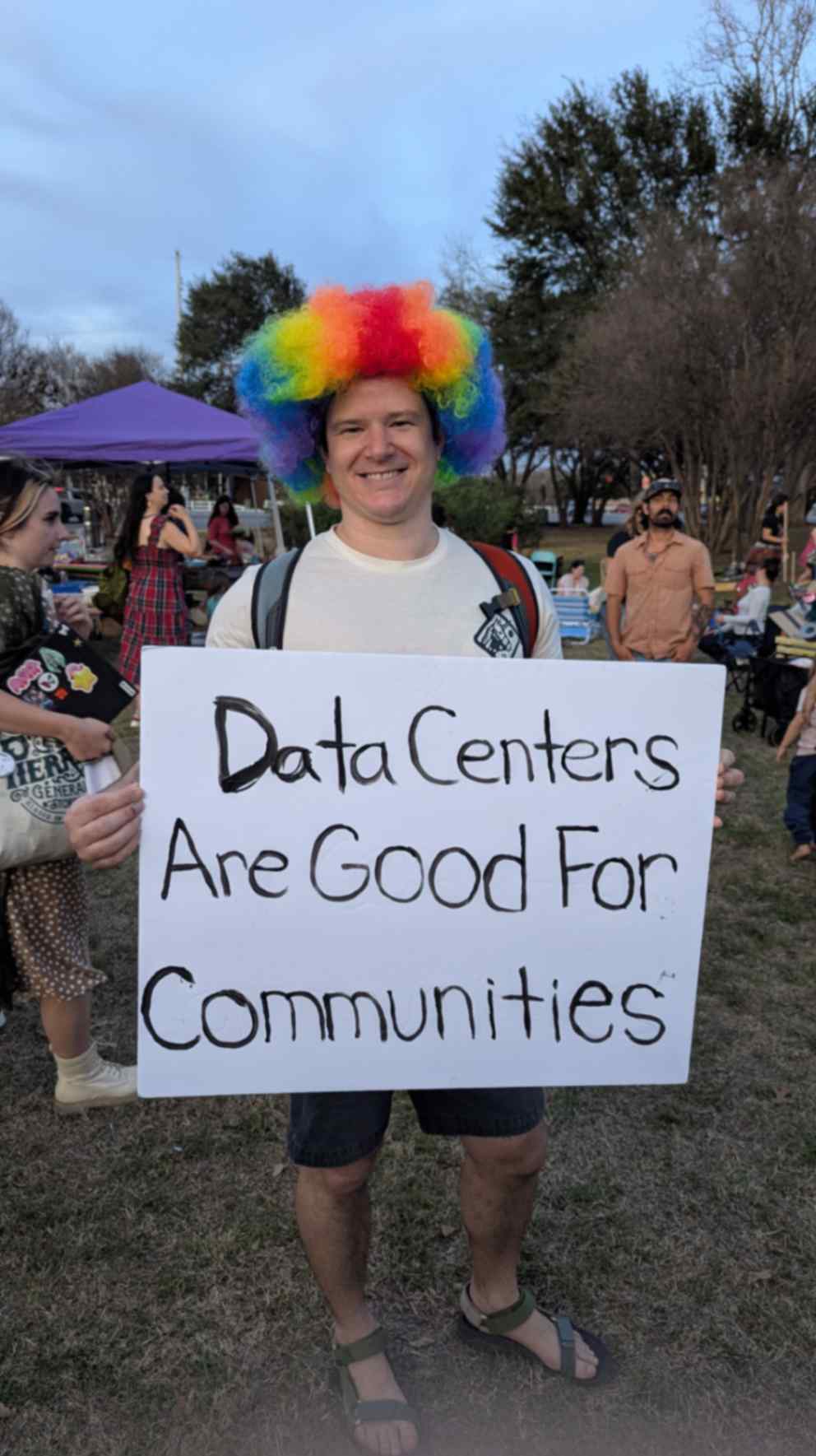
A participant holds a sign supporting data centers, illustrating the competing perspectives surrounding data center development in San Marcos, Texas. Photo taken by author.
Students are not rejecting or embracing AI wholesale; they are making distinctions. Kay saw ChatGPT as a tool to offload an unwanted task, a shortcut around effort she didn’t want to expend. Meanwhile, the students who reject AI graphic generations as “AI slop” make an aesthetic and intellectual judgment, using the term as a synonym for a lack of creativity. My students were actively evaluating AI’s role and utility rather than absorbing it uncritically. This complicates the assumption that children are passive recipients of a technological future being built for them. Education policy is actively being shaped by the potential of an education in and conducted by AI rather than considering the students they are pushing this upon. If a ten-year-old can distinguish between AI as a convenience and AI as a marker of unimaginative thought, then she is already doing the interpretive work that adult policymakers and tech executives assume she is incapable of. Today’s adult frameworks of AI fail to anticipate that children can hold complicated, or even inconsistent, positions about a technology.
Notes
[1] All names of students are pseudonyms.
This post was curated by Contributing Editor Sameeha Vardhan and reviewed by Contributing Editor Kanikka Sersia
References
Abram, C. 2025. “Sam Altman Shows Me GPT-5… and What’s Next.” YouTube video. https://www.youtube.com/watch?v=hmtuvNfytjM.
Amodei, D. 2026. “The Adolescence of Technology.” Darioamodei.com. https://darioamodei.com/essay/the-adolescence-of-technology.
Associated Press. 2026. “New York School Pauses Plan to Deploy Humanlike AI Robot Teacher after Backlash.” NPR, July 29, 2026. https://www.npr.org/2026/07/29/g-s1-136072/ai-robot-teacher.
Boulhrir, T., and M. Hamash. 2025. “Unpacking Artificial Intelligence in Elementary Education: A Comprehensive Thematic Analysis Systematic Review.” Computers and Education: Artificial Intelligence, 100442. https://doi.org/10.1016/j.caeai.2025.100442.
Corsaro, W. A. 1993. “Interpretive Reproduction in Children’s Role Play.” Childhood 1 (2): 64–74. https://doi.org/10.1177/090756829300100202.
Han, A., X. Zhou, Z. Cai, S. Han, R. Ko, S. Corrigan, and K. A. Peppler. 2024. “Teachers, Parents, and Students’ Perspectives on Integrating Generative AI into Elementary Literacy Education.” https://doi.org/10.1145/3613904.3642438.
Jasanoff, Sheila, and Sang-Hyun Kim. 2009. “Containing the Atom: Sociotechnical Imaginaries and Nuclear Power in the United States and South Korea.” Minerva 47 (2): 119–146.
Ma, Kate. 2026. “San Marcos Becomes the First Texas City to Ban Data Centers, Testing Its Local Control.” The Texas Tribune, June 30, 2026. https://www.texastribune.org/2026/06/30/texas-san-marcos-data-center-ban-zoning-laws/.
Manno, M. 2026. “Rural NY School to Launch Humanoid Robot Teacher.” New York Focus, July 14, 2026. https://nysfocus.com/2026/07/14/new-york-humanoid-robot-teacher-salamanca-school-district.
Naser, M. 2025. “The Future Is Here: AI Philosophies among Central Texas Entrepreneurs.” Master’s thesis, Texas State University.
