To what extent do measurements from an electroencephalography headset provide evidence of the aesthetic contemplation state of the person wearing it?
In the 2015 neuroaesthetic research project Action Potential, the art and science Interspecifics collective monitors the brain electrical activity of a group of visitors to an exhibition about Octavio Paz, the famous Mexican poet, and uses these measurements as material for sound composition. What is discovered in this experiment is not exactly a scientific result, since the EEG readings neither validate nor refute any hypothesis about aesthetic experience, but it is also not art in a conventional sense, as it depends entirely on clinical measurement protocols. This ambiguity is the point because by submitting aesthetic encounter to empirical instrumentation, Interspecifics lays bare the assumptions that usually keep the two domains apart with science requiring falsifiable propositions and art resisting reduction to data. What emerges at their contact surface is a productive friction instead of a synthesis, a mode of inquiry that measures and composes without limiting expression, taking us to reconsider what counts as knowledge and what counts as form.
Upon closely examining the results of this experiment, one might pose questions about the categorization of phases of bioelectrical activity, about how boundaries are drawn between a state of attention and other possible states, or whether these boundaries are the same for all people. None of these questions has a straightforward answer, and it is not because the experiment was poorly designed, but because the framework it operates within does not provide the mediums to resolve them. It is this very difficulty in responding that is most revealing about the situation. It seems that the knowledge produced there is a kind of hybrid, resulting from the confrontation between disciplines without belonging exclusively to any one of them.
This text stems from that tension and arises from reflection on the production of knowledge in art-science, particularly from two workshops in which the author participated — first as a participant and later as a facilitator — organized by the collective Interspecifics within the framework of collaborations with the (now defunct) Alumnos 47 foundation in June 2015 in Mexico City, and with the Museum of Modern Art and the Pontifical Catholic University in Santiago, Chile, in March 2024.
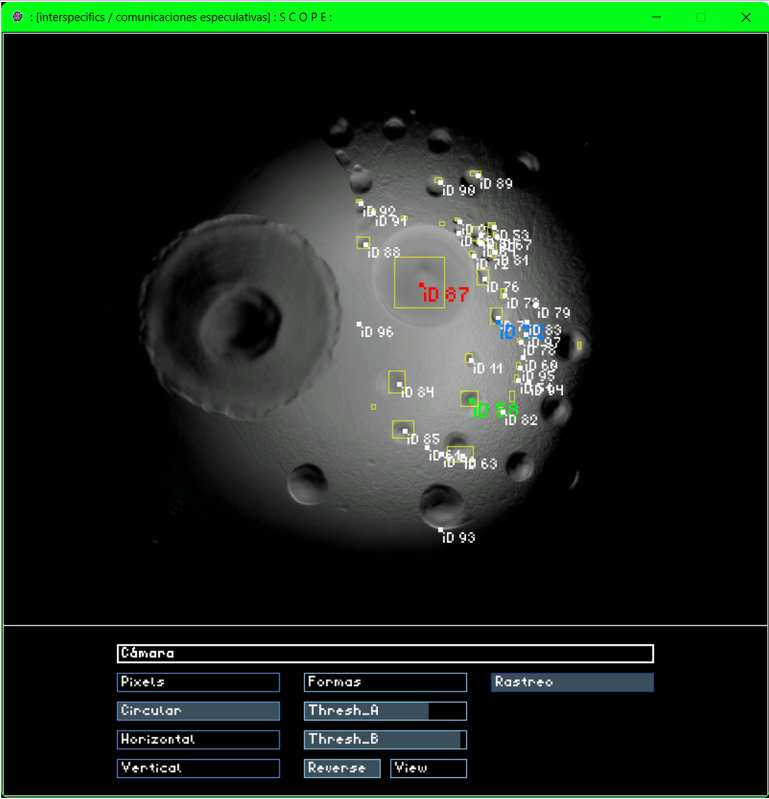
Image 1. The open software Scope tracks the displacement of three regions of a Paenibacillus Vortex colony. The XY plane trajectories are used to control parameters of a sound synthesizer. Original image by Emmanuel Anguiano-Hernández.
The first of these, called BioSensing Lab, brought together artists and interested individuals through an open call to develop methodologies for exploring sonic and visual perceptual phenomena through monitoring electroencephalographic activity and biofeedback. The central tool was the commercial NeuroSky Mindwave headband, a wireless EEG headset that uses a single dry electrode on the forehead, with which they sought to study changes in EEG activity induced by exposure to visual and auditory stimuli, and simultaneously, to collectively create new representations linked to or modulated by the signals recorded by that same device.
The first session began with an introductory talk by Dr. Alejandro Torres García, a specialist in biosignal processing and analysis, on the fundamentals of electroencephalography, a safe, non-invasive test that measures and records the electrical activity of the brain using small sensors attached to the scalp, and its applications. The headband was presented there along with its proprietary software, which allows visualization of brain activity but does not release the data for any other use. The open alternative is a set of tools developed by free software communities, and it did allow redirecting the measurements in real time to work with them freely. This distinction, seemingly technical, turned out to be the first political decision of the workshop: choosing which tool to use meant determining the type of knowledge that would be possible to produce. Even what an audience can witness, interpret, or contest depends entirely on what the chosen tools make visible and to whom. The proprietary program, by confining data to its own visualization interface, forecloses the hybridity the workshop sought, by permitting observation but not reinterpretation, and producing something that looks like science but has no openness and looks like art without freedom. The open software tools, by making the signal available for redirection, restored the possibility of that in-between space.
With both options on the table, the participants carried out a series of collective experiments to familiarize themselves with the system’s operation. Using a virtual reality headset which displayed a 360° visualization with colorful textures and a soundscape, changes in each participant’s brain activity were observed before and after putting it on, as well as during breathing exercises. The goal was not only to learn to read the signals but to recognize in them the features of one’s own electroencephalographic activity in different states. Once that recognition was achieved, the participants organized themselves into teams according to their interests and proposed prototypes of artistic interpretations and devices to develop. This collective authorship was only possible because the open tools had left the data available for reinterpretation, transferring from the instrument to the participants the authority to determine what the signals could mean.
The second session was dedicated to the implementation of those prototypes, which had to to use the activity measurements not merely to observe brain activity but to feed back into it, making a biofeedback loop, designing experiences capable of nudging participants toward calmer or more alert states. The work was collaborative, integrating each participant’s experience and objectives. The resulting prototypes were briefly presented at the workshop’s closing:
- A sound synthesizer that modulated an audio signal using a wave whose frequency varied according to EEG activity in specific bands.
- An activity monitor that recorded the user’s concentration during rhythmic-musical coordination exercises with physical instruments.
- A particle network visualization whose color and connectivity varied according to activity in the bands associated with alertness and cognitive processing states.
The second workshop, BioExploraciones, had a different structure and duration, and was part of a research residency carried out at the Museum of Modern Art in Santiago in collaboration with the Microbiology Laboratory of the Pontifical Catholic University of Chile and Federici Lab. It brought together artists, scientists, and students to develop experimental methodologies for observing and analyzing microscopic life forms, particularly Paenibacillus vortex, a recently discovered bacterium, studied using open hardware tools, computer vision, and machine learning. The resulting analyses were to be incorporated into individual composition and performance processes.
The first two sessions reviewed the fundamentals of a sound synthesis system; the third introduced the biochemical bases of culturing and microbiological behavior. The last session was dedicated to demonstrating the operation of an open-hardware microscope and the open-source software Scope, which would function as the workshop’s translational tool.
Scope translates the representation of one phenomenon into another of a different nature, recoding the activity of a microorganism colony into numerical values representing change and movement. It does this in three ways. The first quantifies the color composition frame by frame, measuring where and how much the image sequence of the video changes; in microscopic recordings, this can indicate how a culture grows, colonizes space, and transforms over time. The second identifies all occupied regions in the sequence, offering an approximation of the number of colonies or individuals present. The third tracks the movement of specific entities, providing information about their motility, trajectory, and interaction with other entities.
As in any recoding process, some information is excluded from the description of the phenomenon due to the tool’s use. The causes of the colony’s transformations, as well as the intrinsic meaning of those changes (that is, what they mean for the colony itself), are left out of the measurement and the rest of the process. To create a manipulable model of the phenomenon, it is necessary to simplify it. Seeing and measuring are operations that do not precede interpretation but constitute it from the outset.
With these tools, the participants developed individual projects based on their own interests:
- The sonification of the decomposition process of tree trunks in a natural environment.
An audiovisual system that recodes the organization and displacement of a bacterial colony into a three-dimensional network-structured visualization. - An audiovisual composition that applies the same computational principles to recordings of atmospheric phenomena — such as a meteor shower — and microbiological activity, creating analogies between radically different scales.
- The sonification of the activity of bacterial colonies with susceptibility to magnetic fields, including Earth’s. The projects were presented in an ephemeral exhibition in a room at the Museum of Modern Art.
Describing these retrospectively places me in a position where it is not easy to separate lived experience from distant past interpretation. But perhaps that discomfort is precisely the most honest starting point.
The first thing that emerges as a reflection is the centrality of devices in configuring what is possible to know. In BioSensing Lab, the EEG headband and its proprietary software represented a concrete obstacle: its closed interface does not release the information, so accessing the data literally involves hacking the system. This action is, in itself, a political stance. If one wants to use a product for purposes other than those it commercially offers, it is first necessary to become aware of everything it conceals, very likely intentionally, and then turn to specialized communities, such as open-source developers, to rely on free and shared knowledge. One might then ask: how much information and how much knowledge are excluded when we use a technical product due to commercial decisions?
In BioExploraciones, in contrast, the central tools — that is, the microscope and its Scope software — are entirely open, developed by Interspecifics in collaboration with Federici Lab. This openness does not eliminate mediation but rather reveals it. What the system translates and what it discards is neither transparent nor neutral; it is the result of design decisions that condition which aspects of the phenomenon become visible and manipulable.
Both workshops also share a constant negotiation arising from the heterogeneity of their participants. The languages of each discipline come into confrontation, each person’s interests follow different directions, and the modes of doing determine that the results are hybrid and borderline objects: they function across different disciplines without fully belonging to any one. The nature of these results remains in a kind of epistemic limbo. Are they aesthetic objects, scientific hypotheses, or instruments of artistic interpretation? All three?
And then there is the question of the audience. In BioSensing Lab, the only witnesses were the workshop participants themselves, although some of them continued the inquiry and incorporated the results and methods into their practices. In BioExploraciones, the presentation was more open: the audience consisted of the participants’ own invited guests. How many of those people somehow grasped the disciplinary hybridity present in what they saw/heard? Were they witnesses to an art event, a science event, or something for which we still do not have a comfortable name?
Art can dispense with justifying itself. But these points of encounter between art and science seem to precisely highlight that moment of rupture: the question of for whom knowledge is produced and who has access to it does not disappear simply because the piece is in a museum gallery. The ephemeral condition of these exhibitions says something about the particular temporality of art-science knowledge: it exists in the event and does not necessarily aspire to accumulation. Whether that is a statement, a limitation, or both at once is perhaps what is still worth continuing to ask.
This post was reviewed by Contributing Editor Iván Flores and Multimodal Contributing Editor Eva Steinberg.
