I was picking up an order on 67th st and Columbus Ave when I saw the guy get on my bike and start to ride away. I got out of the shop and grabbed him; he said, “Sorry, I thought it was my bike.” A friend helped me hold onto him so we could call the police. The guy tried to break free and reached into a DoorDash bag he was carrying… Suddenly, he pulled out a syringe and started threatening us with it. I let go of his shirt but kept holding onto a backpack he was wearing; eventually, he slipped out of the backpack and ran away. I called the police to hand over the backpack and the DoorDash bag (which contained multiple syringes and a knife), but they never showed up.
So, I went to the precinct at 83rd and Columbus Ave to file a report.
Once there, an officer asked why I hadn’t just thrown the stuff away. He told me I’d have to wait 30 minutes to file a report because the officers were heading out and waiting for their replacements. When an officer finally talked to me, he was very rude, asking why I had the bag and the backpack—accusing me of stealing them from the guy (the thief!). I explained that during the struggle, the thief had escaped and slipped out of them. It’s a shame that the police don’t pay attention to these kinds of things; you end up looking like the bad guy just for trying to do the right thing. And on top of everything, I was penalized by the platform because I could not deliver the order on time.
Here is the photo of the bike and the thief’s belongings.
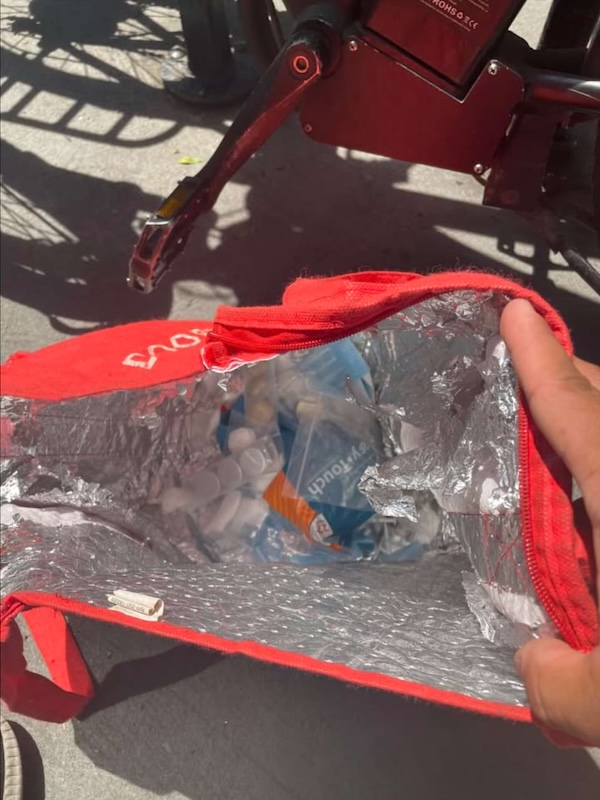
(Source: Food delivery worker, personal testimony submitted via private message to the Facebook group for delivery workers, October 3, 2024.)
Being a delivery worker means navigating risks that extend beyond the platform itself, including accidents, bike thefts, and assaults. For couriers, risk is a lived reality, embodied in daily decisions about where to lock a bike, what building to enter, or which street to avoid. Since 2020, food delivery has become a prominent form of urban labor in NYC. Delivery workers, most of them migrants and racialized workers, move on ebikes throughout the city navigating traffic, unfamiliar buildings, and public spaces for parking, often under intense time constraints. Yet institutional responses in cases of accidents and bike theft are often limited, delayed, or absent. While platforms focus on optimizing delivery flows, and governments address urban safety at a broader scale, workers feel that they are frequently left to manage the immediate consequences of violence and insecurity themselves.
In response, workers have developed their own strategies for navigating uncertainty. They draw on situated knowledge gathered through embodied experience and everyday encounters with risk. At an individual level, they make their ebikes appear older or less valuable, hide the brand and model information, avoid high-risk areas at certain times, use multiple locks or remove batteries, and install multiple GPS trackers on their bike. At the collective level, workers have turned digital platforms into a distributed network through which knowledge travels across the city.
Between 2021 and 2026, I conducted ethnographic research with food delivery workers in New York City, combining participant observation and interviews and following conversations unfolding across WhatsApp and Facebook groups. As a Mexican researcher, my relationship with this community was shaped by shared language and cultural references, but also by the trust that developed through sustained engagement in their everyday lives. I accompanied delivery workers during food deliveries, attended vigils for deceased couriers, experienced stolen bikes recoveries and spent time with them during their community watch. Here, I share some of the insights that I gained from this experience, and the way these expanded my understanding of how digital communication channels facilitate collective action and accountability among delivery workers.
Watching the City Together
As I followed delivery workers’ conversations across WhatsApp and Facebook groups, I began to see these as spaces where knowledge about the city was constantly being produced. Researchers have shown how gig workers use digital platforms to organize, build solidarity, and push back against the platforms they work for (Tassinari and Maccarrone 2020; Lei 2021; Muñoz and Martinez 2022; Zhou & Pun 2022; Grohmann, Mendonça, and Woodcock 2023; Pei 2026). Yet, the longer I followed these conversations in NYC, the more I realized that these networks were doing more than helping workers resist the platform or support one another. I began to think of these Facebook and WhatsApp groups as infrastructures (Star 1999)—networks that workers relied on to make sense of what was happening around them. Together, they formed a kind of collective map, continuously updated through everyday encounters with urban risks.
How do workers decide what knowledge to trust? A report about a stolen bike, spilled oil in the street, police activity, or an accident only becomes meaningful through a collective process of verification. For instance, when a worker reports a stolen bike, other members ask for additional details (the location, photographs, or identifying features). Workers near the reported area immediately start looking, and reporting whether they have seen the bike pass and in which direction it was moving. In this process, individual observations gain credibility through their connection to others: workers corroborate, and add to what has been reported until a shared account of the whereabouts begins to take shape. These processes of verification also explain why documenting in real time has become so popular within this community.
I first recognized this dynamic while accompanying Marco and several delivery workers during one of their regular livestreams. While streaming, Marco received a message in one of the WhatsApp groups reporting that a delivery worker had been involved in an accident. He immediately read the message aloud and asked whether anyone nearby knew what had happened or could provide additional details. “If anyone is in the area, let us know,” he said, adding that they would continue gathering information and keeping viewers updated. Over the next several minutes, messages began to arrive. Some confirmed the location of the accident, others shared photographs, while workers nearby described what they could see on the ground.
In this way, livestreams transform observation into publicly visible evidence beyond the physical location where the streamers are at. Phrases such as “we are here with the thief” establish credibility through presence and direct observation. When Marco, one of the group’s founders, told me “we are the ones who see reality; we are the ones who are on the street,” he pointed to the value workers place on firsthand observation as a source of credible knowledge.
Deciding Together
As I continued following these conversations, I noticed that workers were making decisions together. When practical or ethical uncertainties emerged, workers turned to WhatsApp groups to ask for advice, weigh different perspectives, and negotiate what should be done. Should someone confront a suspected thief or should they wait for the police to arrive? Should they leave an abandoned bike alone or take it home to secure it while trying to locate the owner?
For instance, after encountering an injured courier whose bike was at risk of being stolen, a worker sought guidance in the WhatsApp group. Members debated possible responses, weighed the risks, and offered recommendations. By turning to the group, the worker recognized the collective as a legitimate source of judgment. Workers distributed responsibility for action across the network rather than leaving it with a single individual.
These interactions suggest that communication infrastructures can become spaces of collective governance (Kelty 2009; Gillespie 2009). Rather than simply facilitating communication, they help workers negotiate responsibilities, establish shared expectations, and produce forms of moral judgment. The same digital networks that allow workers to see what is happening across the city also become spaces where they decide how to respond.
Claiming a Place in the City
Moreover, these infrastructures contribute to the formation of collective identities. Through livestreams and other public forms of communication, delivery workers construct narratives that challenge dominant representations of migrant gig workers. Rather than depicting themselves as isolated workers managed by digital platforms, participants foreground practices of mutual aid, protection, and collective responsibility. For example, one day a group of food delivery workers decided to clean the Willis Bridge. The bridge is part of the everyday infrastructure of their work and is crossed by many of them that live in the Bronx and go to work in Manhattan. Marco and Miguel livestreamed the cleanup, explaining that they wanted to contribute to the city by caring for a place they relied on every day. At the same time, they used the livestream to call attention to the bridge’s poor lighting and ask the city to improve it to reduce the risk of robberies. These spaces, thus, operate as sites where workers articulate alternative understandings of labor, migration, and community, while simultaneously producing a shared sense of belonging.
What Workers Build Together
These observations extended the way I understood the role of digital platforms in delivery workers’ lives. Through them, they produce knowledge about the city, exchange resources, negotiate responsibilities, care for one another, construct public identities.
Platform labor is often understood through the systems that manage workers: algorithms, ratings, GPS tracking, and apps that coordinate the movement of people and goods. Yet, workers also repurpose these same digital arrangements for purposes that platforms did not necessarily intend. The infrastructure built to distribute labor across the city becomes, in workers’ hands, an infrastructure for solidarity, knowledge, care, and collective life. What began as an interrogation into how delivery workers respond to risk became a broader question about what people build around the platforms that organize their labor.
This blog post is part of the Future of Work Series. This post was curated by Contributing Editor Kanikka Sersia, and reviewed by Contributing Editor Seon Shim.
References
Arriagada, A. (2023). The gig economy in Chile: Examining labor conditions and the nature of gig work in a Global South country. Digital Geography Society.
Baldry, K., Koekemoer, E. & Chantal, O. (2026). The Pursuit of Decent Work in Precarious Contexts: Motorbike Delivery Riders’ Psychological Experiences. Journal of Career Assessment.
Bonhomme, M & Muldoon, J. (2025). Racism and food delivery platforms: shaping migrants’ work experiences and future expectations in the United Kingdom and Chile. Ethnic and Racial Studies. 48. 1-24.
Chan, J. (2021). Hunger for profit: how food delivery platforms manage couriers in China. Sociologias. 23. 58-82.
Gillespie, T. 2018. Custodians of the Internet: Platforms, Content Moderation, and the Hidden Decisions That Shape Social Media.
Huang, H. (2023). “The Food Delivered is More Valuable Than My Life”: Understanding the Platform Precarity of Online Food-Delivery Work in China. Journal of Contemporary Asia, 53(5), 852–868.
Iazzolino, G., Celoria, E., & Varesio, A. (2026). The Algorithmic–Bureaucratic Precarization of Migrant Food Delivery Workers in Italy. International Migration Review, 60(1), 181-203.
Kelty, C., M. 2009. Two Bits: The Cultural Significance of Free Software. Duke University Press.
Lei Y-W (2021) Delivering solidarity: platform architecture and collective contention in China’s platform economy. American Sociological Review 86(2): 279–309.
Muñoz KM and Martinez AD (2022) Self-organization among delivery platforms workers in neoliberal Latin American countries. The cases of Peru and Chile. Journal of Labor and Society 25: 299–328.
Pei, L. (2026). Making a global gig workers’ movement meaningful locally: Friction in activists’ everyday strategies. New Media & Society, 28(8), 3863-3879.
Rafael Grohmann, Mateus Mendonça & Jamie Woodcock (2023), “Communication and Work From Below: The Role of Communication in Organizing Delivery Platform Workers” — this is probably the single most important citation for your paper.
Star, S. L. (1999). The Ethnography of Infrastructure. American Behavioral Scientist, 43(3), 377-391.
Tassinari A and Maccarrone V (2020) Riders on the storm: workplace solidarity among Gig economy couriers in Italy and the UK. Work, Employment and Society 34(1): 35–54.
Yohanna Sánchez, D., Maldonado, O. J., Agudelo-Londoño, S., Hernández, M., Hernández, L. J., Suárez-Morales, Z. B. (2024). Infrastructuring platform delivery work: exclusions, coercions and resistance in delivery platforms’ migrant work in Bogotá, Colombia. Tapuya: Latin American Science, Technology and Society, 7(1).
Zhou Y and Pun N (2022) Affording worker solidarity in motion: theorising the intersection between social media and agential practices in the platform economy. new media & society 26(8): 4885–4903.
