In Season 2 of the show Ramy, two Muslim American men perform umrah (the minor pilgrimage to Mecca) while sitting in an Atlantic City hotel room. Ramy is known for its bold and subversive humor in the way it addresses Muslim American identity and experiences. In this episode, two of his friends wear VR headsets. One of them, Mo, tearfully embraces the wallpaper, which his goggles have transformed into the Ka’ba, Islam’s holiest site. His friend Ahmed whispers, “It’s a miracle, subhanallah,” then adds, “and you don’t have to worry about your sandals getting stolen at the haram!”
Ahmed’s joke about germs and stolen sandals acknowledges the absurdity. Mo’s tears—while also absurd—demand that we take the scene a bit more seriously. Can a pixelated Ka‘ba elicit immanence (divine copresence) or does it mostly just parody a sacred ritual? If time resists digitization even as space becomes malleable (McGlotten 2013, 46), and “time is not a semiotic isolate” (Agha, 2007, 320) how might the concept of chronotope, the intrinsic connection between time and space be useful in thinking about religious practice and the digital? Through this seemingly absurd example of a VR pilgrimage, we might better understand the notion of chronotope as it relates to the digital and how, through affect and copresence, the sacred becomes immanent (and perhaps transcendent) in new configurations, even as time “resists” digitization.
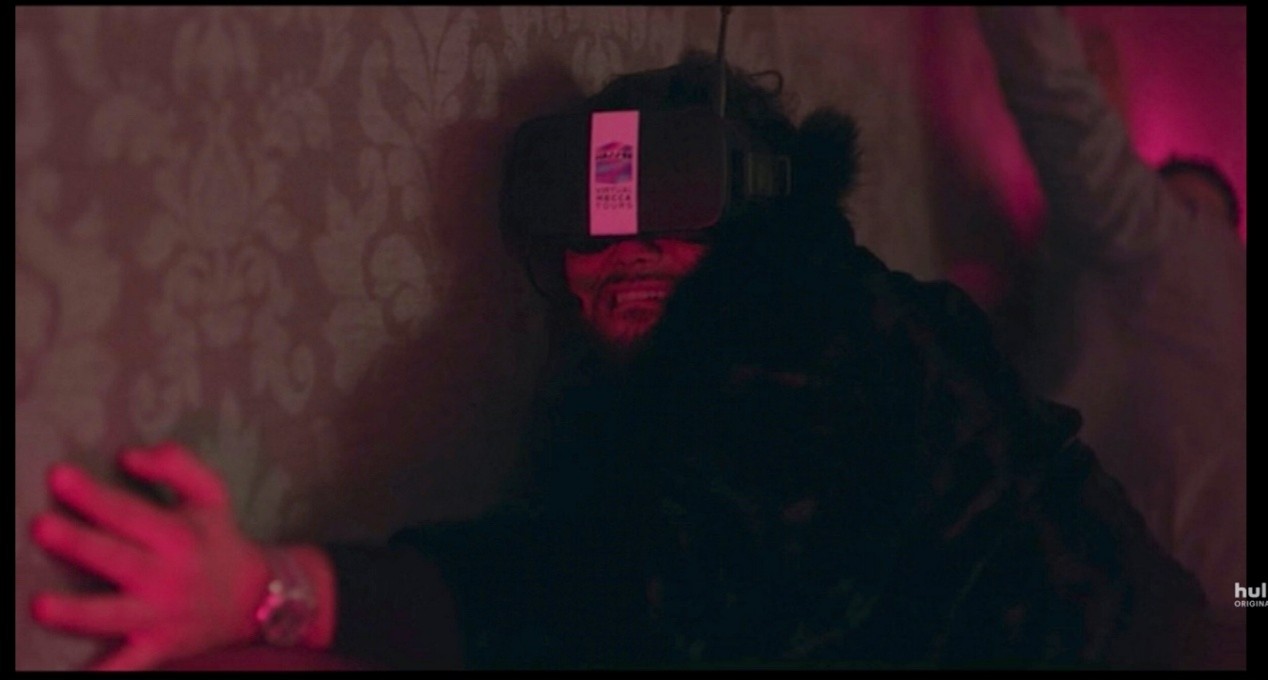
Mo (Amer), embracing wallpaper in the Atlantic City hotel room while on a virtual reality ʿumrah to Mecca, Ramy, Season 2, Episode 7, 2020. From: PLATFORM: ʿUmrah in Atlantic City: The Representation of Muslim-American Space in Ramy [1]
Ahmed’s joke about germs and stolen sandals acknowledges the absurdity. Mo’s tears—while also absurd—demand that we take the scene a bit more seriously. Can a pixelated Ka‘ba elicit immanence (divine copresence) or does it mostly just parody a sacred ritual? If time resists digitization even as space becomes malleable (McGlotten 2013, 46), and “time is not a semiotic isolate” (Agha, 2007, 320) how might the concept of chronotope, the intrinsic connection between time and space be useful in thinking about religious practice and the digital? Through this seemingly absurd example of a VR pilgrimage, we might better understand the notion of chronotope as it relates to the digital and how, through affect and copresence, the sacred becomes immanent (and perhaps transcendent) in new configurations, even as time “resists” digitization.
Ahmed (with VR headset): “It’s a miracle, subhanallah”
Mo (with VR headset): “Subhanallah indeed, and you don’t have to worry about your sandals getting stolen at the haram”
Ahmed: “Hajj with all the germs? I can really come around to this”
I want to think through this scene with help from several scholars. Shaka McGlotten’s (2006) work on queer virtuality through his autoethnographic research about dating apps helps us understand how intimacy operates as a force that exceeds normative scripts, producing forms of connection that are both excessive and unpredictable (including the “failure” of digital pilgrimage). Aisha Beliso-De Jesús developed the concept of “copresence” in relation to her practice and study of Santería (2015); it refers to the felt, embodied multiplicity of beings present in, on, and around the body and affords us a way to take Mo’s tears seriously while holding space for the scene’s absurdity. Copresences are sensed through chills, shivers, premonitions, and yes—tears. They are felt in the body. Mo’s body in that hotel room, for example, becomes a site for sacred copresence. Agha (2007) and Das (2008) offer linguistic anthropological tools for understanding these phenomena: Agha shows how mediated interactions produce “recombinant” selves across multiple chronotopes, while Das shows how diasporic Tamil communities in Montreal “reformat” time-space rules by scaling linguistic and social boundaries to stake claims about their identities. The VR umrah similarly reformats the pilgrimage chronotope, compressing spatial distance while maintaining temporal distance.
Intimacy, Virtuality, Immanence
Media and digital anthropology have long examined how technologies reformat social practices and power structures. In religious contexts, digital platforms can destabilize notions of presence, belonging, and divine encounter. In Virtual Intimacies (2013, 11), McGlotten frames the virtual as a site of “immanence” or a “structure of feeling” where intimacy operates as a “contact zone of psychic, social, and political energies.” For McGlotten, intimacy is “always already virtual”: it names the connection itself, the feeling of belonging or nonbelonging, of being touched or left untouched.
McGlotten draws on Deleuze’s concept of immanence or the idea that the divine isn’t transcendent, hovering above everyday life, but immanent, or folded into it. This may be different from how many Muslims might understand divine immanence, where Allah’s presence is both transcendent as well as immanent. But the overlap here is generative in that both of these frameworks locate the sacred within and through affective experience to some extent.
In Ramy, Mo’s tears index an affective intensity that suggests digital immanence: the VR Kaʿba, though simulated, elicits a kind of embodied devotion. McGlotten’s concept of queer virtuality further supports this, proposing that digital encounters always expand rather than diminish intimacy (p. 11). This expansion of virtuality and intimacy through digital chronotopes occurs through affect. VR does not introduce mediation where there completely was none but rather alters its form. The Atlantic City hotel room in Ramy becomes an unexpectedly sacred space: materially mundane (or even profane) yet affectively charged. The humor in Mo and Ahmed’s exchange (“Hajj with all the germs?”) acknowledges the presence of VR’s artifice while acknowledging what it offers relief from. As McGlotten notes, intimacy is somewhat “scripted” by “diverse and sometimes contradictory” power relations like the technological, economic and religious infrastructures that enable VR umrah.
The VR headset contracts physical distance but cannot replicate the sensorial affective valences of umrah in Mecca—the feeling of crowds of people whose shoulders press against yours, the warmth of the bright desert sun in the morning or the coolness of the nights with giant beams of floodlight coming from overhead, the sound of people reciting prayers, the glare of phone screens with Facetime calls or prayer apps open. As Mo embraced the Ka’ba, he may have felt his skin pressed against the virtual Ka’ba/Atlantic city hotel wallpaper, but he did not feel the velvety black fabric or take in its actual rosewater musk scent. And yet, Mo’s visceral reaction suggests that the feeling of connection transcends the medium’s constraints. It still seemed to be a moment of humility, gratitude and deep connection to God.
Pilgrimage Is Always Mediated
Pilgrimage in Mecca is mediated by crowds, by distance, by the limits of bodies that can’t always press through to touch the Ka’aba, or the black stone (a sacred relic). VR expands this mediation but also helps us remember that affect is the throughline when it comes to religious practice and that sacred presence materializes through practices of attention, orientation, and affect. A sajdaga is another example of space-travel similar to VR (Ahmad, personal communication, 2025). A sajdaga is a small clay tablet that Shia Muslims often use during daily prayers. These tablets are usually made from soil taken from Karbala, the site of Hussain’s martyrdom. When a Muslim presses their forehead to that clay, they are touching a place that is both physically elsewhere and spiritually here. The timing of the prayer remains contingent on the position of the sun in the sky, but the tablet transports a person across place through this ritual.
Both VR technology and sajdagas are technologies of sacred mobility and presence, though one is digitized and the other is analog. Digital intimacy is linked to past social practices. Networks are “systems of interconnectivity” but also “symbols for, or actual embodiments of, real world power and control” (p. 6). Digital intimacy is also not inherently liberatory; it exists within larger structures that shape possibilities for connection and exclusion (p. 49). It is embedded in broader anxieties about technology disrupting “normal” life and older versions of ritual practices.
Beliso-De Jesús writes about what she calls “technorituals” or the use of media technologies as extensions of ritual space. In her work on Santería, she notes that “spirits like screens.” Video is a conductor for the orisha’s energy. Similarly, the VR headset in the Ramy example is a conductor for divine presence, affective intensity, or a kind of divine co-presence. The binary between “in-person” and “digital” collapses through affect.
Chronotope and the Limits of Virtuality
Mikhail Bakhtin’s concept of chronotope describes the intrinsic connectedness of temporal and spatial relationships. Traditional umrah is deeply chronotopic in that it is anchored to Mecca’s fixed coordinates, tied to lunar time, and entered through the ritually-specific physical state of ihram. VR umrah disentangles the ritual from those chronotopic coordinates. Mo and Ahmed perform it anywhere and anytime.
But time resists digitization in ways that space does not. As McGlotten puts it, “entering into a virtual world does not also mean one enters a virtual, otherworldly time even if the experience of time appears to contract or expand. A day does not suddenly become twenty-six hours, and there are only so many hours a day in which one can play the game” (2013, 46). Space bends in VR. Time holds firm. Mo’s tears occur in real time, as real as any pilgrim’s tears in Mecca. The hotel room’s “now” and the Ka’ba’s present coexist in tension.
Beliso-De Jesús’s concept of copresence helps us sit with this tension. Copresences, she writes, “undo linearity and show up in the form of a past that is not past.” They traverse time. The Ka’ba is both a historical site and a living presence. Mo’s VR headset lets him see the Ka’ba, but it cannot transport him to Mecca’s time, the rhythm of communal worship, of collective effervescence. He is stuck in Atlantic City’s time, even as he virtually moves through Mecca’s space.
Linguistic anthropology offers tools for understanding this process with greater precision. Agha (2007) shows that chronotopic representations are always experienced within participation frameworks, and that mass-mediated chronotopes create “recombinant selves” through cross-chronotope alignments (326-327). Mo’s VR experience is an example of a recombinant self; his diasporic Muslim self remains in Atlantic City while his affect is oriented toward Mecca. Das (2008) adds that ideologies and practices are “reformatted” through spatiotemporal scaling and the boundaries between linguistic forms, interlocutors, and contexts (2). The VR umrah reformats the chronotope of pilgrimage, compressing spatial distance while maintaining temporal distance.
Diasporic Assemblages and “Failure”
Beliso-De Jesús rethinks diaspora as an assemblage with a focus on connections, disruptions, intensities, and feelings. Diasporas are shaped by power, by money, by racial and sexual politics. Thinking with the concept of assemblages helps us see intensities, conflicts and contradictions.
The Ramy scene is a kind of diasporic assemblage. It brings together Atlantic City, Mecca, VR technology, Muslim American identity, and the specific histories of pilgrimage as a practice shaped by colonialism, capitalism, and transnational mobility. Mo and Ahmed’s VR umrah is a messy, mediated, and politically charged encounter.
McGlotten’s concept of “failure” is useful here. This kind of VR umrah experience remains absurd or blasphemous for many to think about because of its lack of chronotypic accuracy, but even this perceived “failure” still shapes religious tradition and experience. McGlotten reframes failure as a productive force that generates alternative forms of connection and relationality. Beliso-De Jesús might add that copresence does not require spatial accuracy. The orisha are present on screens; the Ka’ba can “be present” in a hotel room. While finances, anti-Muslim and anti-Shia visa regimes remain significant barriers for Muslims to perform Hajj or umrah, there have also been calls for boycotting Hajj, the mandatory pilgrimage. In the current political climate, where Saudi Arabia benefits from Israel’s genocide in Gaza, perhaps boycotts or an intentional “failure” to perform umrah or Hajj (minor and major pilgrimages) in this sense, is also a form of the sacred.
Affect as the Throughline
While this article would have benefitted from an engagement with Islamic legalities on virtual pilgrimage, it aims to provide insight from the perspective of embodied experience. McGlotten invites us to theorize online intimacy as a set of affective, political, and embodied relations that emerge through failure, friction, and the unpredictable force of the virtual. Beliso-De Jesús writes that Santería’s copresence is nontranscendental and that spirits are in the body, the screens, and the smells. Linguistic anthropology sharpens this inquiry, helping us see how the “fracturing” of chronotopes through VR, or other digital technologies is a kind of scalar reformatting of participation frameworks; while holding space for the affective conditions for sacred copresence (Agha 2007, Das 2008).
Perhaps the question is not whether VR pilgrimage is “real” but rather what it reveals about the structures that shape our access to the sacred. The encounter is messy, mediated and technopolitically charged. Beliso-De Jesús asks us to center African diasporic religion, to reject theories of mediation based on Christian models of transcendence, and to take copresence seriously as a felt, embodied reality. VR pilgrimage, in its absurdity and its sincerity, asks us to do something similar for a Muslim diasporic digital practice. How might this example of virtual pilgrimage help us think more generally about questions of diasporic belonging, racialized access, and religious authority as religious practices of all sorts become more technologically mediated? How might digital chronotopes require a rethinking of how space, time, personhood and affect co-constitute sacred experience? The screen makes immanence differently real. And that difference, with all its frictions and failures, is worth paying attention to.
Special thanks to Multimodal Contributing Editor Seon Shim, who curated this post and to Contributing Editor Misria Shaik Ali for their thoughtful comments. Thank you as well to Prof. Gabriel Dattatreyan for his comments on an early draft of this piece, which emerged from a final paper for his Digital Cultures class at NYU.
Notes
[1] Copyright Disclaimer under Section 107 of the Copyright Act 1976, allowance is made for ‘fair use’ for purposes such as criticism, comment, news reporting, teaching, scholarship, and research. All credits for the above image go to its rightful owner.
References
Agha, Asif. 2007. “Recombinant Selves in Mass Mediated Spacetime.” Language & Communication 27 (3): 320–35.
Bakhtin, M. M. 1981. The Dialogic Imagination . University of Texas Press.
Beliso-De Jesús, Aisha M. 2015. Electric Santería: Racial and Sexual Assemblages of Transnational Religion . Columbia University Press.
Das, Sonia Neela. 2008. “Between Convergence and Divergence: Reformatting Language Purism in the Montreal Tamil Diasporas.” Journal of Linguistic Anthropology 18 (1): 1–23.
McGlotten, Shaka. 2013. Virtual Intimacies: Media, Affect, and Queer Sociality . SUNY Press.
