“My Dear Sir,” wrote Henry Fox Talbot one Wednesday in late 1870,
“I am informed by Mr. Cooper that a new Society under your auspices is going to be…formed for the promotion of Egyptian and Assyrian Archæology and Biblical Chronology…It will perhaps be difficult to devise a suitable name [Talbot’s emphasis] for the Society, that of Syro-Egyptian being preoccupied. Perhaps Egypto-Chaldæan would do – I know nothing of the Syro-Egyptian beyond its name, but I suppose from the fact of your promoting a new society, that you think the Syro-Egyptian a failure.”[1]
Talbot was a British aristocrat and a scholar of Assyrian cuneiform, writing to Dr. Samuel Birch, keeper of Oriental Antiquities at the British Museum. The two men had corresponded about Assyrian antiquity for almost twenty years, working to decipher cuneiform texts stamped into ancient clay tablets. Birch’s response was swift. His new project would combine the Syro-Egyptian Society with another organization, the Chronological Institute, to create an expanded journal for “researches connected with Biblical lands.”[2]
The Syro-Egyptian Society, founded in 1844, investigated Egyptian and Assyrian antiquity. But as Birch put it, “allways [sic] a weak Society it struggled on under the guidance of one or two enthusiasts but at last finally collapsed.”[3] Meanwhile, the Chronological Institute, founded six years later, sought hard evidence of ancient narratives, putting astronomy into conversation with records of ancient celestial events to ascertain exactly where and when these events occurred.[4] Yet it had been overtaken by the “same fate.”[5] Birch, a keen and respected scholar, wished to marry these topics together in an organization centered around regular presentations which could then be published. But how to start? Talbot was right. Birch needed the perfect name.
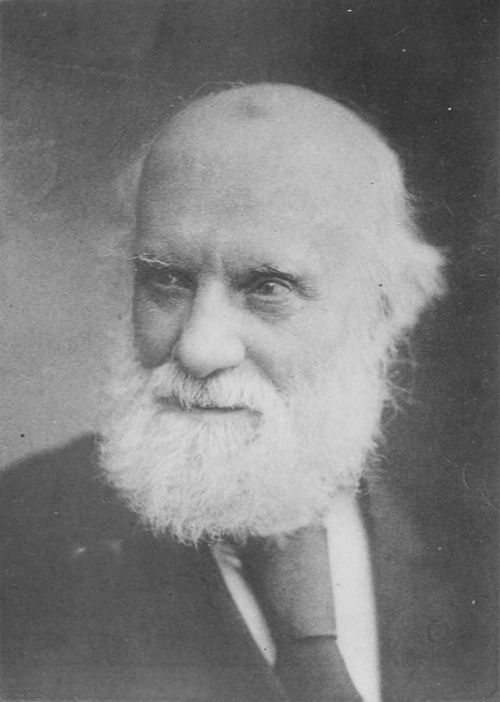
Samuel Birch (1813-1885), President of the Society of Biblical Archæology, 1870 to 1885 (Society of Biblical Archæology, Public Domain, via Wikimedia Commons).
Enthusiasm, Rigor, and Scholarly Institutions
Throughout the 1840s, 50s, and 60s, excavators in Ottoman Iraq and Egypt had uncovered abundant artifacts and shipped them to Europe. Illustrated accounts of these digs exploded in the United Kingdom, and Londoners thronged the British Museum to gawk at the Assyrian and Egyptian statuary they had revealed.[6] In the same period, cuneiform and hieroglyphics—writing systems inscribed on these objects—were being slowly but surely deciphered by scholars like Birch and Talbot. But while those in the know considered these writing systems legible by the 1850s, most excavated papyri and clay tablets remained unread, slowly decomposing in storage in Europe.
So given this archival promise, why did the Syro-Egyptian Society and Chronological Institute flounder? In his letter to Talbot, Birch blamed their leaderships’ “enthusiasm.”[7] Writing in the period in which the term “amateur” was beginning to lose respectable luster, Birch felt that these organizations lacked the expertise, analytical rigor, and intellectual discipline to do justice to the ancient past.[8] He knew that an organization dedicated to presenting and publishing decipherments and analyses of ancient texts would exponentially increase expert knowledge of Assyrian and Egyptian pasts: it would spread both primary sources and the ability of scholars to test their own translations. But it had to have intellectual legitimacy. And needing at least a hundred members to recuperate the cost of printing any of their proposed papers, Birch was not “sanguine” as to its potential success.[9]
Historians of science have long viewed the second half of the nineteenth century as a period of great institutional change in the sciences. Disciplines like anthropology, biology, and physics were emerging out of the natural history and natural philosophy of previous centuries.[10] “Redbrick” universities were being built to compete with Oxford and Cambridge, metropolitan institutions whose shiny new laboratories became central loci of scientific research.[11] Fitting an older brand of scholarly legitimacy, Birch held no university degree. Rather, he had published considerable works on Egyptological and numismatic topics, and by 1870 he had worked at the British Museum for over 30 years as the sole Egyptological expert. This gave him significant credentialling indeed, as museums were as much part of the infrastructure of knowledge production as they were a novel space for “the public” to engage with information about the world.[12] Scholarly societies were part of this milieu, and Birch sought one that fit his exact needs.
Unfortunately, printing work about Assyrian and Egyptian pasts, artifacts, and languages could get expensive and difficult. The way Birch wanted to do it required a publishing house to have access to founts of cuneiform and hieroglyphic letters that could be inserted into their printing presses, as well as costly engravings of antiquities. To his chagrin, Birch had to engage in what Aileen Fyfe and Bernard Lightman have called the “marketplace of science.”[13] His ideally rigorous society still had to attract enthusiasts willing to fund scholarship that they might not be able to participate in themselves.
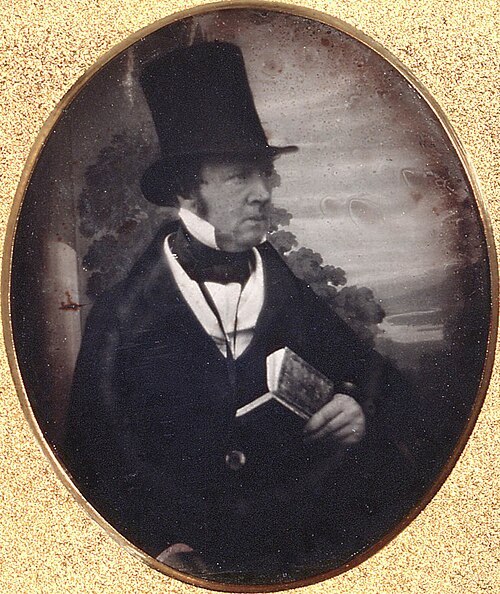
Daguerreotype portrait of William Henry Fox Talbot by Antoine Claudet, ca. 1844 (Antoine Claudet, Public Domain, via Wikimedia Commons).
Injecting Religious Rhetoric
Help came in the form of Joseph Bonomi, curator at the Soane Museum, illustrator of Assyrian and Egyptian monuments, and crucially, member of both the Syro-Egyptian Society and the Palestine Archaeological Association. The Palestine Archaeological Association had been founded in the early 1850s to “discover monuments of antiquity” in situ in Palestine and bridge some of the geographical gap left between Egypt and Assyria by the Syro-Egyptian Society. Breathlessly, the Morning Chronicle exclaimed that the monuments this region promised might even include the “sacred ark, supposed to have been concealed by the Hebrew prophet Jeremiah in some recess,” such treasures sure to be “corroborative of the sacred writings.”[14] Likewise, one of the other erstwhile members of the Syro-Egyptian Society had doubled as the secretary of the Anglo-Biblical Institute. According to the Hebrew Observer, this Institute’s purpose was to promote Biblical Criticism and produce “a superior Translation of the bible into the English Language.”[15] Unlike the Syro-Egyptian Society, the Anglo-Biblical Institute did not focus on ancient texts to understand the societies they had come from. Rather, it hoped to improve modern British Christianity through new, vernacular proximity to the faith’s central text.
Appeals to a Victorian sense of shared Christian heritage had become especially poignant in the wake of Darwinian theories of natural selection and evolution, which posited an ancient world shaped not by God’s hand but random chance.[16] The names Assyria, Egypt, and Palestine denoted geographies that were being administered by Ottoman imperial powers, but were familiar to the Victorian public from Biblical and Classical texts. Invoking Testaments both Old and New, these regions were viewed by Orientalists as ripe for the taking—through intellectual, scholarly means as well as bellicose ones.[17] In 1870, the Palestine Archaeological Association and the Anglo-Biblical Institute were willing to subsume themselves into Birch’s new collective. And he noticed that their names exhibited a timely theological edge that Syro-Egyptian and Chronological did not.
The Society of Biblical Archaeology
John Kitto’s famous and well-respected Cyclopaedia of Biblical Literature (1845) explained in its preface that Biblical Archaeology “is that part of theological science which tries to unravel the various circumstances and conditions which have exercised more or less influence upon the composition of the Scriptural books.”[18] This form of scholarship, which Kitto was very clear to define as a science, took as its object the landscapes and people that formed the Bible in its earliest stages. The landscapes and people of the bible: who were they but the umbrella for each of the four societies Birch was trying to combine? His organization would be called the Society of Biblical Archaeology. The name invoked religious stakes, a sense of history, a sense of scientific induction and logic—all respectable and sober pursuits, in the service of something deeply important to the average Victorian: their religious heritage. By Birch’s death in 1885, the Society of Biblical Archaeology boasted a membership of 432, a number that would plateau above 600 in the 1890s. He could die satisfied in the knowledge that he had successfully coordinated a scholarly body that published frequent, rigorous work that, in 1885, led the field of decipherment and showed no sign of slowing down.
And yet.
Printed in the Society of Biblical Archaeology’s very first Transactions (or collection of papers given that year at regular meetings and published as a book), Birch carefully explained that theology was not the goal. What was “meant by holy writ” was not the topic of study—rather, it was people and empires in biblical landscapes.[19] In fact, Birch explicitly banned theological work from meetings in the Society’s earliest years.[20] But despite this attempt at a scientific secularity, more spectacular questions about Assyrian religion’s relationships to Christianity kept bleeding through and people consistently submitted articles arguing for evidence of an Assyrian knowledge of the Christian godhead. Given that Birch decided to name his society the Society of Biblical Archaeology rather than a more geographically niche, “Egypto-Chaldaean” Society, perhaps this was inevitable.
Notes & References
[1] Henry Fox Talbot to Samuel Birch, December 7, 1870. Doc 9734, The Correspondence of William Henry Fox Talbot, last updated September 1, 2003, https://foxtalbot.dmu.ac.uk/, accessed Feb 6, 2025.
[2] Samuel Birch to Henry Fox Talbot, December 9, 1870. Doc 9737, The Correspondence of William Henry Fox Talbot, last updated September 1, 2003, https://foxtalbot.dmu.ac.uk/, accessed Feb 6, 2025.
[3] Ibid.
[4] “Address of the Chronological Institute of London,” Transactions of the Chronological Institute of London, part 1 (London: T. Richards, 1852).
[5] Birch to Talbot, December 9, 1870. Doc 9737, The Correspondence.
[6] Austen Henry Layard’s Nineveh and its Remains became a bestseller, and throughout the mid-century decades papers like the Illustrated London News and the Daily Telegraph reported on visitors to the Assyrian and Egyptian halls at the Museum.
[7] Birch to Talbot, December 9, 1870. Doc 9737, The Correspondence.
[8] Philippa Levine, The Amateur and the Professional: Antiquarians, Historians, and Archaeologists in Victorian England, 1838-1886 (Cambridge University Press, 1986).
[9] Birch to Talbot, December 9, 1870. Doc 9737, The Correspondence.
[10] George W. Stocking, Victorian Anthropology (Free Press, 1987); Michel Foucault, The Order of Things: An Archaeology of Human Sciences, Vintage Books, 1994 (Pantheon Books, 1970).
[11] Levine, The Amateur and the Professional.
[12] Susan Sheets-Pyenson, Cathedrals of Science: The Development of Colonial Natural History Museums during the Late Nineteenth Century (McGill-Queen’s University Press, 1988); Eilean Hooper-Greenhill, Museums and the Shaping of Knowledge (Taylor & Francis, 1992); Sadiah Qureshi, Peoples on Parade: Exhibitions, Empire, and Anthropology in Nineteenth-Century Britain (University of Chicago Press, 2011).
[13] Aileen Fyfe and Bernard V. Lightman, eds., Science in the Marketplace: Nineteenth-Century Sites and Experiences (University of Chicago Press, 2007).
[14] “Palestine Archaeological Association,” The Morning Chronicle, October 3, 1853, 5. British Newspaper Archive, accessed February 5, 2025.
[15] “Report and Transactions of the Anglo-Biblical Institute—1852-1853,” Hebrew Observer, September 23, 1853, 9. British Newspaper Archive, accessed February 5, 2025.
[16] See Stocking, Victorian Anthropology.
[17] Edward W. Said, Orientalism: Western Conceptions of the Orient (Random House, 1978); Mary Louise Pratt, Imperial Eyes: Travel Writing and Transculturation, 2008 (Routledge, 1992).
[18] John Kitto, “Preface,” Cyclopaedia of Biblical Literature, 1845 (London, 1890), xii.
[19] Kitto, “Preface,” xi.
[20] “Theological and Political Papers are not accepted by the Council.” “Objects,” Transactions of The Society of Biblical Archaeology, vol. 2 (Longmans, Green, Reader and Dyer, 1873), xxv.
[21] In one early paper, Henry Fox Talbot explains that “Amidst the chaos of names a feeling of the real unity of the divine nature is visible.” Henry Fox Talbot, “On the Religious Belief of the Assyrians No. II,” Trans. of the Soc. of Bib. Arch., vol. 2, 34.
This post was curated by Contributing Editor Andra Sonia Petrutiu, reviewed by Contributing Editor Sameeha Vardhan, and translated into Portuguese by Amanda Domingues. Portuguese recording by Amanda Domingues.
