Surrogacy is a form of assisted reproduction in which the gestational labor of birthing a child is carried out by someone other than the intending parent/s. Surrogacy in India has gained a great deal of popularity over the last three decades, emerging as a major transnational commercial hub. Generating close to $2.3 billion in annual revenue (Rudrappa 2015), the industry was largely unregulated, until recently. In December 2021, the Indian state passed the Surrogacy (Regulation) Act, criminalizing commercial surrogacy and permitting only altruistic surrogacy for select clients. The Act bans the “commercialization of surrogacy services,” outlawing any possible compensation for surrogate workers, whether it is “payment, reward, benefit, fees, remuneration, or monetary incentive in cash or kind” (Government of India 2021, 2). In effect, surrogacy is legally permitted only if it is “altruistic,” with heavy punitive measures in place for commercial surrogacy. By “altruistic” surrogacy, the state means an unpaid surrogacy arrangement that is borne out of the good will and selflessness of the surrogate worker, upon whose body the biomedically intensive, complicated, and risky process of surrogacy is carried out. It is important to note that surrogacy arrangements in India are largely shaped by stark power imbalances. Surrogate workers tend to come from marginalized socioeconomic backgrounds, and are often low-income, oppressed-caste women from rural areas. Intending parent/s, by contrast, are typically more privileged – urban, middle-to-upper-class, and from dominant-caste groups. These structural disparities have significant implications for surrogate workers in the current moment, with the regulatory turn to “altruism.”
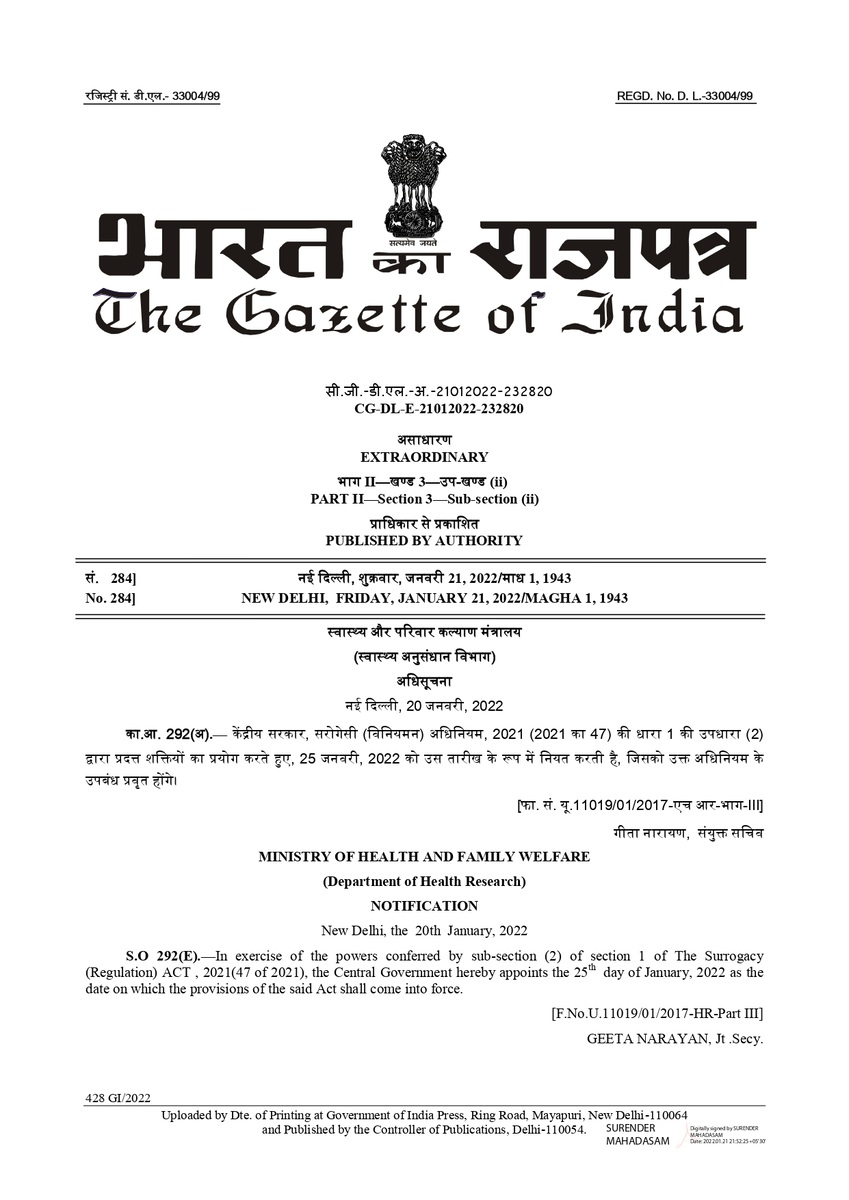
Screenshot of a notification from the Gazette of India on the enforcement date of the Surrogacy (Regulation) Act, 2021. The Act was implemented on January 25, 2022. Source: Department of Health Research, Government of India, January 20, 2022; screenshot taken by the author.
A medical professional I interviewed during my dissertation field research in West Bengal, India, told me that surrogacy is a risky process, involving “lots of complications – potential complications and real complications” for the surrogate worker. Surrogate pregnancies have been found to be higher risk than non-surrogate pregnancies, with documented medical risks including multiple order pregnancies (i.e., the transfer of multiple embryos into the surrogate to increase success rates), postpartum hemorrhage, severe pre-eclampsia, along with other potential obstetric risks (Suryanarayanan 2022, Velez, et al. 2024). The process of surrogacy entails a transfer of “risk burden” (Qadeer 2010) onto the surrogate worker – along with the shifting of gestational labor, care work, and affect, any potential medical or obstetric risks are also transferred onto her body. This burden is further intensified for workers due to the structural constraints that disproportionately impact them and their communities – such as, the state’s rolling back of welfare schemes, limited access to quality healthcare and education, poor nutrition levels, and limited and insecure employment opportunities, mostly in the informal sector. Such structural conditions determine their marginalized social locations and push them into forms of “clinical labor” like surrogacy in the first place (Cooper and Waldby 2014, Nadimpally and Marwah 2019).
Surrogacy agents I spoke to in the field, who used to be surrogate workers before the law, noted that workers would often enter the industry hoping to earn considerably more money in the 9-month period of the pregnancy than they would in their usual employment, generally as domestic or agricultural workers. The total earned of about 400,000 – 500,000 INR (about 4,000 – 5,000 USD) could potentially alleviate immediate financial pressures, such as paying off debts, buying consumer goods like a fridge, TV, or furniture, building a pukka (permanent) house, paying for a family member’s medical expenses, or saving for a child’s wedding. Although some workers believed that this would be a life-changing amount of money that would help secure upward social mobility, this was rarely the case unless one became a surrogate multiple times. Some workers would instead be left with long-term health conditions or disabilities incurred from the pregnancy, such as diabetes, cardiovascular problems, impaired vision, or mental health issues.
With the passage of the Surrogacy (Regulation) Act (2021), some of these risks are ostensibly addressed, although the ethical dimensions of the Act remain questionable. For instance, the law mandates that intending parent/s cover all medical expenses during the pregnancy and provide health and life insurance for the surrogate worker for three years postpartum. While this provision acknowledges the medical risks of surrogacy, it does not specify the amount of coverage, nor provide a mandate for long-term care beyond three years. The law frames insurance coverage as replacing the need for economic compensation for the surrogate worker, as though this is an adequate safeguard protecting the worker’s well-being. The law manages risk procedurally through financialization and insurance, without recognizing surrogacy work as labor deserving of remuneration. While adding the clause of insurance coverage is no doubt necessary, it obscures the state’s role in protecting women’s rights and welfare as workers and economic agents. Similarly, the Act grants surrogate workers the formal right to terminate a pregnancy at any stage. However, this provision must be understood in the context of structural disparity, intense biomedicalization, and legal surveillance that govern surrogacy arrangements. In practice, surrogate workers’ socioeconomic precarity and limited familiarity with medical and legal procedures complicate the exercise of this right. Far from enabling meaningful reproductive autonomy, the formal availability of termination operates within deeply unequal power relations, rendering autonomy largely nominal and reinforcing the state’s tendency to manage risk without addressing the material conditions and contractual relations that shape surrogate workers’ lived experiences.
It is within this context that the criminalization of commercial surrogacy emerges as a key site where risk is not eliminated, but intensified. Through my field research, I found that despite the severity of the new criminal legislation, commercial surrogacy continues to take place through underground networks. This is not unsurprising, as scholars have predicted the growth of an underground market in response to the potential criminalization of surrogacy (Rudrappa 2017; Pande 2020; Banerjee and Kotiswaran 2020). The pace of the industry has slowed, and there are now far fewer registered surrogacy clinics in the country. The law has emerged as a deterrent to the growth of the industry, with participants increasingly hesitant to engage. Fewer surrogates enter the industry now, fearful of the strict criminal law, and the open networks that connected fertility clinics to surrogacy agents and workers have mostly disappeared. Intending parent/s are now responsible for finding surrogate workers, and this is often through secret, “word-of-mouth” channels. The worker’s payment is informally and privately negotiated, often between the intending parent/s, agent, and worker. Sometimes, the payment is disguised among the medical and dietary expenses of the surrogate and sent to the agent “to avoid any trouble.” Sometimes, interest payments on a house loan, or the surrogate’s child’s school fees are directly paid by the intending parent/s. Since there is no longer a monetary contract due to the new criminal law, the payment is decided and transferred under the table, leaving workers with little bargaining power and no legal recourse in cases of exploitation or abuse. Workers are instead expected to behave with quiet gratitude for being paid at all, despite the heightened medical and legal risks they bear.
Hailed as a “revolutionary step in the field of women’s reform,” (Swaraj 2016, 2:41), the state has passed this law to regulate the burgeoning surrogacy industry, along with ostensibly protecting surrogate workers from “exploitation.” Labeling the previous phase of commercialism in surrogacy as necessarily exploitative and hence illegal, the state’s turn to “altruism” in this new phase of regulation implies that women’s reproductive labor must be unpaid, selfless, and maternal, in order to be legitimate. It is pertinent to note that the Act and other legal documents around this legislation refer to surrogacy only as a “service,” rather than as “work” or “labor.” Here, “service” is not used by the state in the Marxist feminist sense of social reproduction (Ferguson 2020; Bhattacharya 2017), but rather, as a “selfless,” “voluntary,” and “altruistic” act in service of society (India, Parliament 2020, 22). “Service” in this sense becomes inextricably linked to femininity and motherhood, and the “service” of such outsourced reproductive labor as surrogacy is naturalized and romanticized by the state. The state does not address how making surrogacy altruistic will solve the problem of exploitation, instead reifying gendered subjectivities of women as selfless, nurturing beings whose labor must be deemed free. I suggest that the biological and embodied nature of surrogacy work, wherein the surrogate’s gestational, reproductive capacity is mobilized as biocapital, may be central to the state’s anxiety about the commercialization of outsourced reproductive labor and its presumed exploitation.
The Surrogacy (Regulation) Act (2021) has brought with it a dynamic restructuring of the surrogacy industry, fraught with ethical considerations about the value of women’s labor. By criminalizing surrogate workers’ right to economic compensation for their biomedically intensive, risky, intimate labor, the state refuses to recognize them as workers, pushing them into further precarity. In allowing surrogacy to only be “altruistic” in the name of “exploitation,” the state turns a blind eye to surrogate workers’ material and structural conditions, facilitating the growth of an underground market in commercial surrogacy that puts workers at greater risk instead. Taken together, these dynamics suggest that the turn to “altruism” does not eliminate exploitation, but rather reconfigures it under conditions of criminalization, informality, and heightened risk for surrogate workers.
This post was reviewed by Contributing Editor Dani Dilkes.
References
Banerjee, Sneha, and Prabha Kotiswaran. 2021. “Divine Labours, Devalued Work: The Continuing Saga of India’s Surrogacy Regulation.” Indian Law Review 5 (1): 85–105. doi:10.1080/24730580.2020.1843317.
Bhattacharya, Tithi. 2017. Social Reproduction Theory: Remapping Class, Recentering Oppression. London: Pluto Press.
Cooper, Melinda, and Catherine Waldby. 2014. Clinical Labor: Tissue Donors and Research Subjects in the Global Bioeconomy. Durham and London: Duke University Press.
Ferguson, Susan. 2020. Women and Work: Feminism, Labour, and Social Reproduction. London: Pluto Press.
Government of India. 2021. Surrogacy (Regulation) Act, 2021. No. 47 of 2021.
India, Parliament, Rajya Sabha, Select Committee. 2020. Report of the Select Committee on the Surrogacy (Regulation) Bill, 2019. New Delhi: Rajya Sabha Secretariat.
Nadimpally, Sarojini, and Vrinda Marwah. 2019. “Body as ‘Resource’ in Surrogacy and Bio-Medical Research: New Frontiers and Dilemmas.” In Equity and Access: Health Care Studies in India, by Purendra Prasad and Amar Jesani. New Delhi: Oxford University Press.
Pande, Amrita. 2021. “Revisiting Surrogacy in India: Domino Effects of the Ban.” Journal of Gender Studies 30 (4): 395–405. doi:10.1080/09589236.2020.1830044.
Qadeer, Imrana. 2010. “The ART of Marketing Babies.” Indian Journal of Medical Ethics Vol VII No 4 October-December 2010.
Rudrappa, Sharmila. 2015. Discounted Life: The Price of Global Surrogacy in India. New York: NYU Press.
Rudrappa, Sharmila. 2017. “Reproducing Dystopia: The Politics of Transnational Surrogacy in India, 2002–2015.” Critical Sociology 44 (7-8): 1087-1101.
Suryanarayanan, Sheela. 2022. “Surrogacy Biomarkets in India: Troubling Stories from before the 2021 Act.” The India Forum.
Swaraj, Sushma. “Cabinet Briefing by Union Ministers | Aug 24.” Filmed 2016. YouTube video, 42:09. https://www.youtube.com/watch?v=wtI4Mskjpnk
Velez, Maria P., Marina Ivanova, Jonas Shellenberger, Jessica Pudwell, and Joel G. Ray. 2024. “Severe Maternal and Neonatal Morbidity Among Gestational Carriers: A Cohort Study.” Annals of Internal Medicine.

1 Comment
Great post!!