Author Archives: Ritu Ghosh

Ritu Ghosh is a PhD candidate in Anthropology at the University of Illinois, Chicago, and holds a graduate concentration in Gender and Women’s Studies. Her research lies at the intersections of reproductive technologies and justice, gender, and law in the Global South. Her dissertation ethnographically examines India’s surrogacy industry in the wake of legislative reforms that restrict surrogacy to “altruistic” arrangements. She explores how this regulatory turn criminalizes compensated reproductive labor, reshaping gendered subjectivities and facilitating the expansion of informal and underground reproductive markets. Prior to beginning her doctoral research, she worked as a professional editor in the education technology sector and with a non-profit curatorial organization.
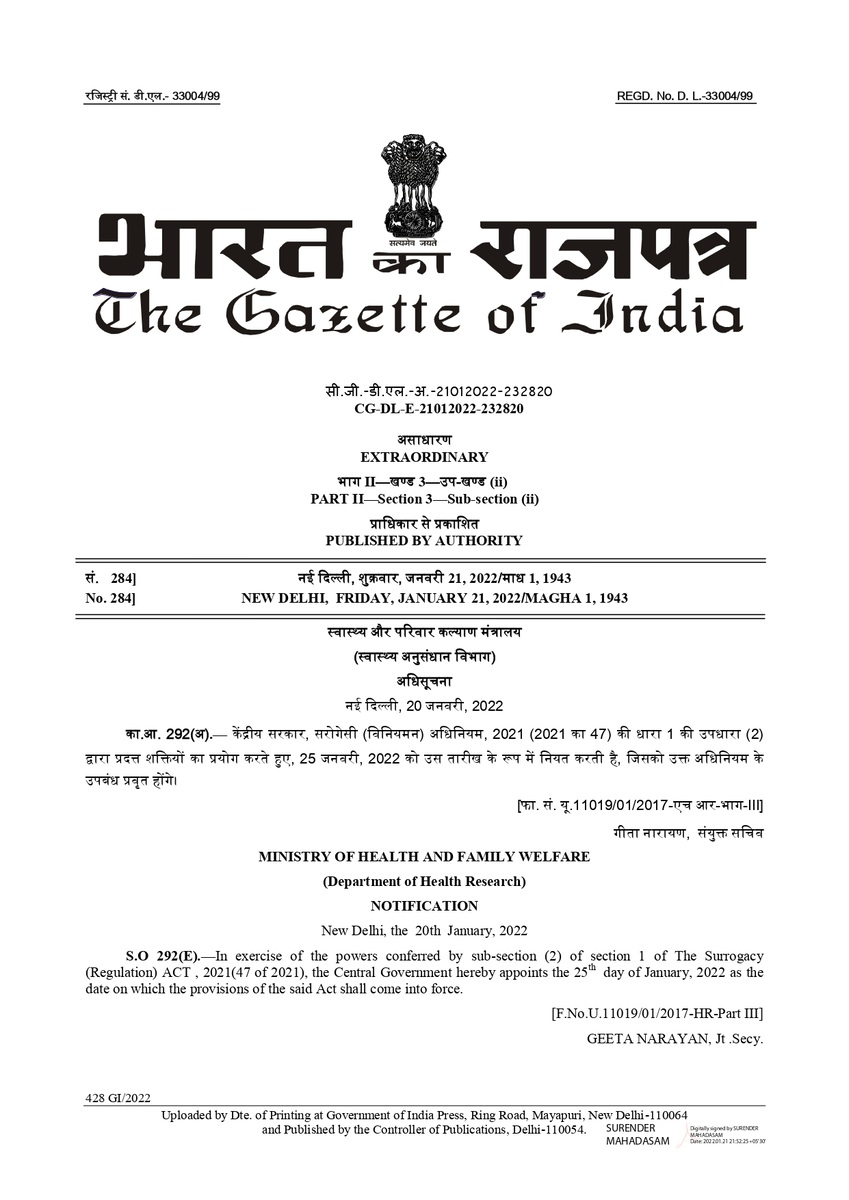
A screenshot of an official, public notification from the Gazette of India announcing the enforcement date of the Surrogacy (Regulation) Act, 2021. The text is in English and Hindi, and describes the source of the notification (Ministry of Health and Family Welfare, Department of Health Research, Government of India), and states that the provisions of the Act will come into force on January 25, 2022.

Criminality, Risk, and Labor: Altruistic Surrogacy in Contemporary India

Surrogacy is a form of assisted reproduction in which the gestational labor of birthing a child is carried out by someone other than the intending parent/s. Surrogacy in India has gained a great deal of popularity over the last three decades, emerging as a major transnational commercial hub. Generating close to $2.3 billion in annual revenue (Rudrappa 2015), the industry was largely unregulated, until recently. In December 2021, the Indian state passed the Surrogacy (Regulation) Act, criminalizing commercial surrogacy and permitting only altruistic surrogacy for select clients. The Act bans the “commercialization of surrogacy services,” outlawing any possible compensation for surrogate workers, whether it is “payment, reward, benefit, fees, remuneration, or monetary incentive in cash or kind” (Government of India 2021, 2). In effect, surrogacy is legally permitted only if it is “altruistic,” with heavy punitive measures in place for commercial surrogacy. By “altruistic” surrogacy, the state means an unpaid surrogacy arrangement that is borne out of the good will and selflessness of the surrogate worker, upon whose body the biomedically intensive, complicated, and risky process of surrogacy is carried out. It is important to note that surrogacy arrangements in India are largely shaped by stark power imbalances. Surrogate workers tend to come from marginalized socioeconomic backgrounds, and are often low-income, oppressed-caste women from rural areas. Intending parent/s, by contrast, are typically more privileged – urban, middle-to-upper-class, and from dominant-caste groups. These structural disparities have significant implications for surrogate workers in the current moment, with the regulatory turn to “altruism.” (read more...)


Enigmas of Corporeal Justice: Surrogacy and Legality in India

Over the last two decades, India has become a popular global destination for what is commonly referred to as reproductive tourism, wherein clients travel from one part of the world to another to seek biomedical interventions to help them have children. Breakthroughs in assisted reproductive technologies (ART), such as in-vitro fertilization (IVF), have led to a boom in surrogate pregnancies as a means of having children, with international clients (mostly from the Global North) flocking to countries in the Global South, like India, to avail of these services. Like much of the medical tourism industry, this movement is motivated by access to state-of-the-art medical facilities, skilled professional care, along with remarkably low costs and the availability of poor bodies to extract from. (read more...)