New reproductive and bodily intervention biotechnologies not only promise to cure or prevent diseases, but are also shaping a new regime of bodily normalization that redefines which lives are desirable, correctable, or eliminable. For several years, countries such as Iceland have stood out for medical procedures that identify the conditions under which a fetus is developing and then ask parents whether they wish to continue or terminate the pregnancy. Between 80–85% of pregnant women in Iceland undergo prenatal screening and, when the result is positive for trisomy 21, termination rates approach 100%. In Denmark the percentage is 98%, in France 77%, and in the United States 67%. Geneticist Kari Stefansson, founder of deCODE Genetics, stated: “My understanding is, basically, that we have almost eradicated Down syndrome from our society; there will hardly ever again be a child with Down syndrome in Iceland” (Quijano, 2017).
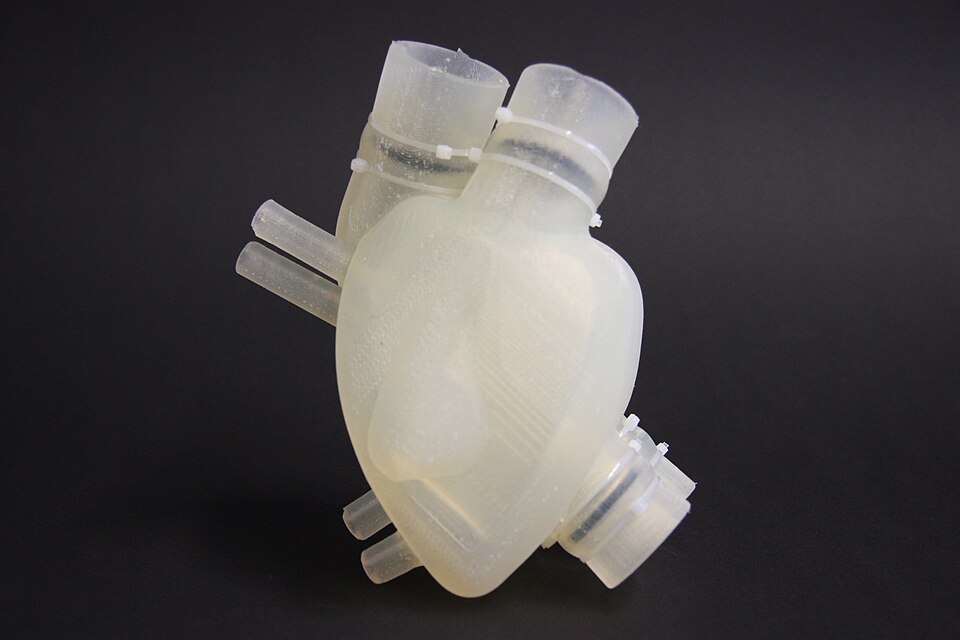
Soft Total Artificial Heart, developed in the Functional Materials Laboratory at ETH Zürich. The prototype evokes contemporary intersections between biomedical engineering, bodily intervention, and technoscientific imaginaries of repair and optimization. Sourced from Wikimedia Commons
Beyond prenatal diagnosis, recent developments in genomic technologies have expanded the capacity not only to identify genetic conditions, but also to actively select particular bodily futures. Companies such as Genomic Prediction use “polygenic risk scores” to calculate the probability that an embryo will develop diseases such as diabetes, certain forms of cancer, or schizophrenia, offering prospective parents the possibility of selecting, among several embryos generated through in vitro fertilization, the one with the lowest risk of disease. A co-founder of that same company has suggested that such selection could eventually extend beyond disease prevention toward traits unrelated to illness, such as enhancing the intellectual capacities of these future bodies. In 2025, tools such as AlphaGenome enabled the interpretation of the human genome with unprecedented precision, improving the prediction of gene functions and facilitating clinical annotation (Avsec et al., 2025).
For scholars such as García-Santesmases (2023), we are facing a clearly eugenic discourse that places disability justice critiques of the ideal, healthy, and able body in tension with feminist struggles that defend abortion as a right. When it becomes socially legitimate to terminate a pregnancy because the fetus presents a disability or malformation, the populations who embody those bodies are simultaneously being told that their existence within society is undesirable. At best, those already born are encouraged to intervene upon their bodies in order to resemble the ableist norm more closely.
In this scenario, the problem lies in the language used to describe these advances, insofar as it is a eugenic and discriminatory language directed toward bodies that already exist and inhabit the world. In other words, these bodies are being told, implicitly, that they are unnecessary, disposable, and that they must be radically modified if they wish to have a place in this world. If reproductive technologies allow for the selection of which bodies will come to exist, other biomedical innovations seek to intervene in bodies that already inhabit the world. Many of these technologies are presented through narratives of autonomy, repair, and functional enhancement.
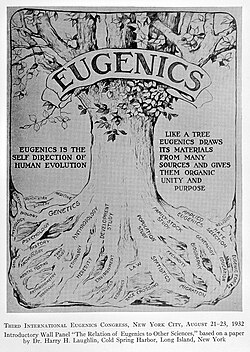
Introductory wall panel from the Third International Eugenics Congress held in New York City in 1932, titled “The Relation of Eugenics to Other Sciences.” The diagram situates eugenics within a broader network of scientific, social, and political disciplines. Sourced from Wikimedia Commons
In this sense, it is increasingly common to encounter hopeful language promising healing, cure, and repair. One example is the case of Noland Arbaugh, a quadriplegic man who was paralyzed following a swimming accident in 2016. In 2024, Arbaugh became the first patient to receive a Neuralink brain implant, and he reports that, thanks to the implant, he can now control a computer with his mind, has gained greater autonomy in his daily life, and now has the opportunity to explore new personal and professional possibilities (Infobae, 2025). Similarly, advances in 2025 in exoskeletons controlled through brain-computer interfaces already allow people with spinal cord injuries to walk naturally by combining epidural stimulation with artificial intelligence capable of detecting obstacles and adjusting trajectories in real time (Lim et al., 2025).
But what happens when bodily difference is not only corrected, but selected against or eliminated before birth? Western science appears to be responding to this question from multiple laboratories. A study conducted by Mass General Brigham in the United States and the Eye & ENT Hospital of Fudan University in China, which successfully reversed severe hearing loss through gene therapy, maintained results considered positive for more than two years (Jiang et al., 2026). Gene therapy has enabled the repair of DNA in children born with genetic defects causing deafness, opening possibilities for addressing more than 20,000 genetic diseases identified in humans. Another example is a study in Japan led by Dr. Ryotaro Hashizume, which claims that Down syndrome, caused by trisomy 21, can be eliminated (Hashizume et al., 2025).
What we are witnessing is not merely the prediction and control of reproduction, but the possibility of eliminating and producing bodies that conform to the desires and expectations of different users. This does not arise solely from individual desire; rather, it reflects the extent to which people internalize ableist bodily norms anchored in a capitalism that is increasingly productive, faster, more efficient, and intolerant of failure. Under this logic, it is worth asking: who embodies the bodies most desired by capitalism? Perhaps no one can fully achieve this ideal, but the norm functions precisely by sedimenting hierarchies that position some bodies as more desirable in contrast to others, which increasingly come to represent what should not exist.
This may be giving rise to forms of reproduction and normalization that, although apparently presented as serving humanity, are inscribed within structures that produce different forms of inequality and are far from disappearing. On the contrary, they seem to become even more crystallized with each technological advance. In the case of disability, there is a renewed tendency to treat its existence as though it were a disease. This raises a number of pressing questions: What kinds of bodies are desired? What organs, people, and objects produce them? How does the field of professionals involved in these technologies operate, and what forms of training shape them? Is there a hierarchy of bodies that determines which bodies are available for others? Is there a correlation between productive demands and the elimination of bodies? And with these technological developments, is this the end of disability?
What is clear is that the laboratories and experiences cited here are located in places with dominant technological and economic power. In response to these technoscientific horizons, different collectives and social movements have developed alternative ways of understanding disability and bodily diversity. For example, countries such as Colombia and Spain have technological and legal experiences that support identity-based frameworks for bodies embodying long-standing struggles. In Colombia, the Deaf community has benefited from extensive legislation that over time has enabled the consolidation of identity politics aimed at recognition and political positioning (INSOR, 2024). In the case of people with Down syndrome, there have also been legal advances aimed at abolishing figures such as guardianship and reproductive control practices historically associated with castration, in order to promote autonomy. In Spain, the Independent Living Movement and Crip collectives have developed interpretive frameworks distinct from the medical model, proposing concepts such as functional diversity and neurodiversity (Moya, 2022). These perspectives have also enabled disability to be experienced and understood as a site of desire (García-Santesmases, 2020).

Artist talk by Amy Karle, “Diagramming Bionic Futures – Creating the Material, Revealing the Spiritual,” presented at the FILE Electronic Language International Festival in 2017. The work explores speculative relationships between bodies, biotechnology, and future forms of human modification. Sourced from Wikimedia Commons
All of this demands that Science and Technology Studies critically examine how forms of knowledge, practices, positionalities, and possibilities for life are being configured in relation to the bodies being produced in the twenty-first century. Likewise, it is necessary to trace the meanings mobilized by these technologies and ask whom they ultimately serve. Functional diversity may therefore allow us to understand more broadly that technology forms part of a network of interested and historically situated activities shaped by the conditions under which they materialize. Technology is always embedded within social, historical, and political practices that produce not only knowledge, but also possibilities of world-making.
Consequently, if the end of disability occurs in the way some studies proclaim, it will not be because of a universal search for the good of humanity, but rather because of the triumph of one political position over another. In other words, the issue is not simply that new bodies and new forms of normalization are being produced, but that the structures of inequality sustaining capitalism and its multiple mechanisms of oppression are being updated and technologized. These structures continue reproducing a patriarchy that requires women and feminized bodies to remain disadvantaged, relies on ableism to racialize, marginalize, and eliminate bodies that escape the norm, and depends on colonial structures to determine which bodies may be used and by whom.
For all these reasons, the kinds of biotechnological knowledge and experimentation presented as triumphs for humanity may instead constitute a highly specific way of privileging a type of human marked by greater efficiency, productivity, and optimization, within an ecosystem of apparent genetic control positioned above all other ways in which diversity and mutation may be expressed.
This post was curated by Contributing Editor Juan Camilo Ospina Deaza and reviewed by Contributing Editor Clarissa Reche
References
Avsec, Ž., et al. (2025). AlphaGenome: AI for better understanding the genome. Google DeepMind.https://deepmind.google/blog/alphagenome-ai-for-better-understanding-the-genome/
García-Santesmases, A. (2020). crip, WHAT?? Enunciaciones, tensiones y apropiaciones en torno a la reivindicación de lo tullido en el contexto español. Papeles del CEIC. International Journal on Collective Identity Research, (2), papel 232. https://doi.org/10.1387/pceic.21027
García-Santesmases, A. (2023). El cuerpo deseado: La conversación pendiente entre feminismo y anticapacitismo. Kaótica Libros.
Hashizume, R., et al. (2025). Trisomic rescue via allele-specific multiple chromosome cleavage using CRISPR-Cas9 in trisomy 21 cells. PNAS Nexus. https://doi.org/10.1093/pnasnexus/pgaf068
Instituto Nacional para Sordos (INSOR). (2024). Misión institucional y política pública para la población sorda en Colombia. Ministerio de Educación Nacional. https://www.insor.gov.co
Jiang, L., et al. (2026). Multicenter gene therapy for OTOF-related deafness followed up to 2.5 years. Nature. https://doi.org/10.1038/s41586-026-10393-y
Lim, J., et al. (2025). Real-time brain-computer interface control of walking exoskeleton with bilateral sensory feedback. arXiv. https://arxiv.org/abs/2505.00219
Moya, L. (2022). Teoría tullida. Un recorrido crítico desde los estudios de la discapacidad o diversidad funcional hasta la teoría crip. Revista Internacional de Sociología, 80(1), e199. https://revintsociologia.revistas.csic.es/index.php/revintsociologia/article/view/1112
Quijano, E. (2017, agosto 15). Inside the country where Down syndrome is disappearing. CBS News. https://www.cbsnews.com/news/down-syndrome-iceland/


