Joginder Kaur (54) had no formal schooling. For her, phone calls always meant pressing the green button to receive a call. Dialling numbers or navigating menus were not part of that routine—until they became unavoidable. In came emojis, used to mark different people in her contact list: Birds, hearts, and just a smiley face. Each representing a new contact.
Kaur is not alone in her practice of using emojis to navigate contacts. Across villages in the Malwa region of Punjab where I lived and conducted fieldwork over the last five years, affordances like emojis (or emoticons) to visually express an emotion have been reappropriated in everyday practice. Individuals who are not literate use emojis to save contacts and navigate through a user interface that is not designed with them in mind. This reflects a shift from dependence on warm experts—informal experts within their peer networks who provide technical help (Martínez and Olsson 2022).
This article examines such practices through the lens of affordances and domestication (Haddon 2007a; Wyche, Simiyu, and Othieno 2019). Affordances refer to the possibilities for action that a technology makes available to its users. Domestication, in turn, shifts attention from the design of technology to its everyday integration: how users appropriate technology via reshaping and making sense of it within specific contexts. Bringing these together, I argue that these possibilities are not simply adopted as originally intended, but are reappropriated across contexts(Boyd 2010; Van Raemdonck, Picone, and Pierson 2025).
In the context of emojis, this is observed in the shift of the use of emojis for expressing emotions to markers for people: a visual workaround for users who are not literate but have access to mobile phones. This reflects a reconfiguration of a feature for a different purpose. Such practices are not intuitive but labour- intensive. Kaur, like her counterparts, puts effort into remembering what emoji corresponds to which contact and navigating the interface of her feature phone. This becomes an ongoing negotiation, especially with phones updates, requiring active participation.
Across the history of communication technology, humans have domesticated them(Haddon 2007b; Lehtonen 2003; Ling, Nilsen, and Granhaug 1999). From missed calls in the era of expensive long-distance telephone plans to the use of acronyms to reduce Telegram costs, domestication has taken many forms. But these stories do not find a space in technocentric histories that centre the communication technologies and their affordances as a solution to problems. Unlike the creative use of emojis as reappropriation of technology and its subsequent domestication, not every instance of such domestication ends on a positive note.
Affordances across social media platforms (often accessed by rural Indian women exclusively through mobile phones)—like “Last Seen” or “Online Status”—are reappropriated as a tool of surveillance, and become grounds for moral judgement. Whether it’s blocking a relative or hiding one’s “last seen” status on WhatsApp, these acts bear similar costs for women as being online at odd hours.
For women in collectivist settings like in many rural Indian villages, being online is not neutral (Chakraborty and Garg 2025). It is evaluated through reappropriation. Time spent on the phone invites scrutiny: why is she online so often? Who is she talking to? For how long? And in case the affordance of “hiding” such metrics is used, a new set of questions emerges: Why is her last seen hidden? What does she not want us to know?
“You should talk to her. She is always online,” some young girls told me, pointing towards Kajal (name changed), 16, in the rural Jharkhand’s coal belt in eastern India. I had approached them with my usual script, explaining my study of mobile media interactions among rural Indian women. The setting was starkly different from the agrarian expanse of rural Punjab, but the stories repeated themselves with uncanny similarity. Kajal’s online presence has been the subject of ridicule in her community, as it was evident from the sneering and giggling around her. Here too, an affordance is reappropriated to keep usage of mobile phones by women in control.
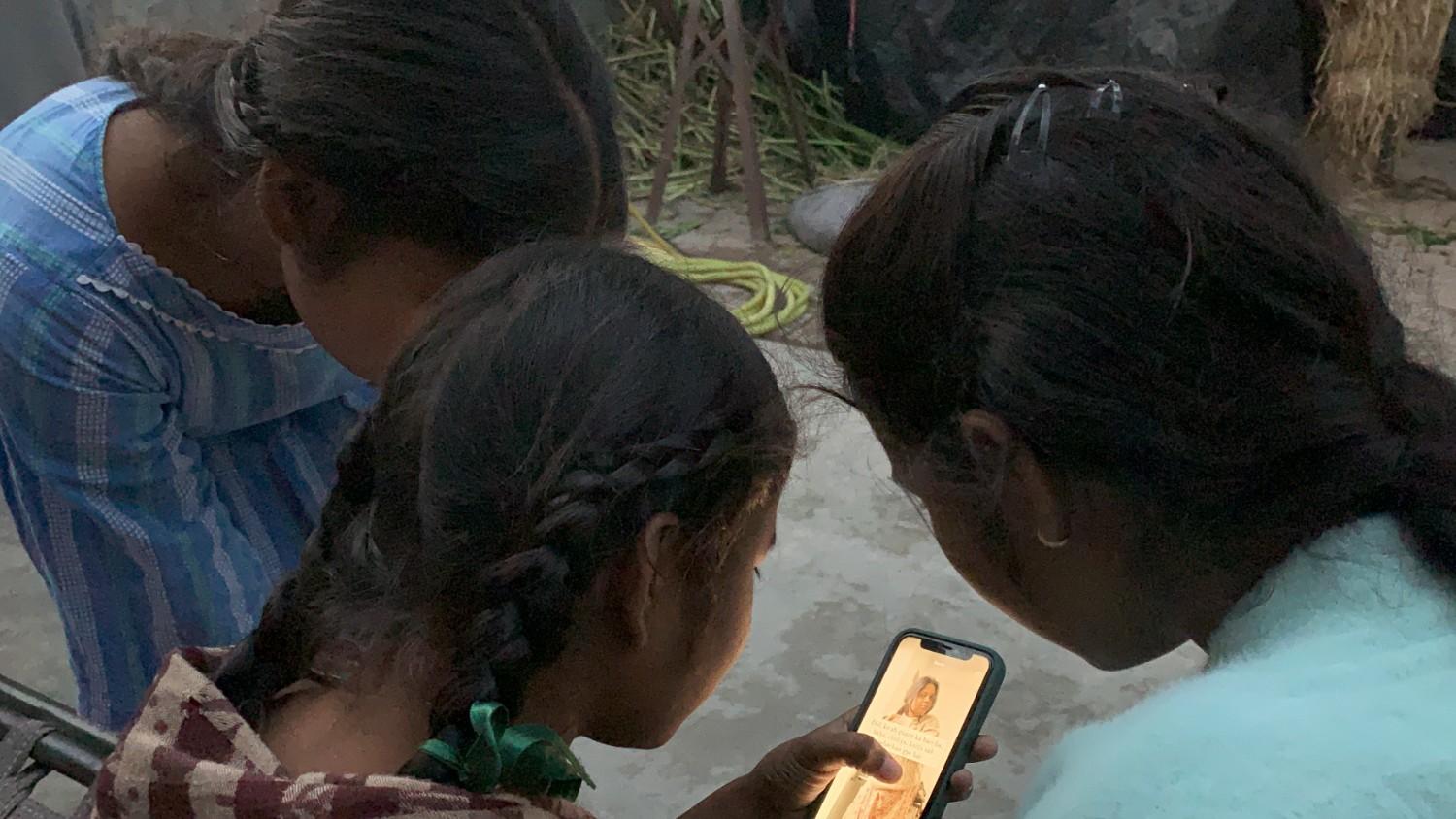
Three sisters use their shared phone to browse Instagram in Aulakh, Punjab, 2023. [Image by Author]
This article outlines this exact tension, in context of mobile media usage of rural Indian women drawing from my interactions, observations, and reflections over the last five years. What happens when you are forced to include a technology in your life that you were not trained to use? How do you make space for it? Especially in routines that you have perfected over the years?
Encouraged by low internet prices and COVID-19 restrictions that pushed digital connectivity over face-to-face interactions, internet-enabled mobile phone ownership in India has skyrocketed in the past decade (Madhukalya 2020; Statista 2023). India is largely a mobile-first internet-using nation, with over 99% of broadband connections wireless in nature (TRAI 2024). This expansion is not limited to just the urban pockets but the rural hinterlands are increasingly connected as well.
This increased access, however, comes with differences in how users experience mobile phones. Usage patterns are shaped by social meaning such as family roles, community power hierarchies, gender performance expectations, and the basic collectivist nature of the society (Garg 2021; Sanghera 2018). The affordances or features don’t enter these spaces as intended, and instead reinforce existing social structures.
Beyond contact navigation, similar reappropriations emerge across everyday uses of mobile phones. Features designed for one purpose are routinely used for another even outside rural settings. The phone torch, for instance, is used collectively during concerts and gatherings, transforming individual devices into a shared visual spectacle: a recreation of waving a lighter in the air. Cameras are used not only to capture the present, but also to digitise old photographs, allowing families to archive memories without the need for formal scanning technologies. Even geo-tagged images are repurposed to document compliance for government records, turning everyday photography into bureaucratic evidence. Dedicated applications have been developed and are mandated across government projects across India. These practices further illustrate how affordances are not fixed in their function but are continuously redefined through situated use, often in ways unanticipated by designers.
For Kaur, this becomes an ongoing process of remembering which emoji corresponds to which contact, especially as more people around her get phones. For Kajal, on the other hand, her phone use becomes a measure of proving her “morality” shaped by gender expectations. She faces the consequences of reappropriation as a surveillance tool, but has no active power in negotiating the same. As she continues her usage, she chooses to be laughed at, ridiculed, and policed for what is deemed as “too much” online activity.
Kajal’s “always online” status, that is continuously evaluated, has a different meaning for her. Rather than adjusting quietly as is expected of her, she frames her usage as purposeful. She shared that she wants to be an influencer—someone who creates content regularly. Hence, being online, for her, is not excess but aspiration.
This defiance sits uneasily within her household. Her parents rely on Kajal to navigate the smartphone including recharge and placing online orders[1] . They recall a time when her familiarity with the phone was a source of pride. Yet, as neighbours and relatives begin to comment on her constant online presence, that pride gave way to concern. Their objections are framed in terms of distraction and risk of falling behind instead of the morality narrative that exists in the community. Her refusal to hide visibility or usage thus becomes both a site of aspiration and conflict, where the same affordances that enable her imagined social mobility are reinterpreted by others as evidence of excess and moral failure.
The question, then, is no longer simply whether users can access technology. Domestication of affordances is central to the concept of how humans interact with technology. It affects different people differently even in the same setting: as illustrated in this article. The focus is on how possibilities of the same features or affordances are reshaped within unequal social worlds. Affordances do not travel unchanged; they are rewritten in practice, taking on meanings that reflect the lives of which they become a part of.
Note
[1] Kajal’s story is explored through my recent work on understanding how this peer surveillance is a weaponization of affordances to enforce rules and expectations of moral behaviour. It is available at: https://www.tarshi.net/inplainspeak/on-knowing-too-much-intimacy-visibility-and-peer-surveillance-in-rural-digital-life/
This post was curated by Contributing Editor Sameeha Vardhan and reviewed by Contributing Editor Karina Aranda
References
boyd, Danah. 2010. “Social Network Sites as Networked Publics: Affordances, Dynamics, and Implications.” In A Networked Self, edited by Zizi Papacharissi, 47–66. New York: Routledge.
Chakraborty, Disha, and Chhavi Garg. 2025. “‘(Virtuous) Wives Don’t Have Anything to Hide’: Understanding Digital Privacy Perceptions and Behavior of Married Women in Rural India.” Social Media + Society 11 (1). https://doi.org/10.1177/20563051251313665.
Garg, Chhavi. 2021. “Is Mobile Phone Use Invading Multiple Boundaries? A Study of Rural Illiterate Women in India.” Indian Journal of Gender Studies 28 (1): 29–45. https://doi.org/10.1177/0971521520974845.
Haddon, Leslie. 2007a. “Roger Silverstone’s Legacies: Domestication.” New Media & Society 9 (1): 25–32. https://doi.org/10.1177/1461444807075201.
Haddon, Leslie. 2007b. “The Contribution of Domestication Research to In-Home Computing and Media Consumption.” The Information Society 22 (4): 195–203. https://doi.org/10.1080/01972240600791325.
Lehtonen, Turo-Kimmo. 2003. “The Domestication of New Technologies as a Set of Trials.” Journal of Consumer Culture 3 (3): 363–385. https://doi.org/10.1177/14695405030033014.
Ling, Rich, Sjøfart Nilsen, and Steinar Granhaug. 1999. “The Domestication of Video-on-Demand: Folk Understanding of a New Technology.” New Media and Society 1 (1): 83–100. https://doi.org/10.1177/14614449922225492.
Madhukalya, Anirudh. 2020. “India’s Internet Consumption Up during Covid-19 Lockdown, Shows Data.” Hindustan Times. https://www.hindustantimes.com/india-news/india-s-internet-consumption-up-during-covid-19-lockdown-shows-data/story-ALcov1bP8uWYO9N2TbpPlK.html.
Manzerolle, Vincent, and Michael Daubs. 2021. “Friction-Free Authenticity: Mobile Social Networks and Transactional Affordances.” Media, Culture & Society 43 (7): 1279–1296. https://doi.org/10.1177/0163443721999953.
Martínez, Claudia, and Thomas Olsson. 2022. “The Warm Expert—A Warm Teacher? Learning about Digital Media in Intergenerational Interaction.” Convergence: The International Journal of Research into New Media Technologies 28 (6): 1861–1877. https://doi.org/10.1177/13548565211070409.
Sanghera, Tanveer. 2018. “Wide Gender Gap in Mobile Phone Access Is Hurting India’s Women.” IndiaSpend, November 1. https://www.indiaspend.com/wide-gender-gap-in-mobile-phone-access-is-hurting-indias-women/.
Statista. 2023. “Number of smartphone users in India from 2010 to 2023, with estimates through 2040.” https://www.statista.com/statistics/467163/forecast-of-smartphone-users-in-india/.
TRAI (Telecom Regulatory Authority of India). 2024. Telecom Subscriptions Reports. https://www.trai.gov.in/release-publication/reports/telecom-subscriptions-reports.
Trepte, Sabine, Michael Scharkow, and Tobias Dienlin. 2020. “The Privacy Calculus Contextualized: The Influence of Affordances.” Computers in Human Behavior 104: 106115. https://doi.org/10.1016/j.chb.2019.08.022.
Van Raemdonck, Nathalie, Ike Picone, and Jo Pierson. 2025. “Affordances-in-Practice: How Social Norm Dynamics in Climate Change Publics Are Shaped on Instagram and Twitter.” Social Media + Society 11 (1). https://doi.org/10.1177/20563051251319066.
Wyche, Susan, Nightingale Simiyu, and Margaret E. Othieno. 2019. “Understanding Women’s Mobile Phone Use in Rural Kenya: An Affordance-Based Approach.” Mobile Media & Communication 7 (1): 94–110. https://doi.org/10.1177/2050157918776684.
