John Snow’s 19th century dot-map (from the series introduction) is representative of a shift in the public management of infectious diseases towards measuring density of confirmed cases within a geographic region. This practice is referred to in epidemiology as spatial clustering and as “hotspots” more colloquially. Today’s outbreak investigations use visual representations of disease spread as a standard practice.[1] Johns Hopkins’ COVID-19 tracker was one such communicative tool for showing the intensification of an outbreak across space and time. The visual becomes representative of a more than normal number of confirmed cases in spatial and temporal balance, to allow the viewer to identify what we reference as hotspots. In what follows, I will examine the utility of the term hotspots through an investigation into the public discussion of the current United States measles outbreaks (2024—) put in contrast with the localized practice of frontline healthcare professionals in South Florida. I will show how hotspots have meaning beyond their colloquial uptake as clear and accurate representations of who is getting sick.
As a medical anthropologist, I have conducted hospital and clinic-based ethnographic research in the United States among healthcare professionals, including infectious diseases specialists, surgeons, pharmacists, nurses, and intensive care unit specialists, since 2012. My investigation with the Chicago Prevention and Intervention Epicenter (2016-2020), supported by the United States Centers for Disease Control and Prevention, provided a critical microsociological understanding of antibiotic prescribing contexts in hospital settings (Rynkiewich et al. 2023).
In 2022, as I joined the faculty in the Department of Anthropology at Florida Atlantic University, I started looking at the sociological and temporal context of infections outside of hospital settings. I began the “Points of Prescription” project (2022-2026) that placed undergraduate and graduate student observers at key community-based providers of medical care, including urgent care centers, pediatricians’ offices, obstetrics and gynecology clinics, and private pharmacies in Palm Beach County, Florida. Points of Prescription was developed to map diagnosis and prescription habits of community-based providers as they navigate dynamic infectious disease across the region.
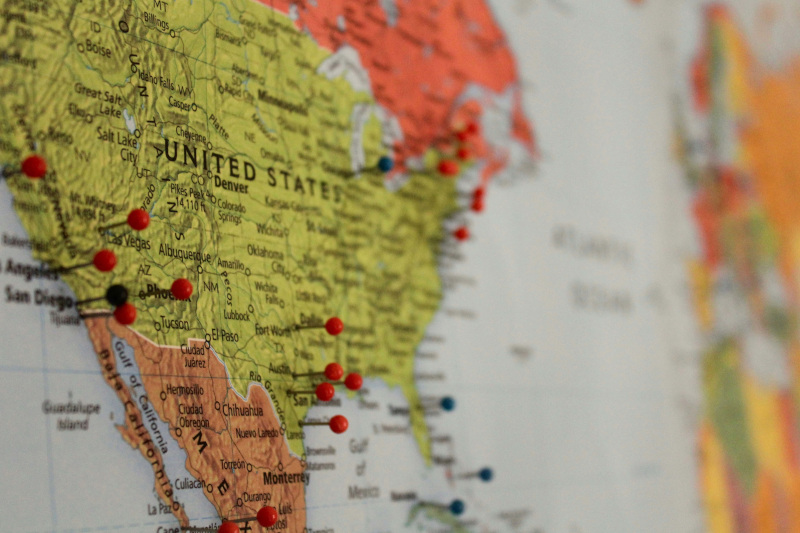
Maps can show the density of disease cases reported in a geographic region. Credits: Morgan Lane (Unsplash License)
Pockets of Measles Infections in the United States, 2024 to Present (2026)
Measles is an example of one such dynamic infectious disease threats to the region. It is a vaccine preventable, highly contagious disease caused by the virus Morbillivirus hominis. Measles is known for causing a splotchy rash, high fevers, and can result in serious complications particularly for those with weakened immune systems or are very young. The ongoing United States measles outbreaks spread in small clusters to Florida in February 2024 during the Points of Prescription project, but provider-patient interactions had already begun to show strain from the shifting legal boundaries related to immigration and vaccination in the state. A pediatrician explained to our student observer the spaces of the clinic that immigration officers were “legally prevented” from entering, and information sheets were given to patients about their rights in the clinic. Still, appointment cancellations for the pediatric clinic in the study increased when immigration enforcement activity rose in the region. In September 2025, the Surgeon General of the state, Dr. Joseph Ladapo, compared childhood vaccination requirements to “slavery” and the rights of parents to refuse vaccines as allowing for “God’s will.” The Palm Beach County-based pediatrician for my own child recommended an early (extra) dose of the measles vaccine prior to travel due to the expansive reach of the ongoing outbreaks, commenting that she was sorry I had to deal with the “irresponsible” acts of others.
What I was seeing in talking to frontline healthcare professionals was fear of the impact were an outbreak to occur in South Florida and frustration at the lack of support in public conversations featuring state healthcare representatives. They had reason to worry. Figure 1 shows the surge in cases since the start of 2026.
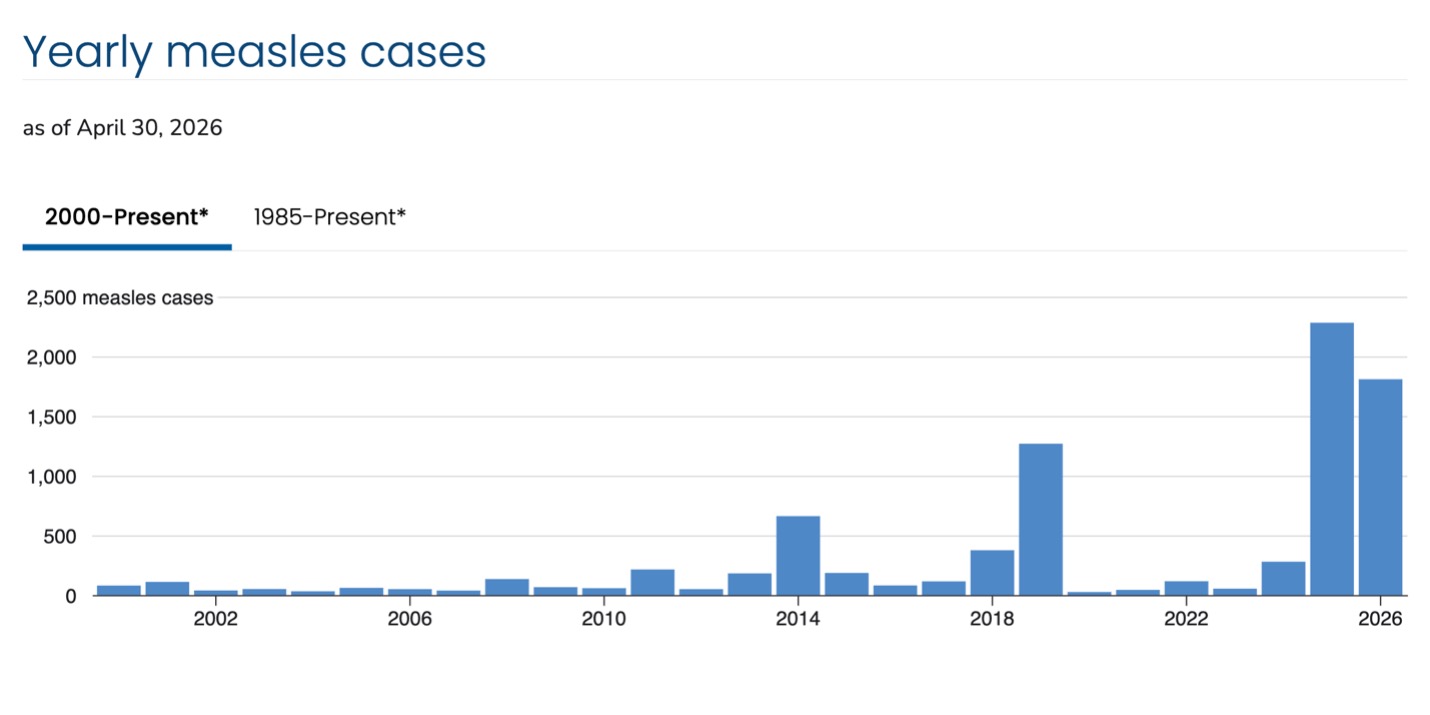
Figure 1. Measles cases in the United States since 2000. Source: Measles Cases and Outbreaks. May 1, 2026. https://www.cdc.gov/measles/data-research/index.html, accessed May 2, 2026. Reference to specific commercial products, manufacturers, companies, or trademarks does not constitute its endorsement or recommendation by the U.S. Government, Department of Health and Human Services, or Centers for Disease Control and Prevention.
In early 2024, the National Emerging Special Pathogens Training & Education Center announced the following situation report:
“From January 1 to March 14, 2024, the Centers for Disease Control and Prevention (CDC) has recorded 58 confirmed cases of measles across 17 jurisdictions in the United States. These cases have been attributed to seven outbreaks, compared to the 58 total cases in four outbreaks reported throughout the entirety of 2023. Ninety-three percent of the reported cases in 2024 are linked to international travel. Among the affected individuals, the majority are children aged 12 months and older who have not received the measles-mumps-rubella (MMR) vaccine.”
In the two years since this report was released, the largest clusters of confirmed measles cases were reported in Texas, Arizona, and South Carolina. Since the start of 2026, additional large clusters of confirmed measles cases have been identified in Utah and in Florida. The sheer number of hotspots of United States measles cases in 2025 and 2026 can be viewed on a Johns Hopkins University tracking website reminiscent of their now well-known COVID-19 tracker. The United States measles cases in 2026 are shown below in Figure 2.
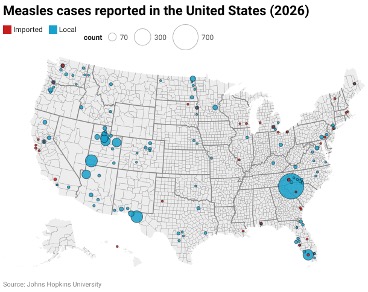
Figure 2. This map shows the spread and density of measles cases in the United States since January, 2026, to May 1, 2026. Developed by the John Hopkins University, the map takes data from official sources and continues to be updated as more cases are reported. Source: U.S. Measles Tracker: Tracking Measles Cases in the U.S. https://publichealth.jhu.edu/ivac/resources/us-measles-tracker, accessed May 1, 2026.
References to pockets and areas of spread signal the geographic focus of public conversation about the measles spread. North Florida-based pediatrician Dr. Mark Toney was interviewed by the National Public Radio affiliate WUSF, stating, “It is unusual to have cases of measles, period,” Toney says. “For us to have little pockets like this is even more unusual.” Dr. Toney’s remarks highlight the distinction between a case here and there, and a group of cases in close geographic proximity.
Tracking maps like these make visible the clustering effect of infectious disease outbreaks, with larger circles representing a greater count of individuals with confirmed infection. Identifying and reacting to these regional outbreaks of measles infection is a function of the public health infrastructure that is now being fractured through funding and personnel cuts by the Trump administration. The day to day work of research staff at state and local health departments includes gathering and analyzing data on infectious disease spread, work that is essential to visualizing and responding to outbreaks.
In 2026, there are pockets of infection in almost every state according to Figure 2, though the largest hotspots not generated from imported cases appear to be present in primarily Republican-leaning states. There is less unpredictability in the disease spread seen here, and more of the anticipatory action that Ben Anderson (2010) argues makes an imagined future into something that both causes and justifies present action. As one South Carolina pediatrician and infectious diseases specialist stated for Scientific American, “Measles anywhere is a risk everywhere.” And while this is true, high concentrations of unvaccinated communities can help facilitate spread, as happened in the mid-1990s in Missouri and Illinois (Centers for Disease Control and Prevention 1994). Considering continued resistance to vaccination and accelerated changes to childhood vaccination schedules, the future of measles in the United States will err on the side of peaks of confirmed cases rather than valleys of vaccine protection.
Perspectives on Hotspots as a Visual Tool
The scientific literature is adept at recounting the last twenty five years of measles spread in the United States. From disease elimination in 2000 (Feemster and Szipszky 2000) to the rise in vaccine hesitancy continuing into the 2000s, from early outbreaks often associated with travel and imported cases, and now widespread outbreaks as represented in Figure 2 (Edward 2026; Bednarczyk and Sundaram 2025; Tahir et al. 2024; Bidari, Yuan, and Yang 2026). Scientists have provided evidence that there is an association between increased vaccine refusals and increased numbers of new measles infections (Bednarczyk and Sundaram 2025). The science is clear, but this was never about science alone.
Maps containing hotspots are sociotechnical objects (Latour 1988) rather than scientific communication alone in that they serve to solidify the cultural imaginaries surrounding the intensification of disease spread. Maps containing hotspots are the co-produced (Jasanoff 2004) visual that links public cultures of infection (Caduff 2015) to the fragmentation of public health infrastructure. The fact that Figure 2 not only shows where measles is spreading but can also be read as the locations where rates of vaccine refusals have been on the rise involves the political as a vector of disease. And if maps showing infectious disease spread are sociotechnical objects, they are also visual culture formed to fit the fears and understandings of the present moment (Lynteris 2022). Hotspots, therefore, were never clear and accurate depictions of who is getting sick.
Brown and Kelly (2014, 283-4), drawing from multispecies ethnography, claim:
“Studying the hotspot ethnographically locates transmission within dynamics that may include ecological abundance and economic scarcity, social proximity and administrative distance, convergence and fragmentation, excess and lack. But further, as we describe in greater depth below, it shifts focus away from establishing causal patterns and instead to the persistent and shifting spatial, material, and historical copresences that shape viral amplification.”
What Brown and Kelly describe has, in this reading of the United States measles outbreaks, aligned in all its political, institutional, and cultural context to form the basis for the resurgence of a previously eliminated disease.
Nading (2023) works through the political economy and labor implications of the term “hotspot,” showing the necessity of recognizing the long histories existing prior to and in formation of a disease event. Nading (2023, 4) states, “Critical scholarship recasts the hotspot as something more material: a slower-moving phenomenon, a more accretive form of both interspecies becoming and structural and environmental violence.” The frontline healthcare professionals who participated in the Points of Prescription project were disappointed but not shocked to be dealing with the fracturing of healthcare infrastructure at a time when measles was also spreading again in their community. The roots of the hotspot are in place long before the tree grows.
Examining the concept of hotspots can start by identifying other, related terms used commonly in reference to placing infection. Terms like outbreaks, clusters, pockets, and area of spread are, at times, used interchangeably with hotspots, as Lessler and colleagues (2017) have usefully described. Beyond working through the lexicon of disease spread, an explanation based in ethnographic observation serves to highlight the entanglements—of space, of time, and of people— that form what we might refer to as hotspots.
The community-based providers who participated in the Points of Prescription project have front row seats to the recent waves of measles hotspots in the Florida region. Providers feel the multiple burdens acutely, from the threat of measles to the shifting procedures surrounding immigration enforcement. It is an impossible task for providers to navigate the intersection of national and state policy on vaccinations, public attitudes towards vaccination, local networks of infection-related care, and the spread of disease while also prioritizing positive patient outcomes. But it is precisely because these forces are intersecting to create the current climate of infection control that interpretation of public conversation surrounding the United States measles outbreaks should sit in context with frontline healthcare professional experiences. The hotspots that are highlighted, in Figure 1 and other visuals produced during the last two years of outbreaks, make clear the historical contexts of why hotspots appear in certain regions, the political influence over public health, and the need for an expansive understanding of the future(s) of measles in America.
Footnote
[1] Prior to conceptualizations of disease as a phenomenon that spreads over geographic regions, explanations of disease arose primarily from religious and spiritual traditions. For a cultural history of disease spread, see William H. McNeill’s Plagues and Peoples (1976) or James A. Trostle’s Epidemiology and Culture (2005).
This post is the second essay in a series examining the spatial, temporal, and conceptual boundaries of infection. You can read the first essay here.
This post was curated by Contributing Editor Tayeba Batool and reviewed by Contributing Editor Genevieve Collins.
References
Anderson, Ben. (2010). Preemption, precaution, preparedness: Anticipatory action and future geographies. Progress in Human Geography 34(6): 777–798.
Bednarczyk, Robert A., and Meenakshi E. Sundaram. (2025). The continued risk of measles outbreaks in the United States resulting from suboptimal vaccination coverage. Public Health Reports: 1-3.
Bidari, S., H. Yuan, and W. Yang. (2026). Assessing the transmissibility and outbreak risk of measles in the United States, 2024–2030. Journal of Infectious Diseases 233(1): 132–136.
Brown, Hannah, Ann H. Kelly. (2014). Material Proximities and Hotspots: Toward an Anthropology of Viral Hemorrhagic Fevers. Medical Anthropology Quarterly 28(2): 280-303.
Caduff, Carlo. (2015). The pandemic perhaps: Dramatic events in a public culture of danger. Duke University Press.
Centers for Disease Control and Prevention (CDC). (1994). Outbreak of measles among Christian Science students–Missouri and Illinois. MMWR Morb Mortal Wkly Rep. 43(25):463-5.
Edward, M. (2026). Resurgence of measles in the United States: Examining the outbreak, vaccine hesitancy, and future directions. Global Public Health 21(1): 1-5.
Feemster, Kristen A., and Christine Szipszky. (2020). Resurgence of measles in the United States: How did we get here?Current Opinion in Pediatrics 32(1): 139–144.
Latour, Bruno. (1988). The pasteurization of France. Harvard University Press.
Lessler, Justin, Andrew S. Azman, Heather S. McKay, and Sean M. Moore. (2017). What is a hotspot anyway? American Journal of Tropical Medicine and Hygiene 96(6): 1270-1273.
Lynteris, Christos. (2022). Visual plague: The emergence of epidemic photography. MIT Press.
Nading, Alex M. (2023). The plantation as hotspot: Capital, science, labour, and the earthly limits of global health. Medicine Anthropology Theory 10(2): 1–26.
Rynkiewich, Katharina, Sarin Gole, Sarah Won, and David N. Schwartz. (2023). Cultures of antibiotic prescribing in medical intensive care. Social Science & Medicine 324: 1-7.
Tahir, I. M., V. Kumar, H. Faisal, A. Gill, V. Kumari, H. M. Tahir, and M. A. Haque. (2024). Contagion comeback: Unravelling the measles outbreak across the USA. Frontiers in Public Health 12: 1-5.
