This article is a part of a series about stuckness in science and technology. Read the introduction to the series here.
On a sunny day in November 2021, I was taking a walk with two forest scientists, Junho and Minho (pseudonyms). Junho was then working as a junior researcher at a premier research institution in South Korea, whereas Minho was a Ph.D. candidate at a university lab. During my fieldwork with forest scientists from 2017 to 2023, I frequently encountered growing expectations that new field technologies—drones, high-resolution satellite sensors, or LiDAR (Light Detection and Ranging) devices—would replace some of the traditional fieldwork components that depended on diameter tapes, calipers, hypsometers, or increment coring. For many younger scientists, these field techniques were considered notoriously time-consuming, toilsome, and costly. While many of my interlocutors called such expectations a “hype,” Junho and Minho, as technophiles both in their early 30s, were excited about the introduction of such technologies to their fields.
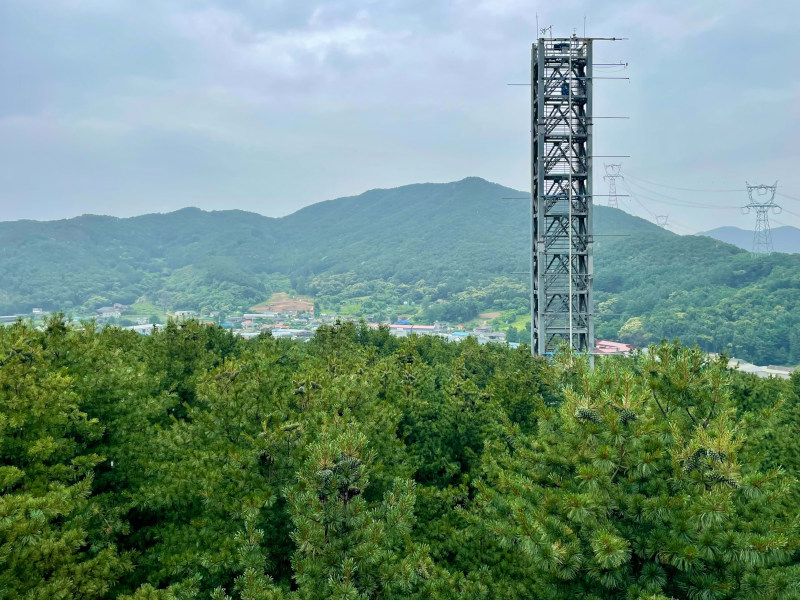
Forest sciences in South Korea have successfully replenished the country’s extensive mountain forests since the 1970s. Photo by author.
With great enthusiasm, Junho shared his experiences in testing drones and LiDAR at his laboratory and experimenting with practicable ways to apply them to field measurement. As I listened to their conversation, I asked Junho whether he had felt much difference between his previous university-based lab and his current lab funded by the government. He first lamented that his lab members, as public officers, usually do not have as much discretion in selecting research topics as they would at universities. However, “here,” Junho added, “I can use new technologies without worrying about their expenses.” That is, Junho could experiment with state-of-the-art devices that he couldn’t afford at his previous lab due to budget constraints. Junho further explained that such experiments would be an opportunity to catch up with their counterparts and colleagues in the “advanced countries” in the West, especially the United States. However, Junho quickly added:
I like playing with drones, LiDAR, and other fancy things here, but… when you look at the actual results of field measurement from them, they often turn out to be unreliable compared to those from the United States. To be honest, our country’s forests tend to have too many species and their geomorphologies are too complex to reliably use these technologies. I’m not sure whether we should continue using drones and LiDAR like [scientists in the United States] do. I wonder if it’s okay to waste massive amounts of taxpayers’ money on simply trying out such new technologies.
I was struck by his pessimistic answer, and asked him to clarify why he felt that way. Junho first seemed a bit hesitant, but gave me an answer: He was not confident that using new imported technologies could contribute something significant to forest sciences and scientific forestry in South Korea. He also added that both forests and forest sciences in South Korea had already reached a mature stage, leaving little room for scientific excitement or breakthroughs. I came to see that Junho was not just talking about a technical or methodological concern; his answer was also articulating a much deeper question about what his discipline is for in the present. Then Minho jumped into our conversation:
Minho: But we still have the “p’ŭraidŭ [pride],” you know. We have the pride of having created forests to this extent, despite there being no forests until the 1970s. I guess we can’t just let go of that pride; we just keep trying to do something.
Junho: To be honest, when my friends half-jokingly ask me “what do you do at [the institution]? The forests have all been created. Can’t they just live there on their own?” I usually don’t have much to say. I mean, since the 1970s, what great things have we [forest scientists] accomplished? Other than creating forests like these?
Minho: The task back then was to replenish [denuded] forests. And even though they are now all done, we still can’t let go of the pride.
Here, their short conversation encapsulates something I want to think with throughout this essay: a particular form of professional anxiety—which I characterize as a kind of “stuckness”—born not of failure or stagnation, but of historical success. Junho’s reservation about new field technologies, and Minho’s refusal to “let go of the pride,” are not simply generational moods. Rather, their exchange registers a temporal dissonance that hums beneath South Korean forest sciences today: the accelerated rhythm of new field technologies and knowledge production; the institutional inheritance of “successful” reforestation; and the slow, open-ended lifetimes of the postcolonial forests themselves. This essay traces how this particular form of stuckness took shape, how it bears on state-aligned, postcolonial sciences, and how scientists try to re-ground themselves when their founding mission has, in some sense, already been accomplished.
The Korean Peninsula experienced centuries of chronic deforestation due to local overuse, which was exacerbated during Japanese colonial rule (1910-1945), especially during the Second Sino-Japanese War and the Pacific War, and the Korean War (1950-1953). However, as Minho and Junho mentioned—and as their teachers repeatedly emphasized in undergraduate classes—forests in post-war South Korea recovered remarkably, especially during the 1970s and the 1980s. Historian of science Moon Man-yong called this historic transformation the “dual green revolution” (rice and trees), which involved mobilizing millions of citizens and government officials to restore devastated forests and to maximize crop production (Moon 2010). The rich, green landscapes that now extensively populate the country serve as a living symbol of national reconstruction in the wake of colonialism and war. This recent formation of human-made forests in South Korea indicates that forest-related projects have been an integral part of the country’s postcolonial nation-building projects after 1945.
However, these forests, while still standing as national symbols, live on lifetimes that exceed the particular campaigns in the past that created them. The pine, larch, and many other species planted in the 1970s and 1980s have grown into more mature stages, and the long-term trajectories of these anthropogenic stands—their succession dynamics, responses to a warming climate, slow processes of soil recovery and increasing biodiversity—will continue to unfold over decades, if not centuries. Forests, in this sense, are not simply the remnants of past intervention but ongoing, living processes whose timescales stretch well beyond the careers of individual scientists and the horizons of any single administration. Therefore, these extended forest timelines are never abstract; they have become the very working conditions of forest sciences today.
Working on these novel yet fragile ecologies, forest sciences have received strong government support, and have been able to implement extensive monitoring and interventions throughout the country. What Minho characterized as “pride” points to such institutional alignments and affinities with state-level imperatives. As fieldwork went on, I came to understand that this institutional privilege was actually double-edged. On the one hand, many forest scientists could exercise an authority grounded in their expertise and entertain certain entitlements based on their institutional standing with the (post-)developmental state, such as advisory roles in policy-making, stable funding for long-term projects, and historical recognition for their discipline’s role in national recovery. On the other hand, they remain keenly aware that their funding streams and research priorities are subject to the shifting agendas of successive administrations. In the end, Junho’s drone and LiDAR experiments had not been his own initiatives; rather, they were assigned by his institute as part of its efforts to align with current government interests in “smart forestry.” Their expertise, in this sense, has been institutionally privileged, but also politically contingent.
Indeed, forest sciences in postcolonial South Korea emerged through an alignment with the developmental nation-state that resembled, but also intensified, what Chandra Mukerji characterized as an “elite reserve labor force” that remains “on call” for state imperatives in the context of U.S. Cold War science (Mukerji 1989, 5). South Korean forest scientists were not merely on “reserve”: they were also actively recruited, commissioned, and deployed in the national reforestation campaigns after 1945. Their expertise in forest regeneration was legible, both scientifically and publicly, and their discipline’s relevance was unambiguous during that time. In 2025, I met with Dr. Shin,* a retired scientist in his early 80s, well known for his lifelong achievements in wood anatomy. I came to learn that he started to study forest sciences in the 1970s as an undergraduate, and I asked why he had chosen the field in the first place. “Everyone who went to college was national elites back then,” he answered, “and most of my friends wanted to major in engineering and contribute to national development. But I happened to meet a forest science undergraduate who came to my high school, and he told me that if I majored in forest science, I would be able to contribute to the nation through transforming 70% of the entire territory. I was struck by his words, and that’s how I ended up majoring in forest sciences.” For his generation, forest sciences were a vocation defined by a close alignment with postcolonial reconstruction projects—and that particular alignment, in turn, conferred both purpose and prestige for their discipline.
I notice, however, that this historical ground is what makes younger scientists like Junho and Minho feel stuck. The remarkable success of the reforestation campaigns in the 1970s—the billions of trees planted during that time, the green landscapes that now define the country—continues to inform the present. Minho’s repeated invocation of “pride” is not merely a personal feeling; it also refers to an institutional heritage that continues to authorize ongoing scientific projects in the present even after their original grounds appear to have been fulfilled. His words—“we just keep trying to do something”—captures this particular tension: the work continues, but without a clear mission that their predecessors once had.
The inability to “let go of that pride,” as Minho mentioned, also shows how the past continues to haunt their self-understanding, professional identities, and institutions. Dr. Shin’s recollection above echoes within Minho’s words: the sense of contributing to the nation-state at a transformative scale was something the previous generations could take for granted, but it is a legacy, not a new mission or horizon, that the younger generation both inherits and inhabits. And Junho’s (melancholic) skepticism about imported, cutting-edge technologies reflects not just methodological cautiousness or prudence, but a deeper uncertainty about legitimacy in an era when the historical raison d’être of his field has been seemingly accomplished.
If this particular form of stuckness is born of historical success as I suggested above, what gives it its particular weight is how that success continues to inform everyday practice and professional identity today. Resonating with field scientists in oceanography and Antarctic sciences (Helmreich 2023; O’Reilly 2017), the day-to-day work of younger forest scientists, such as Minho and Junho, is characterized less by spectacular breakthroughs or new discoveries than by procedural, long-term, and routinized measurements and observation. But this seemingly-mundane character of their everyday work carries an added weight: it unfolds not only within the extended temporal horizons of postcolonial forests but also within institutional inheritances built around a past that looms more impressive than the present. In a recent ethnography, Fearnley and Sun (2025) show how young rice geneticists in China find themselves sandwiched between plant timelines in labs and the accelerated pace of scientific competition. Young forest scientists in South Korea face an analogous bind, but it is also stretched across forest lifetimes of decades or even centuries, and haunted by a foundational storyline of remarkable success that retrospectively renders subsequent projects anticlimactic.
Here, the concept of stuckness sheds light on how the intersection of professional careers, institutional histories, and ecological processes creates specific forms of scientific identity and expertise in a postcolonial country. It also points to a particular condition of state sciences whose authority, funding, and public relevance are tightly bound to political projects and governmental imperatives (cf. Scott 1998; Mukerji 1989). When their state-led projects succeed, like South Korean reforestation campaigns arguably did, the scientific expertise that made such successes possible may find itself stranded: institutionally inherited and (once) publicly endorsed, but no longer animated by the very projects that once gave it prominence. In this light, stuckness is not simply a case of intergenerational moods, but a symptom of broader structural and historical conditions that characterize how state sciences work across different contexts. At the same time, stuckness illustrates how scientific expertise can be deeply tied to more-than-human histories, such as anthropogenic forests, whose timescales extend beyond the lifetimes of individual scientists and the institutional horizons that frame them.
Yet I want to suggest that being stuck in the trees is not simply a condition of paralysis, confinement, or even degeneration. In the end, the daily work scientists do still places them among the trees. Even when Junho articulated his melancholic skepticism, he was still actively testing drones and LiDAR in his lab, trying to find ways to improve the working conditions of scientists and technicians in forests. Likewise, Minho’s words—“we just keep trying to do something”— also gesture toward how being stuck can still be generative and open-ended. Taken together, forest scientists continue to sustain certain forms of persistence, experimentation, and reflexive questioning, which might be rarely registered as “breakthroughs” but still inform what forest scientists could do in “mature” landscapes (both institutional and ecological) in a postcolonial context. Dwelling with stuckness, therefore, asks us to attend to the slow, ongoing labor through which scientific expertise attempts to re-ground itself in changing worlds that extend beyond individual careers and particular historical junctures.
* Name changed
This post was curated by Contributing Editor Michelle Venetucci and Shoko Yamada, and edited with the help of Contributing Editor Juan Ospina.
References
Fearnley, Lyle, and Chen Sun. 2025. “Green Involution: Mediating Plant Times and Lifetimes in a Chinese Rice Genetics Laboratory.” Cultural Anthropology 40 (3):435–62.
Helmreich, Stefan. 2023. A Book of Waves. Durham: Duke University Press.
Moon, Man-yong. 2010. “Ijungŭi Noksaek’yŏngmyŏng: Pakchŏnghŭi Shidae Shingnyangjŭngsan’gwa Sallimnok’wa” [The Dual Green Revolution in South Korea: Reforestation and Revolution under the Authoritarian Regime]. Jeonbuk Sahak 36:155–184.
Mukerji, Chandra. 1989. A Fragile Power: Scientists and the State. Princeton: Princeton University Press.
O’Reilly, Jessica. 2017. The Technocratic Antarctic: An Ethnography of Scientific Expertise and Environmental Governance. Ithaca: Cornell University Press.
Scott, James. 1998. Seeing Like a State: How Certain Schemes to Improve the Human Condition Have Failed. New Haven: Yale University Press.
