The EU Nature Restoration Legislation was finally adopted in 2024, after going through the rounds of the EU parliament since 2022. The passing of the law marks a key moment in the EU’s pursuit of the European Green Deal, adopted in 2019. The European Green Deal is the EU’s growth strategy aimed at putting EU on the path to a green transition, with the ultimate goal of reaching climate neutrality by 2050. The ambitious Nature Restoration Legislation is expected to provide legal instruments to facilitate the restoration of declining ecosystems across the European Union. It supports some of the key goals of the biodiversity pillar of the Green Deal (the EU Biodiversity Strategy 2030), akin to how the European Climate Law (Regulation (EU) 2021/1119) sets legally binding climate neutrality targets for the member states. Some of the measures outlined in the regulation include supporting sustainable agriculture, greening cities and towns, protecting pollinators, and restoring wetlands and rivers.
The Usual Suspects: Mapping the Opposition to Environmental Regulation in the European Union
It is neither unprecedented nor surprising that this seemingly radical and far reaching legislative reform faces intense opposition in diverse locales of the public sphere within the EU. Climate change mitigation and environmental protection measures are innately fiercely polarising and contested. However, most analyses of these debates explain them away in terms of broadly categorised interest groups, often referred to as ‘lobbies’. While the logic of interest- group politics is fine, the devil is in the details. As a researcher interested in social processes and sustainability working in the Czechia, in this article, I delve into the politics of knowledge claims around this EU law, and its adoption in the EU member State.
The general analysis of the law notes that it finds allies and supporters in the strong pro-environmental lobby and civil society groups in the Czechia. Also, the usual suspects, the strong agribusiness lobby in the country, are expected to oppose the implementation of the provisions of the law tooth and nail. This feels all the more intuitive given the popularity of the industrialist-politician Andrej Babiš, who is now at helm of the current Czech government. However, looking closely at the public discourse pertaining to Nature Restoration Law in Czechia, one observes that the lines against which these interests cleave and coalesce remain fairly blurry. Even in the EU parliament, 21 members from the conservative party, the European People’s Party (EPP), voted in favour of the law, which contributed significantly towards tilting the outcome in the favour of the adoption of the law, reaffirming the volatile nature of interest group allegiances.
Neither East, Nor West : Nature Conservation in Central Europe
Within Czechia, I look at the articulation of opposition of the provisions of the regulation by two key groups. The Association of Private Farming of the Czech Republic (ASZ ČR) and the Association of Municipal, Private, and Church Forest Owners in the Czech Republic, commonly referred to as SVOL (Sdružení vlastníků obecních, soukromých a církevních lesů v ČR). Environmental policy analysts note that one of the most important next step to further the implementation of the act across EU member states would be to facilitate a reconciliation between the agricultural groups and forestry groups, the two key contending ‘lobbies’. Additionally, within the agricultural groups, as a rule of thumb, big business lobbies such as Copa-Cogeca, are known to rally against pro-environmental outcomes while the small farmers’ organisations are touted to have a generally favourable view of these measures. However, a closer introspection brings forth the specificity of fissures within these known constituencies. In the Czech context, the Association of Private Farming of the Czech Republic (ASZ ČR) has been known to distance themselves from Copa-Cogeca owing to their divergent positions on farm subsidies under EU Common Agricultural Policy (CAP), environmental regulations and Green deal targets. However, contradicting the intuitions that only big businesses and industrialists will oppose the nature conservation regulation, private farming groups and private forest owners’ groups expressed serious concerns against it. These groups support the broader logic of nature conservation, but they argue that the law attempts to reinforce what these actors call as ‘Brussels (European Parliament) driven technical metrics’. Spokespersons of SVOL frame the mandates of EU nature restoration directives as protectionist maximalism (ochranářský maximalismus).
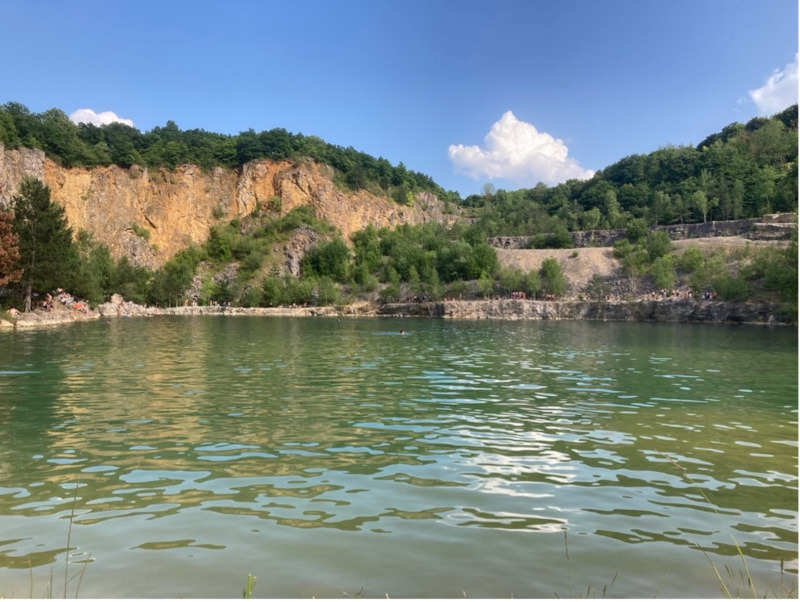
The Czech Karst, a protected landscape area. Photograph by the author.
These actors argue that EU policies ignore the specificity of the central European forestry context, specifically ecological crises such as the bark beetle outbreak. The outbreak rendered vast stretches of Czech forests barren, leaving vast swathes of uncleared deadwood in the region. This makes metrics such as the ‘standing deadwood indicator’ not only unviable in the context, but rather extremely hazardous, creating the danger of forest fires. This shows that not only the said conflict between agricultural and forestry groups is a false binary, the very categories of ‘agriculture’ and ‘forestry’ have a complex constitution. Coming from a completely different positionality, the supposedly pro-environment groups find themselves in the company of the agribusiness lobby that has been leveraging the purported threat to food security to oppose the law.
Claim No Easy Victories : The Luminous Nature of the Politics of Knowledge
In the past few decades, contestations around knowledge claims, standards, indicators, targets, and definitions in key areas such as environmental and climate regulation, air quality, and nature protection have become more and more common. Indices for air quality, discount rates in the case of climate policies, definition of protected areas are some interesting examples. Even as the phrase evidence-based policy enjoys popular currency in international governance, scientific and legal authorities are increasingly contested as ‘scientific’ knowledge that forms the basis of the authority has been shown to be malleable. For instance, when Delhi’s air quality levels reached frightening levels in 2025, the government moved quickly to change the category labels associated with air quality thresholds, hence, redefining the projected health risks. The debates in Czechia around the implementation of Nature Restoration Law (NRL), particularly around what counts as legitimate indicators and targets for conservation bring these points home sharply. Additionally, while most analyses define the opposition to NRL as a grid lock between major interest groups, the contradictions of interest group mobilizations in Czechia show that it is myopic to lean into vaguely defined phenomenon such as ‘lobbying’ as new constituencies are always under a perpetual process of construction and deconstruction.
One might ask, if interests, constituencies and social structures are always in flux, why should one engage in the futile practice of discussing how knowledge claims are mobilised in controversies such as the NRL? I argue that taking a closer look at the actors, and the dynamic constituencies they bring along, the epistemological and material resources they deploy could help us situate these knowledge claims better. As the Czech case underlines, these strategies interact with the social, historical and political context of the country, and that it could be perilous to omit the nuances and contradictions in the positions of broadly classified interest groups.
This post was curated by Contributing Editor Thomson Chakramakkil and reviewed by Contributing Editor Ritu Ghosh.
References
Aubert G., Underwood E. (2024). The Nature Restoration Law – A Hard-Fought Victory for Biodiversity and Society. Institute for European Environmental Policy.
Matěj Moravanský M. (2023, 12. července). Martin Rexa: Schválení evropského zákona
o obnově přírody je i v zájmu zemědělců. Denik Referendum.
