Seeing, Acting, Believing: The CyberKnife and the Transformation of Medical Imaging
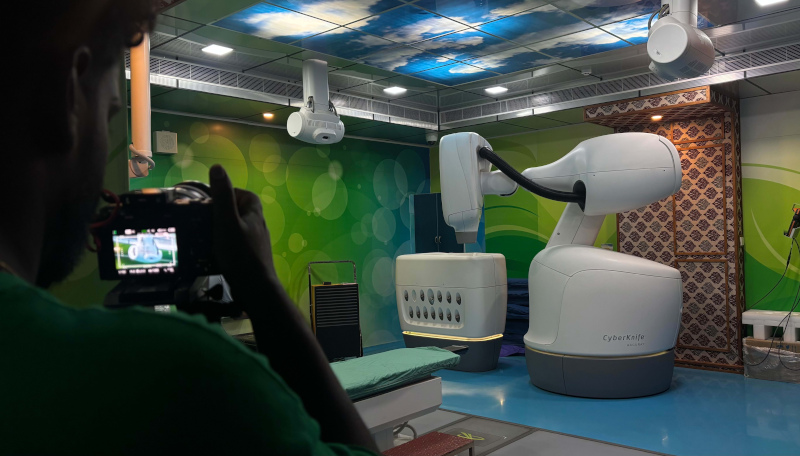
Dr. Sinha is the anti-Benjamin of our times. He asks his patients to believe in the aura of the machine. When I meet him in the treatment room at the corner of the Radiation Oncology wing on a Thursday afternoon—its ceiling painted blue with drifting, improbable clouds—he speaks in paragraphs, waxing lyrical about the CyberKnife’s precision. The CyberKnife’s industrial robotic arm, he tells me, is a direct import from the automobile assembly line. At his cue, the technologists in the control room set it in motion. The arm whirrs as it moves along three linear and rotational axes; it is designed to track the movements of the patient’s body in real time. Dr. Sinha walks me through each piece of the ensemble: the ceiling-mounted x-ray machines that track the tumour’s position, the large linear accelerator that charges the radiation beam, a phantom skull laid on the table for setting delivery coordinates. “High dose and minimal margins,” he insists, “is the future of radiation therapy.” (read more...)
