
Author Archives: Katharina Rynkiewich

Katharina Rynkiewich is an Assistant Professor of Anthropology at Washington State University, funded in part by the National Science Foundation. She holds a PhD in Anthropology from Washington University in St. Louis and a MA in Social Sciences from the University of Chicago.
The image shows part of a map of the contiguous United States with red and green pins in different places.

The Hotspot as a Sociotechnical and Political Object: Frontline Healthcare Professionals and Public Conversation alongside the Intensification of a U.S. Measles Outbreak

John Snow’s 19th century dot-map (from the series introduction) is representative of a shift in the public management of infectious diseases towards measuring density of confirmed cases within a geographic region. This practice is referred to in epidemiology as spatial clustering and as “hotspots” more colloquially. Today’s outbreak investigations use visual representations of disease spread as a standard practice. Johns Hopkins’ COVID-19 tracker was one such communicative tool for showing the intensification of an outbreak across space and time. The visual becomes representative of a more than normal number of confirmed cases in spatial and temporal balance, to allow the viewer to identify what we reference as hotspots. In what follows, I will examine the utility of the term hotspots through an investigation into the public discussion of the current United States measles outbreaks (2024—) put in contrast with the localized practice of frontline healthcare professionals in South Florida. I will show how hotspots have meaning beyond their colloquial uptake as clear and accurate representations of who is getting sick. (read more...)

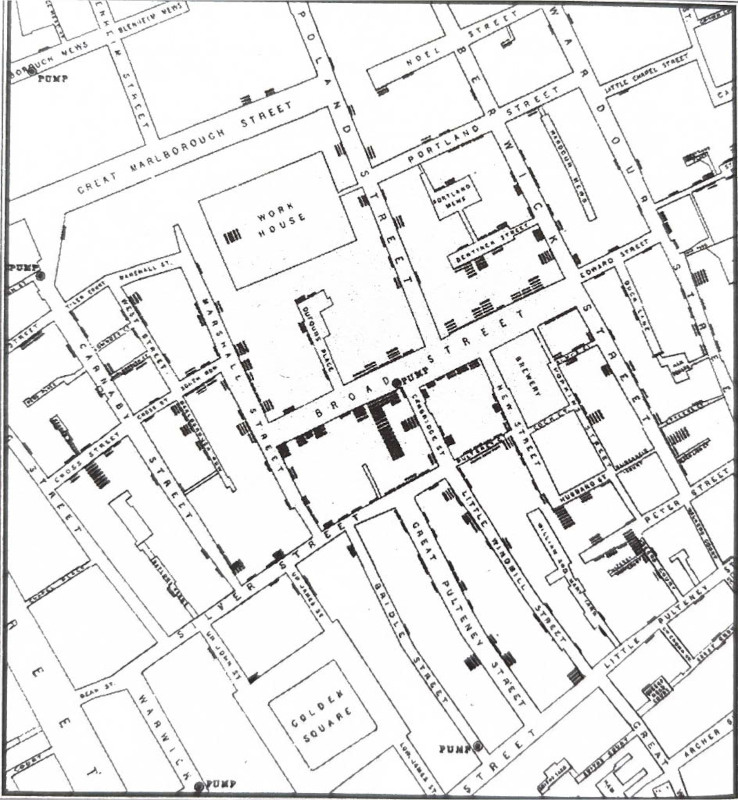
A detailed black-and-white map of a 19th-century London neighborhood, showing square dots that indicate cholera cases, which concentrate around Broad Street.

From Hotspots to Outbreaks: Keywords for (Un)Grounding Space, Temporality, and the Boundaries of Infection

This special series examines the spatial, temporal, and conceptual boundaries of infection. As a primarily analytic approach, the authors in this series unpack epidemiologic keywords such as outbreak, hotspot and epidemic, to assess their uptake, uses and meanings amongst scientists, public health and healthcare practitioners, experts and broader publics. As disruptions to public health ripple through the healthcare landscape in the United States, and whilst the global COVID-19 pandemic continues to haunt our collective present, the fundamental terms or “keywords” through which we understand disease transmission demand ethnographically-grounded inquiry, critique, and theorization. The posts in this series look at how infectious diseases and their conceptualizations spread through space and time, as well as how ethnography can articulate the expansive, lived realities of infection. (read more...)