Digital tools, such as WhatsApp, have offered methodological opportunities for connection, data collection, and the democratization of knowledge production, in part because they are easily accessible and affordable. These advantages notwithstanding, we must critically reflect on the limitations and ethical implications of these digital platforms (Leurs, 2023; Lintner, 2025; Mavhandu-Mudzusi et al., 2022). This is especially true regarding concerns about data sensitivity, data surveillance, and data security and storage by third-party providers (Leurs, 2023; Tomás & Bidet, 2024). Given the heightened ethical scrutiny surrounding the use of social media as tools of research, it is likely that scholarship and ethics committees will continue to critically assess the use of platforms such as WhatsApp, despite its accessibility to many (Lavorgna & Sugiura, 2022; Wilson et al., 2026).
In the paper “My Phone Is Like My Office” three uses of WhatsApp during and after research are discussed: (1) WhatsApp as a tool for private communication with research participants; (2) WhatsApp as an observation tool through its status update feature; and (3) WhatsApp as a platform for coordination, discussion, and collaborative reflection among the authors during the writing process (Wilson et al., 2026). For this blog, I focus on the last use.
This blog contributes to the discussion of techno-ethics and feminist AI by critically reflecting on the use of WhatsApp during the joint process of writing an academic paper. The main argument being that digital tools, such as WhatsApp, can promote the inclusion of highly relevant analyses and insights by authors who feeling uncomfortable with and excluded by academic (English) jargon, see themselves hampered to participate in written knowledge production.
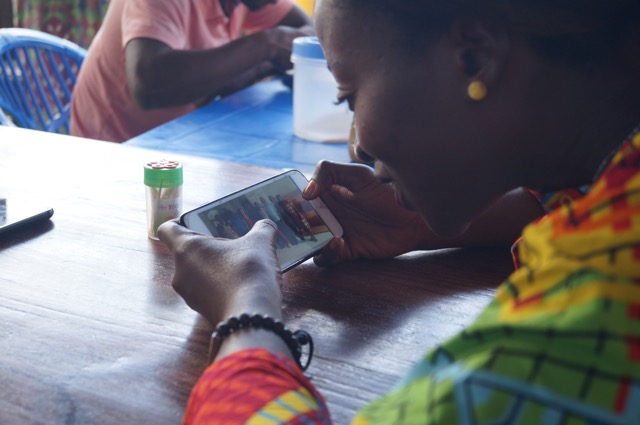
A migrant woman in Dar es Salaam looks at photographs on her smartphone (photographed by Christina Wilson, 2019).
The Context of Research
Between 2019 and 2022, together with DIGNITY Kwanza, a Tanzanian human rights and advocacy non-governmental organization, and as part of a larger project (TRAFIG)[1] , we investigated how vulnerable migrants in refugee like situations use mobility and transnational and local networks to manage their everyday lives (Wilson et al., 2021). For this purpose, we collected information among DIGNITY Kwanza’s clients who self-identified as vulnerable migrants in Dar es Salaam. Even though the use of social media was a salient theme from the outset of the project, we did not think of social media entrepreneurship as a central part of our research (Wilson et al., 2026). Its relevance stood out during COVID-19 and especially after January 2020, when the national biometric SIM card registration was imposed for all mobile phone users in Tanzania by the government. As from that date, without an identity card or another legal document, potential users were not allowed to activate a pre-paid SIM card. This regulation impacted the daily lives of vulnerable, often times undocumented, migrants deeply (Wilson et al., 2026).
The research design for this project followed an ethnographic approach that combined face-to-face interviews, focus group discussions and observations. As we exchanged phone numbers with participants, this face-to-face rapport was enhanced with communication through social media. We soon noticed various women engaging in social media entrepreneurship for a living by posting products and services on their status update features (Wilson et al., 2026). When the biometric SIM card registration was enforced, thwarting the access to social media and WhatsApp, we understood that it would impact the women’s possibilities of practicing social media entrepreneurship (Wilson et al., 2026). What would happen to them without digital access to promote their businesses? In many cases, what had been at first a fruitful path to find a means for livelihood suddenly came to a halt. Both vulnerable migrant men and women were excluded because of increased enforcement and not being able to present the required legal documentation (Wilson et al., 2026). For women there was an extra dimension that played a role: not having the right documents to register a SIM card made them susceptible to undesired sexual advancements. We collected narratives by women complaining that registrars were willing to close their eyes and to provide a SIM card to migrant women in exchange of a sexual interaction. Here access to social media was not synonymous to opportunity but turned into a liability (Wilson et al., 2026).
It needs to be noted that digital communication was only possible because we had been able to establish previous bonds of trust offline during periods of traditional ethnographic research. Herein, the longstanding personal relationship between DIGNITY Kwanza and its clients, played an important role (Wilson et al., 2026). Digital ethnography and digital tools cannot replace ethnographic presence or personal connections (Tomás & Bidet, 2024); they add to it. Also, among the authors, it was only after having laid down the first bricks for a relationship in person that WhatsApp helped us to keep in touch and enabled multi-directional and multi-modal conversations (Lintner, 2025), even long after the fieldwork period came to an end.
The Process of Writing Authoring
As we observed social media entrepreneurship on our phone screens, and we collected data through screen shots and follow-up digital interviews, we realized, as it so often happens in ethnography, that the process was part the object of research. We started focusing not only on our participants’ WhatsApp use, but also our own. Our exchanges, and the fact that we lived in different countries, thrusted us to set up a group chat among the authors. This was the first step in the writing process of the article. Our closed group in WhatsApp facilitated spontaneous reciprocity and unfiltered exchanges (Lintner, 2025). We used the group to keep in touch, for logistical coordination, such as scheduling meetings (in WhatsApp or Zoom), and to discuss ideas. As our schedules did not always align, synchronous meetings were not always possible. Voice messages then filled the void and proved to be an effective medium for discussing nuanced ideas asynchronously, i.e. by allowing each participant in the group to reply, and listen, at their convenience.
Voice messages, however, were part of a broader multi-modal exchange composed of written messages with direct responses, emojis, (edited) photographs, screenshots (with visual additions), links to Google Docs, PDFs and Word documents and more (see figure hereunder). Despite its joviality and informality, the joint platform stimulated an inclusive and analytical space for discussion and reflection. It also served as an archive. Because we churned through information in what became a collage of different formats, WhatsApp proved to be a useful tool to bridge the gap between the written and the non-written, as well as the gap between different writing styles, from jargonistic to informal. The exchange of content in the group helped sustain the interplay between different knowledge formats without necessarily placing them in a hierarchy. While not all authors were writing in the strict sense of the word; all authors were part of the process of exchanging ideas, adding nuanced details, and critical analysis.
Inspired by heterography (Blommaert, 2008), a way of reading texts which goes beyond strict standards of writing, and pluriversal literacies (Perry et al., 2023), an invitation to break away from strict ‘book smart’ hierarchies, I propose the term authoring. Following African feminists engagement in “making knowledge live beyond the walls of the academy” (Nyabola, 2024, p. 97) and with ‘conviviality’, as “a predisposition of curiosity with the experiences and views of others, an interest in their stories” (De Vries, 2024), authoring acknowledges not only the written, but also the oral, visual and multi-modal epistemological practices that precede and accompany the mechanical movement of fingers on a keyboard. Authoring acknowledges these practices not as complemental to the written but as core epistemological practices, without which the written cannot exist.
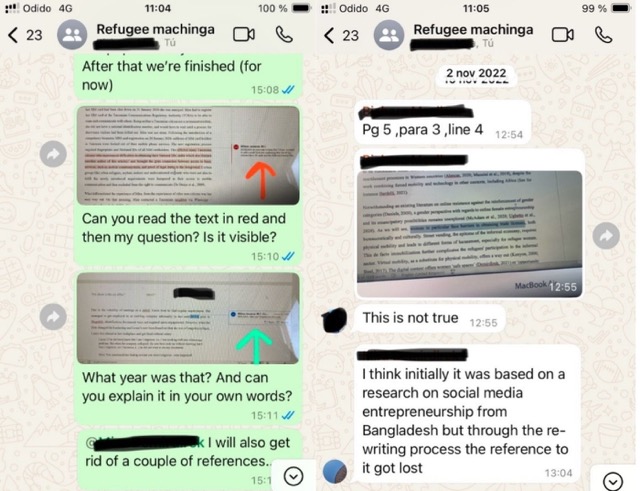
Two examples of the authors’ exchanges with relation to the writing of the article. These examples are taken from our three-membered WhatsApp group “Refugee machinga” in 2022. They include messages and computer screenshots. The left screenshot has additional colored arrows to emphasize certain issues and facilitate communication.
Concluding Thoughts
Fast forward to October 2025: a result of the Tanzanian elections being contested by the urban youth, was that the government shut down Internet for five days (Collord, 2025). Demonstrations accompanied by Internet cut-offs are not foreign to (post) electoral contexts in Africa (examples range from the Democratic Republic of the Congo and Burundi in 2015, to Chad in 2021 and Mozambique in 2024). In fact, Internet cut offs are implemented by oppressive regimes across the globe. Communication is a vital need, and in contexts in which it is hampered, people are quick to resort to Virtual Private Network (VPN) connections to continue communicating, informing and organizing themselves, as well as to seek emotional support (Lintner, 2025). In October 2025, for five days, Tanzanians were not only cut off from one another but also from world news and communication across the borders.
It felt contradictory that as youth demonstrations were taking place in Tanzania, we were concluding our article – and at the time we were unable to reach out to some of the authors. This contradiction acted as a reminder of how easy it is to shut people out of their basic rights to communication and information, especially when big companies comply with the rule of law set by governments. In these contexts, social media platforms like WhatsApp are readily shut off. The demonstrations were also a reminder that the online cannot be fully dissociated from the offline; as the former depends on materialities that exist and decisions that are taken outside the digital realm. Here too, like in the process of research, the digital does not exist without the offline world.
To conclude: While digital tools offer opportunities for the inclusion of research participants and researchers alike, especially in terms of knowledge production, writing and dissemination channels; these tools need to be used mindfully. It is important to consider that while social presence is not indispensable, it is hard to replace. In qualitative research, digital tools are best used in combination with moments of face-to-face contact. Moreover, as the use of digital tools evolves quickly, it continuously raises important ethical questions. This is an invitation not to shy away from using digitals tools in research and writing; but rather, to deepen methodological discussions (Tomás & Bidet, 2024) that push us to use these tools in an inclusive and mindful manner.
Note
[1] The Transnational Figurations of Displacement project was funded by the European Union’s Horizon 2020 research and innovation program (grant No 822453). See also https://trafig.eu/ (accessed June 2nd, 2026).
This post was curated by contributing editor Eva Rose Steinberg, with help from Tiên-Dung Hà.
References
Blommaert, J. 2008. Grassroots Literacy: Writing, Identity and Voice in Central Africa. Routledge.
Collord, M. 2025. After the coronation. AFRICA IS A COUNTRY. https://africasacountry.com/2025/11/after-the-coronation
De Vries, J. (2024). Centering Africa as context and driver for Global Health Ethics: Incompleteness, conviviality and the limits of Ubuntu. Wellcome Open Research, 9, 371. https://doi.org/10.12688/wellcomeopenres.22508.1
Lavorgna, A. & Sugiura, L. 2022. Direct contacts with potential interviewees when carrying out online ethnography on controversial and polarized topics: A loophole in ethics guidelines. International Journal of Social Research Methodology, 25(2), 261–267. https://doi.org/10.1080/13645579.2020.1855719
Leurs, K. 2023. Digital Migration (Eerste editie). SAGE Publications Ltd.
Lintner, C. 2025. Connected journeys: Exploring refugee lives through digital tools and mobile research. Qualitative Research Journal. https://doi.org/10.1108/QRJ-01-2025-0011
Mavhandu-Mudzusi, A. H., Moyo, I., Mthombeni, A., Ndou, A., Mamabolo, L., Ngwenya, T., Marebane, T., & Netshapapame, T. 2022. WhatsApp as a Qualitative Data Collection Method in Descriptive Phenomenological Studies. International Journal of Qualitative Methods (21). https://doi.org/10.1177/16094069221111124
Nyabola, N. 2024. African Feminisms as Method: Rethinking African Feminisms in the “New” Normal. Feminist Africa, 5(2), 94–112.
Perry, Mia, Marcela Ramos, and Nancy Palacios. 2023. “Changing Conceptions of Literacy: Pluriversal Literacies.” In Adult Education and Social Justice: International Perspectives, 1st ed., vol. 17, edited by Maria Slowey, Heribert Hinzen, Michael Omolewa, and Michael Osborne. Firenze University Press. https://doi.org/10.36253/979-12-215-0253-4.19.
Tomás, L., & Bidet, O. 2024. Conducting qualitative interviews via VoIP technologies: Reflections on rapport, technology, digital exclusion, and ethics. International Journal of Social Research Methodology, 27(3), 275–287. https://doi.org/10.1080/13645579.2023.2183007
Wilson, C., Demirdirek, M., & Kwanza, D. 2026. “My Phone Is Like My Office”: Refugee Women’s Social Media Entrepreneurship in Dar‐es‐Salaam. Social Inclusion, 14(0). https://doi.org/10.17645/si.10869
Wilson, C., Msallam, B., Kabyemela, J., Demirdirek, M., Sanga, J., & Ruhundwa, J. (2021). Figurations of Displacement in and beyond Tanzania: Reflections on protracted displacement and translocal connections of Congolese and Burundian refugees in Dar es Salaam (Working Paper No. 8; TRAFIG Working Paper, p. 36). BICC. https://trafig.eu/output/working-papers/trafig-working-paper-no-8
