The question that opens this text guides a research project that brings together two fields on the margins of social studies of knowledge, materiality, and technology: olfactory studies and textile studies. At this intersection, we seek to ethnographically explore a minor gesture: smelling the clothes of someone who is no longer present in an everyday, domestic context. In this exploration, we are confronted with thinking of writing, rather than as a means of describing what is perceived, as a way of being present; something that accompanies the gesture, that accounts for what happens when we smell, what is evoked and fabulated, something that also shapes the encounter itself.
These reflections began in mid-2025. Tania had been studying the power of textile-making for several years, inquiring, among other things, about the various rags that everyday people kept in the corners of their homes. There she had come across a recurring reference to how smell evoked absences. The question connected her to her history as a second-generation migrant, but she wasn’t sure how to follow that lead. Without a clear horizon, seeking a partner to think with, she contacted Ana, who had been working with sensible knowledge associated with smell in both gastronomic and chemical research contexts. She, a university professor like Tania, but also the mother of a 4-year-old, had found that it wasn’t always easy to align her questions with the tight schedules of the people who prepared their noses to study the aromas of tropical fruits in chemistry laboratories or evaluate the sensory profile of a coffee in a cupping lab. Meeting Tania represented an opportunity to research and think in plural terms about something closer and more feasible for her.
What follows is a conversation between the two of us about this encounter — of objects of study, but also of concrete people — and about what it has entailed, politically and methodologically, to imagine an ethnography of the infraordinary (Perec, 2008) that describes in order to contemplate and to pause.
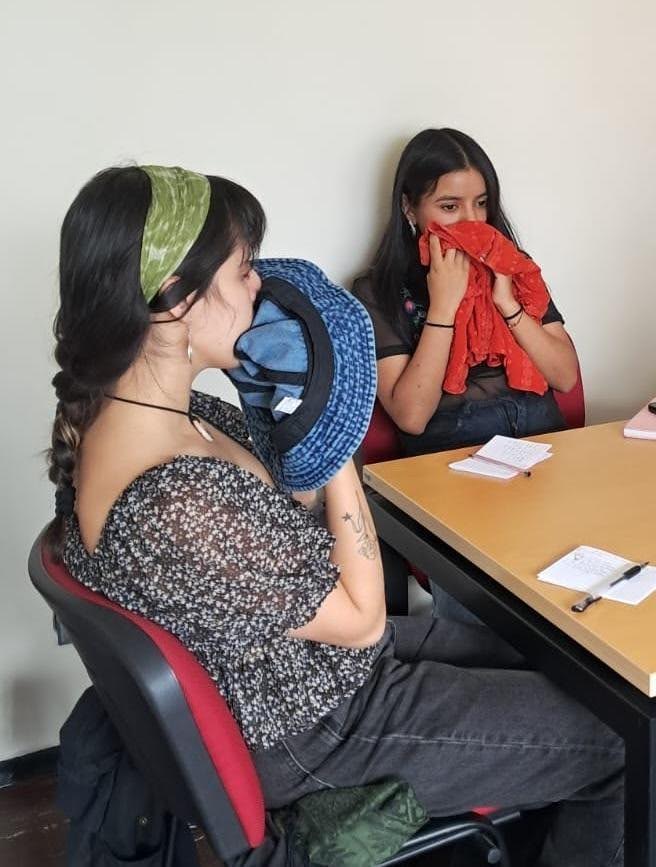
Students from the Semillero de Investigación in an olfactory exercise with someone else’s clothing. Photography: Research project archive, taken by Ana María Ulloa-Garzón.
Tania: Ana, tell us, how has this collaboration been and in what way has it challenged us?
We started in an exploratory way, recognizing from the outset that the object of our interest — the smell in clothes — was slippery. Rather than delimiting that ephemeral and volatile condition through a fixed research question, we agreed to explore it with others, gradually sharpening our understanding along the way. We were interested in collectively thinking about that relationship between smell and clothing, assuming that this would imply gathering around these materials and smelling them. The figure of the semillero de investigación — a Latin American pedagogical form in which undergraduate and graduate students develop research practice under faculty mentorship — that I led from the Universidad de los Andes, called anthropology of sensible knowledge, turned out to be a favorable institutional place for our meetings.
At first, we were not very clear about where we were heading. You wanted to learn about the particularities of smell, and I about the materiality of a textile gesture. The intersection of fields that deal with minor and everyday objects was attractive to both of us but was epistemologically and methodologically uncertain. A matter determined by the very nature of what generated our curiosity. With the first students we gathered with, we went through the uncertainty of this exploration asking ourselves several things at once. We inquired about the olfactory properties of different textile materials, seeing how the smell changed depending on whether they were of animal or plant origin. We saw how the porosity of the fabrics encapsulated the aromas with which these surfaces come into contact: the body odors of whoever wears them, of the places where they are found, of the cleaning products with which they are washed. We invited the group to pay attention to practices aimed at the elimination or transformation of smells in clothes in the domestic sphere and to inquire about the affective dimensions of these practices. We noticed that ethnographic writing was difficult, that the smell became elusive in the descriptions that the students made of their exercises.
The following semester, we reopened the semillero, seeking to articulate our research with our pedagogical practice. In addition to reviewing the literature on methodological proposals to the study of smell, and what these might offer for studying textiles, we designed a series of olfactory exercises aimed at activating sensory perception and memory. This began to shape our search for an anthropology connected to life itself. We allowed ourselves to pause on the gestures, to fix our attention on them, and to privilege description over explanation. Centering the exploration on how, by smelling clothes, one could inquire about something that was absent, became the driving force of these exercises.
Ana: Tania, what would you say about the ways in which studying the smell in clothes has configured particular forms of research?
Smelling clothes is an intimate gesture; especially when it is tied to an absence. Exploring a garment through smell brings us closer to the body of the person who wore it. And this is an evocative movement, but it is also a presence. Although ephemeral, that absent body is there, in that smell, just as the places and practices that that body inhabited, traveled through, or embodied are there; and we say this in both a material and a symbolic sense. It is that presence that summons memory, sometimes even leading us to imaginarily fabricate the smell itself.
Inquiring about that gesture of closeness is a way of bonding with it; of recognizing that to smell a garment we must touch it, hold it close, stay there for a moment, appreciating the subtlety of what reaches us, but also of what is imagined and evoked: memories, stories, sensations. There is a methodological call here to take responsibility for that intimacy produced in the very gesture we are questioning. To this end, we have invented ways of researching that acknowledge that intimacy, that embrace it, and cultivate it with care. For example, by conducting sensory exercises in which we invite participants to smell someone else’s garment, going first through smelling ourselves and then one another, and then describe the atmosphere of that encounter; by also thinking of writing as a process of attentively observing what is happening. These research exercises are attuned to a complex sensibility — one that is plural, fluctuating, uncertain, elusive, and resistant to standardization. A sensibility that allows itself to be affected by what it means to approach an absent body and that allows for that pause.
In our explorations, we have sought to carefully foster those encounters in which, upon smelling a garment, we touch a strange presence that passes through us—what Barad calls, touching the stranger within (2023). We want our methodologies to allow us to be there, rather than to understand or analyze, to contemplate the political and poetic complexity that dwells in those minor and infraordinary gestures. And here, paying attention, in methodological terms, is a concrete practice.
These are research methodologies that summon bodies and sensibilities, that make us feel, that move us. In contexts of cognitive capitalism, we believe that studying the smell in clothing allows us to pause.
Tania: Ana, how would you describe the ethnographic writing work of those explorations?
One of the main challenges in this type of research is creating space — and giving due importance to — the recording of olfactory, sensory, emotional and mnemonic dimensions of experience. If smells call us to study them in particular ways, our experiments have shown that the task is not to develop a shared language for describing smells as is often done in professional settings. Rather than clearly identifying what clothes smell like, and attempting to delimit or fix those smells, ethnographic writing calls for descriptions that dwell on small gestures and attend to the ways smells shape everyday life and mediate relationships with others through clothing.
With this in mind, we invited students to engage in a form of writing that dares to describe sensory qualities that are shifting and ineffable, but at the same time profound and revealing. Smells may fade from clothes but leave an intense trail in memory. We seek to account for the evocative power of the smells that inhabit these particular objects, through a mode of writing that makes visible the ties and relationships woven around them. Smells, as you, Tania, wrote in your notes after a meeting, indicate, but above all they affect. They reveal things in relation.
Our efforts have been directed towards building particular ethnographic and writing research practices capable of grasping the complexity of what smells do in the clothes we treasure in our homes. In the midst of this search, we have come across a series of textile objects (an old t-shirt, a doll, a baby hat, pajamas, a scarf) that have been kept without a clear reason. Yet,when we began to ask about them and attend to their smell, these objects unfolded the affective bonds held within them, revealing how people negotiate the absence that linger on their surfaces.
Ana: What comes next, Tania?
Seeking what is possible. These questions that call us together are not easily fundable, so we face the challenge of continuing our explorations without the financial resources to do so. Making space for the time our questions deserve, amidst the work that sustains our lives. This is challenging, but we believe it is also necessary. As we have suggested here, asking about the smell in clothes to scrutinize what is absent is an invitation to pause; to be present in our inquiries and in a form of writing that gives account, that gathers those ways of exploring that which is immanent and ineffable to us. To look calmly, to witness what is happening and cannot be observed directly. How necessary this is today when we are overloaded with distractions and imposed demands.
The horizon of our inquiry thus involves identifying garments of people who are no longer with us and that are kept in perfectly ordinary homes. We wonder about those minor geographies — the drawers or corners inhabited by those objects — and about what happens when we explore them in alongside those who treasure them. The baby T-shirt of a daughter who has grown up, kept in a sealed bag in special drawer of a dresser, the pajamas of a grandfather who died recently, which his granddaughter puts on every night to sleep. What happens to these objects and to these bonds when we approach them through smell? What gestures and stories unfold in this search? What does it imply to inquire about this in the very home that hosts that material gathering between the clothing, its smell, and the absence? So far, these objects have come to us through stories and olfactory exercises in class; we are curious to delve ethnographically into the domestic geographies that house them, into the everyday forms and the world of things in their place.
We seek that these explorations are not just ours. That by asking about the absent in this way, whoever treasures a garment also allows themselves to pause before the traces left there by that person who is no longer here. That they can contemplate that subtle presence. These inquiries are thus collective ways of taking a pause: gathering, taking the garment out of the drawer, smelling it together, contemplating what emerges in that encounter. There is a staging in that gesture—collectively setting the stage for something to happen and to affect us. For this, ethnography can draw on methodologies from theater and performance: conducting exercises with people, fostering material encounters grounded in the respect required to enter an intimate space. To research in order to contemplate, to do so with others, to look at the world with pause and at a measured pace.
Now our challenge is to locate those treasured garments, beyond our own circles.
This post was curated by Contributing Editor Clarissa Reche, and reviewed by Contributing Editor Iván Flores.
References
Perec, G. (2008). Lo infraordinario (M. Cebrián, Trad.). Impedimenta.
Barad, K. (2023). Tocando al extrañx interior: La alteridad que entonces soy (S. Puente, Trad.). En M. Bardet, A. Ruiz Folini y K. Barad, Tocando al extrañx interior / Dar la mano / M/e toca (pp. 5-30). Editorial Cactus.
