Health interventions move across spaces and geographies that they themselves help to produce. I argue that health interventions organize relationships among places and people. They define where expertise is presumed to reside, who is expected to teach, and who is expected to learn. In doing so, they reproduce an imagined distinction between places even when everyday practice continually blurs those boundaries. This post contends that health interventions designed in Guatemala City do more than travel to communities across the country. They also produce an imagined geography in which urban spaces become associated with expertise, innovation, and authority, while predominantly Indigenous Maya communities are positioned as recipients of external knowledge. Drawing on ethnographic fieldwork with nutrition and health interventions, I show that this distinction, between the urban spaces of Guatemala City and rural spaces of Indigenous Maya Communities, repeatedly breaks down in practice as communities and fieldworkers, those directly responsible for carrying out the interventions in the communities, reshape interventions and generate knowledge of their own.[1] Yet the interventions themselves continue to reproduce the very rural/urban divide that everyday experience disproves.
Anthropologists have studied health interventions not merely as technical solutions but sociopolitical projects that shape relations of power, knowledge, and governance (Yates-Doerr et al. 2023). Studies of global health have examined the different ways interventions travel across national borders, evidence is translated into practice, communities negotiate biomedical expertise, local actors reshape programs during implementation, and how interventions perpetuate power imbalances and reproduce the same problems they claim to solve (for example, Duclos et al. 2019; Hall-Clifford 2024; Pentecost 2024; Yates-Doerr 2024). Building on this literature, I pay attention to the ways that interventions also produce specific spatial imaginaries by assigning expertise to some places and lack of knowledge to others. I argue that interventions also produce space by organizing a geography of knowledge. Rather than simply moving across rural and urban landscapes, they help constitute those categories by positioning cities as sites of expertise while casting predominantly Indigenous Maya communities as recipients of external knowledge.
Producing Rurality
Officially, Guatemala defines urban and rural areas according to population size and access to public services, such as electricity and running water (Instituto Nacional de Estadística (INE) 2019). Yet in everyday life, rurality often carries different meanings. Rurality is closely associated with a connection to the land, particularly agricultural work as a source of income and/or for household food supplementation (McCreery 1994, 2011), as well as with poverty and Indigenous Maya identity (Carey 2005; Grandin 2000; Metz and Webb 2014), regardless of whether a place meets the official demographic definition of rural or urban. As a result, places with electricity, running water, and an official urban classification may still be imagined understood as “rural” because they are predominantly Indigenous Maya.
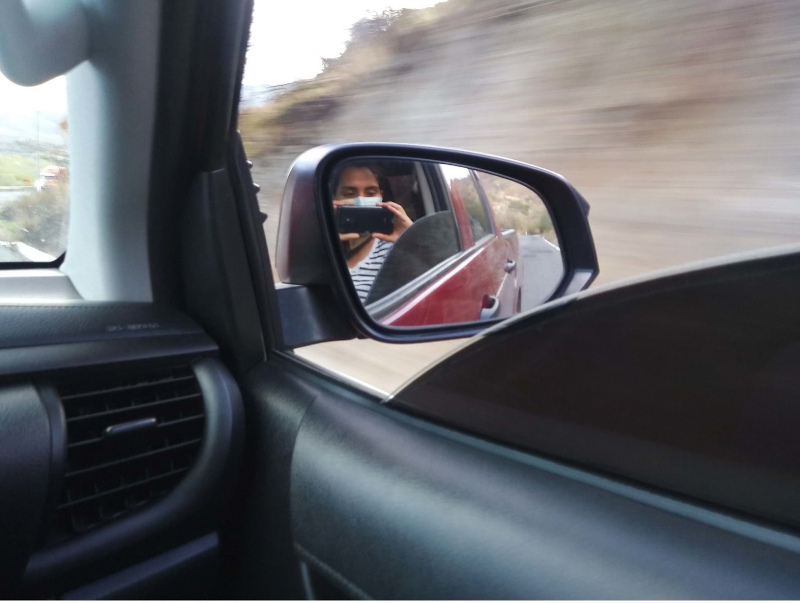
The author’s self-portrait while commuting with a fieldworker from Ciudad de Guatemala to a community where an intervention was being carried out. Photo by the author.
The social nature of this classification became clear to me during the time I spent commuting from larger urban centers—Guatemala City and other larger cities in the country—to smaller urban and peri-urban areas, and from there to rural communities during my fieldwork research from 2021 to 2023. These trips were part of nutrition and health interventions conceived primarily in Guatemala City, the country’s capital, and implemented in communities across the country to prevent chronic malnutrition in children. The interventions targeted young mothers and their children under two years of age. It focused on women empowerment, income-generating strategies, and individual behavior-change education, often accompanied by some form of food or nutritional supplementation. Funded by private corporations, the interventions were carried out through corporate foundations or corporate social responsibility (CSR) offices. Most often, I traveled alongside fieldworkers, who were on different levels of institutional hierarchy, as they carried out their daily activities, moving repeatedly between the urban spaces where interventions were conceived and the communities where they were implemented. Experiencing these movements firsthand revealed that the presumed distinction between urban planners and rural recipients did not hold in practice. The daily movement exposed the instability of this distinction. The same people who were expected to deliver expertise also depended on local knowledge to carry out their work. Rather than serving as passive sites awaiting intervention, the communities I visited were socially dynamic spaces where people interpreted, negotiated, and reshaped interventions in ways that challenged the assumptions embedded in their urban design. In fact, I found that some program officers and most fieldworkers demonstrated an increasing willingness to learn from the communities where they worked. However, rather than connecting two already existing worlds, the interventions continually remade the relationship between them. As result institutional narratives continued to frame expertise as originating in the city and traveling outward.
Geography of Expertise
In early August 2022, I participated in a meeting that was held at the regional office of one of the corporate foundations where I conducted fieldwork. The office is in a municipality in the Guatemalan highlands. Although the municipality is officially classified as urban, some of the foundation’s senior staff did not perceive it as such because its population is predominantly Indigenous Maya. The expectation of expertise traveling to Indigenous Maya communities from the city was clear to me during this event.
For weeks, the staff at the regional office had been preparing for the two-day meeting. Administrative personnel, fieldworkers, and those with combined roles coordinated presentations, logistics, and participant attendance. Several beneficiary mothers (those who had received support from the intervention) were also invited to present their experiences alongside foundation staff, while guests traveled from Guatemala City to attend.
When I arrived early on the first morning, everything was ready. The meeting room had been arranged in presentation style, with a projector displaying a welcome slide. The projector rested on a table draped with blue and red fabric resembling traditional Maya textiles. Two speakers flanked the table, and white plastic chairs were arranged in a semicircle for the audience.
Slightly past noon, the guests from Guatemala City arrived—two senior corporate officers funding the intervention and two consultants hired to support the program’s expansion to other regions across Central America. Dressed for the cool highland weather in sweaters or fleece vests over casual shirts, jeans, and tennis shoes, they greeted the regional staff and took their seats. Some of the mothers participating in the program had also arrived a few minutes earlier. It was the first time that I had seen some of them wearing traditional Maya clothing since during routine activities they typically wore jeans. For this occasion, they had carefully prepared their appearance, signaling the importance they attached to the event.
Throughout that afternoon and the following morning, foundation staff, and participant mothers presented evidence of the intervention’s achievements. Rather than simply reporting outcomes, they highlighted the knowledge, labor, and commitment of the participating communities. As strong and active community leaders themselves, the participant mothers explained how they engaged with their communities to ensure the success of these programs. They shared examples of how they presented their activities and results to their community authorities and encouraged other women to stay and benefit from the program. The guests from Guatemala City listened attentively, asked questions, and engaged with the presentations.
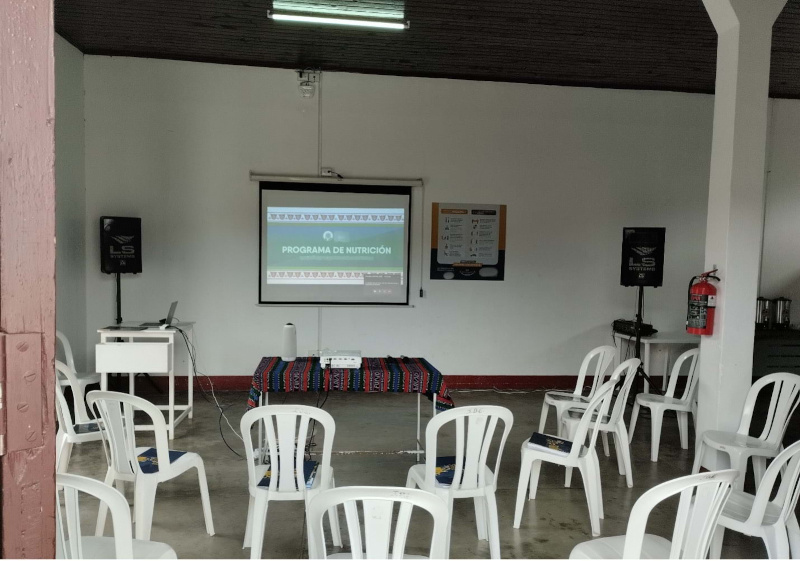
Meeting room where the presentation of results was carried out. Photo by the author.
This predominantly Indigenous Maya place has been constructed as needing external expertise, as evidenced by the presence of an intervention designed to address nutrition and health problems originating from the country’s capital. Yet, paradoxically, the guests from Guatemala City had come because they believed the intervention had succeeded—maybe because of the active participation of the participant mothers and their communities—and hoped to reproduce it elsewhere. The encounter thus complicates conventional assumptions about the direction of expertise. Knowledge was flowing in the other direction, from the beneficiary mothers to the consultants. Even so, this reversal occurred through the very intervention that continued to portray expertise as something originating in the city. Therefore, maintaining an imagined supremacy of this knowledge reinforced the idea that expertise resides in urban spaces, while rural Indigenous Maya communities are positioned as lacking such knowledge. Community knowledge, on the other hand, became visible because it had been incorporated into the intervention and evaluated from Guatemala City.
Health interventions produce space by assigning social meaning to places. If Indigenous spaces are already imagined as rural and therefore lacking expertise, interventions can appear as the natural movement of knowledge from the city to Indigenous communities. Geography, in this sense, is not simply the setting in which interventions operate. Rather, interventions depend on specific geographic distinctions while simultaneously reproducing and reshaping those distinctions through practice. Through funding decisions, project design, monitoring systems, evaluation meetings, and narratives of capacity building, interventions repeatedly position Guatemala City as the location from which expertise departs and Indigenous communities as the destinations to which it must travel.
Even after the presentation of results, when guests from the country’s capital arrived at the regional office to learn about communities’ experiences and the program’s successes, the expectation persisted that communities would remain primarily receivers of knowledge. When communities, community authorities, or the mothers themselves resisted an intervention, or particular aspects of it, they were often characterized as ignorant or resistant to change by program officers. Yet this resistance was also instrumental in teaching program staff that involving community authorities in the planning stages could make interventions more acceptable and effective within communities. In this sense, communities were not simply passive recipients of interventions. Their responses actively shaped how programs were implemented and adapted. At the same time, community members recognized these interventions as efforts to improve children’s nutrition and health, but also as opportunities to strengthen household economies through the resources and income-generating activities provided by the programs.
Conclusion
In conclusion, viewing health interventions are producers of space and geography shifts attention from where programs are implemented to how the interventions define the places through which they move. Interventions reproduce the spatial hierarchy on which the authority is placed on urban expertise, thus requiring the very distinction between urban expertise and rural deficiency. Rather than merely carrying expertise from cities to rural communities, interventions help construct cities as centers of knowledge and Indigenous Maya communities as sites of deficiency. Ethnography reveals the instability of this geography: fieldworkers learn from communities, communities reshape interventions, and successful local innovations travel back toward the city and back again. Therefore, the everyday practice continually unsettles these beliefs. In recognizing these processes of geography making, we must also acknowledge their racialized and classed implications for the relationships they create and maintain between people and places. When an Indigenous Maya place is characterized as lacking knowledge and capacity its autonomy can more easily be overlooked or disregarded, particularly when specialized knowledge originated in the city is assumed to be necessary to address the nutrition and health problems of children. Such assumptions not only position external actors as the holders of expertise but also make Indigenous Maya communities more readily legible as recipients of intervention rather than as agents with their own knowledge, priorities, and capacities.
Footnote
[1] Along this post, as well as the rest of my work, I use the term fieldworker to name what the literature often refers as Community Health Worker (CHW). My decision is guided by these people’s own definition of their work as fieldworkers (trabajador/a de campo).
This post is the third essay in a series examining the spatial, temporal, and conceptual boundaries of infection. You can read the first essay here and second essay here.
This post was curated by Contributing Editor Tayeba Batool and reviewed by Contributing Editor Sook Lin Toh.
References
Carey, David Jr. 2005. Engendering Mayan History. New York.Duclos, Diane, Sylvain L. Faye, Tidiane Ndoye, and Loveday Penn-Kekana. 2019. Envisioning, Evaluating and Co-Enacting Performance in Global Health Interventions. Anthropology in Action. March 1. https://doi.org/10.3167/aia.2019.260103.
Grandin, Greg. 2000. The Blood of Guatemala: A History of Race and Nation. Duke University Press.
Hall-Clifford, Rachel. 2024. Underbelly: Childhood Diarrhea and the Hidden Local Realities of Global Health. https://direct.mit.edu/books/oa-monograph/5777/UnderbellyChildhood-Diarrhea-and-the-Hidden-Local.
Instituto Nacional de Estadística (INE). 2019. “Censos Nacionales XII de Población y VII de Habitación 2018. Glosario.” https://censo2018.ine.gob.gt/documentacion.
McCreery, David. 1994. Rural Guatemala, 1760-1940. Stanford University Press.
McCreery, David. 2011. “Land, Labor, and Community.” In The Guatemala Reader:History, Culture, Politics, edited by Elizabeth Oglesby, Deborah T. Levenson, and Greg Grandin. Duke University Press. https://doi.org/https://doi.org/10.1215/9780822394679-023.
Metz, Brent E., and Meghan Farley Webb. 2014. “Historical Sediments of Competing Gender Models in Indigenous Guatemala.” In Masculinities in a Global Era, edited by Joseph Gelfer. Springer. https://doi.org/10.1007/978-1-4614-6931-5_11.
Pentecost, Michelle. 2024. The Politics of Potential: Global Health and Gendered Futures in South Africa.
Yates-Doerr, Emily. 2024. Mal-Nutrition: Maternal Health Science and the Reproduction of Harm. Oakland, California.
Yates-Doerr, Emily, Lauren Carruth, Gideon Lasco, and Rosario García-Meza. 2023. “Global Health Interventions: The Military, the Magic Bullet, the Deterministic Model—and Intervention Otherwise.” Annual Review of Anthropology 52 (1): 187–204. https://doi.org/10.1146/annurev-anthro-041520-093024.
