At India’s southern tip, eight reactor buildings line the shore of the coastal communities of Tirunelveli district, Tamil Nadu—one of the four districts my family and I call home. These reactor buildings are of the Kudankulam Nuclear Power Plant (KKNPP), envisioned to be India’s largest nuclear park. People living in the nearby Idinthakkarai and Kootapalli villages mock the association of a risky technoscientific complex to anything close to a ‘park,’ or poonga—a forest or garden of flowers, in Tamil.
The sea that rolls against the compound of KKNPP is where women protestors claimed that they derived their energy to lead the protest against the plant in March 2011. Following suit, fishermen rowed and drove their boats into the sea to protest the commissioning of the plant. In the award-winning woman protest leader Sundari’s words, “Atomic power is a danger for humanity, that’s why we are protesting.” In this post, I briefly address how the controversy at Idinthakkarai is being resolved nearly 15 years after the protest.
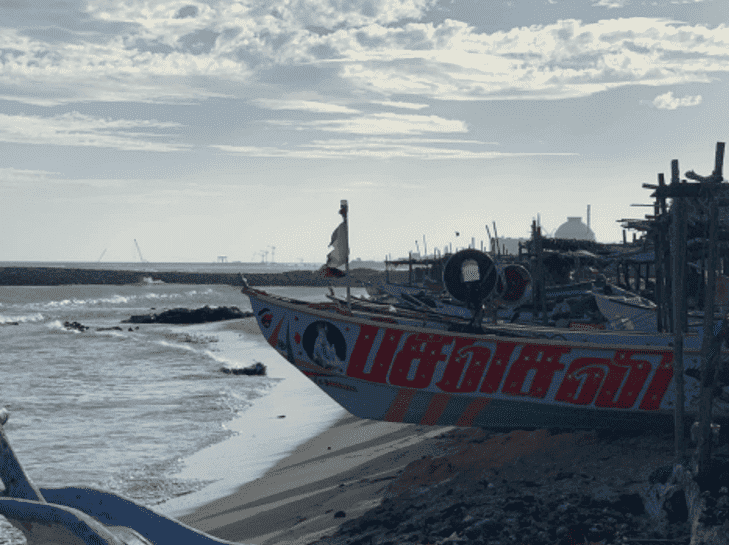
Idinthakkarai’s shore with KKNPP in the background. Photograph taken by the author in September 2021.
As I visited the field in 2015, 2017, 2018 and 2021, I sensed that protestors’ resolve against the plant remained steadfast. Their emotional state, on the other hand, shifted from the power of voice in 2015 to an eerie silence in 2017 and 2018, where voices were episodic and targeted only for my voice memos and those of other reporters. By 2021, this transformed into body pain amongst the women—a remark that I heard also around Tummalapalle Uranium Mine and Mill, Andhra Pradesh in 2021 and 2025 and Madras Atomic Power Station in 2023. For protestors, every emotion, concern, energy and minute shared with me was a step in the direction of resolution, I sensed. Smitten by ethnographic helplessness, as I navigated the academic jungles to address this nuclear controversy and others, I realized that resolutions are what matter most on ground, in their embodiments, emplacements and discursive-materialities.
Resolving scientific controversies are significant to a dignified existence in the age of environmental contamination, plagued by compounded causes and vulnerabilities. As science procedurally solves contamination’s cause, victims in contaminated places await technoscientific answers to establish regulatory accountability. Dorothy Nelkin (1980) remarks that the resolution of controversies show that public interests and the use of technical information often remains colored with political interests, making it difficult for the public to assess the authenticity of information in a climate of mistrust. In this piece, I deliberately shift focus from the contents of controversies to center resolution in controversies asking, “How do we resolve controversies?” and “Do resolutions always mark an end to the controversy? If so, for whom?”[1] I treat resolutions in three ways: resolving between multiple aspects and interest groups in a controversy, resolution as in visual sharpness about a controversy in and through accounting for diverse perspectives and knowledges in decision making, and the resolved-ness against regulatory neglect.[2]
The Multiple Ties of Resolution
At Idinthakkarai and Kootapalli, ever since 2011, resolutions, or the lack thereof, have weighed down on many facets of everydayness. The scales of criticism put forth by the coastal communities range from the individual to planetary. The protestors severely criticize the construction of dyke and intake and outlet pipes of cooling water in a location where the fishermen catch Singu Eral. Abila, interlocutor and a woman who led the protest, remarks on the regional danger of KKNPP’s radioactive accident: “if the danger only concerns our village, or oor, it’s a different issue. But an explosion here will spread radiation to Madurai, Rameshwaram and Thiruvananthapuram (cities in southern Tamil Nadu and Kerala). Should one die for the cause of another? Hence, we will have to chase them out of here.” Sundari akka, in claiming that “fish does not have their locations tattooed on their forehead,” speaks on planetary impacts as any release of radioactive plume could spread across the world’s oceans by a migrating fish.
The resolution, or mudivu, to address the controversy is the closure of KKNPP. In Tamil, mudivu is an offshoot of the word mudiyum that means both “an ending” and “can”—a possibility. In Tamil, hence, resolution/decision, end, possibilities tie (tie is called as “mudi” in Tamil) together in a word.
A Singular Perspective on Nuclear Safety
On the other hand, for KKNPP, the resolution for the risks posed by nuclear energy is through safe design, safe operations and management, and the monitoring of labourers and the environment for safety of the operations. All of this constitute nuclear safety practices in a nuclear facility and have been critiqued for being mere technological fixes. The promise of technological fixes as solutions to public concerns over risks has been criticized in STS studies of controversy (Hughes 2004, 455). While this remains a productive concept for STS, on the grounds of Idinthakkarai, the critique of scientific faith in technological fixes does not resolve the controversy for the people concerned about nuclear risks. Idinthakkarai coastal community are reminded of the endurance of the controversy through visible froth over cooling water let out from the plant, and the smell and noise from the power plant—all of which are essential to ensure nuclear safety. In the contradiction between safety as technological fix and the inertia of technological fixes over people’s endurance, the weight of an unresolved controversy looms over this region of Tamil Nadu.
Experts Resolving (Against) Danger and Risks
For 1750+ days, woman in the villages carried out a relay hunger strike in the veranda and steps of the Lourdes Matha church. The resolve of women to shut down the plant was tested by an unresponsive state, and significant repression including over 9,000 protestors charged with sedition and over 55,000 charged with other offences. Walking on thin ice and expecting further protests, KKNPP also engaged in public relations campaigns through science communication as a resolution. In one of KKNPP’s public awareness book that provided simplified explanations of a nuclear power plant, a kettle on a fire is used to explain the heating process within the reactor. The villagers remarked, “don’t we know the difference between heating water in a kettle through fire and heating water in a reactor through nuclear fission?”
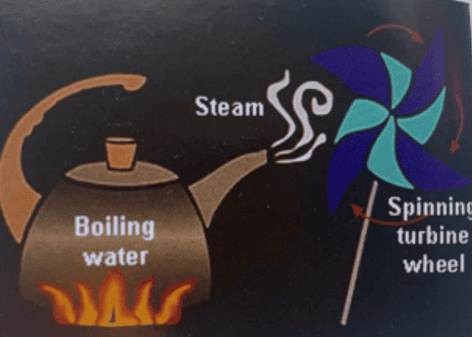
Figure 2: Image explaining what happens in a nuclear power plant by KKNNP. Source: KKNPP (2018). Public material, permitted to reproduce by Nuclear Power Corporation of India Limited (NPCIL).
KKNPP’s conception of lay people in public sphere informs the re-presentation of complex nuclear processes using a boiling kettle in this public communication material. This conception of lay people undermines not only the epistemic agency of the coastal community but also visualizes the risks in low resolution, producing a grainy climate of mistrust. Resolution of technoscientific controversies, in this way, involves pluralizing perspectives on shared concerns where resolutions in controversies are weighed on par with the resolve of protestors or public to achieve public protection against harm.
However, the resolve of the public around KKNPP remains largely ignored in the state’s technoscientific policy as regional parties move in and out of power in Tamil Nadu. Hence ignored, details of the controversy thin out as coastal communities’ onto-epistemological perspectives on planetary ecologies are translated to risk perceptions by KKNPP. Here, public protection measures against harm come to be addressed through nuclear safety measures such as safe design, operations, management, and monitoring.
Enduring, unresolved controversy on their shoulders, people continue with their necrovital lives – that is, making life within the deadly conditions that structure risks in the plant and socio-economic dangers out in the sea (Shaik Ali 2025). While KKNPP seem to have resolved the criticism of the people though nuclear safety and public communication, for the people of Idinthakkarai, without an mudivu, a resolution is rendered impossible.
This post was reviewed by Bronte Jones.
Notes
[1] I developed this perspective on “endings” for analyzing resolution of controversy through the reflections “on endings” by Nancy Campbell, Aya Kimura and Abby Kinchy in their panel on “The Science of Getting Back to Normal,” organized by Aya Kimura and Abby Kinchy, Annual Conference of the Society for Social Studies of Science, 2025, Seattle.
[2] STS scholar Gwen Ottinger who participated in the above referenced panel, helped identify these three aspects of resolution, in and through the discussion over my question on whether resolution always marks an end, posed to Nancy Campbell, Aya Kimura and Abby Kinchy.
References
Hughes, Thomas P. 2004. American Genesis: A Century of Technological Enthusiasm, 1870-1970, 2nd ed. Chicago: University of Chicago Press.
KKNPP (Kudankulam Nuclear Power Plant). 2018. Nuclear Energy: Safe|Clean|Green (Rev5). Kudankulam: Kudankulam Nuclear Power Plant
Nelkin, Dorothy. 1980. Controversy: Politics of Technical Decisions. Beverly Hills: Sage Publications.
Shaik Ali, Misria. 2025. “Necrovitality and Porous Exclusions: On Dying amidst Chemical Vitalities.” Platypus: The CATSAC blog, October 9. Accessed on March 10, 2026. Retrieved from https://blog.castac.org/2025/10/necrovitality-and-porous-exclusions-on-dying-amidst-chemical-vitalities/
