In one testimony from Colombia’s armed conflict, a parrot named Lola repeated the phrases she heard around her: “Paraco asesino” (“paramilitary murderer”), “Viva la guerrilla” (“long live the guerrilla”), and “The vultures are coming” Her voice condensed the sounds, fears, and political tensions of war into a multispecies archive of memory. Far from being passive witnesses, animals moved within the infrastructures of conflict as companions, alarms, transportation, and sometimes even weapons.
Yet these violent incorporations are only the most extreme expression of a broader multispecies world of conflict.
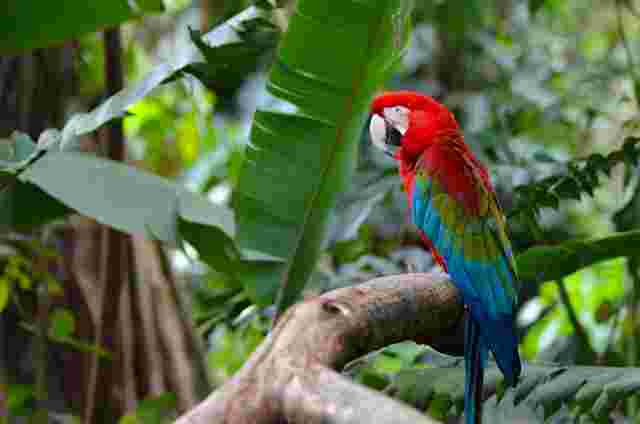
Figure 1: A parrot perched in a tropical environment. Birds such as parrots, often associated with regions like Colombia, can act as carriers of sound and memory, echoing human voices and participating in the sensory infrastructures of conflict. (Image by Deisy Vidal on Unsplash). Sourced from: https://unsplash.com/photos/red-green-and-blue-parrot-on-brown-tree-branch-during-daytime-57SHaZUAOtQ
Across Colombia’s rural war zones, animals were an integral part of camps, trails, rivers, farms, and sites of captivity as companions, war technologies, food sources, and unwanted intruders. Although the memory of Colombia’s war is usually centered on human actors, one question arises: How can we reconstruct the memory of the Colombian armed conflict by including the animals that also experienced it? To remember the armed conflict through these relations is to expand the archive beyond human testimony and rethink war itself as a multispecies assemblage.
This prolonged conflict has produced profound social, political, and humanitarian consequences, including the forced displacement of populations, the persistence of violence in rural areas, and innumerable human rights violations. In this context, the Revolutionary Armed Forces of Colombia (FARC), one of the longest-standing guerrilla movements in Latin America, emerged in 1964 as a Marxist–Leninist guerrilla group that sought to transform the political order and the country’s land distribution model. Their activities were primarily concentrated in rural areas, where they implemented various forms of irregular warfare; later, in 2016, this organization signed a peace agreement with the Colombian government, marking a milestone in the reduction of the armed conflict, although some of its dynamics and effects still persist in certain regions of the country.
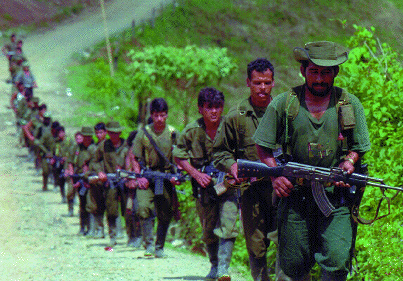
Figure 2: Armed members of the Revolutionary Armed Forces of Colombia (FARC) in 1998. Sourced from: https://commons.wikimedia.org/wiki/File:Revolutionary_Armed_Forces_of_Colombia_(FARC)_insurgents.GIF
However, these traditional narratives leave out other modes of experiencing and recording the conflict that have not been sufficiently problematized, such as the interactions, uses, relationships, and bonds with animals that inhabited and moved through armed conflict contexts at the same time as humans. The Colombian armed conflict was not solely a relationship between human actors, but rather a phenomenon that unfolded in deeply hybrid rural environments, where multiple forms of life participated in, were affected, and reconfigured the dynamics of war. This does not imply granting them voice in an anthropomorphic sense, but rather recognizing that they were inscribed within socio-technical and affective networks that influenced the material configuration of war. By decentering the anthropocentric gaze, a multispecies assemblage becomes visible, one that permeated the everyday life of rural worlds during the conflict: dogs, mules, horses, pigs, primates, insects, rodents, livestock, and birds were not merely passive witnesses or instruments, but participants in the transformation of practices, decisions, and power relations as relational agents within these entanglements.
“Fireflies served as lanterns during overnight stays, where any artificial light could reveal the location and lead to subsequent bombardment; the praying mantis would settle on the leaves, often accompanying the sentry during guard shifts. Howler monkeys arrived in groups among the tree branches at the camps to take food; sometimes the howler monkeys acted as an alarm signalling the approach of people, while tamarins seemed to mock those who observed them. The tapir could cause great alarm when the sound of its movement was heard” (Sanroque in Álvarez, 2021).
My theoretical-methodological approach, grounded in the field of Science and Technology Studies, proposes understanding animals as non-human actants (Latour, 2005), that is, as entities capable of influencing the configuration of socio-technical networks; as cyborgs (Haraway, 1991), as combined natural and cultural dichotomies; and as participants in techniques-in-use (Edgerton, 2007), whose meanings emerge in practice rather than in technical innovation. This triad makes it possible to approach, in a situated manner, the role of animals in the Colombian armed conflict.
Within this framework, the relevance of animals does not lie in their exceptional status, but rather in the situated efficacy with which they participate in practices of survival, transport, surveillance, companionship, or sustenance in the everyday life of war. Consequently, the question of an essence of the animal is displaced, and instead multispecies forms of agency that structure the everyday life of the armed conflict in the country are brought into view.
Animals played an active and diverse role: they served as companions for combatants, local inhabitants, people in captivity, and civilians in areas near guerrilla camps; they functioned as surveillance devices by alerting to the proximity of the enemy and helping to define routes; they made possible the transport of medicines, food, the wounded, and members of armed groups; and they contributed to food provision through fishing, livestock rearing, or supply networks linked to urban centres. At the same time, their presence also generated forms of conflictual coexistence, whether through the transmission of diseases, the deterioration of belongings, or their intrusion into strategic spaces of warfare.
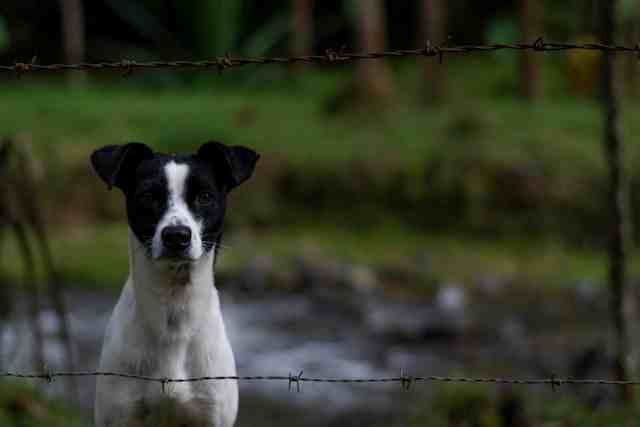
Figure 3: A dog stands behind a barbed wire fence in a rural environment. Animals in conflict settings often operate within regimes of surveillance and territorial control, blurring the boundaries between companion, sentinel, and infrastructure within multispecies assemblages of war. (Image by Daniel Quiceno on Unsplash). Sourced from: https://unsplash.com/photos/white-and-black-short-coated-dog-JlusPYi4bhw
In this way, far from being marginal actors, animals participated in the material and everyday configuration of the conflict, revealing that war was sustained through multispecies relations that combined cooperation, dependence, and friction. The following section presents an approach to testimonies that account for the agency of animals within the socio-technical networks of the internal armed conflict. In terms of companionship, the accounts show how certain animals became integrated into the daily lives of captives and combatants, generating affective bonds that shaped their experience of the conflict: “The commander gave us three hens, two small white ones and a fine rooster (…) those animals became part of our group and allowed us to relax a bit” (Rojas, 2009, p. 186).
In other cases, animals functioned as surveillance devices, actively participating in the anticipation of danger: “She spent her old age in a ranch, where he kept some cows, two dogs, and a parrot named Lola, who perfectly repeated everything she heard from Doña Ximena: she was a “moña amarilla,” with green, yellow, black, and red plumage. Lola would say many things: “Paraco asesino” “Viva la guerrilla” “The vultures are coming [referring to the enemy armed group]”. (Cruz, 2021, p. 78) Likewise, their role in transportation was essential for mobility in hard-to-reach territories: “In most fronts of the former FARC-EP, we had mules for carrying loads up to areas near the camps. We even travelled long distances through trails, roads, and paths that connected us with other regions and departments. Those we could not keep near the camps were kept on nearby farms and in work sites we built ourselves in the jungle. Mules were essential and useful for easing the harsh tasks of combat, bringing war material closer to these potential scenarios” (Cruz, 2024, p. 93).
In relation to food, the testimonies reveal subsistence practices in which animals were directly incorporated into the diet: “One day a caiman came out from under where we were bathing (…) the guerrillas killed it and we ate it for lunch (…) in a place where we stopped on the banks of a river (…) they brought a young bull to slaughter it and then smoked the meat to take it with us and continue the march (…) they brought us ‘moquiado’ fish, a fish that, once caught, is exposed to smoke without removing anything at all until it becomes like roasted meat, ready for consumption, and before being eaten it can last many days without spoiling” (Pinchao, 2008, p. 146, 160–161).
On the other hand, these relationships also involved forms of conflictual coexistence, in which animals materially affected everyday life: “I had the terrible idea of hanging my underwear to dry on a tree branch in full sunlight. When I went back for the clothes, I was struck by an uncontrollable fit of laughter. The ants had made little circles out of the fabric and carried it away. What remained was taken by termites, which used the material to build their tunnels” (Betancourt, 2010, p. 139).
Moreover, the use of “animales bomba” (“bomb animals”) constitutes one of the most extreme expressions of conflictual coexistence between armed actors and animals in war contexts, as it reveals the violent instrumentalization of non-human life within the dynamics of the conflict. Animals such as dogs, horses, mules, donkeys, or even turtles were loaded with explosives, introduced into urban and rural spaces, and subsequently detonated. This practice shows how animals were also forcibly incorporated into networks of violence, where their corporeality was turned into a means of attack, eliminating any form of their own agency and revealing a limit case of interspecies relations.
Within this network of animals and social actors, relational agency is configured through constant negotiations of coexistence, in which humans and non-humans adjust their behaviours according to the environments they inhabit and move through. These negotiations do not respond to fully symmetrical decisions, but rather to situated processes of adjustment in which interspecies bonds are reconfigured and values emerge that oscillate between care and instrumentalization, as well as between affect, utility, and subsistence needs (Sánchez, 2025).
From this perspective, the aim is not to generalize or homogenize these relationships, but rather to account for the heterogeneity of practices and assemblages in which non-human animals participate. Each relationship configures specific materialities, affects, and forms of utility, producing situated experiences that are irreducible to one another. In this sense, as Law and Mol (2009) argue:
“You cannot know what a sheep is by looking at a photograph. It is more helpful to unravel the practices in which a sheep figures, in which it is enacted in one way or another. If we do this, then we do not discover a sheep that is unified and coherent. On the contrary, we find a ‘multiple sheep’. This is because in each practice a slightly different sheep is produced”.
It is not a matter of identifying a unified essence of the animal, but rather of tracing the practices in which it acts and is acted upon. Thus, far from a coherent and singular animal, what emerges is multiplicity: in each practice, a different animal is produced. This perspective challenges traditional narratives of the Colombian armed conflict that have reduced animals to mere war machines. Instead, they are understood as situated actants, whose agency is configured within networks of affect, utility, risk, and survival. From a Science and Technology Studies (STS) perspective, this approach emphasizes the relational and distributed nature of agency across human and non-human actors.
The narratives examined show how these interactions blur the boundaries between the utilitarian and the affective, the domesticated and the wild, complicating the understanding of war in its everyday dimension. Recognizing this multiplicity not only expands the field of memory, but also transforms the way we understand who participates in war, forcing us to rethink the very limits of the political and the human in studies of conflict. Remembering Colombia’s armed conflict through animals does more than add forgotten victims to the archive. It reveals war itself as a multispecies infrastructure, forcing us to rethink memory, agency, and political life beyond the human.
This post was curated by Contributing Editor Juan Camilo Ospina Deaza and reviewed by Contributing Editor Andra Sonia Petrutiu
References
Álvarez, J. (2021). Common Nature. Non-fiction accounts by ex-combatants for reconciliation. Editorial Lectores Secretos.
Betancourt, I. (2010). There Is No Silence That Does Not End. Aguilar, 3rd edition.
Cruz, M. (2021). Pets in the Armed Conflict and Other Stories. La Imprenta.
Cruz, M. (2024). Pets in the War II. Eleven Market Editorial.
Edgerton, D. (2007). Innovation and Tradition. Crítica, Barcelona; Spanish translation, Spain.
Haraway, D. (1991). Science, Cyborgs, and Women: The Reinvention of Nature. Spain: Ediciones Cátedra, Universidad de Valencia.
Latour, B. (2005). Reassembling the Social: An Introduction to Actor-Network-Theory. Manantial Publishing.
Law, J., & Mol, A. (2009). The enacted actor: Cumbrian sheep in 2001 = El actor-actuado: La oveja de la Cumbria en 2001. Política y Sociedad, 45(3), 75–92.
Pinchao, J. (2008). My Escape to Freedom. Ediciones Planeta: Colombia.
Rojas, C. (2009). Captive. Bogotá: Grupo Editorial Norma.
Sánchez, V. (2025). Animals and Armed Conflict in Colombia: Tracing Uses, Assemblages, and Non-Human Actants. Master’s thesis in Social Studies of Science and Technology, Universidad Nacional de Colombia. Available at: https://repositorio.unal.edu.co/items/37b6c5aa-7ed2-4b79-94fd-ae65d7bc250f

_insurgents.GIF)