In County Donegal, Ireland, an estimated 30,000 buildings are crumbling due to governmental and commercial mishandling of building materials such as concrete. A lack of urgency in governmental response has left homeowners living with severe mold, electrical risks, structural cracks and the impending threat of their homes collapsing, see image below. Homeowners have described living in these homes as being in a constant state of fear—fear their homes will crumble on top of them but also fear that the government they once trusted “to do right by them” will never fix their homes.
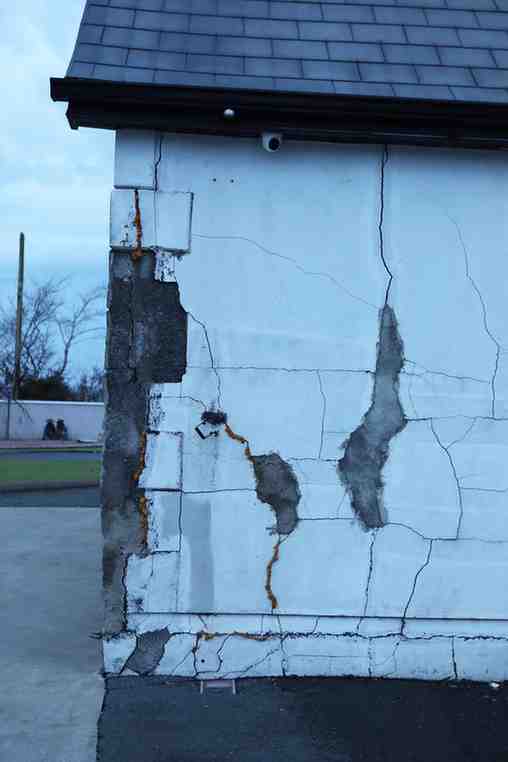
In Donegal County, Ireland, over 40,000 buildings are crumbling due to the mismanagement of building materials such as concrete. Many homeowners not only fear their homes will collapse but also live in unhabitable domestic conditions with major electrical issues and mold. Photo Courtesy of Defective Concrete Activist Angela Tourish.
For over a decade, homeowners depended on government officials to conduct scientific tests and identity the cause of the crumbling concrete, but then the unthinkable happened—the government identified the wrong culprit. In 2015, the Irish National Government set up an expert panel to “carry out a desktop study … to establish the nature of the problem in the affected dwellings.” Without extracting and examining their own samples, the expert panel concluded that mineral MICA was the reason these homes were cracking and turning to dust. Unsatisfied with the desktop study and the government’s “laughable science,” homeowners began to reach out to international geologists and experts who determined with material testing of the blocks other minerals the iron sulfides, pyrite and pyrrhotite, were the real minerals behind the crisis (Leemann et al. 2023). European standards state that the total sulfur content in concrete aggregate should not exceed .1%, but in some of these homes the total sulfur levels far exceeded this standard, with some values of up to 0.75%.
Debunking the results of the previous government-led panel has had severe consequences. Not only has this misdiagnosis impacted homeowners’ plans and reimbursements for rebuilding, but homeowners have lost trust in their government officials. Even today, many government officials have continued to defend the desktop study, denying overwhelming evidence that proves a misdiagnosis. Because part of the state campaign against homeowner redress has been a complete denial of scientific evidence related to the iron sulfides causing the crisis, ordinary citizens have had to turn to international scientific conferences, academic journals, and engineering and geology experts to publicly debunk disinformation campaigns led by local and national politicians.
In this piece, I explore how public pedagogies related to sharing scientific knowledge, such as community-wide forums and readings of international concrete journals, become tools for engaged citizenship in a heightened era of conspiracy and disinformation. Similar to the ways medical practitioners in America have had to speak out against trends such as “Make America Healthy Again,” (Coleman and Reinhart 2025) where contemporary policy recommendations are not always based on expertise, but sometimes on questionable studies and misinformation, homeowners in rural Ireland have had to become experts themselves to question the scientific authority of the Irish government .
“You Can’t Give Us the Runaround”
While conducting 12 months of ethnographic fieldwork on the concrete crisis, I attended several political meetings where government officials interacted with homeowners on the issue of defective concrete. At one meeting in May 2023, emotions were running high and the hot topic of the night was introduced—home foundations. In the draft for an updated redress scheme at the time, concrete foundations—poured from the same concrete that made the crumbling blocks—were not included in the scheme. The government was telling homeowners they could knock down the walls that were built with bad concrete blocks, but they had to rebuild on the old foundations. In a redress scheme estimated to cost over 3.2 billion euros of taxpayer money, the government was asking homeowners to rebuild on potentially faulty foundations. For homeowners, not including the foundations in the scheme would mean they either have to build on foundations that could start cracking in the future, leading to their new homes sinking, or pay an estimated 20,000-plus euros themselves to ensure their new homes were stable. Emotions in the town hall that night were running particularly high as many homeowners were not only frightened their homes would collapse on them but also frightened of the crippling debt rebuilding their homes may cost them.
Charlie McConalogue, a Fianna Fáil politician and then Minister of Agriculture, led most of this town hall and said, “None of our engineers have come forward telling us not to trust the foundations.” He went on to talk about the newton strength of the blocks vs. the foundations, a tangent I was having trouble following even after extensive conversations with engineers about defective concrete and its risks to foundations. From my own conversations with experts, the newton strength of the blocks vs. the poured concrete was not the issue when it came to knowing whether foundations were secure or not. The question was whether the amount of unsafe iron sulfides in the blocks was also in the foundations. I started to realize what was happening – Charlie was using scientific jargon like “newton strength” to outsmart the crowd and the people around me were visibly agitated. They knew exactly what he was trying to do. A homeowner near me yells, “Charlie, we’ve done our research, you can’t give us the runaround! Where were you at the scientific defective concrete conference last fall? I didn’t see you there. You are making us build on foundations that are not fit for purpose.”
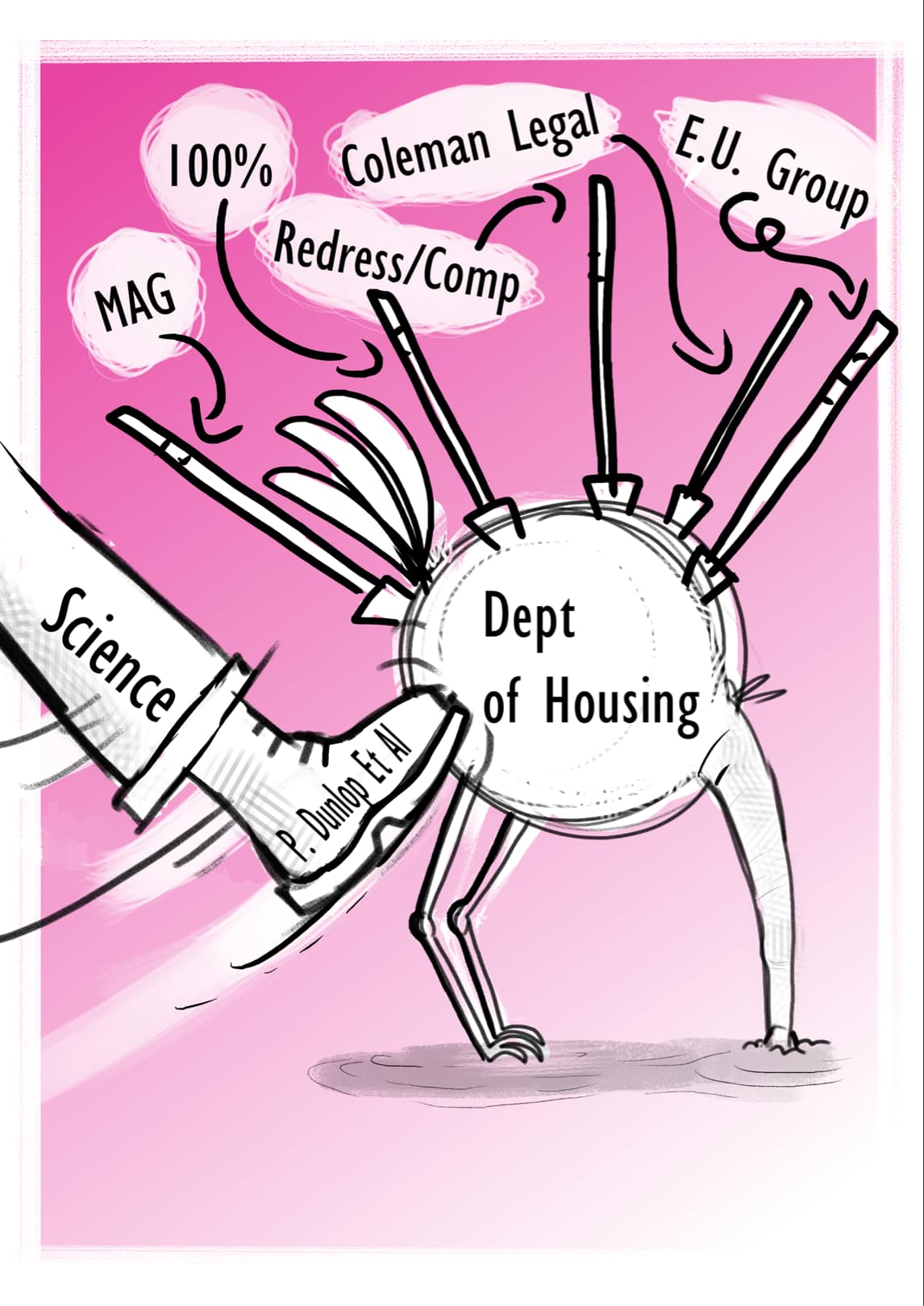
This graphic created by 100% Redress Homeowners and Activists depicts how activists believe independent science confirming iron sulfides are the main culprit of the crisis are the main defense they have in gaining financial redress from the Department of Housing. Other forms of resistance such as local action groups like MAG And 100% Redress, as well legal groups, are also working for redress, but the independent science is what drives it all forward. Graphic Courtesy of Defective Concrete Activist Mary Connors.
The homeowner was referring to the international conference titled “The Science and Societal Impacts of Defective Concrete” in November 2022 that brought leading international experts in geology, earth sciences, and engineering from Canada, the United States, Switzerland, Norway, and Ireland to present independent, peer-reviewed scientific data focusing on iron sulfides as the cause of concrete failure in Donegal. A shocking revelation from that conference is that of the hundreds in attendance, many were ordinary homeowners learning the science behind their crumbling homes. The graphic above, created by activists, depicts how important they believe the independent science is for going against the government’s misdiagnosis and getting their homes rebuilt. These homeowners came with printed binders of peer-reviewed scientific studies, highlighted notes on academic materials related to iron sulfides and MICA, official engineering reports of their own homes, and notebooks filled with specific questions on iron sulfides for the international experts. Only a few government officials were in attendance that day, Charlie and the other members of the May townhall were not among them. Another activist enters the conversation, “Us in this room right now. We know the science. We have read the science. We were at the defective concrete conference in the fall. We have read Paul Dunlop and Andrea Leamann’s research.[1] We know the only way to fix it is to tumble it. The government has had 10 years. Where is the urgency?”
“I Didn’t See Any Results”
Toward the end of the townhall, another prominent activist calls on another panel member, Senator Niall Blaney, to respond to the issue of foundations, “Senator Blaney, where do you stand on the issue of foundations? Where do you stand on your comments about Paul Dunlop’s work being pseudoscience? What do you think of the new test results that have been out for months now?”
Blaney, who up until this point had been mostly looking at this phone, simple responds, “I didn’t see any results.”
The activists responds, “Really?”
Another activist in the crowd yells, “I emailed all government officials the article months ago.”
Blaney replies, “Didn’t see any results myself.”
The reaction in the room was a mix of a deep sigh and a small cackle of laughter. At this point, I would have imagined almost every person in that room had at least hard about Paul Dunlop’s—an affected homeowner and geologist at Ulster University in Derry—research testing homes in the area. The article was published in the peer-reviewed Journal on Cement and Concrete Research and made most of the news outlet in the county. It was considered a major win for activists who had been working for years to counter the government’s MICA misdiagnosis.
After Blaney’s comments, the townhall ended rather abruptly. Many homeowners seated near me were in tears. I spoke with one after the meeting who said, “They [the government officials present that day] don’t even care to know the facts. They don’t even want to know the truth. Sometimes it just feels like there’s no light at the end of the tunnel.” Since the misdiagnosis, many government officials have chosen not to engage with the independent research, in what some researchers describe in other instances as a selective ignorance (McGoey 2012) or even disavowal (Fortun 2010). Not only are these officials’ denying responsibility, but in refusing to acknowledge these new scientific studies, they are strategically using this ignorance to their advantage. And in the case of defective concrete, the fight over which diagnosis to trust—MICA vs. Iron Sulfides—has over a billion euros at stake. In moments like I witnessed at the townhall, though, the intense knowledge of homeowners which resulted in the very public interrogation of the science presented by the government revealed cracks in the status quo. Just a month after this meeting in June 2023, official government research on defective concrete in Donegal—including samples for analysis from foundations—was funded by the Department of Housing, Local Government & Heritage and commissioned by the Geological Survey of Ireland with results eventually affirming the primary cause of concrete deterioration is “due to an internal sulfate attack” (Ryan 2023).
Conclusion: “Ordinary People Driving This Forward”
Throughout my research a line I would hear repeatedly is “we’re just ordinary people; ordinary people are the ones driving this forward.” And for many homeowners, the saddest thing for them was that as “ordinary people” they had to educate politicians, bureaucrats, and even people within the building industry on the science and real dangers of living in their homes. Without the independent science, homeowners believe they would have “no hope for any form of remediation.” The strategy to broaden this type of research-based activism to other aspects of the crisis has been employed over the years. While I was volunteering with redress groups during my time in Donegal, we worked with homeowners on health and safety assessments and professional mold testers to gather evidence on specific harms for those living in defective concrete homes. The committee decided health and safety risk assessments, often used to identify workplace hazards, evaluate specific risks, and then implement measures to mitigate those risks, would be a good tool to show the ways private homes in Ireland have little oversight. Conducted by a professional assessor, we concluded that many of these homes would be considered “high risk” environments if conducted in a workplace, leading homeowners to ask the question: “We wouldn’t let employees work in these conditions, why should we let people live in them?” This became part of a strategy by activists to shift their language from documenting and experiencing a housing crisis to living through a humanitarian crisis.
This post was edited by Multimodal Contributing Editor Christine Kim and reviewed by Contributing Editor Pradip Sarkar.
Footnote
[1] This peer reviewed article titled, “The ‘Mica Crisis’ in Donegal, Ireland – A Case of Internal Sulfate Attack?” was published in Cement and Concrete Research in 2023 and featured an international group of scientists, including Paul Dunlop, a local defective concrete homeowner.
References
Coleman, Gabriella and Eric Reinhart. “How MAHA Is Helping Poison Americans While Claiming to Save Them.” Politico, April 2, 2025. https://www.politico.com/news/magazine/2025/04/02/rfk-jr-s-maha-movement-has-a-fatal-flaw-00263926.
Department of Housing, Local Government, and Heritage. Remediation of Dwellings Damaged by the use of Defective Concrete Blocks Regulations 2023. https://www.gov.ie/en/publication/1291c-remediation-of-dwellings-damaged-by- the-use-of-defective-concrete-blocks-regulations-2023/.
Fortun, Kim. 2010. “Essential2life.” Dialectical Anthropology 34 (1): 77–86. JSTOR.
Leemann, Andreas, Barbara Lothenbach, Beat Münch, Thomas Campbell, and Paul Dunlop. 2023. “The ‘Mica Crisis’ in Donegal, Ireland – A Case of Internal Sulfate Attack?” Cement and Concrete Research 168 (June): 107149. https://doi.org/10.1016/j.cemconres.2023.107149.
MacCoy, Debra. 2022. “Ireland’s Time Line On The Precipice.” June. https://drive.google.com/file/d/1u4E-SYocjN9_dXbupWO7j4owOyTgwcmr/view.
McGoey, Linsey. 2012. “The Logic of Strategic Ignorance.” The British Journal of Sociology 63 (3): 533–76. https://doi.org/10.1111/j.1468-4446.2012.01424.x.
Rabach, Katilyn. 2024. “‘Laughable Science’: The Irish Government’s Response to the Crumbling Homes of Donegal.” Backchannels. Society for the Social Studies of Science. (https://4sonline.org/news_manager.php?page=35567).
Rabach, Kaitlyn. 2025. “Toxic Recurrences” Roadsides 13. https://roadsides.net/collection-no-013/c-13-rabach/
Ryan, Emma. 2023. Concern for Donegal Householders as Research Finds Evidence That Defective Concrete Impacts Foundations. December 12 2023. https://www.independent.ie/regionals/donegal/news/concern-for-donegal-householders-as-research-finds-evidence-that-defective-concrete-impactsfoundations/a1315864886.html.
UlsterUniGES. “The Science and Societal Impacts of Defective Concrete.” Accessed April 8, 2024. https://www.youtube.com/watch?v=lXyP-xbe-20.
Upset in Concrete. “Charlie Ward & Mary Connors: McConalogues Meeting.” Accessed April 8, 2024. https://upsetinconcrete.backstory.ie/e/9-charlie-ward-mary-connors-speak-about-charlie-mcconalogue-s-latest-public-meeting/.
