In the summer of 2015, I was a first-year graduate student when I joined a field project at La Ferrassie, a Neandertal’ site tucked into the Périgord region of southwest France. We camped in the backyard of the late Harold Dibble’s dig house in the small town of Carsac-Aillac, where the morning air smelled of walnuts and apple trees, and the sunset turned the golden bales of hay into glowing embers each evening (Fig 1).
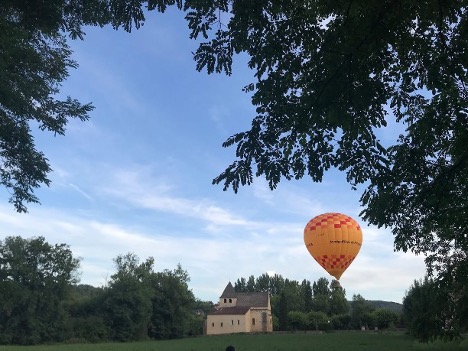
Fig 1. View of the small town of Carsac-Aillac, southwest France.
One night, Dennis Sandgathe (one of the directors) and I tried to replicate a traditional fire-making technique, using the strike a light method. We were striking pyrite—an iron sulfide mineral with a yellowish luster—against the flat side of chipped flint stones. We were using a specific tinder, Fomes fomentarius, a type of tree fungus used historically for starting fires because it catches and propagates sparks well. We blew gently on the faintly glowing tinder, fed it wisps of dry grass and small sticks, watching the smoke thicken and curl upward. We added larger pieces of wood, slowly, carefully. Then, suddenly, a flame caught and danced to life (Fig 2).
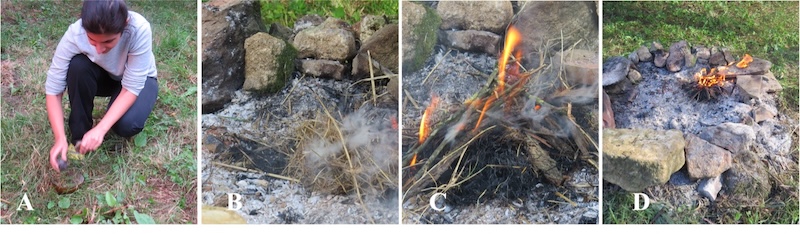
Fig 2. A:I tried to replicate a traditional fire-making technique, using the strike a light method. B: Sparks can ignite by blowing on tinder; C: Add small pieces of fuel, such as grass and small woods; D: Feed the ignited fire with more fuel gradually.
The team began to gather around the fire and fed it with wood and twigs. The night deepened as the fire burned bright and warmed our hearts. We shared stories and sang campfire songs. For a while, we weren’t archaeologists or students or scientists—we were just people sitting around a fire, much like others had done for thousands of years before us. Long after the flames faded, I sat by the embers, wondering: How did Neanderthals keep their sparks alive, literally and metaphorically?
Just Like Wood Maintains Fire Functions, It Is Change and Adaptation That Sustain Human Resilience
Resilience is the ability to draw on past experiences to anticipate future uncertainties and adapt to new challenges. Modern humans are defined by our resilience to a world of constant changes and it is integral to our success as a species. Our closest fossil relative, Neandertals, were also resilient to large scale changes in their environment. But how were they resilient and what does that mean for us?
Retelling the Stories of Humans Past Experiences
In every heap of ash, heat-altered bones and stones at archaeological sites, there are countless memories of past human experiences. In looking into the past, we are, in a way, still sitting around ancient campfires, still telling and retelling the stories of how we survived, adapted, and learned to live with the uncertainties of a shifting world.
Far beyond written records or oral histories, we find traces of a remarkable human species: Neandertals, who evolved and lived outside of Africa between approximately 400,000 and 40,000 years ago (Roebroeks and Soressi 2016). We, Homo sapiens, emerged in Africa likely Jebel Irhoud, Morocco around 379,000 years ago and ventured outward across the world (Hublin et al. 2017). Around 80,000 years ago, the paths of Neanderthals and modern humans crossed—likely in the Middle East like Zagros Mountain in Iran (Guran et al. 2024) and Tinshemet Cave in Israel (Zaidner et al. 2025).
Genetic evidence shows that Neanderthals and modern humans met and interbred (Green et al. 2010). Their descendants, who carried Neanderthal genes, spread out widely and contributed to traits that help us today including stronger immune systems, better metabolisms, and adaptations to diverse environments. For example, Neanderthal genes shaped skin pigmentation and hair characteristics, helping humans adapt to colder and lower-UV environments in Eurasia (Sankararaman et al. 2014). Also, genes related to immune system inherited from Neanderthals helped modern humans to respond better to various pathogens (Dannemann et al. 2016).
Archaeological clues scattered across Eurasia evidence that Neandertals were continually learning to adapt to new environmental conditions over time and space. When large prey like reindeer or bison were scarce, they turned to rabbits or turtles (Carvalho et al. 2025). When stone tool raw materials were in short supply, they recycled their flakes and tools by resharpening them multiple times (Vaquero et al. 2015). When wood for fuel was limited and the cost of gathering it to make fire outweighed its benefits, they either sat fire very briefly, or moved into different regions with more abundant resources (Henry 2017). Among all the traces they left behind, fire residues offer one of the most profound glimpses into their versatile behaviors.
Neandertals knew about fire’s benefits—longer days, warmer nights, safer shelters, and perhaps even more digestible, tastier smoked bison. They also knew fire came at a cost: fuel collecting and fire maintenance. But whether they depended on it to adapt to their environment is still an open question and one with important implications for understanding not just their biological and social adaptations, but also ours.
Tiny Pit-shaped Heat Scars on Stone Artifacts: Clues to the Use of Fire
We don’t stumble upon stone-lined hearths or perfectly preserved campfires at archaeological sites. Instead, we work with scattered patches of dark soil, tiny flecks of ash (Aldeias et al. 2012), and heat-altered bones and stones to collect most facts about how our human ancestors used fire in the past. Even then, mistakes are possible as minerals like manganese can mimic the chemical signatures of ancient fires (Goldberg et al. 2009).
In my search for understanding whether Neandertals relied on fire as a technology to live in colder climatic conditions, I study heat-altered flint artifacts through conducting controlled laboratory heat experiments. Burned lithic artifacts represent an important body of evidence for prehistoric fire behavior. They are among the most reliable fire proxies in the archaeological record. These are flint stone artifacts that were discarded by Neandertals and then accidentally exposed to fire at temperature above 350°C when they built fire on the ground surface inside caves and rockshelters. Heat leaves identifiable marks on these stone artifacts: It can cause cracking, changes to their original color, or create tiny pits in their surface (Fig. 3). Learning about those marks can tell us more about the nature of fire use at the archaeological sites, such as the heating duration and maintenance of hearths (Abdolahzadeh et al. 2023).
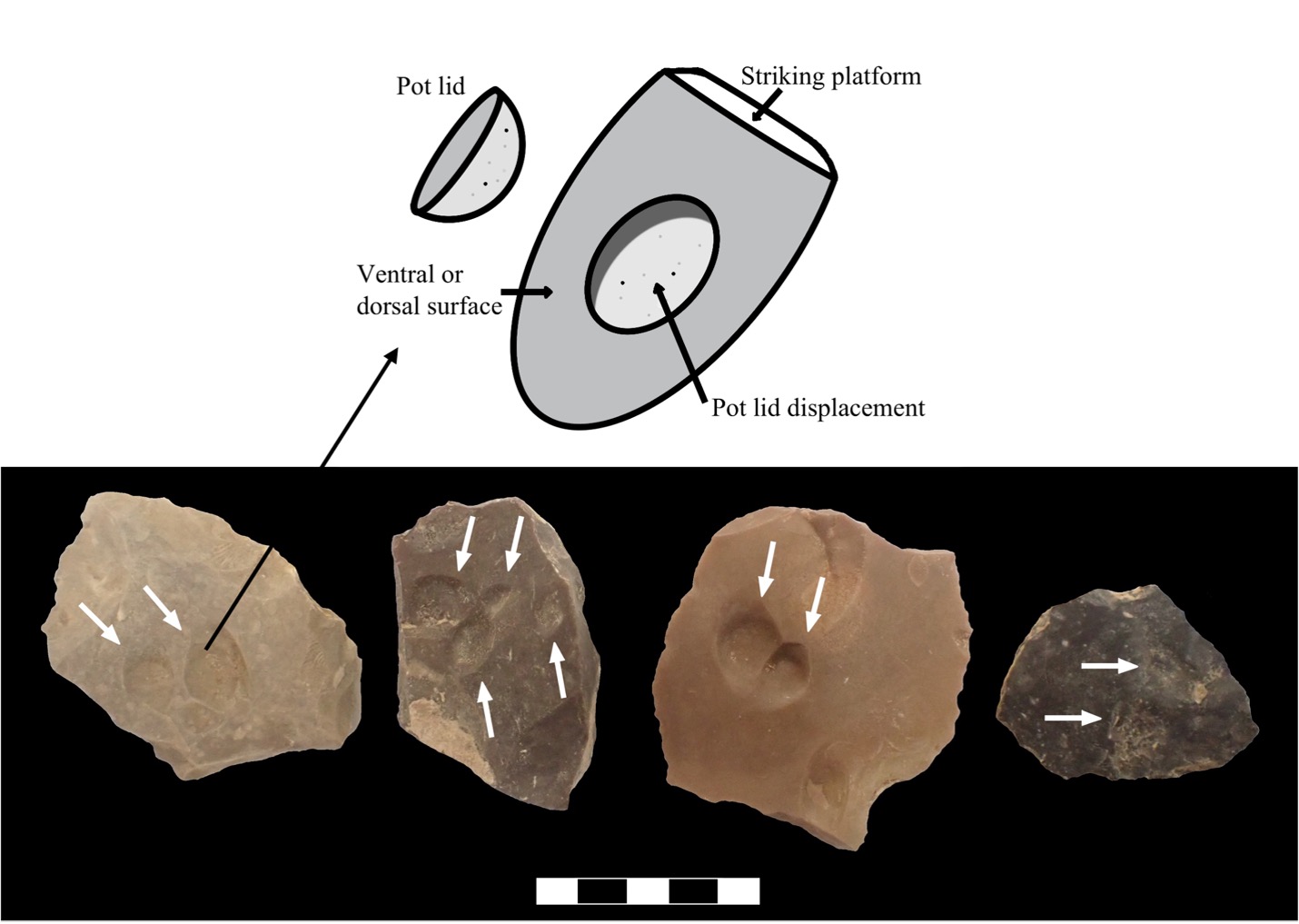
Fig 3. Burned flint flakes with color change and pot lids from Nahr Ibrahim lithic collection from Lebanon.
I studied the characteristics of the heat alterations on several thousand flint artifacts from Middle and Upper Paleolithic archaeological sites across Europe and southwest Asia. These sites date between ~150,000-32,000 years ago, a span of time (Late Pleistocene) during which Eurasia experienced significant climate fluctuations: back and forth of interglacial (mild and temperate) and glacial (extreme cold conditions) periods. These environmental changes played a major role in shaping Neandertals’ genetic and physical diversity, behavioral adaptations, population size, and, to some extent, their disappearance from Eurasia around 30,000 years ago (Higham et al. 2014). I also analyzed burned flints from archaeological sites in Southwest Asia during the transition to Neolithic agriculture (~14,000–6,000 years ago), a period of time marking the shift from the last glacial to interglacial conditions. During this time, climate changed from cold and dry to warmer and more stable. These conditions allowed modern humans to settle in villages, domesticate plants and animals, and produce pottery alongside stone tools.
When we look closely at evidence of fire use over thousands of years, a broader pattern emerges: regional variability in how often humans used fire, shaped by local and global climate shifts. Both Neandertals and modern humans tended to use fire more frequently under stable and warmer conditions. Climate fluctuations pushed Neandertals to be both opportunistic and selective (flexible) in how and when they used fire, hunted game, and sourced raw stone materials, whether from nearby or farther afield, depending on where they were and what the environment offered.
From the cold steppes of northern Europe to the Mediterranean woodlands and the arid edges of southwest Asia, their deep ecological knowledge of seasons and flora and fauna, helped Neandertals adapt, endure, and thrive for over 200,000 years (Fig. 4).
For instance, Neandertals inhabited Kulna cave in the Czech Republic seasonally between ~ 77,000 to 46,000 years ago, taking advantage of the open steppe landscape that offered prey such as mammoth and reindeer during relatively cold periods. Although evidence of fire use at Kulna is limited, it did not diminish over the course of their presence at this cave.
In contrast, at Abri du Maras in southeast France, Neandertals used the site between ~ 72,000 to 40,000 years ago as a seasonal campsite during warmer months. Here, they hunted a diverse range of animals and used fire when resources were available. They also sourced stone raw materials both locally and from farther away, showing a broad knowledge of the landscape.
In the Mediterranean regions, between ~ 54,000 to 43,000 years ago, at sites such as Abric Romaní rockshelter in Spain, where fuel remained abundant even during colder climatic periods, Neandertals burned their fires brightly and often. They returned to this site repeatedly throughout the year when horses and red deer roamed the landscape.
And in even more southerly latitudes, between ~ 185,000 to 50,000 years ago, at Ain Difla rockshelter in Jordan, and Nahr Ibrahim in Lebanon, Neandertals used fire more frequently during colder time periods when there was abundant steppe vegetations to make good fuel. The heat marks on discarded stone tools at these sites tell us that groups came through, stayed briefly, and light small fires before moving on to the next place.
Across these archaeological sites, patterns of fire use appear to align closely with various key factors—like fuel availability, access to food, climate shifts, and the seasonal movement of animals. This may suggest that Neandertals didn’t rely on fire alone to survive. Instead, they adapted using a broader set of strategies offered by their environment.
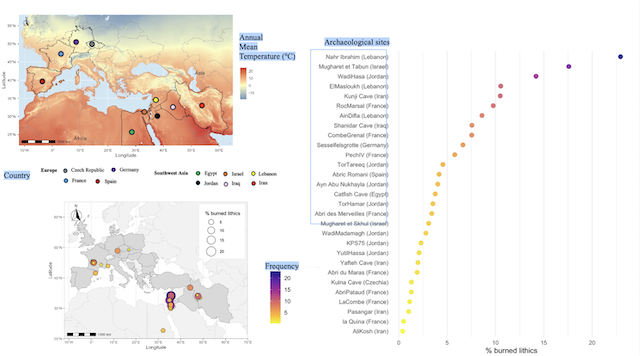
Fig 4. Paleoclimate data are derived from CHELSA TraCE21k (https://www.chelsa-climate.org/models/chelsa-trace21k) downscaled simulations for the Last Glacial Maximum, using the bioclimatic variable BIO1 (annual mean temperature). White dots on the paleoclimate map indicate the locations of archaeological sites. The lower-left map displays the mean percentage of burned lithics at each site, with color intensity representing higher proportions and point size scaled to reflect frequency. The right-hand plot presents the mean percentage of burned lithics for each site individually, using the same color scale for consistency across panels.
Why Is It Important to Know Neandertals Better?
Neandertals are often viewed through a binary lens: either they were like us—or they weren’t. Did they bury their dead the way we do? Did they use, maintain, and make fire like modern humans? Framing their lives in this way makes it hard to truly understand who they were, what they did, and how they lived.
Our understanding of how Neandertals adapted physiologically and genetically to cold climates remains limited—particularly in places where they did not rely on fire as a technological aid. Gaining deeper insight into how they coped with environmental extremes could offer valuable lessons for us today. As we face intensifying environmental challenges, important questions arise: Can humans live in warmer climatic conditions for a long period of time? And beyond mastering technology, will we be physiologically, socio-culturally, and genetically equipped to adapt to a rapidly changing environment?
Lessons in Resilience
If our human ancestors and close fossil relatives knew how and when to tap into environmental resources—and how to draw on past experiences to face future uncertainties—then that wisdom lives in us too. But every adaptation, even the successful ones, comes with limitations. Change is the key to going beyond adaptation; it’s what truly makes a difference. Neanderthals helped us become better at adapting, and we, Homo sapiens, excel at change—especially when adaptation alone is no longer enough.
This post was curated by Contributing Editors Volney Friedrich and Bronte Jones
References
Abdolahzadeh, Aylar, Shannon P. McPherron, Dennis M. Sandgathe, Theodore G. Schurr, Deborah I. Olszewski, and Harold L. Dibble. 2022. “Investigating Variability in the Frequency of Fire Use in the Archaeological Record of Late Pleistocene Europe.” Archaeological and Anthropological Sciences 14 (4): 62. https://doi.org/10.1007/s12520-022-01526-1
Abdolahzadeh, A., Leader, G. M., Li, L., Olszewski, D. I., & Schurr, T. G. (2023). “Heat Exposed Lithics: An Experimental Approach to Quantifying Potlids by Temperature.” Journal of Archaeological Science: Reports, 48, 103894.
Vera Aldeias, Paul Goldberg, Dennis Sandgathe, Francesco Berna, Harold Dibble, Shannon McPherron, Alain Turq, Zeljko Rezek. 2012. “Evidence for Neandertal use of fire at Roc de Marsal (France).” Journal of Archaeological Science 39 (7). 2414-2423.
Milena Carvalho, Jonathan A. Haws, Emily Lena Jones. 2025. “Late Neanderthal Subsistence and Foraging Mobility at Lapa do Picareiro: A Zooarchaeological and Taphonomic Analysis of Level JJ.” Frontiers in Environmental Archaeology 4:1545249. https://doi: 10.3389/fearc.2025.1545249
Dibble, H. L., Abodolahzadeh, A., Aldeias, V., Goldberg, P., McPherron, S. P., & Sandgathe, D. M. (2017). “How did Hominins Adapt to Ice Age Europe Without Fire?” Current Anthropology, 58(S16), S278-S287.
Goldberg, Paul, Christopher E. Miller, S. Schiegl, et al. 2009. “Bedding Hearths and Site Maintenance in the Middle Stone Age of Sibudu Cave, Kwazulu-Natal, South Africa.” Archaeological and Anthropological Sciences 1: 95–122. https://doi.org/10.1007/s12520-009-0008-1.
Guran, S.H., Yousefi, M., Kafash, A. et al. 2024. “Reconstructing Contact and a Potential Interbreeding Geographical Zone Between Neanderthals and Anatomically Modern Humans”. Scientific Report 14, 20475. https://doi.org/10.1038/s41598-024-70206-y
Henry, A. G. (2017). “Neanderthal Cooking and the Costs of Fire.” Current Anthropology, 58(S16), S329-S336.
Tom Higham, Katerina Douka, Rachel Wood. et al. 2014. “The Timing and Spatiotemporal Patterning of Neanderthal Disappearance.” Nature 512, 306–309 https://doi.org/10.1038/nature13621
Hublin, Jean-Jacques, Abdelouahed Ben-Ncer, Sarah E. Bailey, et al. 2017. “New Fossils from Jebel Irhoud, Morocco and the PanAfrican Origin of Homo Sapiens.” Nature 546: 289–292. https://doi.org/10.1038/nature22336.
Wila Roebroeks, Marie Soressi 2016. “Neandertals Revised.” PNAS 7;113(23):6372-9. doi: 10.1073/pnas.1521269113. PMID: 27274044; PMCID: PMC4988603.
Sankararaman, Sriram, Nick Patterson, Heng Li, Svante Pääbo, and David Reich. 2012. “The Date of Interbreeding between Neandertals and Modern Humans.” PLOS Genetics 8 (10): e1002947. https://doi.org/10.1371/journal.pgen.1002947.
Sankararaman, Sriram, Swapan Mallick, Michael Dannemann, et al. 2014. “The Genomic Landscape of Neanderthal Ancestry in Present-Day Humans.” Nature 507: 354–357. https://doi.org/10.1038/nature12961.
Manuel Vaquero, Amelia Bargallo, Maria Gema Chacon, Francesca Romagnoli, and Pablo Sanudo. 2015. “Lithic recycling in a Middle Paleolithic Expedient Context: Evidence from the Abric Romani (Capellades, Spain)”. Quaternary International 361 (10), 212-228.
Zaidner, Yossi, Marion Prévost, Ruth Shahack-Gross, et al. 2025. “Evidence from Tinshemet Cave in Israel Suggests Behavioural Uniformity Across Homo Group in the Levantine Mid-Middle Palaeolithic circa 130,000-80,000 Years Ago.” Nature Human Behaviour 9: 886–901. https://doi.org/10.1038/s41562-025-02110-y.
