During my doctoral research, focused on neuroscience laboratories and their forms of engagement with other spaces in the city of Bogotá, Colombia, I have been observing how artists and researchers use different processes to modulate, transform, and process biological signals in order to create artistic works. This experience led me to try to learn how to use the same software they employ. I created a small piece that I would like to show, along with a brief presentation of some of the reflections that emerged from it.
In the piece that accompanies this text, I use software typically employed for sound synthesis and real-time audiovisual composition. This software is also used in some laboratories in Colombia and in other parts of the world to develop artistic presentations. By connecting recording systems such as EEG and capturing biological signals, it becomes possible to transform or modulate visual and musical parameters, allowing for the creation of immersive artistic pieces that engage audiences. In this particular case, I composed the music using synthesis (the creation of sound through electronic signal generation and manipulation), together with an audio-reactive visual system in which the images change in response to the sound’s rhythm, frequency, or intensity.
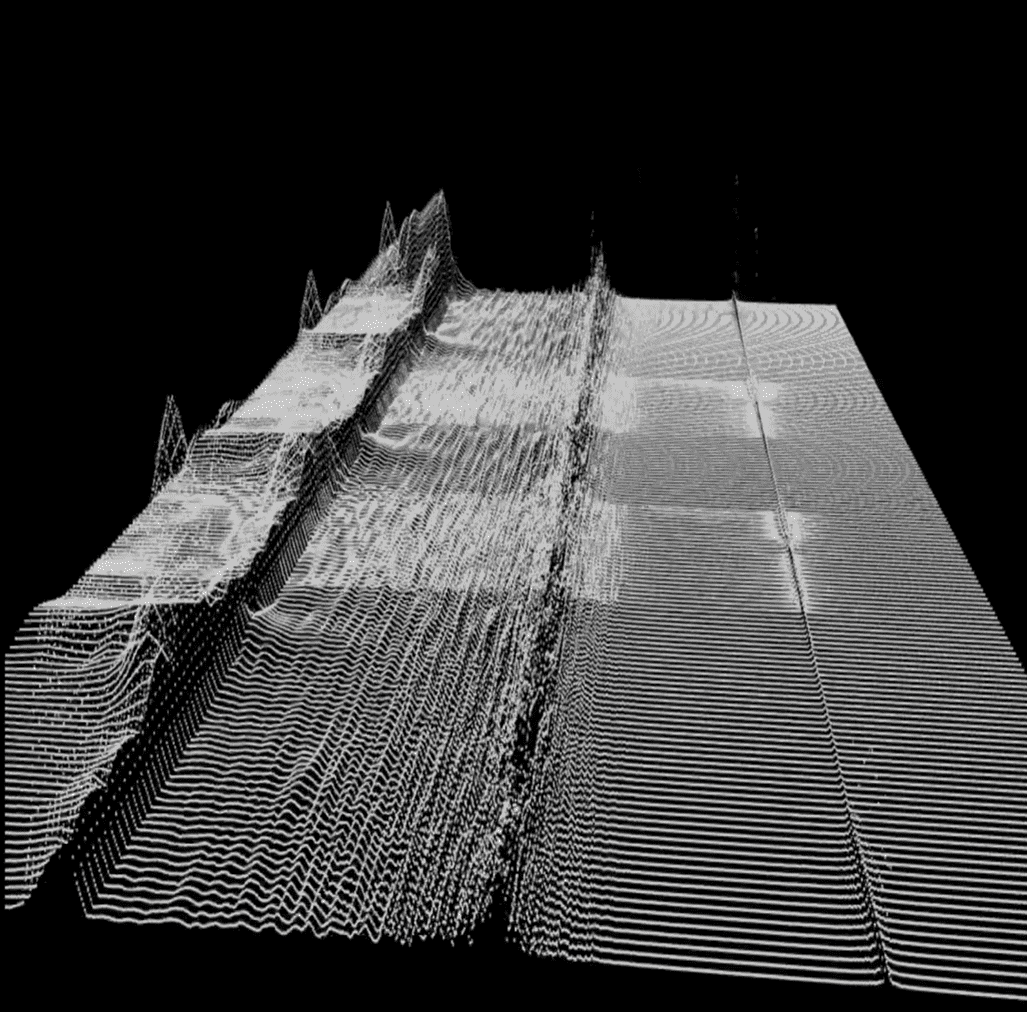
It is a three-dimensional network generated in TouchDesigner, where connecting the software to sound signals allows the image to react in real time, transforming its structure and movement according to variations in the audio. Created by the author.
Engaging with these practices, specifically those developed in neuroscience laboratories involved in art and science collaborations, has allowed me to understand that, although they involve technical procedures with a very specific vocabulary, it is by approaching the software they use that it becomes possible for us to better grasp what is taking place in these laboratories and to explore the possible futures of their relationships with broader dimensions of contemporary society. Through learning to use the software employed in these laboratories, I came to realize that the creative use of biological signals is closely related to practices in electronic music and contemporary installation art, where different kinds of data are translated into sound or visual forms. This reveals an interconnection between laboratory logics and those of contemporary creative ecosystems.
Without going deeply into the theoretical implications, since the main purpose of this short text is to introduce the piece, I want to highlight a central point: current possibilities of interaction between art and science are largely shaped by languages of communication. In a context marked by digitality, these encounters are not only possible but operational, as they are grounded in shared technical infrastructures.
To think through this condition, The Language of New Media by Lev Manovich (2002) was particularly insightful. The book argues that digital media operate through principles that enable the circulation, transformation, and integration of different forms of information within computational systems. From this perspective, neuroscience shows a particular affinity with these practices. On the one hand, much of its work relies on measurement: neural activity and physiological processes are captured as signals and translated into digital data. This digitalization allows these processes to be observed, recorded, and compared, but also to circulate within a broader ecosystem of computational tools, where they can be stored, processed, and analyzed.
On the other hand, this introduces a principle of modularity: once phenomena are translated into data, they can be separated and recombined in different ways, much like building blocks. Just as blocks can be arranged to form different structures, these data elements can be articulated in multiple configurations and integrated as components within larger systems, allowing them to interact with other forms of data, including sound and visual media. This, in turn, allows systems that are primarily scientific to become articulated within different types of creative ecologies, whose forms and possibilities we are only beginning to understand.
In this way, these operations can be readily incorporated into contemporary creative ecosystems, either as visible elements or as modulators of other processes with which they become articulated.
What this exercise has allowed me to see is that the relationship between art and science is not limited to an exchange of content, but takes place at the level of operations themselves: in the ways signals, data, and processes are captured, transformed, and rearticulated across different contexts.
From this perspective, the study of media, both in terms of their uses and their material supports, becomes a key area for understanding how science enters into dialogue with society. This implies that, for those of us conducting ethnographies in these fields, it is essential to attend to what happens in these other registers, that is, the spaces where scientific processes and data are translated into different modes of expression, such as artistic practices, installations, and audiovisual forms. In these contexts, what begins as measurement or signal can be reconfigured as sound, image, or interactive experience, allowing these materials to circulate beyond strictly scientific settings and engage with broader publics.
Reaching this conclusion would have been much more difficult without having interacted with the software they use. Only through practical engagement is it possible to perceive these connections. From now on, whenever I attend an electronic music concert or an installation, I will be more attentive to the logics that run through them and to how they connect with laboratory practices.
What follows is the piece:
This post was curated by Contributing Editor Mauricio Baez, and reviewed by Contributing Editor Sook Lin Toh.
Reference
Manovich, Lev. 2002. The Language of New Media. Leonardo. Cambridge, Mass.: MIT Press.
