A few months ago, I underwent four surgeries to remove two wisdom teeth. Long and painful, they took from me solid parts with strange shapes — a friend, on seeing one of the pieces, said it looked like a shark’s tooth! It was a slow, drawn-out experience: after each surgery, I had to recover before starting the next stage of the same process. During each one, I heard the dentist and her assistants discussing how stubbornly that tooth was attached to my skull.
Before each of the surgeries, on entering the office, I had to prove to the receptionist that I, who had booked the appointment, was who I claimed to be. She consulted a file whose history was unknown to me. “You’ve been here with us before, haven’t you?” — a sign that something had been recorded about me, without my knowing exactly what. On each of these occasions, after I passed through the reception and the waiting room, I would see a piece of my skull printed in blue on a screen. There, hidden away, was a tooth that should not have been there.
Over the course of those months, many people — I don’t know exactly who they were — accessed that image before accessing my body. I remember when I picked up the first removed piece: something that had been hurting inside me was suddenly transformed into a blur on a screen, and shortly afterward into small, solid, stained parts. That tooth left my body only once — but I wonder whether its record continues to circulate.
Through this experience, I came to share an unease similar to the one that anthropologist Mariza Peirano (2014) described feeling in a different context, that of biometric electoral re-registration: what was I doing at the dentist’s? Was it a surgery or, even under anesthetics and pain, ethnography? Or both? I had realized that an extension of my body, before being removed, had become a discrete unit of information.
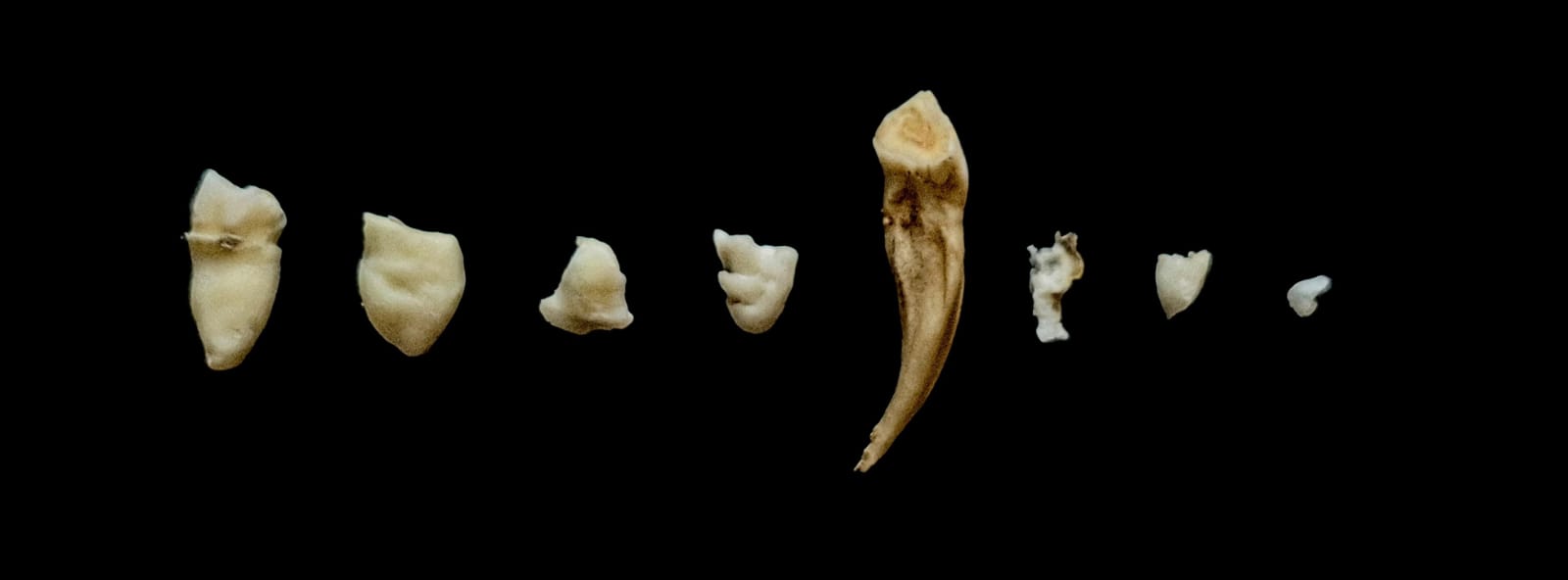
Seven pieces of the author’s two wisdom teeth, arranged from the largest (left) to the smallest (right). Between the fourth and fifth fragments lies an ethically collected equine incisor. Photo taken by the author.
My body was decomposed and abstracted from its typical contexts of existence and then reorganized through a series of data flows: I found myself before my own disembodied body, before what the sociologist Kevin Haggerty and the economist Richard Ericson (2000) named a “data double” of pure virtuality.
It was out of this displacement — of a piece of my body that now exists outside it, portable and catalogable — that I began to build a small biometric archive. A simulation that would make visible the fragmentation of the subject into records that never align, and that, precisely for this reason, produce no stable representation.
In archives, we find exactly the kinds of things that the sociologist Susan Star (1999), referring to infrastructures, called boring — lists of numbers, forms, records, identifiers, standardized images. Here, I seek to make non-boring (or ethnographically alive) what normally blends into the background.
The historian Ann Laura Stoler (2009), studying Dutch colonial archives, proposes that such territories should not be read solely in search of their silences, but also along the grain of what they insist on recording, and of the way in which they record. Colonial archives were, in her account, sites of epistemic anxiety: full of hesitations, traversed by classifications that overlapped and contradicted one another. There, the act of cataloging involved the insecurity of producing certainties in a world that escaped the colonial State.
From this I take an observation: the incompleteness we experience before biometric archives circulating in the data centers of megacorporations seems to be a property of archives as such. Systems that must catalog produce, alongside their records, their own zones of anxiety and obscurity — gaps, redundancies, and records that exist to mark the impossibility of other records. The gesture I propose seeks a speculative construction that reproduces the “archive-form”[1] by making visible, on a small scale, properties that biometric archival infrastructures, in their normal functioning, conceal.
Building an Unsustainable Archive
The system, built in JavaScript with the assistance of large language models, presents itself as a booster pack: a batch that, once opened, reveals four cards. The format explores a thesis about one’s relationship with one’s own data, given through probabilistic opening. We do not choose which traces are processed, recombined, or returned to us: we receive what the archive gives us. The repetition and the wait for a “rare” fragment seem to be part of the way infrastructures return us to ourselves, fragmented.
The archive contains nineteen discoverable records and a twentieth, ER-000, that is permanently inaccessible. The user may attempt to access it as many times as they wish, and the system will merely register the attempt and deny access. The ER-000 card is the affirmation of some conventions of the “archive-form” as observed by Stoler (2009): certain forms of access — even those pertinent to the data subject — may remain restricted by design.
ER-000 implements this logic on a small scale. It is a kind of secret: its circulation is controlled within the system itself. The very existence of the card is the gesture that signals “here, there is a record you will not read.” To attempt to access it is to discover this restriction as a structural condition. The archive, then, is incomplete because incompleteness is what it does. And with this, stable ways of representing the subject become destabilized.
Each of the other 19 cards displays a photograph — for the most part, passport-style photos of me, captured at different moments and under different regimes of circulation — alongside a minimal set of metadata. There are no proper names: in this archive, the subject is defined entirely by their legibility. Each of these photographs circulated in systems unknown to me. The user has sovereignty over the simulated archive because the referenced subject — the author — has no sovereignty over the real archives that supplied the material.
There is, however, a limit to this user sovereignty. Periodically, the system withdraws from circulation one of the already-discovered records: the card remains visible as an entry, but its content becomes inaccessible. The loss is recorded in the log and persists across sessions. The user may try to open more batches, may export reports, may erase everything at once — but cannot prevent records from disappearing. The archive decays with use, and this erosion escapes even the one who operates it. The user’s sovereignty over the archive is that of one who can only erase, but not preserve.
The cards are classified as common, rare, or epic, in open reference to the grammar of collectible games. Each category corresponds to a distinct regime of infrastructural legibility. Common cards (70%) are stable — sharp images, preserved metadata, institutional provenance — and represent a manageable subject. Rare cards (22%) are unstable — non-institutional contexts, uncertain sources, low biometric confidence — and represent a problematic subject, partially processed without being resolved. Epic cards (8%) are the archive’s blind spot: records whose ways of representing the subject stand in tension with those held to be institutionally legible. There is one card — the rarest — that displays the image of a horse I photographed in the region where I grew up. I am quite fond of horses, and even though it is considered anomalous, the system has a protocol that forces its incorporation.
The horse breaks the ontology the archive assumes: it is not a subject in the sense that the other records are. Even so, it receives an ID, a year of capture, and an index. The archive classifies it as anomalous, assigns it a regime of rarity, and treats it as one more fragment among the others. The science and technology scholar Irma van der Ploeg (2012) indicates that, when a biometric system cannot handle variations in human characteristics that fall outside a given range (and here, the horse is a non-human affective index that condenses human affects), to catalog and exclude is, for the archive, preferable to not cataloging at all.
A Horse in the Archive?
The tooth outside the body, the biometric record — both share the property of existing as signs detached from their referent, circulating within regimes that the subject neither controls nor necessarily knows about. I am reminded of Observatory Mansions, a novel by Edward Carey (2002), in which the protagonist secretly collects intimate objects stolen from his neighbors — objects saturated with the affects deposited in them by their former owners. Once cataloged, the object becomes an index in a system from which the subject is absent.
The anthropologist Alfred Gell (1998) proposes that people distribute aspects of their agency through index-objects that circulate as extensions of them in their absence. The concept of distributed personhood, then, allows us to think of the person as a configuration that spreads through the things that continue to act on their behalf.
But Gell deals, in general, with authorized distributions — agency extends because the subject takes part in the gesture. The point of inflection that interests me is another: what happens when this distribution occurs without the subject’s consent? When the indices carrying portions of them circulate without their knowledge, within systems in which they take no part? Here, the distribution of the person seems to become a symptom of vulnerability.
Van der Ploeg (2012) observes that who we are, how we are, and how we will be treated are questions increasingly accessible to others through information derived from our bodies. The identities attributed from this can become like a shadow: hard to fight, impossible to shake. The computer scientist Nina da Hora (2026) locates the mechanism of this attribution in the pipeline of face recognition systems itself: a face must be aligned to a canonical geometry — a template that decides which variations count as signal and which as distortion — before it can be recognized. What cannot be stabilized under that discipline is positioned as excess. She names this computational epistemicide, drawing on philosopher Sueli Carneiro’s (2005) concept of epistemicide: the face becomes knowable only by being reduced to what the system can stabilize as data.
Where Gell (1998) might see the extension of the subject, Haggerty and Ericson (2000), van der Ploeg (2012) and da Hora (2026) may perceive its multiplication: the person is unfolded into additional “selves” that they do not control. The “data double,” as Haggerty and Ericson observe, circulates among different centers of calculation, serving as a marker for granting access in ways often unknown to its referents. Da Hora (2026) reads this operation through Mary Shelley’s Frankenstein: parts dissected, stitched into a proxy whose legitimacy is asserted by the procedure that made it. The creature, in her account, is the vector itself. I, therefore, became the creature — and if Gell is right that the person spreads through the things acting on their behalf, the creature is not separate from me, but continuous with me. Where one ends and the other begins does not seem to be a question biometric archives and infrastructures are built to ask.
The horse returns here as a limit case. Like the tooth, it is a sign detached from its referent; unlike the tooth, its referent was never a data subject at all. And still it carries something of me that no passport photo does: a place of affection condensed into a non-human index, a dear memory. The archive has no category for that. It files the horse as an anomaly and moves on. In doing so, it shows what it has been doing all along: it recognizes the form of a record, not the person the record is supposed to be about.
On Labor and Incompleteness
If the process of creating a “data double” involves transforming the body into pure information, making it more mobile and comparable, this transformation also passes through the subject: the maintenance of such doubles demands continuous and invisible labor.
Star (1999) reminds us that the operation of technical systems depends on labor that is frequently unacknowledged, requiring a delicate balance between invisibility and visibility. In the context of biometric data, there is a kind of articulation work the subject performs upon themselves in order to remain legible to certain infrastructures.
We fill out forms, position our face against a light background before a camera, grant authorizations and updated information, and offer symbolic indices as a means of proving that “yes, I am who I say I am.” Each of these operations is labor — a stitching between the subject and the infrastructure that will catalog them. This labor, however, goes unnoticed most of the time: it simply happens.
And yet even this cooperation is not enough. The incompleteness seems to be a property of the archive-form rather than a flaw to be compensated for by the subject’s labor. The effort toward legibility seems to feed a cycle — the more the subject cooperates, the more material the archive has to fragment and recombine, and the further it gets from any stable representation.
Back to the Dental Office
I return, by way of conclusion, to the dentist’s office. At the end of the last surgery, the dentist — who took part in two of the four surgeries — reiterated the difficulty of extracting my tooth, something I had heard in every surgery. “I even mentioned it to a friend of mine who’s also a dentist! It was the most difficult wisdom tooth I’ve ever removed in my career.” To understand the reason for such difficulty, she asked me new questions, especially about the biochemical organization of my body. I answered. A story about my tooth was shared by someone who had access to the records and the hypotheses about it. Was a “virtual physical examination” (van der Ploeg, 2012) of my body performed? The piece of the tooth stayed with me, but the information about the body it came from — and the forms of processing that make it possible to know that body — remain foreign to me.
There is a symmetry here worth naming. The control the system in question grants to those who use it is the negative of the control I did not have over the images that constitute it. Perhaps this is the unease that the archive I have presented seeks to make palpable: each batch produces cards that are, at one and the same time, evidence of prior cooperation (the photos already existed) and signs of an incompleteness by design. The nineteen visible records and the sealed card operate together: no subject appears in full, and yet the demand that they appear continues to be made of them.
This post was reviewed by Contributing Editor Shreyasha Paudel and Multimodal Contributing Editor Christine Kim.
Notes
[1] For Stoler (2009), the archive-form includes prose style, repetitive refrains, rhetorics of persuasion, affective tonalities that shape supposedly rational responses, categories of confidentiality and classification, and genres of documentation. The archive is as much what is said as the way in which it is said.
References
Carey, Edward. 2002. Observatory Mansions: A Novel. New York: Random House.
Carneiro, Sueli. 2005. A construção do outro como não-ser como fundamento do ser. Ph. D. Dissertation. São Paulo: Universidade de São Paulo.
da Hora, Nina. 2026. “Frankenstein in the Pipeline: Computational Epistemicide in Facial Recognition.” In The 2026 ACM Conference on Fairness, Accountability, and Transparency (FAccT ’26), June 25–28, 2026, Montreal, QC, Canada. New York: ACM. https://doi.org/10.1145/3805689.3812284
Gell, Alfred. 1998. Art and Agency: An Anthropological Theory. Oxford and New York: Oxford University Press.
Haggerty, Kevin, and Richard Ericson. 2000. “The Surveillant Assemblage.” British Journal of Sociology 51 (4): 605–622. https://doi.org/10.1080/00071310020015280
Peirano, Mariza. 2014. “Etnografia Não É Método.” Horizontes Antropológicos 20 (42): 377–391. https://doi.org/10.1590/s0104-71832014000200015
Star, Susan Leigh. 1999. “The Ethnography of Infrastructure.” American Behavioral Scientist 43 (3): 377–391. https://doi.org/10.1177/00027649921955326
Stoler, Ann Laura. 2009. Along the Archival Grain: Epistemic Anxieties and Colonial Common Sense. Princeton: Princeton University Press.
Van der Ploeg, Irma. 2012. “The Body as Data in the Age of Information.” In Routledge Handbook of Surveillance Studies, edited by Kirstie Ball, Kevin Haggerty, and David Lyon, 176–183. London and New York: Routledge.
Acknowledgements
My heartfelt thanks to Managing Editor Kim Fernandes for embracing this project outside the regular editorial cycle and for their thoughtful guidance throughout the editorial process. I am also deeply grateful to the STS scholar Brittany Fields, whose generosity transformed an unexpected encounter into an invaluable reading of this manuscript.
