Debates about the future of work often center around adapting the workforce to fit capitalist proposals of what work should look like. Pre-digital examples include scientific management, just-in-time production, and de-skilling of industrial labor in favor of more mechanized and automated processes. Recently, capitalist proposals of arrangements of work have centered on digital platforms, algorithmic management, pervasive surveillance, and the deskilling of white-collar work through aggressive adoption of large language models (generative AI). In the face of these changes, workers are expected to accept their new, typically more controlled, unstable, exploitative work arrangements, re-train and re-skill to find employment in different or new types of work or face un- and under-employment with whatever safety net might be available. Underlying these changes to work arrangements is a drive for efficiency and profit.
This post is the first post in a series about the future of work. It consists of a selection of perspectives presented as part of a triple panel at the 2025 Society for the Social Studies of Science Conference in Seattle. Through subsequent posts in this series, we present three posts that seek to challenge this status quo and center perspectives from the periphery — alternative futures of work. This series asks and answers the following questions: how can the sociotechnical imaginaries dominating government and corporate discussions of the future of work be interrupted? How can decolonial, feminist, pluriversal futures of work be imagined and, in some contexts, how are they already enacted? How are marginalized workers and unemployed people resisting futures of work that devalue their contributions and minimize their voices?
We offer these questions as an entry point into conversations about the future of work with the acknowledgement that these futures are already happening. A sharper attention to the ways they are being shaped helps us to see what makes certain futures possible while foreclosing others. In particular, this series includes empirical, historical, and theoretical perspectives on gig and platform work—the various ways in which workers organize to protect themselves and make meaning within platform ecologies that are frequently designed to generate returns for venture capital investors at the expense of workers’ well-being and values.
Although perspectives from all panels are not represented through this series, the image below summarizes some of the themes from across the presentations of the panels. Technological change in the workplace that increases surveillance and efficiency at the cost of workers’ power and control of their labor process is often framed as inevitable. Presentations across each panel responded, including responding to the framing of the “inevitability” of this type of “technological progress” by not only prefiguring and reimagining our future, but also directly acting and resisting in our present. In particular, these presentations critically approached the study of what might seem at first glance like technological progress, asking instead how this progress is experienced by those who work to make it possible. Panelists pointed out the importance of using collective sensemaking in order to infuse care into our conversations and critically reflect what the role of researchers, designers, or technologists could be in the broader narrative.
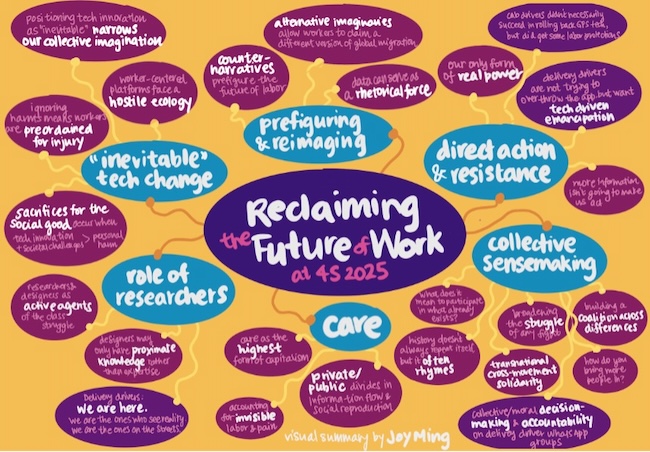
Visual summary of the themes that emerged from the panels at the 2025 Society for the Social Studies of Science.
The three subsequent posts that this series includes expand on the themes from the panels in different ways.
First, we have Ambar Reyes’ reflection on the experiences of food delivery workers in New York City from indigenous communities from Mexico and Guatemala, serving as a deep empirical dive into the realities of frontline workers in the context of migration, precarity, and institutional neglect. Ambar’s post attends to the strategies that workers have developed for mitigating and responding to everyday encounters with risk, such as bicycle theft and violence, on the streets of New York City. In particular, it looks at how communication platforms enable the development of networks among workers, including Facebook livestreams and WhatsApp group conversations. When both labor platforms and the police are indifferent to delivery workers’ problems, these networks offer mutual support through the sharing of tips, warnings, and news. Workers’ digital communications help transform observation into evidence, mediate social and economic relations beyond the circulation of information, and create a space for collective governance. The stories that are shared by the gig workers evidence how workers take care of each other in a hostile ecosystem and assert a collective identity other than the one the platforms try to assign them.
Then we have Lucy Pei’s post, which links empirics with a broader context, diving deeper into the issues around cross-national identities raised by Ambar’s post and historicizing these observations into theoretical trendsa discussion about scale-making across different types of gig workers among gig worker activists. Lucy starts with the self-conscious claims made by one gig worker’s union that their movement is global in scale. The post further explores scale-making as an ongoing and contested project, where actions and discursive choices of different actors bring different units of space and place into focus. Putting today’s global gig worker movements in conversation with past examples of transnational labor solidarity and alter-globalization (a set of transnational movements in the 1990s and 2000s that fought against neoliberal globalization) draws analytic attention to how scale is claimed and argues that academics and workers alike should continue to center transnational solidarity in the reclaiming of the futures of work.
Finally, Gena Kim and Nathan Kim build on Lucy’s argument for academics and workers to work together and present a call to action that centers researchers, technologists and designers. Gena and Nathan analyze the (future of) their work through the lens of class struggle, deepening a discussion about the role and positionality of researchers. The lens of class struggle foregrounds the ambition to “identify the vulnerabilities of capital” and politicize technologists toward struggling against injustice and dispossession. They call on human-computer interaction and kindred researchers to reorient how they understand their work: instead of trying to improve scholarship by considering class struggle as one of many theoretical frameworks, the various theories of scholarship can be understood as possible components of class struggle.
Through empirical, theoretical, and rhetorical claims, these posts explore the precarity workers face in the present and how they are prefiguring future care and collectivity, such as how delivery drivers and other gig workers are organizing using social media and other digital tools. These posts challenge the narrative that the futures of technological progress are set in stone, presenting alternatives to corporate and capitalistic power. Moreover, they problematize the boundaries set between nations on a global scale and also between types of work like frontline or gig work and back office or knowledge work.
At the 4S Meeting in Toronto in 2026, we will be continuing this conversation with new and ongoing empirical contexts and conceptual framings. The panels will take us through what we can learn from imagined futures, idealized presents, and differently remembered pasts from around the world and across different scales. Global South, global majority, and decolonial lenses help us to break out of dominant points of view. Taking on a range of methods, the empirical and conceptual works draw lessons from workers’ embodied experiences and relationships to one another and to the places they work, from discourse and discursive objects, and from speculative engagements. We are eager for the cross-pollination and discussions that will come out of these panels as we continue to fight to reclaim the futures of work.
This post was curated by contributing editor Wanqing Iris Zhou and reviewed by contributing editor Juan Camilo Ospina Deaza.
