This article is the second in a series about gig and platform worker unions in India written by members of the Labor Tech Research Network. Read the introduction to the series here.
This post offers a worm’s-eye view of the tensions and opportunities shaping platform labour organising in contemporary India. Platform work has exposed larger numbers of workers, especially younger workers with little memory or experience of organizing, to mobilize against capital and to do so using innovative means and campaigns (Wadikar, 2025). Building upon literature on platform workers’ mobilization in India (Ray and John, 2025), we highlight how efforts to organize emerge within regionally specific terrains of culture, politics and histories of labour mobilization.
Through three vignettes, we bring the everyday together with the cultural, political histories and contexts of three metropolitan Indian cities – Bengaluru, Delhi and Kolkata, cities in which we have lived and engaged in research and activism with platform workers. Spanning between 2019 and 2025, these vignettes reflect the political landscape in India. They shed light on the capital–state nexus that limits the power of workers, unionization efforts built on foundations of loyalty and often exclusionary hypermasculine politics. What are the tensions and contradictions that we confronted while doing research with ‘gig’ worker unions? How do we navigate making certain aspects of unionizing visible while muting others? How can we be less extractive and more useful to the workers we write about?
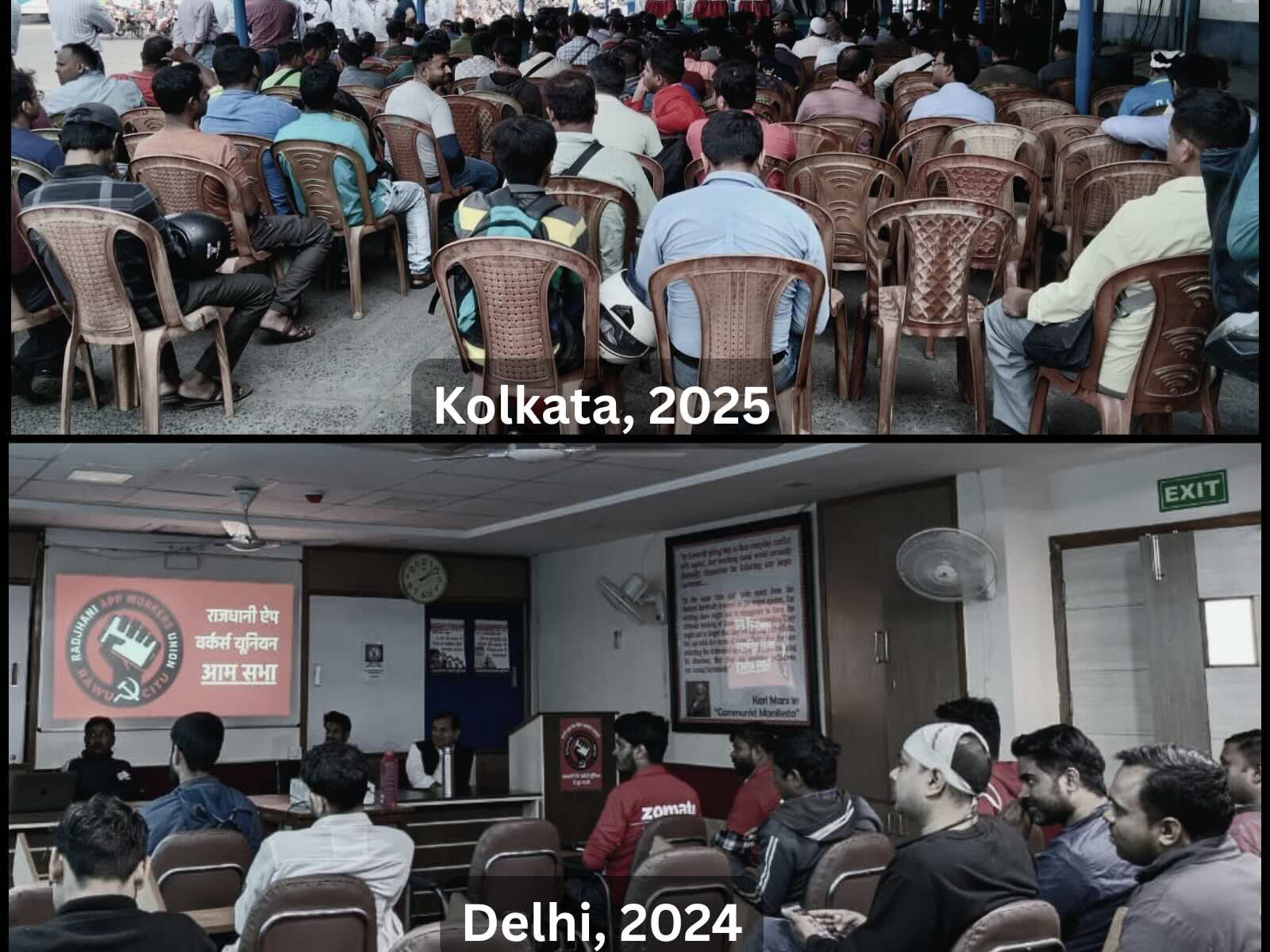
Images of two union meetings from the authors’ fieldwork
Red and Yellow: The Politics of Othering in a Karnataka Drivers’ Union
What struck me as I stepped into the union office to meet S, it’s ‘leader’ or ‘adhyaksha’ [President] as he often referred to himself, were the large, garlanded photographs that adorned the walls of this one-room office in north-west Bangalore in 2019. Instead of the usual photos of Mahatma Gandhi, or Dr. B.R. Ambedkar, I saw photographs of famous Kannada cinema actors – Dr Rajkumar and Shankar Nag – icons dear to auto and cab drivers in Karnataka. These late actors are synonymous with Kannada language and culture, and (hard-working) working-class masculinities.
S, like several other drivers I had met during fieldwork in the city, remarked about my fluency in Kannada. Over time, I realized how chance aspects like my name Kaveri – itself closely associated with Kannada culture – and my Kannada speaking abilities helped me build rapport and gain access to the everyday working-lives of cab drivers in Bangalore.
As I introduced myself to S and expressed my rationale for interviewing him, S enthusiastically remarked, ‘Madam, let’s make this a Facebook live! That way hundreds of people will listen to us!’ During our hour-long, camera-conscious conversation, S – often performing for an invisible audience – revealed his long-standing commitment to the union, deep knowledge of Uber and Ola’s rise in Karnataka, and efforts to build a statewide movement for better fares and working conditions.
S’s personal Facebook page had unending photos of him addressing drivers wearing red and yellow ‘shawls’ as colours of the Karnataka flag. Referring to S as ‘anna’ (elder brother in Kannada), posts also consisted of member drivers creating short videos of S that interspersed his images with a roaring lion or a lone elephant, reflecting tropes of masculinity and hero-worship. I chose not to focus too much on these internal dynamics of the union in my writing (Medappa, 2023), lest it steal attention from the union’s work.
Over time, through my participation in the union’s chat groups I saw how Kannada/Karnataka language and culture was a key tool to organize drivers. Driver members – a majority of whom were from land-owning politically powerful caste groups – coalesced around cultural events such as the Karnataka State Day or Shankar Nag’s birth anniversary. Even events such as blood donation camps, ‘chaha kootas’ [tea-meetings] or cricket matches showed drivers wearing the union’s shirt with its red and yellow coloured logo, paired with ‘shawls’ round their necks. It was heartening to see how drivers constructed their own social value and created community using language and myth-making amidst the alienation they experienced as app-based drivers. These events served as an antidote to the apathy and marginalization they faced from platform capital and state actors.
Having left India to return to university to write my doctoral thesis, I continued following the union through 2020 until late 2021 on the many chat groups they had allowed me into. Kannada language and culture increasingly became a tool to ‘other’ fellow marginalized platform workers. As material conditions of app-based drivers deteriorated, especially in the background of COVID-19 lockdowns in 2020 and 2021 (Medappa, 2023), I saw regular posts of drivers carrying out campaigns against app-based bike-taxi drivers for allegedly stealing their livelihoods. Union members often chased Rapido bike taxis, and in some instances, even physically threatened its drivers. These workers were labelled ‘outsiders’ [horaginavaru] or ‘Hindi avaru’ [‘Hindi-people’] or ‘north Indians’. Hapless bike-taxi drivers often bore the brunt of drivers’ frustrations at their own immiseration and the regulatory vacuums that platforms like Rapido exploited in Karnataka. While I was tempted to send audio notes to the groups about how motorbike taxi riders, like drivers, were also simply trying to eke out a living, I refrained. Instead, I sent regular updates and audio notes explaining the legal battles won by unions outside of India (e.g., in the UK against Uber in 2021) and drew attention to cross-platform worker protests (happening in many parts of South America in the aftermath of the pandemic) to inspire collective action.
In the years since 2021, the union has become a shadow of what it was. It was found that S had been mismanaging finances of the union and was made to step down. In recent years, exclusionary Kannada language and culture politics has raised its head in Bengaluru, yet again. Although they reflect broader trends of divisive politics and ‘other’-ing in India more widely, the growing anti-Hindi and pro-Kannada sentiment is also rooted in a distinct and complex political history and struggle for identity, autonomy and representation (Nair, 2000; Sheth and Kava, 2024). What is disheartening is that this ire targets fellow, mostly working-class Bengalureans, permeates everyday life in the city, and undermines cross-platform and cross-sectoral mobilization among (platform) workers in the city.
Kolkata: A City in Motion
The maverick Marxist filmmaker Mrinal Sen once made a film calling Kolkata his Eldorado (Sen, 2024). He meant it ironically, not as a city of gold, but as one full of passion, politics, and struggle. As I think about my fieldwork on platform work – conducted between February and June 2025 in Kolkata – the film’s charged and chaotic city echoes in my thoughts.
Once an imperial capital dotted with gentlemen’s clubs and an ebullient elite, the city was slowly transformed by working-class movements that grew out of its streets and factories (Agarwal, 2022). Communist party aligned unions were instrumental in peeling away the city’s colonial skin, mobilizing the “hungry skeletons” that populated its social interiors. Kolkata’s rich history of strikes and tool-downs makes it a city where unions have historically been strong.
It is true that the relationship between unions and political power was never simple. Even in the heyday of communist parties, their politically affiliated unions often became vehicles for strongman leaders to grow their clout or for the government to suppress genuine worker demands. Nonetheless, the logic of unionization itself was rarely questioned (Gooptu, 2007).
With the Left’s decline, however, new unions have appeared either linked to the regionalist political party Trinamool Congress (TMC) or the Hindu right-wing party Bharatiya Janata Party (BJP). Many claim to be apolitical but are connected to powerful political figures that articulate relations of clientelism. For example, worker-members of these unions paste pictures of party leaders onto their vehicles among other acts of loyalty. The whisper among platform workers is that they are better termed as syndicates. These syndicates operate with impunity: they extract chada (monetary donation) from workers and discriminate against those who do not pay them their protection money.
During a meeting I attended with one such union, workers, local leaders, and one “respected” political figure had gathered to discuss workers’ issues. The meeting began at the union office on the outskirts of the city where all the workers were crammed in with very little space to move. I was under the impression that workers would raise their daily issues with police harassment, random ID blocks, low kilometer rate, etc. But that didn’t happen. Only intermediary strongmen responsible for a particular area were given the opportunity to speak. These intermediaries spoke in such an obsequious manner that it felt more like a gathering at a landlord’s house than a union meeting, and the discussion revolved around individual political interests and not worker demands.
As this unfolded, the workers stood quietly in the background and waited to see how things played out. The air was thick with hierarchy. As the bickering was ongoing, the “respected leader” rose in a fit of anger and demanded that a worker not be allowed to drive his cab because his loyalties were in question. Every worker in the room was stupified by this sudden outburst, as were some of the intermediaries. The “respected leader” had in good measure displayed his feudal wrath. The only time workers felt some form of association was when Shingara (fried pastry) was served. As they were finishing, munching on the savory, workers slowly slipped out of the crowd.
In retrospect, as a labour researcher, the first step for critical engagement with the rightward shift I witnessed is unpacking what is going on as much as amplifying broadbased leftwing trends within the union space. Political scientist Bhattacharyya (2023) called this new phase in Bengal politics “franchisee politics’: a system where power is spread out among local strongmen and intermediaries, each controlling their small patch of influence. For platform workers who lack collective organization, franchisee politics raises a worrying question: where does their voice fit in a system built around loyalty rather than rights? Once, unions remade the image of this city as a restless entity constantly at odds with the forces of capital. That image is slowly devolving into a network of decay, while capital strikes back insidiously. Platform workers are caught in the crossroads!
Organizing as Method: The Case of Delhi
Over the last few years, Delhi has become dotted with hundreds of ‘dark stores’ or warehouses, in or near residential neighborhoods, that draw workers from the city’s abundant perpetually informalized settlements. The city is not friendly towards its workers, their movements, or unions, despite having a long history as the epicenter of people’s movements and political power equally (Sinha, 2024). The working classes in Delhi have had a long history of confrontation with capital but they are by no means organised under any formal unions now or historically. Even though national trade unions and ‘independent’ sectoral unions both function in the city, neither category has made significant inroads into unionizing the highly mobile and transient delivery workforce.
Despite this, every now and then, news reports crop up of strikes at Blinkit or Zepto warehouses or food delivery workers in the city – most are responses to dropping earnings, but they are also at times about ID blocking (or algorithmic termination of workers’ accounts) or lack of basic infrastructure such as toilets and drinking water (Soni, 2020). As I realized quickly during the first month of my year-long fieldwork in the city, these reports failed to capture the sheer dispersion and frequency of workers’ mobilizations.
Delivery workers in the city are a militant class. I found that periods of striking and unrest follow cycles of fluctuation in earnings corresponding to demand curves. Workers are constantly keeping up with small and big shifts in how components of their wages are calculated. For months, I met workers who said “rates had just been dropped a few weeks ago,” and they wanted rates back at their original calculations. However, the only workers who had ever heard of a union with any strength were migrants from Bengal. Younger workers had no conception of what organized mobilization could look like.
Gig workers in the city were difficult to do research with, not least because they were an over-researched demographic. On my first day on the field, I went to a bus stop near Delhi University, where a worker called me out immediately – “you have come to write a report right? Students often come here to ask us about our earnings for their assignments.” In other cases, workers were acutely aware that their lives and conditions of work have been documented by journalists and social media influencers. They were no longer able to see any value in sharing their stories. Several workers told me I am wasting my time talking to them.
After witnessing a few strikes up close, I decided to partner with a labour union as an organizer along with doing my research. There isn’t much value academic research standards of objectivity and lack of interventionism can offer workers directly, in the short or long term, especially during ongoing unrest and consequent repression from capital and state apparatuses. In one instance, I found out about an ongoing strike at a store where negotiation failure with the management led to the police being called on workers. In this period of crisis, I chose not only to document this instance of repression but actively intervene through the tools provided to me by the union as an organizer – I immediately passed on the case to union lawyers who successfully got the workers released.
These cases were also symptomatic of the incremental criminalization of workers movements and dilution of labour rights, a feature of neoliberal development in urban India. In these circumstances, labour researchers must not just passively document but act as political agents – or in the words of Babasaheb Ambedkar: “Educate, agitate, organize!”.
Conclusion
These three vignettes illustrate the varied trajectories of platform worker unionization and the tensions that shape them. In Bangalore, linguistic regionalism often takes precedence over labour as a shared identity, fragmenting possibilities for broader solidarity. In Delhi, with its large migrant workforce, workers have staged powerful spontaneous protests, yet sustained forms of collective organization have proven difficult to maintain. Kolkata, by contrast, carries the weight of a long union history but now faces a rightward political shift that has eroded older bodies of worker mobilization and left many vulnerable.
Taken together, these urban experiences reveal more than local particularities. They point to the unfolding afterlives of 1990s neoliberal development models. Platform workers navigate a web of power politics, often connected to the dominant norms of local political formations. Yet in these moments of interregnum (Gramsci, 1995); contestation, however partial or fleeting, reminds us that workers continue to experiment with new languages of organization.
For researchers, these questions are not only analytical but also ethical. Participating in and writing about worker movements demands a balance between internal critique, which grows from involvement, and external critique, which offers perspective. To inhabit that space in between is to acknowledge that research itself is a form of collective practice, one that is ridden with tensions and one that seeks to make visible the shifting grounds on which labour stands today.
References
Agarwal, P. 2022. “Workers’ way”: Moments of labor in late 1940s Calcutta. International Labor and Working-Class History 102: 225–247.
Bhattacharya, D. 2023. Of conflict and collaboration: Mamata Banerjee and the making of ‘franchisee politics’ in West Bengal. Economic & Political Weekly 58(36): 46–55.
Gooptu, N. 2007. Economic liberalisation, work and democracy: Industrial decline and urban politics in Kolkata. Economic and Political Weekly 42 (21): 1922–1933.
Medappa, K. 2023. Rethinking mutual aid through the lens of social reproduction: How platform drivers ride out work and life in Bengaluru, India. Journal of South Asian Development 18(3): 383–408.
Nair, J. 2000. Language and the right to the city. Economic and Political Weekly 35 (47): 4141–4146
Ray, A., & John, A. 2025. A new politics of welfare? The origins and strategies of India’s gig and platform workers’ unions in the era of digital capitalism. Competition & Change.
Sen, M. 2024. Calcutta My Eldorado (Mrinal Sen) Online Video]. Available at: https://www.youtube.com/watch?v=CYZrIqSSP2s (accessed 24/10/2025)
Sheth, A & Kava, S. 2024, November 14. Kannadiga versus Hindi ‘outsider’: The multiple dimensions of the Bengaluru divide. Newslaundry. http://newslaundry.com/2024/11/14/kannadiga-vs-hindi-outsider-the-multiple-dimensions-of-the-bengaluru-divide (accessed 13/09/2025)
Sinha, A. 2024. In the Valley of Historical Time: Towards the History of the Working Class Movement in Delhi. Brill.
Soni, Y. 2020, 19 September. ‘India’s Gig Economy On Strike.’ Inc42. https://inc42.com/features/the-outline-by-inc42-plus-indias-gig-economy-on-strike/Wadikar, RA. 2025, March 23. ‘Why are Ola, Uber, Rapido cab drivers in Hyderabad starting a ‘no AC campaign’ from March 24? Hindustan Times. https://www.hindustantimes.com/india-news/why-are-ola-uber-rapido-cab-drivers-in-hyderabad-starting-a-no-ac-campaign-from-march-24-101742692274655.html (accessed 10/10/2025)
This post was reviewed by Contributing Editor Sam DiBella.
