An animated peanut with a bowler hat and a white beard sits on one side of a campfire, opposite three smaller peanuts grinning back at him adoringly. Amid the chirping crickets and the crackling of the fire, the older peanut calls out: “Gather round my little legumes, it’s story time!” A small redheaded pod responds, “Grandpa, tell us the M and M’s story again.” Grandpa responds in a chiding tone: “We’ll get there! But, let’s start at the beginning…”
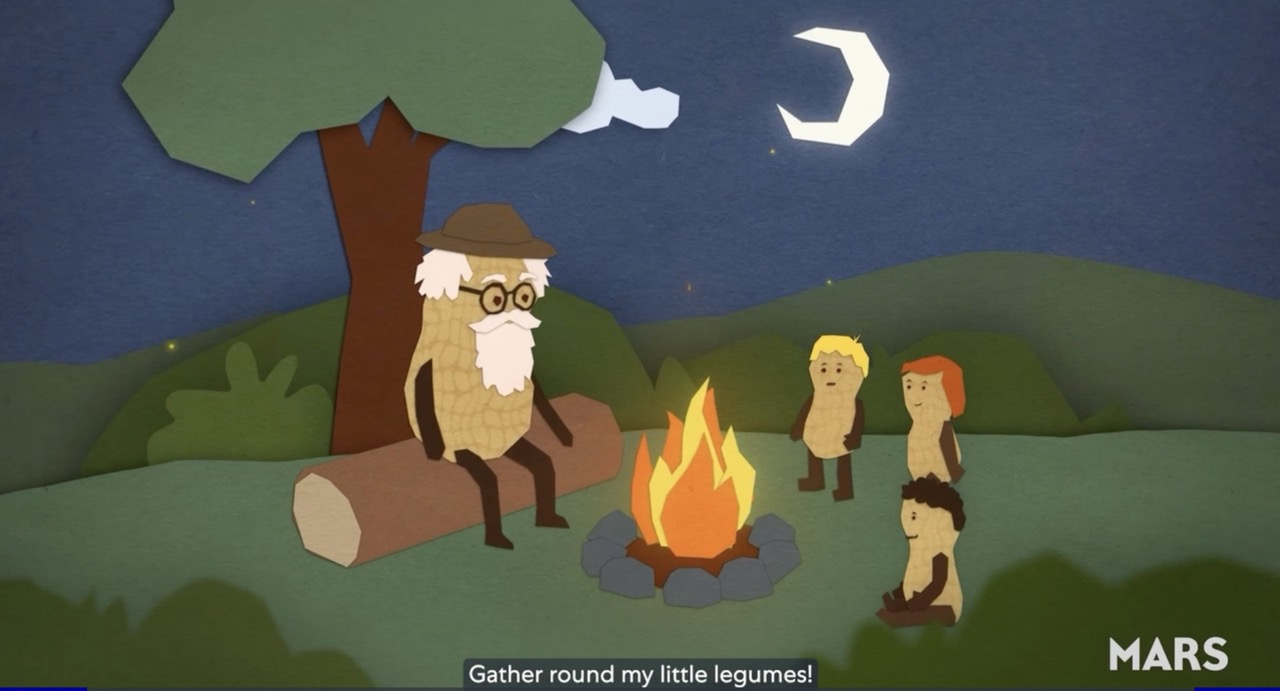
The opening scene from Mars’ #ProtectthePeanut video, featuring Grandpa Peanut and his three grand-nuts. © Mars Wrigley Confectionery or its affiliates. Used with permission from Mars Wrigley Confectionery.
Over the course of this two minute and 34 second video, Grandpa narrates the environmental threats to the 10,000-year-old practice of peanut cultivation and the ways in which, through genomics and breeding, scientists funded by Mars Candy Corporation are ensuring that we can “#SaveThePeanut” (Mars 2025). The scientists in question are David and Soraya Bertioli, a peanut breeding power couple at the University of Georgia, who recently received a 5 million dollar grant from Mars for their research that aims to, in their words, “improve the peanut crop by broadening its genetic base with the gene diversity of wild peanut species from South America” (UGA Wild Peanut Lab 2025). By analyzing these wild peanuts, most of which are nearly unrecognizable as peanuts at all, the Bertiolis and their collaborators aim to identify desirable traits such as pest resistance and drought tolerance that will result in “elite” peanuts containing the wild genes coding for these traits. This endeavor is in anticipation of climate change, which, according to Grandpa, means that up to 30% of peanuts don’t make it from pod to plate. A concerned blond peanut interrupts Grandpa’s regaling of these existential climatic threats, asking: “But what about all the Snickers bars, Grandpa?” He comforts his grand-nuts, explaining that thanks to genetic research and plant breeding funded by Mars, “things are starting to look up!”
A small peanut with brown hair calls out: “Grandpa! Can you just tell us where stronger peanut babies come from?” Grandpa replies wistfully, “Ah, the art of peanut matchmaking….”
The screen shifts to a game show, with shockingly accurate-looking animated Drs. Bertioli standing in the middle of the desks meant for the contestants. They gesture to the seats on either side, as the contestants, Uncle Archie on the left (a partially bald Brazilian peanut with great disease resistance) and Aunt Hope on the right (who loves dry weather), appear in the seats, demurely eyeing and waving at each other. As Grandpa explains, it’s “peanut love at first sprout!”
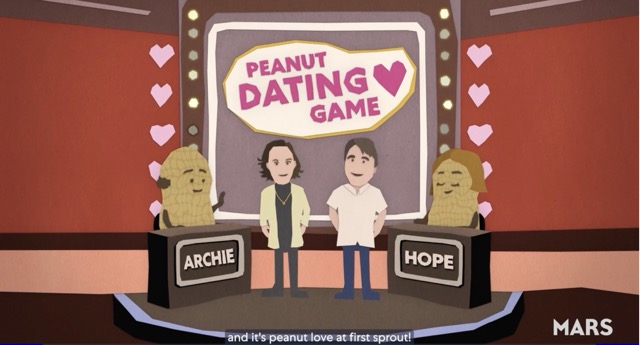
Drs. Bertioli’s peanut matchmaking show, with Uncle Archie and Aunt Hope. As Grandpa explains, it’s “peanut love at first sprout!” © Mars Wrigley Confectionery or its affiliates. Used with permission.
Now that Uncle Archie and Aunt Hope are in love, we see the products of their romance: a family tree leading from a kissing Archie and Hope to three baby peanuts (diaper and pacifier included), as Grandpa explains: “Together, they create super peanut kiddos the all-natural, GMO-free, kind of way, destined for delicious Snickers and M&M’s.”
Adding to the strangeness of this family orientation is the fact that peanuts do not naturally reproduce by crossing with other peanut varieties. I learned this the hard way after approaching a peanut breeder asking about the feasibility of mixing different varieties, to which he responded: “You know peanuts are self-pollinating, right?” as if it were the most obvious fact ever, which, to a peanut breeder, it is. In order to make peanut crosses, one needs to do the finicky work of hand pollinating them, which still only works 30-40% of the time. This process becomes even more convoluted with wild peanuts, because, unlike domestic peanuts, which are allotetraplods (meaning they have two separate but combined genomes, or four sets of chromosomes), wild peanuts are diploids and have two sets of chromosomes (similar to humans). This is one of the reasons why wild peanuts look so different from domesticated peanuts: the more DNA in a plant, the bigger it will be. This is also why cultivated bananas are bigger–the ubiquitous Cavendish bananas that we eat are triploids (three copies of each chromosome), which both makes them bigger and means that they don’t have seeds. Wild peanut pods are significantly smaller compared to the peanuts we are used to, and each pod only contains one seed. Peanuts’ allotetraploidy and propensity for self pollination is part of what makes them so interesting for breeders. Because of these traits, there is a smaller amount of genetic recombination and flow, which is part of why scientists look to wild peanuts as a source of new genetic material to improve into existing cultivars.
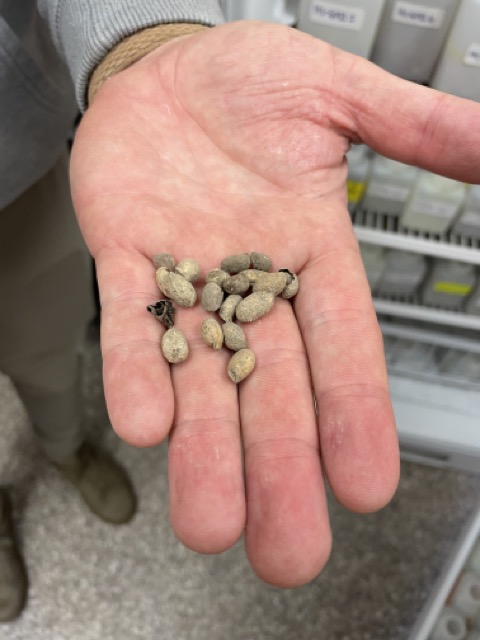
Wild peanuts from the USDA Germplasm Resource Information Network. Photo by author.
To incorporate wild peanut genetics, breeders need to negotiate the hurdles of both self-pollination and the incompatibility of different chromosome numbers. This occurs through a 10-15 year long process of cross breeding, hand pollination, chromosome doubling, grow outs, and selection. Crucially, in order for breeders to cross wild diploid and domesticated tetraploid peanuts, they need to double the number of chromosomes so that each parent plant has the same number of chromosomes. Typically, peanut breeders achieve this using the chemical compound colchicine, which inhibits chromosome separation during meiosis, effectively doubling the number of chromosomes in a plant’s germ cells (Singh et al 2025). Unfortunately, colchicine, although used in small doses as medicine for gout, is highly toxic to humans.
Given this reality, why is it that Mars is emphasizing the “all natural” and “family oriented” aspect of peanuts? The use of marital or romantic language to describe plant reproduction is nothing new: In her book, Nature’s Body: Gender in the Making of Modern Science (1993), Londa Schiebinger notes how Linnaean taxonomy, which continues to organize plants, didn’t only rely on sexual difference, but also “imported into botany traditional notions about sexual hierarchy” (13), adding “Not only were his plants sexed, but they actually became human; more specifically, they became husbands and wives” (22). Others have long written about the ways in which social norms are used to describe scientific processes, and, on the other hand, how science is used to naturalize social hierarchies and norms (Rosenberg 1976; Franklin 1995). The romance of Archie and Hope is not unlike the dynamics Emily Martin describes, demonstrating how the complexities of reproductive biology are not only presented in cultural (and romantic) terms, but “relies on stereotypes central to our cultural definitions of male and female” (Martin 1991, 485). This analogy between plant reproduction and human reproduction is carried forward in Mars’ #ProtectthePeanut Campaign, as germplasm and genetic material become Aunt Hope, Uncle Archie, and Grandpa’s twin brother George, one of the lucky nuts destined to become a Peanut M&M.
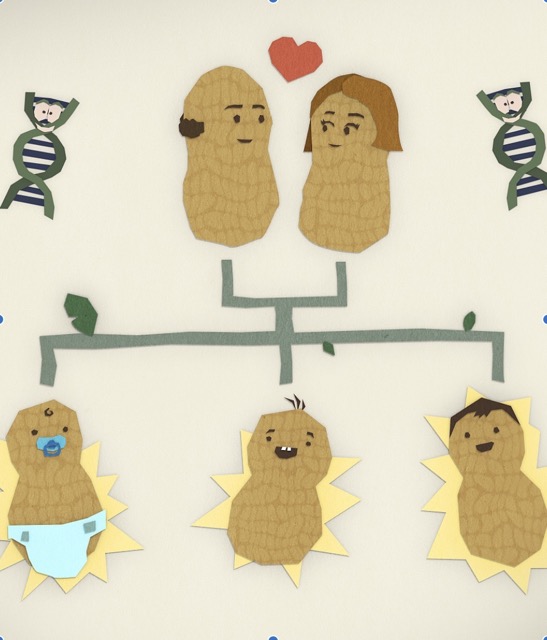
Archie and Hope’s family tree. © Mars Wrigley Confectionery or its affiliates. Used with permission from Mars Wrigley Confectionery.
In portraying plant breeding as a genetically mediated “meet-cute,” Mars obscures the labor entailed in plant breeding, toxic chemicals and all. Instead of describing the often painstaking and tedious tasks that are required to breed peanuts, let alone the added complexity of incorporating wild genes, we are presented with a sweet story about a happy peanut family. More than just rendering the labor of plant breeding invisible, this naturalizes genetic interventions, painting modern plant breeding as a sort of familial fantasy. There is no explanation of what exactly the work of decoding the genome or creating new varieties entails, contributing to what scholars have noted as an invisibilizing move that obscures the power relations permeating modern technoscience (Anthony et al 2023). Even as Mars emphasizes the role of the Peanut Genome Initiative and other genetic interventions in crafting “the perfect peanut,” they write about it in overtly domestic terms, explaining that “Before decoding the peanut genome, peanut breeding was like baking a cake without a recipe. But suddenly, we had the full cookbook” (Mars 2025). Family functions as a symbolic framing for these scientific projects to make them seem more natural. Whereas Marxist feminists have discussed the ways capitalist systems rely on the family to naturalize and gender labor in the home and the division between the public and private spheres (Federici 1975; Vogel 1983), Mars is using the family to naturalize genetic interventions and the role of corporations in maintaining a safe and stable future in the face of climate change.
Despite the toxicity and the chromosome doubling and the botanical reality of peanut reproduction, Mars’s portrayal of peanut breeding as an all-natural gendered family unit contrasts the stability of the nuclear family with the instability of climate change. In doing so, the commodity, in this case Mars candies, becomes an essential safeguard against total climate and societal collapse–a world without peanuts. Rewriting peanut breeding as a family producing new stronger peanut kiddos plays into what literary scholar Lee Edelman describes as “reproductive futurism” through which the imagined future Child is used to justify current political and ideological formations (2004, 2). Edelman argues that by emphasizing children, politicians and others make it so that heteronormative social structures are seen as essential for future imaginations (14). In Mars’s video and campaign, this fictional child is depicted as a literal child in peanut form. By representing the commodity as a child reproduced by heterosexual romance, Mars operates on a similar type of reproductive futurism, in which the survival of the social, as Edelman describes it, is linked to the survival of the commodity.
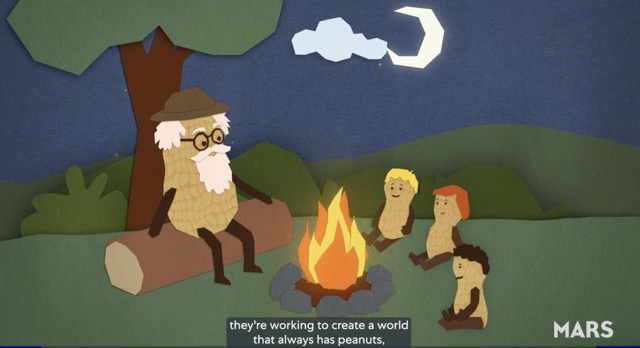
Grandpa explains that Mars is “working to create a world that always has peanuts.” © Mars Wrigley Confectionery or its affiliates. Used with permission from Mars Wrigley Confectionery.
These candies are posed as essential for a good future, made possible through specific paths that both place value on the natural family and biotechnology. This representational move reveals the infrastructures shaping our conceptions of climate change, placing corporations and the commodities they produce as central to a secure future. Simultaneously, Mars links the futures of candy consumers to those Grandpa describes as “the millions of people who count on us.” This crafts what Aihwa Ong describes as “communities of fate,” or groups of people united by similar orientations towards the future. Ong explains how biotechnology is employed to manage people’s relationship to the future, often invoking “traditional values of family,” among others, to do so (2010, 20). By blurring the line between technology and family, commodity and future, this video and the broader #ProtectthePeanut campaign, Mars uses the anticipation of climate change as the frame in which their products are essential. However, in doing so, Mars is perpetuating what Adams et al. describe as “a kind of erasure not just of existing problems but also of recognition of them as problems per se” (2009, 259). Posing the commodity as a natural solution to climate change evades the larger problem of increasingly unpredictable and extreme climates. After all, what is a world without Snickers or M&Ms?
This post was edited by Contributing Editor Ritu Ghosh.
References
Adams, Vincanne, Michelle Murphy, and Adele E. Clarke. 2009. “Anticipation: Technoscience, Life, Affect, Temporality.” Subjectivity 28 (1): 246–65.
Anthony, Patrick, Juliana Broad, Xan Chacko, Zachary Dorner, Judith Kaplan, and Duygu Yıldırım. 2023. “(Un)Making Labor Invisible: A Syllabus.” History of Science 61 (4): 608–24.
Edelman, Lee. 2004. No Future: Queer Theory and the Death Drive. Series Q. Duke University Press.
Federici, Sylvia. 1975. Wages Against Housework. Falling Wall Press.
Franklin, Sarah. 1995. “Science as Culture, Cultures of Science.” Annual Review of Anthropology (Palo Alto, CA 94303-0139, 4139 El Camino Way, P.O. Box 10139, USA) 24 (1): 163–84.
Martin, Emily. 1991. “The Egg and the Sperm: How Science Has Constructed a Romance Based on Stereotypical Male-Female Roles.” Signs: Journal of Women in Culture and Society (Chicago) 16 (3): 485–501.
Ong, Aihwa, Nancy N. Chen, Michael M. J. Fischer, Aihwa Ong, and Joseph Dumit. 2020. Introduction: An Analytics of Biotechnology and Ethics at Multiple Scales. Duke University Press.
“Our Peanut Farming Practices: A Commitment to Save the Peanut | Mars.” n.d. Accessed February 19, 2026. https://www.mars.com/protect-the-peanut.
Research | UGA Wild Peanut Lab. n.d. Accessed February 19, 2026. https://wildpeanutlab.uga.edu/research/.
Rosenberg, Charles E. 1976. No Other Gods: On Science and American Social Thought. Johns Hopkins University Press.
Schiebinger, Londa L. 1993. Nature’s Body: Gender in the Making of Modern Science. Beacon Press.
Singh, Baljinder, Sunyoung Yun, Yeji Gil, and Myoung-Hwan Park. 2025. “The Role of Colchicine in Plant Breeding.” International Journal of Molecular Sciences 26 (14): 6743. https://doi.org/10.3390/ijms26146743.
Vogel, Lise. 1983. Marxism and the Oppression of Women: Toward a Unitary Theory. Rutgers University Press.

1 Comment
I use to work at Harvey’s Peanuts in Leary Ga. We mostly dried and bagged “seed” peanuts. I never fully understood what they were, other than maybe just the best peanut? The was only one farmer (the Jordans) who grew these.
What are they, and how to they qualify as “seed peanuts”.
This work would get someone to college quick.