Salt. That everyday thing we use to season our meals, relax our muscles, or make our icy roadways safer to traverse. Salt is an inescapable part of human experience, and yet, as anthropologists, it often escapes our attention.
In recent years, anthropologists have turned their attention to what Cymene Howe (2026) calls the ‘elemental’, referring to the objects and processes – often simultaneously both – that constitute the world. Ongoing environmental crisis means coming to experience the elemental in new ways, both within and around the body. Salt, or sodium chloride, is one of these elements. By attending to the ways that salt reshapes environments and how we relate to them, we can foreground the material contingencies of continued economic, social, and political survival.
In this blogpost, we want to explore some of the ways that salt is emerging as a contested and existential matter of concern in the making of liveable environmental futures. For each of us, salt is something we find ourselves stumbling across again and again in our fieldsites, in Ecuador (Alexander), the Netherlands (Jackie) and Morocco (Madeline). This is testament to salt’s pervasiveness across a multitude of different conditions, its material necessity for functioning ecosystems, and its capacity to interrupt socio-environmental relations when it becomes more or less noticeable.
This shift to thinking of salt as a matter of concern (Latour 2004) is what we explore through each of the scenes below, drawn from our respective field sites.
Making Saline Value in the Galápagos
In an archipelago once described by Herman Melville as “heaps of cinders dumped here-and-there” and more desolate than “abandoned cemeteries of long ago”, the opportunities for developing any kind of economic potential lie, at first glance, few and far between. Such was the struggle to develop any kind of valuable economic enterprise in the Galápagos Archipelago that archival documents from the early 20th century puzzle over the purposes to which the islands can be put, and often comment on the Government of Ecuador’s lack of knowing what to do with them. Indeed, this lack of drawing economic potential from them was cited as a reason for Ecuador to sell the islands to the United States of America.
And yet, one frequent point of return is salt. Those seeking a point of economic possibility often pointed to the wealth of salt resources present on James Island, now known as Santiago, speculating the potential wealth that could come from setting up a business there. Similarly, archival documents speak of efforts by Norwegian settlers of the 1930s to set up a fishing business, reliant upon the salt of the islands to preserve their catch so that it could survive the 600 mile transit from the archipelago to the continent. In other words, amidst a lack of other opportunities, salt stood firm as a source of future economic hope in a land others wrote off as desolate.
Fast forward to today, and the promise of salt remains. Walking along the malecon of Puerto Ayora, on the island of Santa Cruz, one can find small packets of locally harvested salt, produced on the island of Baltra in the shadow of the former U.S. military base. In a place where regulations rule that 97% of the land is unable to be developed, opportunities for economic practices outside of tourism lie few and far between. And yet, salt remains as a source of potential.
Elsewhere in Santa Cruz, on the other side of Academy Bay to the malecon, lies just after the gateway to the Las Grietas tourist site and on the edge of Bahia Franklin (Franklin’s Bay), a critical site of salt for the island’s fishing industries. These grave-like shapes are salt ponds created seasonally by two individuals, a mother and her son, entrusted to harvest salt from this tidal pool. The work to make these pools is laborious and, without shade, is done early in the morning before the tour groups arrive at the Las Grietas path. Speaking with the son, he tells me of how the salt is valued by local fishermen. While they can buy salt from the continent, this Galapagueño salt is, for them, different in its long term effect on the preservation of fish. Principally, this difference lies in its taste. It is this salt, he tells me, that makes the preserved fish properly of Galapagos.
Thus, salt, in the case of Galapagos, sits as a continually recurring answer to a question of how to create forms of value in a place that has both been historically written off as worthless and contemporaneously limited in the forms of economic possibility that can be developed. In turn, salt remains as a mark of the place itself, with its unique mineral qualities and composition resulting in an irreplicable flavour that, for those invested in its production, makes its presence worth the effort required.
Managing Water/Managing Salt in the Dutch Delta
Salt can be not only an object of value but also the source of existential concern. In delta regions, where waters are brackish – a mix of salty and fresh, not quite either, always both – salt provides the conditions for existence, determining who and what can eke out a living. Deltas are especially vulnerable to the changing presence of salt, as it seeps its unruly way into new geographies and disrupts practices and livelihoods contingent on the delicate balance of brackish flows.
The province of Zeeland, situated in the Rhine-Meuse-Scheldt Delta, was once a series of islands that now boasts one of the most extensive coastal defense infrastructures in the world. As sea levels rise, however, there are serious questions about whether this approach will continue to be effective. Not only are sea levels rising, but the land level is sinking, meaning that in places like Zeeland, salt is coming from multiple sources: it is travelling upriver, permeating coastal infrastructures, and increasingly, seeping into the land through groundwater. These are serious challenges for a region that relies on aqua- and agriculture as the mainstays of its economy.
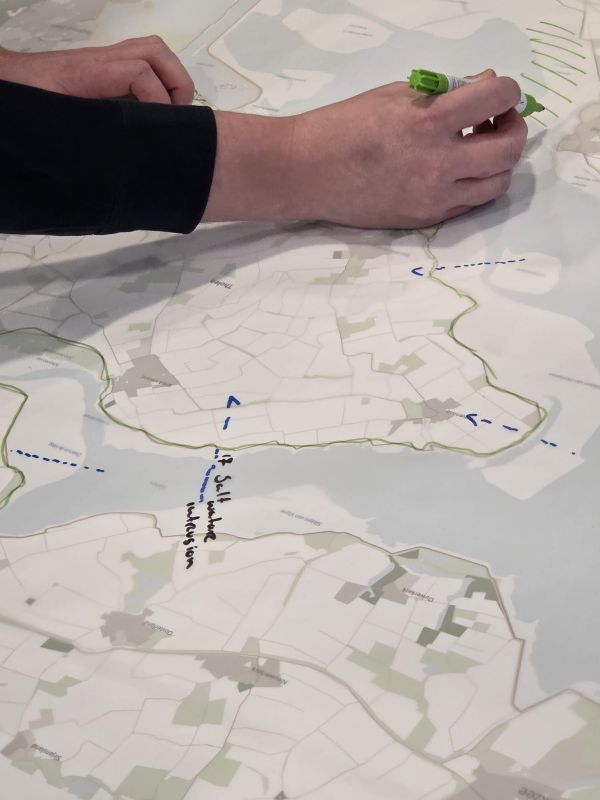
Mapping salt intrusion in Zeeland, the Netherlands, during a scientific workshop. Image by Author Jackie Ashkin.
Both in Zeeland and at a national level, there are ongoing debates about whether to take a more “open” or “closed” approach to the future of the delta. Open approaches welcome salt, intentionally making coastal defences more porous and temporarily returning portions of the coast to the North Sea so that sediments can accumulate and slowly raise the ground level. This is the approach often recommended by ecologically-minded scientists, who are interested in enrolling natural processes in the work of making more resilient coasts (see Helmreich 2023), but would render much of the region’s agriculture untenable and, in some cases, require residents to move. Closed approaches, on the other hand, seek to eschew salt from the landscape entirely by creating new barriers between land and sea that would keep the delta above water while nevertheless transforming it into a predominantly freshwater environment. This approach, at least on the surface, is preferred by local citizens who see this as aligning with national traditions of hydroengineering, but would likely result in the disappearance of the shellfish fisheries that play an important role in the regional culture and economy. Both a salty and a salt-less delta thus have significant tradeoffs, and neither approach promises a liveable future for everyone.
Yet these two approaches are not the most dramatic ways of imagining the future of the delta: some national plans even suggest returning the entire province to the sea and focusing coastal protection efforts elsewhere. Researchers emphasize that the changing conditions wrought by climate change necessitate environmental intervention, and choices not to intervene will not stop the onslaught of salt. Proposals about the future of the delta point to the ways that negotiating saltiness is an inevitable political and existential dilemma in years to come.
Agriculture and Processes of De/salinization in Morocco
After seven years of drought, Mohammed, who grows apples and grains near the headwaters of the Oum er-Rbia river in Morocco’s interior, narrates how water is more scarce and the soil saltier than previously imaginable. As his soil reached a point of salinity where most seeds fail to yield after taking root – an unsavory side effect of evapotranspiration and the prolonged lack of water — Mohammed began to advocate for the widespread return to the use of beldi grain varieties, a Darija term that emplaces and describes something of the land. In Mohammed’s practice, local, indigenous grains are more likely to be productive when drought and salinity disrupt nutrient cycling. Reconsidering the substance of agricultural productivity is a strategy he uses to cope with the impacts of soil suffuse with salt.
Two saline processes course through the sites where I engage with land stewards and agricultural scientists in rural central Morocco: the salinization of soil and the desalination of water. When I ask farmers to tell stories about how their landscapes are changing, the salinization of soil is often cited as a pivotal challenge agriculturalists face. When soils grow saltier, crops fail to grow; salinization stands to reconfigure how and what, if any, agriculture and arboriculture happen. The stakes of crop failure include, of course, the unravelling of agrarian life and livelihood.
As I have come to understand through these conversations, salt and water must be understood together – even and especially in the most water-scarce environments – when seeking to apprehend dovetailing dynamics of degradation and care. Chemical fertilizers, of which Morocco is a major producer and which agriculture globally is dependent on, have been named as contributors to soil salinization. Salinization, in intimate correspondence with desertification, seems to be precisely the process of a soil becoming infertile. The majority of fertilizers are, chemically, salts; now, they are increasingly being advertised as low-salt index, highlighting the perceived and explicit precarities of soil amendment adding more salt to a fragile productive landscape.
Though salt’s presence in this agrarian space is typically most apparent because of water’s absence, the manifest absence of salt from the water used to irrigate crops in coastal areas strikes a strange harmony. The desalination and distribution of ocean water – deemed essential to addressing water crises and hallmark of regional infrastructural and agricultural development projects – illuminates another way in which human intervention into biogeochemical processes becomes foundational to agricultural fertility. Concomitant processes of de/salinization are mechanisms and effects of transforming relationships with the environment.
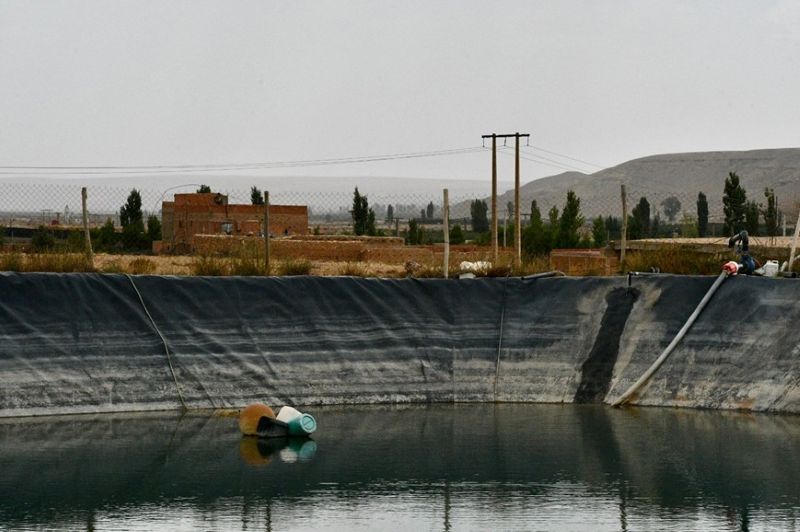
Water catchment in Morocco with evaporation residue. Image by Author Madeline Augusta Turner.
Crystalline Contestations
Salt is not everywhere the same: in the Galapagos, salt can (un)make the authenticity of locally preserved fish. Salt moves in unruly ways: in the Netherlands, salt is matter ‘out of place’ (Douglas, 2002 [1966]) that pushes back against sociotechnical imaginaries of coastal management and environmental mastery. Salt can bring precarity into relief: in Morocco, the uneven distribution of salt between soil and water points to the fragility of landscapes and livelihoods. Salt is transforming the places in which our interlocutors reside, be it through geological impact, environmental absence, or economic possibility.
As we begin to show here, an ethnographic attention to salt attunes us not only to increasing environmental precarity but also to new constellations of economic, social, and political relations that constitute the conditions for survival. Across each of these examples, the material opportunities and threats attached to salt pull it from its place as an environmental matter of fact, and push it forward as a matter of concern (Latour, 2004). Our fieldsites all point to the many ways of thinking about and learning to live with salt – and how salt might prompt us to imagine new forms of environmental futures.
This post was curated by Contributing Editor Jackie Ashkin and reviewed by Contributing Editor Kanikka Sersia.
References
Douglas, M. 2002 [1966]. Purity and Danger: An Analysis of Concepts of Pollution and Taboo. London: Routledge.
Helmreich, S. 2023. A Book of Waves. Durham: Duke University Press.
Howe, C. 2026. ‘Elemental Ethnography: A Proposition.’ American Anthropologist. doi: 10.1111/aman.70080
Latour, B. 2004. Politics of Nature: How to Bring the Sciences into Democracy. Cambridge: Harvard University Press.
