Continuing the series that began in 2025, this year we will present five more posts prepared for Platypus by researchers from the Latin American Network of Feminist Anthropology of Science and Technology (RAFeCT). You can learn more about the network in the introductory post and check out the other posts in this series here.
Last year, we invited Brazilian researchers, seeking to encompass our local diversity. This year, our proposal is to present texts by researchers from different Latin American countries, such as Colombia, Argentina, Chile, and Brazil. In addition to my own writing, professors Tânia Pérez-Bustos, Sol Anigstein, Cecília Rustoyburo and Fabíola Rohden will also contribute to the series. In our contributions to this year’s series, we have challenged ourselves to write about the specificities of an Latin American anthropological critique of science and technology. In addition to discussing what we are doing here and why, we also open this space for global dialogue to reflect on the needs (and difficulties) of communicating and translating these local experiences, as well as to foster and perhaps gather other accounts from feminist researchers organizing in other parts of the world.
The Work of a Network
Why do we, Latin American feminist academics and anthropologists of science and technology, weave networks?
In Portuguese, we call what is called a “hamaca” in Spanish and a “hammock” in English a “rede”. We also call this piece of fabric that shelters, warms, and cradles our bodies a “rede-de-descanso” (resting hammock) or “rede-de-dormir” (sleeping hammock). “Rede” is the same word that we use for “network”. So, keep in mind that every time I refer to “network” here, I mean both “network” and “hammock” at the same time. Translation is always a form of betrayal – but let’s try (we do not believe in purity).
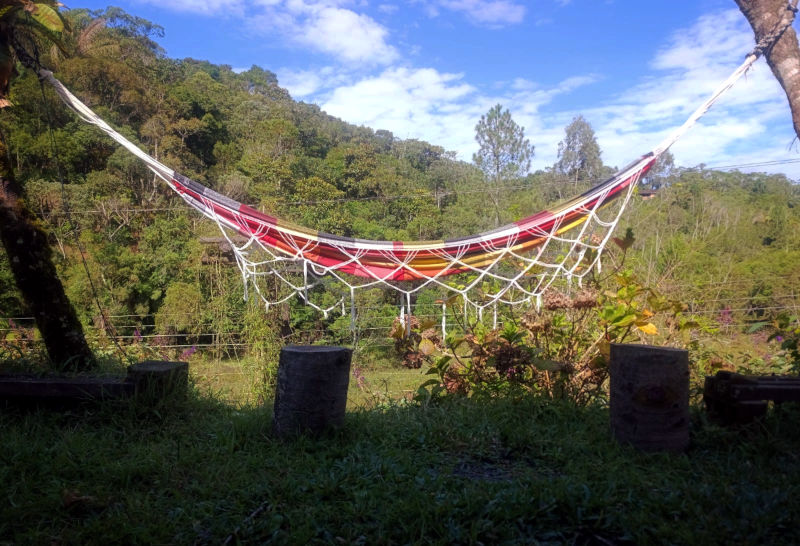
Hammock strung between trees in the Atlantic Forest. Photograph by Clarissa Reche.
Lying in my colorful hammock, tied between two mulberry trees, gazing at the blue sky of the Atlantic Forest, I sway from side to side, feeling the sun kiss my body and the forest wind caress my hair. I remember that they love me, and that I love them too. I watch time pass back and forth, back and forth. And I rest, thinking… why do we weave networks after all?
Making a network is hard work. But it is necessary. The network/hammock, in its polysemy in my mother tongue, is vital. Its fabric carries knowledge, memory, and purpose. I thought of writing “resistance,” but I’m not sure that’s quite it. Perhaps “necessity,” in this sense of vitality—of what is essential for us to be alive and well. We have our beds, with mattresses and pillows and all the rest. But we also have our hammocks, which are a source of joy and pleasure. Here in Brazil, hammocks are a constant presence in our homes.The hammock, which we inherited from those who have lived here since the beginning, persists within us.
And what kind of work does making a “rede” entail (net-work, to play with that foreign language too)? Perhaps we can summarize this work as planting-harvesting-weaving. So, to make networks we need, first and foremost, land. And, thinking along with a lot of people – here I choose to name the Zapatistas, while there could be so many others – we can say with complete certainty that land is a common. Obviously, land is soil, ground, in its material existence. This place where we walk, from which we eat, which we mistreat so much. To create a network, we need to be standing on the land, even if each of us is on geographically distant portions of land. But we also need a common territory. Something that gives us the substrate to care for what needs to sprout, thrive, grow, and be transformed. This territory is common because caring for life is always a collective act. Devastation is the child of individualism.
The work of making a network is a work of caring for a common territory, to make it grow. But it is also a work of transformation (planting-harvesting-weaving), and therefore, a work of knowledge. Anthropologist Varin Mema[1] (2018), Marubo indigenous[2] , tells us about a phrase often repeated by the women of her people: nokẽ mevi revõsho shoĂima awe (what is transformed by the tips of our hands):
Doing is knowing, knowing how to do things, knowledge that makes things happen. Doing is done with the hands, it is the knowledge of the hands. It is a total, embodied know-how, for each person who knows how to do. It is a know-how that ‘belongs’ to the one who knows how to do, just like the things that come into existence through their work. From the hands, knowledge enters the person, is internalized and is externalized. (p 23)
For the older Marubo people, knowing the world means making it adaptable, suitable for living. What we touch without knowing will harm us. And knowing is knowing how to do, it is the body that produces. Furthermore, knowledge is something we learn from the elders, and which we will certainly teach to the younger ones. Varin also recounts that this phrase is uttered by women in a tone of satisfaction with their own actions and achievements, especially with manufactured goods, their “crafts.” This is how they strengthen themselves, how they value themselves and their knowledge. The feeling of seeing something finished, existing, functioning, being beautiful, and knowing that it was the fruit of their labor. Perhaps in the work of making a network we need to add something like “admiration”: planting-harvesting-weaving-admiring.
I would like to return to the question that opens this text, and with the work of a network well-founded, unfold it into other, much more interesting questions:
On what land do we stand? What is our common territory? What are we taking care of? What world – and what people – are we getting to know, adapting to live in? What do we know and do, who teaches us, and whom will we teach? What are we proud of, what actions and achievements do we admire?
Only through work, knowledge, and the time it requires will these questions find their answers. Or not. But for now, they serve as a guide to help us approach our own proud and admirable drive to weave a network.
Mapping Our Common Territory
We began to sketch a map to understand the common territory we are touching and caring for. Under the umbrella and at the crossroads of “feminisms” and the “anthropology of science and technology” lie very diverse research and interests. Below, I present an initial organization of the RAFeCT researchers’ work into thematic areas:
- Body, health and biomedicalization: There is a significant emphasis on research at the interfaces between body, health, reproduction, technology, and social inequalities. Many researchers dedicate themselves to topics such as public health, sexual and reproductive health, biomedicalization, medications, hormones, disability, care, and medicalization processes, often linked to debates on gender, sexuality, and social justice.
- Digital technologies and processes of subjectivation: Another relevant axis brings together studies on digital technologies, algorithms, artificial intelligence, and digital platforms, with special attention to their effects on processes of subjectivation and the social implications of contemporary technological transformations.
- Public policies, rights and inequalities: The network also includes research on public policies, sexual and reproductive rights, motherhood, gender-based violence, and structural inequalities, demonstrating a commitment to urgent social and political issues.
- Ecology, multispecies and the climate crisis: Studies focusing on multispecies relationships, political ecology, and climate catastrophes frequently appear, pointing to a growing interest in the interactions between environment, science, and society.
- Race, coloniality and traditional knowledge: One important axis addresses race, coloniality, and traditional knowledge, including research on ethnicity, Indigenous feminisms, Indigenous collections and epistemologies, ancestral technologies, and the relationships between science and traditional knowledge.
- Critical epistemologies and research methodologies: Finally, there is a significant presence of works focused on critical epistemologies and research methodologies, such as ethnography, autoethnography, and feminist and ethical-political methodologies, indicating a consistent interest in reflecting on the very modes of production of scientific knowledge.
In material terms, the land we stand on is the geography called Latin America, in the colonial grammars. Observing this mapping, we can understand that what we are dealing with is directly related to our history. For us, “science and technology” unfold in a context marked by persistent structural inequalities, colonial legacies, and intense disputes surrounding the body, territory, and rights. The peripheral insertion of our territories as centers of exploitation into global capitalist circuits favors a critical attention to the dynamics of the circulation of technologies, knowledge, and digital infrastructures, as well as their localized effects. The intensification of socio-environmental crises in the region contributes to the growth of approaches that articulate ecology, politics, and science. The presence of strong social movements, especially feminist, indigenous, and anti-racist ones, also drives the production of situated, engaged, and epistemologically critical perspectives that question hierarchies of knowledge and value traditional knowledge and embodied experiences.
As Tânia Pérez-Bustos, a Colombian researcher who is part of RAFeCT and will be the author of the next text in this series, warns us, the work of weaving, as materiality and as a methodological possibility, is recognized as capable of bearing witness to difficult knowledge (2025). In line with what Varin tells us, Tânia describes the act of weaving as a “permanent approximation,” a movement that repeats itself, becomes entangled, unravels, and is done again, because it is a way of thinking-doing necessarily open “to error, to mending, and that summons people and things, a thought that constitutes itself as a material gathering” (ibid). In our work of weaving network at RAFeCT, we continue in a permanent movement of attempts to know ourselves and transform ourselves (as well as to know and transform the world), “not with expertise, but with hesitation and curiosity” (ibid), always experimenting with pride and admiration.
And why do we wave networks anyway?
I think it’s because we’re alive, and we intend to stay that way.
Notes
[1] Nelly Barbosa Duarte Dollis’s social name.
[2] The Marubo people live in the Javari Valley, in southwestern Amazonas, Brazil.
This post was curated by Contributing Editor Clarissa Reche, and reviewed by Contributing Editor Victor Secco.
References
Barbosa Duarte Dollis, N. (2018). “Nokẽ mevi revõsho shovima awe: ‘o que é transformado pelas pontas das nossas mãos’.” Campos – Revista de Antropologia, 19(1), 23–36. https://doi.org/10.5380/cra.v19i1.61162
Pérez-Bustos, T. (2025) “Inacabado.” Theorizing the Contemporary, Fieldsights, October 23. https://www.culanth.org/fieldsights/inacabado
