In early 2026, as reports of the Nipah virus outbreak in West Bengal surfaced, the Taiwan Centers for Disease Control responded with a swift escalation of prevention measures, designating the pathogen as a Category V notifiable infectious disease. In an island nation where the pig-farming industry remains a cornerstone of both the economy and cultural diet, this classification represents the highest tier of state concern, mobilizing an apparatus of epidemiological surveillance and media speculation. Yet, as these institutional gears turned, the discourse spilt over into the digital sphere. Online, the virus animated civic narratives inflected by biosecurity anxiety and the fraught moral politics of naming.
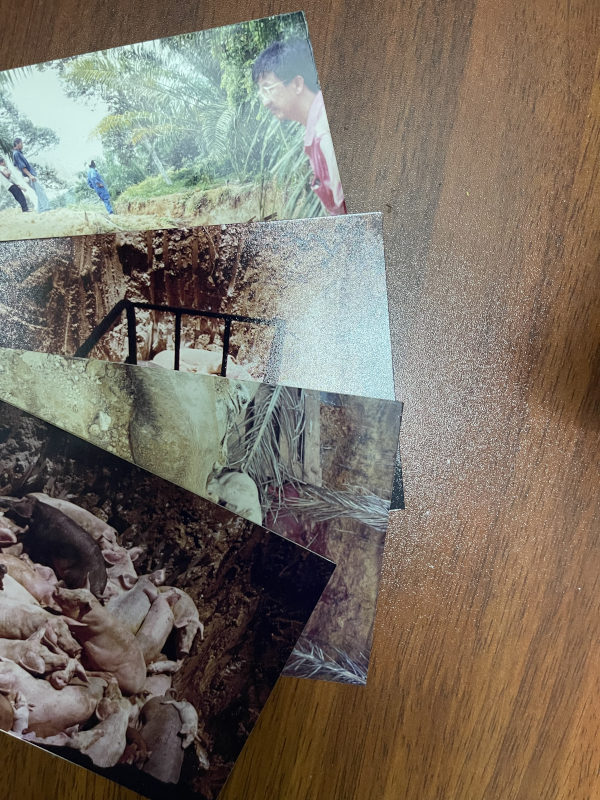
Following the 1999 Nipah outbreak in Malaysia, which at that time was an unknown encephalitic epidemic, the Malaysian military moved from ammunition-led culling to the live burial of ten thousand pigs in mass pits. Images capture the moment human-porcine ecologies were interred and emotional breakdowns. Looking back as both a witness and a survivor from my childhood lens, I recognize these traumatic ruins as the ground from which a lingering history of the virus continues to emerge from its afterlives. Photo provided by the author.
Toponymic Haunting
The name “Nipah” originates from the Malay term for a species of mangrove palm indigenous to Southeast Asian tidal coasts. It marks an ecosystem—specifically that of Kampung Sungai Nipah (literally, a village by the River of Nipah Palms), the Chinese-majority residential area in West Malaysia where I was raised and where the virus was first identified in 1999. During the 1990s, this region was a trans-regional hub for pig husbandry. Led by Foochow-speaking households, the village sat at the center of a sophisticated supply chain in the country, as well as exporting pork to Singapore and Hong Kong to satisfy the appetites of a burgeoning Asian Sinosphere.
For me, as one raised in a pig-farming family whose biography is inextricably entangled with this encephalitis virus, the recent resurgence is not a mere public health update surfacing in the registers of international concern. It is, rather, an intimate return to an everyday domestic life that remains perpetually corroded not only by the singular human-porcine catastrophe of nearly three decades ago but also by the routine responsive acts in its aftermath (Das 2020). This toponymic haunting does not elicit grand bureaucratic gestures from the community. Instead, the local response manifests as an ordinary ethic through a painstaking attentiveness to subtle acts of care that seek to inhabit a zoonotic rupture.
In online debates across the East and Southeast Asian sinosphere, commentators revisit the toponym “Nipah” to question whether geographically anchored nomenclature reproduces territorial stigma in correspondence with the political dispute over retranslating the “Wuhan virus” as the neutrally perceived “Coronavirus”. Yet, these discussions frequently overlook the lived reality of the name as a terrain of everyday practices rather than an epidemiological category. The toponym thus reflects a broader tension in how we narrate viral afterlives. As public discourse fluctuates between clinical data and historical reflections on the 1999 outbreak, it becomes clear that the Nipah metaphor travels not only through viral shedding and transboundary health surveillance but also through digital media. This was particularly salient during the more-than-human crises of 2020 COVID-19 and the 2021 surge of African Swine Fever (ASF).
The social memory was not just to be recalled; it was mobilized as a form of communal grit. Through reminiscence, villagers leveraged viral debris, for instance, abandoned farmlands, counts of casualties, and transformed livelihoods, to navigate future ruination through their repaired bodies. As Ann Stoler (2013) conceptualizes, ruination is never a static historical fact but an ongoing process that weighs heavily upon the present and leaves tangible debris in the collective psyche. By invoking these Nipah memories, the online community awakened a visceral shorthand for collective resilience during the state-regulated COVID-19 lockdowns in Malaysia. On a private Facebook group, a former pig farmer commented, “We survived the Nipah incident; what could possibly break us now?” Other netizens cheered in unison. Soon, members began digging out decades-old newspaper clippings and faded photographs of the pig farming industry at its peak, uploading them to the private group. Among the digital gallery of bustling pig pens appeared the faces of relatives who had perished during that initial outbreak. Sitting abroad at the time, I watched the screen of my phone light up with these mutual expressions of morale and solidarity. The digital intimacy of these lockdown posts collapsed the distance, pulling my memory instantly back to a child’s lens. At this moment, memory acts as a pivotal intervention, mobilizing the debris of a historical epidemic into a form of communal immunity against mounting uncertainties.
A Childhood Retrospective
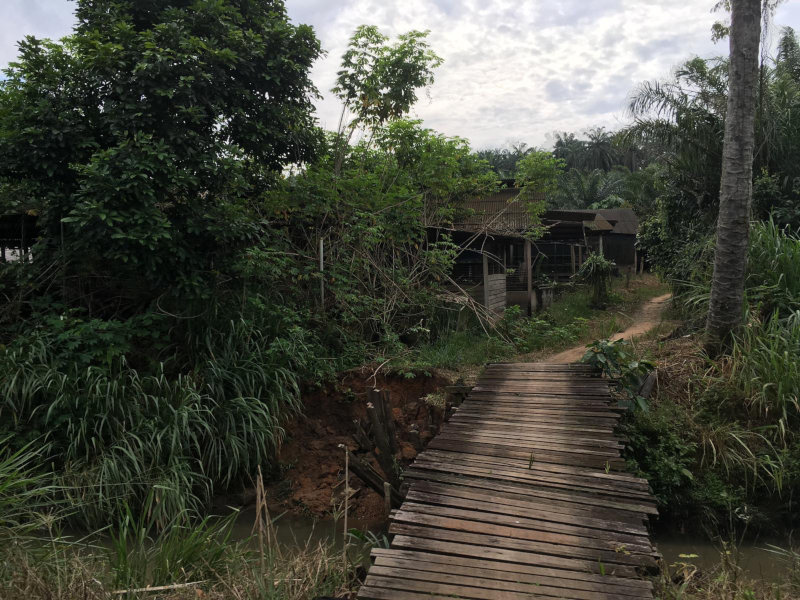
Following the Nipah virus outbreak, the pig sheds were gradually abandoned, and the river stream was cleared, stripped of the pervasive scent of animal waste. In the wake of this viral incident, some households turned to small-scale vegetable and fruit cultivation as a means of livelihood.
Photo taken by the author.
Over the decades, ruderal vegetation has overtaken the rubble at the village farms, as golden beardgrass and blady grass slowly swallow the sensory scenes where children once rode motorbikes to go fishing. From the vantage point of my thirty-year-old body, I find myself compulsively revisiting an archaeology of childhood that did not terminate with the mass pig culling in the 1990s. Having grown up sleeping adjacent to family-owned pig sheds, the aftermath manifested as a series of persistent auditory hauntings rather than a closed biographical chapter. Now becoming a zone of chronic disrepair, these farmlands are fenced off by parental warnings to their children. The ruptured land speaks through circulating rumors of pythons that grew monstrous by scavenging upon unburied swine carcasses, alongside whispers that the local lakes are haunted by the entombed animal bodies. In this terrain, the phantom squeals of pigs mirror piercing cries that some villagers still report hearing from the wilderness of their abandoned farms. This acoustic haunting was mirrored in the nocturnal ruptures of my father, a second-generation pig farmer lost in his nightmares, whose sudden outcries punctuated the domestic subsidence of the post-epidemic period.
My initial comprehension of the outbreak emerged not from the legible metrics of public health but from sensory disturbances and a pervasive atmosphere of dread. The epidemic was lived as a constellation of smells, affects, and familial taboos when it was codified as a zoonosis within the biosecurity sense. In returning ethnographically to this experience, I am drawn to Clara Han’s (2020) analytical register, seeing like a child, which captures how social worlds are apprehended through familial inheritances of violence, interrupted speech, and anxieties that exceed the explanatory power of adult logic. This movement aligns with Gloria Anzaldúa’s autohistoria-teoría, wherein personal memory serves as a critical mode of thinking through historical rupture rather than clarifying into a universal reference (Pitts 2016). The childhood retrospect is not a performance of ethnographic authority rooted in suffering; it is, instead, an acknowledgment that I had embodied a catastrophic history, for which I only later acquired a vocabulary to validate its traumatized relics. In the homeland, the lexicons of trauma and restorative justice remain largely alien. Shaped by a Chinese logic of endurance, my family practiced a tabooed form of silence common to many rural Sinitic households: a refusal of therapeutic disclosure that allowed aftershocks to circulate through bodily exhaustion and the uneasy weather of domestic communication.
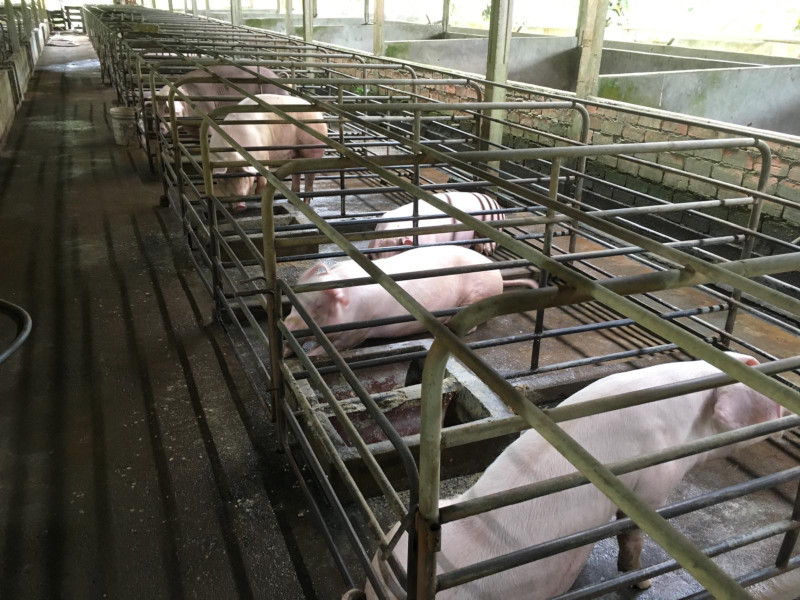
During the COVID-19 pandemic, my father reclaimed his abandoned warehouse and began raising some pigs. Photo taken by the author.
The human-porcine ruins precipitated by the Nipah virus extended beyond mere economic loss; they dismantled the cross-generational relationality and the livelihood ecologies forged through decades of mediated labor. As the village underwent its forced transition, the abandoned pig farms, warehouses, and grave pits where animals were interred alive were buried beneath the earth, eventually yielding fertile soil for dragon fruit plantations. Yet, even as a few villagers tentatively returned to small-scale husbandry, their efforts represented more than accumulating income. They were attempting to stitch together abandoned farms and exhausted soils with the dwindling embodied archives of porcine care—a desperate salvage of a vanishing ontological rhythm.
My father’s decision epitomizes this struggle. Driven by a necessity that was as much existential as it was financial, he sought to renovate our derelict sheds, risking the scrutiny of the Veterinary Bureau to raise a small sounder of pigs. “My whole life has been rearing pigs; I know nothing else,” he would remark, a testament to an identity inextricably tethered to the multispecies labor of the husbandry. Through the eyes of being his child, I have seen my father momentarily reclaim a sense of dignity as a middle-aged adult during the COVID-19 lockdowns, finding in the familiar care of his livestock a way to master his own social time once again. However, this reclamation was short-lived. The subsequent arrival of ASF marked a cruel reiteration of ruination, as pigs once again fell ill and died, leaving these farmers buried under the weight of feed-mill debts. This latest rupture exposed the profound vulnerability inherent in my father’s attempts at recovery, resulting in a recursive disempowerment. The severing of human-pig relations trapped him once more within the physical ruins of the farm. For my father, and for the village, the response to viral afterlives is found in ordinary ethics, that is, the persistent labor of tending to what remains.
The post-collapse landscape underwent a sterile transition. The pungent odor of animal waste vanished, and the turbidity of local streams declined; yet, these were not merely environmental improvements. They were the erasure of the vital markers of a human-porcine interaction. Also, this sensorial shift registered poignantly at the dinner table, where my parents would often remark that pork “no longer tasted the same.” This was a subtle ontological variation detected by taste buds trained through decades of intimacy with the animals they raised, a sensory palate that the sterilized foodscape could not address. Since the ASF epidemic, pork has become a hauntingly rare presence at our dining table. My parents view the current Malaysian market with a deep-seated suspicion, dismissing the available meat as the product of a hollowed-out industrial system—imported, anonymous, gamey and sickeningly pathogenic. “A layman might not perceive the difference in palate texture,” my father would respond, “but for those of us who lived with pigs for generations, our tongues tell the difference.”
Viral Museum
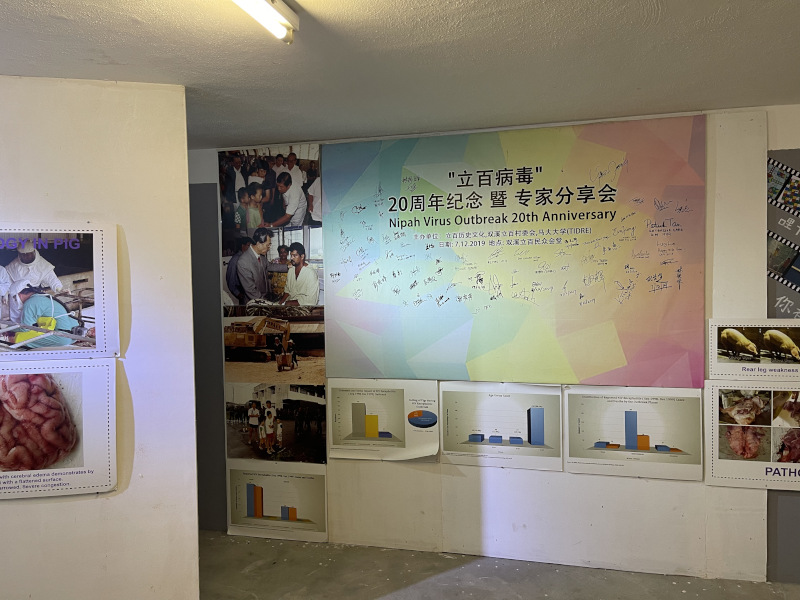
In a corner of the museum stands a commemorative board signed in 2019 to mark the twentieth anniversary of the Nipah virus outbreak in the village. The event was attended by numerous medical professors and experts, including the scientists who first identified the viral strain, alongside various political figures. Photo taken by the author.
In 2018, on the eve of the COVID-19 pandemic, my father messaged me about an effort from the former pig farmers to memorialize the Nipah virus outbreak within the village; they plan to establish a local-scale museum. The museum project emerged from a multi-year negotiation and fundraising between the village committee, state legislators who represent the ethnic Chinese community, and the University of Malaya Medical Centre, where a scientist from the university first identified the viral strain in the village. It signaled an epistemological shift away from the reductive biopolitics of the late 1990s, when state intervention viewed the village solely as a site of contagion to be managed through total eradication and isolation of afflicted bodies. Returning two years later, in 2020, I toured the site with its curator, Mr. Pao. The museum building bears a heavy wooden plaque, carved “Nipah Time Tunnel Museum.” The museum’s nomenclature, specifically the substitution of “virus” with the highlight of “time tunnel”, serves as a localized manifestation of Frédéric Keck’s (2021) viral heritage, wherein the trauma of zoonotic rupture is repurposed as a scaffolding for future preparedness through past nostalgia. This linguistic elision domesticates the pathogen’s legacy, folding it into a narrative of temporal continuity and communal resilience rather than biological stigma.
The museum’s interior is curated into three distinct epistemological zones. The first acts as a repository for press clippings, providing a paper trail of the porcine-engendered crisis as it was mediated to global experts and the public. The second zone transitions into the authoritative vernacular of pathology and animal anatomy, where the discovery of the Nipah virus strain is reconstructed through the cold logic of mortality rates and visceral diagrams of infected organs. This section fulfills a state-sanctioned pedagogical mandate, translating medical research into validated public health responses.
The labor of curation reveals a grassroots repairing of human-porcine ruins. The pig farmers have undergone a profound mobilization; formerly marginalized by state-mandated biopolitical surveillance, they now operate as archivists of their own catastrophe. When I questioned the provenance of this curation, Mr. Pao revealed that the labor distribution was not merely top-down. While university academics provided the data, the actual document assembly was done by local farmers and their children. Leveraging his university background, Mr. Pao accustomed himself to the jargon of pathogenesis and animal anatomy to reclaim the narrative of the Nipah farmers from below. For those who survived, the museum’s reliance on visuality over textual discourse is a strategic choice. By bypassing the grand museum style of dense text, their exhibit renders the physiological reality of the virus accessible through a visual register grounded in shared bodily experience.
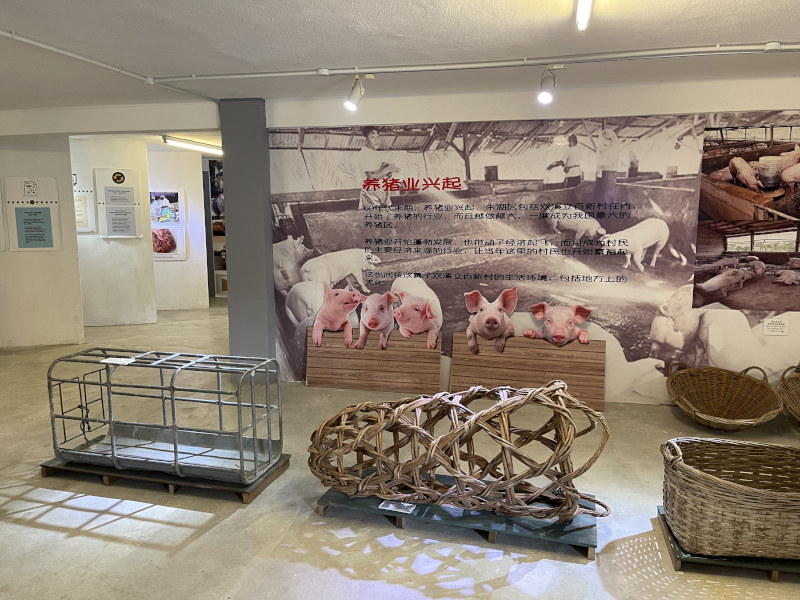
One section of the museum displays the tools once used by the pig farmers, freezing time within the memory of a flourishing porcine husbandry twenty-seven years ago, prior to the Nipah virus outbreak. Photo taken by the author.
One section of the museum displays the tools once used by the pig farmers, freezing time within the memory of a flourishing porcine husbandry twenty-seven years ago, prior to the Nipah virus outbreak. Photo taken by the author.
The third zone marks a significant transition from the pathogen itself to a discourse riveted on the memory of inhabiting an ethnic Chinese New Village in Malaysia. This reminiscing unearths a cultural identity deeply tied to a racialized homeland, confronting an emptied-out reality of economic stagnation and demographic depletion in the wake of the outbreak. Through a collection of porcine figurines gathered from Mr. Pao’s travels in China and refurbished tools salvaged from abandoned pig farms, the exhibit reconstructs the glorious memory of the 1990s swine industry in the region. This curated nostalgia serves as a counter-narrative to animal-linked racialization that polices the boundary between the dominant Malay-Muslim hegemony and marginalized Chinese pig farmers (Neo 2011). By drawing on religious and nationalist tropes, this racialization frames the metaphoric association between Malaysian Chinese communities and polluted pig farming as a marker of being less privileged, or “non-halal,” within the categorical framework of Muslim-led national values.
“Since that year, what died was gone, and those of us who remained could no longer thrive. Even now, decades later, the toxicity feels sedimented in the soil. The state has forbidden us from raising pigs, and if they refuse to fund even this village museum, it is nothing short of an erasure of our Nipah [Chinese] community. We are not building this museum to criticize the state apparatus, nor to merely reopen the raw wounds of our collective trauma. We build it to anchor the history of our New Village for the next generation. . . To reclaim the past, our Chinese economic hegemony within the national livestock supply chain and a reminder for an equal discursive footing to live in the Muslim state.” (Field notes, June 2020)
The viral museum reclaims the human-porcine ruins as a symbol of heritagization rather than a mere on-site archive of biological contagion with its origin. As repaired ruptures responding to the “material excess of ruin” (Harrison 2013: 80), this heritage intervention grants structural debris a curated “second life” (Kirshenblatt-Gimblett 2006) by grafting shattered Chinese livelihoods onto its possessed control over the past. Ultimately, this curatorial site functions as a sentinel institution (Keck 2021) that instrumentalizes zoonotic catastrophe to transform the impacted village into a landscape of permanent imminence, where the preservation of the past becomes the essential condition for navigating a precarious future.
To witness my childhood mobilized as a signifier of transboundary contagion is to recognize that the afterlives of animal-engendered epidemics are never settled. The virus remains sedimented in the name of my homeland’s transition, resurfacing as an intimate, recurring nostalgia for a decayed sense of being, that is, a mourning for an entangled human-porcine existence that was collectively severed and morphed when those grave pits were revealed.
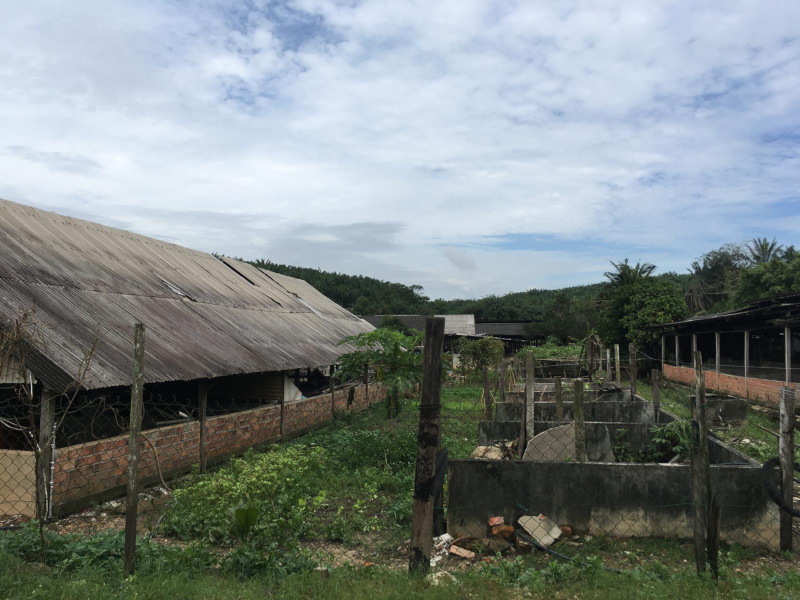
An abandoned pig farm. Photo taken by the author.
This post was reviewed by Lilith Frakes, and reviewed by Contributing Editor Iván Flores.
References
Das, Veena. 2020. Textures of the Ordinary: Doing Anthropology After Wittgenstein. New York: Fordham University Press.Han, Clara. 2021. Seeing Like a Child: Inheriting the Korean War. New York: Fordham University Press.Harrison, Rodney. 2013. Heritage: Critical Approaches. Routledge.Keck, Frédéric. 2021. Preparing and Repairing. The Conservation of Heritage after the 1997 Bird Influenza Outbreak in Hong Kong. Sociologica, 15 N.3, 45–59.
https://doi.org/10.6092/issn.1971-8853/13594Kirshenblatt-Gimblett, Barbara, 2006. “World Heritage and Cultural Economics.” In Museum Frictions, edited by Karp, Ivan, Kratz, Corinne. A., Szwaja, Lynn, and Ybarra-Frausto, Tomas. Duke University Press. https://doi.org/10.1215/9780822388296-008Neo, Harvey. 2012. “They hate pigs, Chinese farmers … everything!” Beastly Racialization
in Multiethnic Malaysia. Antipode, 44, 950-970.
https://doi.org/10.1111/j.1467-8330.2011.00922.xPitts, Andrea J. 2016. Gloria E. Anzaldúa’s Autohistoria-teoría as an Epistemology of
Self-Knowledge/Ignorance. Hypatia, 31, 352-369. https://doi.org/10.1111/hypa.12235Stoler, Ann L., ed. 2013. Imperial Debris: On Ruins and Ruination. Durham, NC: Duke University Press.
Acknowledgements
I thank the surviving pig farmers and my father for taking the time to share life stories with me. Also, my sincere gratitude to Dr June Hee Kwon and the Platypus editors, Lilith Frakes and Iván Flores, for their close reading and kind feedback.
