In October 2022, just as the monsoon was ending, Kalpana pulled me and my field partner, Sandeep, into her house in the rehabilitated village of Popharan, one of the five villages[1] we visited to understand people’s experiences of living next to India’s first commercial nuclear power plant. Popharan was relocated in 2002 to make room for Units 3 and 4 of the Tarapur Atomic Power Station (TAPS). These rehabilitated villages flood severely every monsoon. Kalpana showed us the marks that water had left all across her house; her furniture was entirely ruined. During the worst weeks of the rains, she told us, her sons had to carry her and her grandchildren out of the house to keep them from drowning. Virendra Patil, who has spent two decades advocating for the rehabilitated villagers, walked us past rows and rows of houses abandoned due to their poor construction, each crack in their walls overtaken by plants and shrubs that grow at an astonishing rate in the wet coastal climate of Maharashtra.
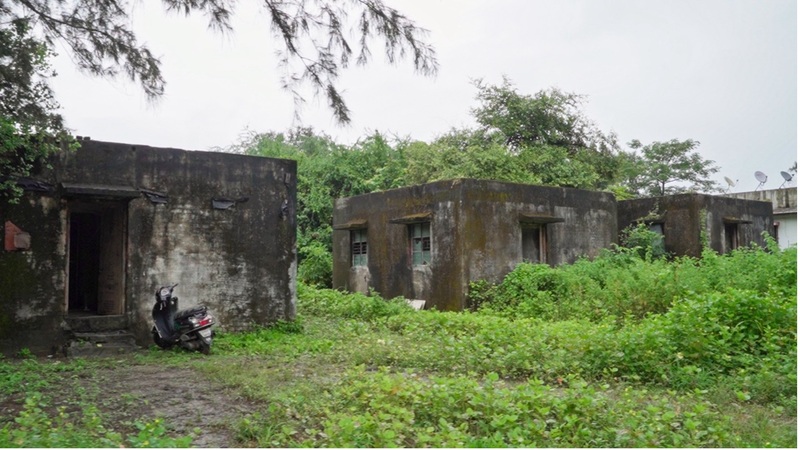
Abandoned houses in the rehabilitated village of Popharan due to poor construction. Photo by Sandeep S.
Kalpana earns 10,000 rupees a month as a contract sanitation worker at the plant her village was displaced for, while her sons are still struggling to find work. What has been lost is hard to account for in monetary terms alone. “Even if we earned less, we used to save more,” she said. In the old village closer to the sea, the fishers and farmers had lived alongside one another and shared their harvest. They had access to firewood, and water came from wells located all around the village. Overcome with emotion she asserted, “it would’ve been better if they had killed us there. Here we are facing so many difficulties. They have committed a huge injustice towards us. I challenge them [the TAPS officials] to come live in my place for 20 minutes.”
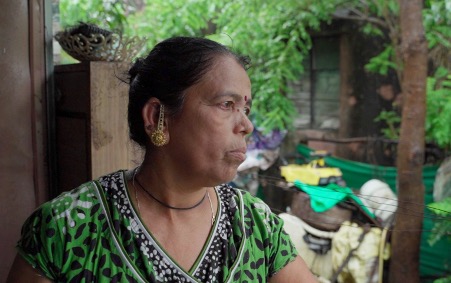
Kalpana, resident of Popharan. Photo by Sandeep S.
The Politics and Poetics of Tarapur: We Gave Up Our Lands Willingly
Some sixty monsoons ago, when officials from the Department of Atomic Energy (DAE) first arrived to survey this coastline, the villagers had welcomed them with open arms. Jitendra Raul’s father, then the sarpanch (village head) of Delwadi, sheltered the visiting scientists when their tents blew away. In the atmosphere of India’s movement for independence, the villagers had greeted the nuclear reactor with pride, willingly giving up their lands for the nation’s progress. However, for the past six decades, they have struggled to make their claim on it.
To understand people’s experience of TAPS, I found Larkin’s framing of the two kinds of work that infrastructure does to be generative. Larkin (2013) argues that infrastructures have a politics—the material work of moving things, of organising electricity and water and traffic, and of materially incorporating some populations while excluding others. And they have a poetics that can be “wholly autonomous from their technical purpose” (Larkin 2013, 329), such as the work of making meaning, of staging an idea of the nation that built them, of producing affect and pride in the audiences the project is designed to address.
The Tarapur atomic power plant was also meant to do both: produce electricity and produce a certain kind of India that was scientific, self-reliant, on the verge of the atomic age that India’s first prime minister Jawaharlal Nehru, addressing the Constituent Assembly in 1948, had called “infinitely more powerful” than steam (Nehru 1948). In 2024, the DAE chairman K.N. Vyas was still pitching the same package, admonishing Gujaratis who had resisted a plant in Bhavnagar: “I personally would have welcomed it because it’s going to generate employment for a long time” (Vyas 2024). The script is now being recycled for small modular reactors (SMRs). Nuclear Power Corporation of India Limited (NPCIL) plans to build a 220 MW Bharat SMR and a 55 MW SMR at Tarapur. The Modi government’s Viksit Bharat (Developed India) 2047 vision adds a new gloss: a corporate-driven developmental future, with private capital invited into nuclear power for the first time and asked to deliver a massive promise of 100GW in just a decade.
When I asked people of the nearby villages what kind of development they had expected, they would point to the Tarapur Atomic Power Station colony (TAPS colony). The TAPS colony is a gated residential township a short distance from the villages, and the contrast is impossible to miss. Entry is strictly regulated, and general public access is prohibited. We could not get inside ourselves, but YouTube videos posted by residents offer a glimpse of the colony which was laid out by the American firm Bechtel in a small-town American pattern, with sidewalks, spacious houses, a swimming pool, a club, and tennis courts. It is populated today by NPCIL’s permanent operators, engineers, and technical staff. The hospitals and schools NPCIL built serve only the colony’s residents and their families.
The locals, however, increasingly find themselves limited to contract work with little job security and poor pay. Harkesh Tamhore has worked since 2004 at the plant’s Electrical Maintenance Unit but remained a contract worker. He told us that contract workers are sometimes made to work in high-radiation zones, even though they don’t receive the health benefits that permanent workers receive. “In the case of a workplace injury,” he told us, “there is a problem to even call an ambulance. They give first aid and then tell us it’s not our responsibility anymore. Now it’s your responsibility.”
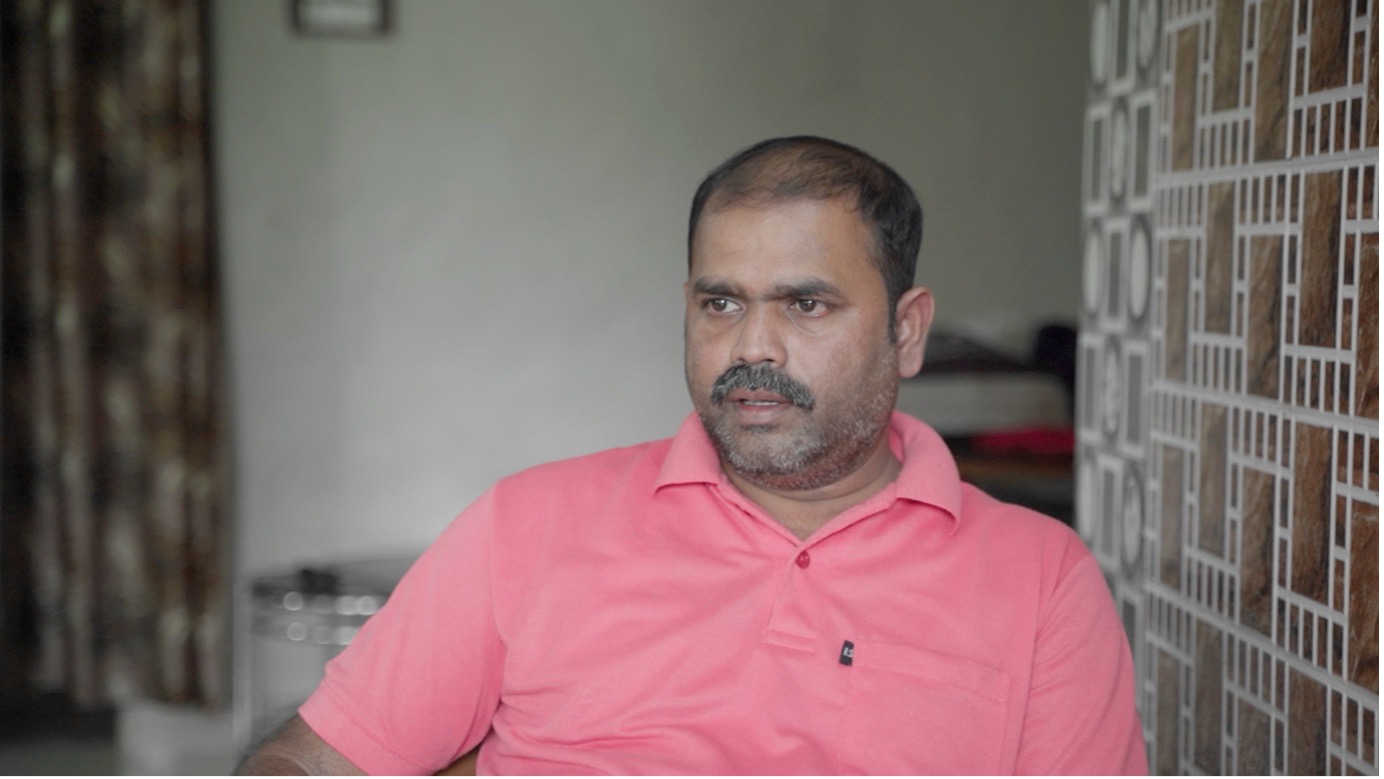
Harkesh Tamhore, contract worker at the Tarapur Power Plant. Photo by Sandeep S.
Nuclear Energy’s Architecture of Opacity: They Have Never Been Local-Friendly
Niraja Gopal Jayal has argued that Indian democracy should not just be judged by voter turnout or macro-level generalisations about political participation, but by its ability to provide the conditions for the meaningful exercise of citizenship rights (Jayal 2013). The distinction is between procedural democracy, which is concerned with the efficacy of political processes and substantive democracy, which asks whether the formal provisions of equal citizenship translate into anything resembling equal opportunities and access. Recent allegations of electoral fraud have raised serious questions about the procedural side of Indian democracy. But by the substantive measure, the people whose lives are reorganised by the country’s largest infrastructure projects find themselves on the losing end of a deep and widening divide—and have been there for far longer.
Nuclear infrastructure’s exception and ivory-tower elevation are written into the law itself. The Atomic Energy Act and the Official Secrets Act together create a legal regime around nuclear power that is not available to any other energy technology in India: information about plant operations, radiation exposures, accidents, and health surveys can be withheld from the public on grounds of national security. Applications under the Right to Information Act too have been denied, citing national security (Ramana 2009, 62–63). Those who expose technical and safety failures have also been punished. The institution running the plants answers only to the Prime Minister’s office. And the independence of the Atomic Energy Regulatory Board, which is supposed to monitor the safety of these nuclear power plants severely lacks independence as critics argue that the regulator reports to the agency it is supposed to regulate (CAG 2012; Gopalakrishnan 1999).
The effects of this architecture are visible to anyone who tries to ask the plant officials a question. Neeraj Raut is a journalist who has covered the Tarapur plant consistently over the years. He told us that the authorities at TAPS “have never been local-friendly. They have never shared information about good or bad happenings inside the plant. It is only through our sources that we learn of incidents. I have written numerous emails asking for information or explanations before publishing news, but [officials at] TAPS [have] never shown willingness to share internal incidents or accidents.” Residents of Ghivali, Tarapur, Uchheli, and Dandi remember officials checking them and their children for radiation exposure, taking food and fish samples over the years, but never sharing the results.
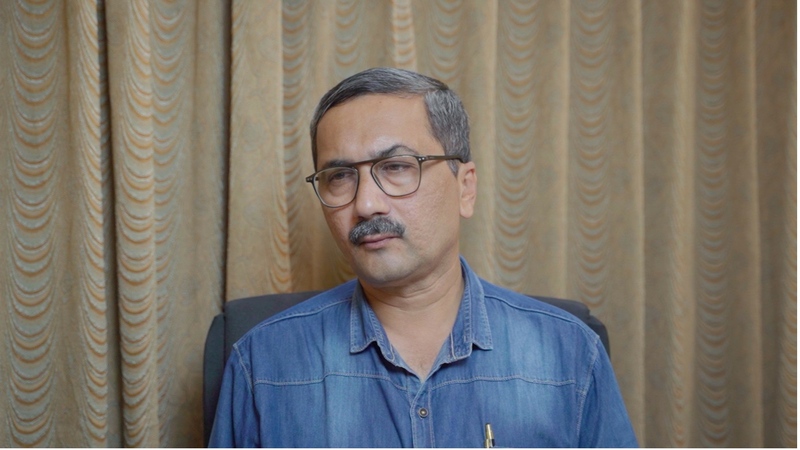
Neeraj Raut, journalist. Photo by Sandeep S.
Claims for Substantive Participation: We’re Being Made to Disappear from the Map of India
The exclusion is felt, and the claims for substantive participation were passionately voiced in the interviews we did. The residents of these villages are not just describing disappointment, they have understood that the affective machinery of the plant was always aimed somewhere else—at metropolitan India, at the international community, and/or at the technical elite—and that they were never its addressees, only its setting.
Mohan Morey and Bhuvneshwar, both former sarpanches of Ghivali (a village sitting controversially at the edge of the plant’s 1.6 km exclusion zone), told me that they often sit together to think about the future of their village. They worry about their youth. They’ve watched young people struggling to find work, taking contract jobs at the plant on the same terms as Harkesh. They completed each other’s sentences as they described what they were feeling.
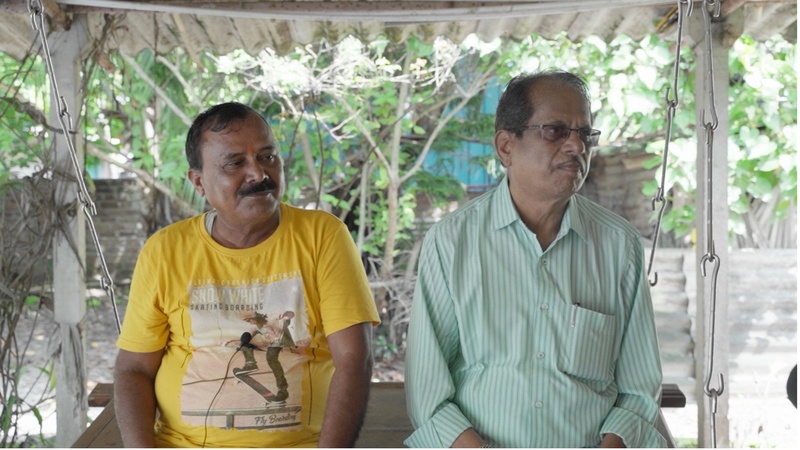
From left, Bhuvneshwar and Mohan Morey, ex-village chiefs, Ghivali. Photo by Sandeep S.
Mohan Morey: So what’s the benefit? What’s the benefit of bearing this plant on our heads? Tell me, we’re making this much sacrifice for the country, so we should get some benefit from it or not? It’s not like—just give us rations.
Bhuvneshwar: We’re not asking for rations, are we?
Mohan Morey: We want to earn through our own labour. We want to take part in the development of this country—let us also have some share in it…We’re human beings—should we live like human beings, or not?
Bhuvneshwar: Along with the plant, develop the villagers too.
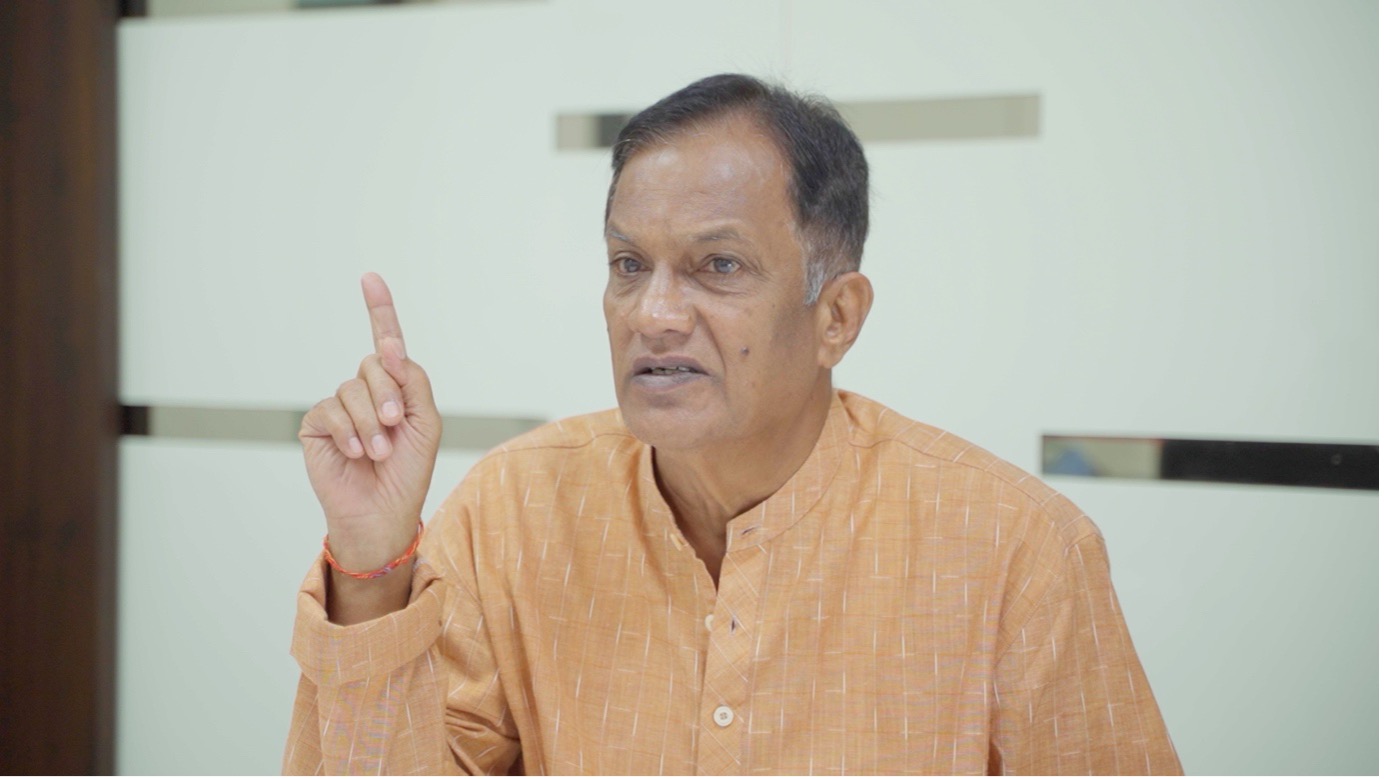
Jitendra Raul, resident and ex-sarpanch (ex-village chief), Navi Delwadi. Photo by Sandeep S.
Jitendra Raul, in Navi Delwadi, asked a similar question in the democratic register while talking about the lack of transparency in NPCIL’s operations: “If this technology is for the good of the people, then what do they have to hide?… If they are doing something for us, something to protect my future, then I should know!… I should be able to decide if what you are doing for me is right or wrong; this is my right in a democracy.”
Yogesh, a fisher in Dandi, voiced the exclusion most directly while talking about the displacement by the plant: “We’re leaving our home here, we’re leaving the land of our birth… even if I went and worked in Kolkata, and the people there asked me—where are you from? We would say the name of our village, wouldn’t we? What will we say if our village is removed? We’re being made to disappear from the map of India.”
Conclusion
What Mohan Morey, Bhuvneshwar, Jitendra Raul, and Yogesh are describing, each in their own register, is the failure of substantive democracy. They have been told to take their complaints to court, to the district collector, to the procedural channels of democracy through which a population is managed.
The procedural side of Indian democracy is now under visible strain. The current government’s relationship to elections, to opposition parties, to the press, and to dissenters of various kinds has made the procedural fissures impossible to ignore. But the substantive failures are older. The Indian “development” was not built by dissolving hierarchies. It was built on them, and on the denial of substantive democracy to those at their base.
The architect of the Indian Constitution, B.R. Ambedkar, warned of exactly this disparity and what it would cost the country’s democracy. Speaking to the Constituent Assembly on 25 November 1949, he said, “On the 26th of January 1950, we are going to enter into a life of contradictions. In politics, we will have equality and in social and economic life, we will have inequality… How long shall we continue to live this life of contradictions?… If we continue to deny it for long, we will do so only by putting our political democracy in peril” (Ambedkar 1949).
Acknowledgments
The author would like to thank Sandeep S. for his evocative documentary photography, which brings the faces and places of this research to life. Sincere gratitude is also due to Pranali Raut, Neeraj Raut, and Rajendra Phatarpekar for generously sharing their insights and for connecting the author to key resources and people in the field — this work would not have been possible without their support.
Notes
[1] We visited two villages, Ghivali and Navi Delwadi, which were affected by the construction of Units 1 and 2 in the 1960s. We also went to Popharan and Akkarpatti, villages that were relocated to make way for Units 3 and 4, which became operational in 2004. Additionally, we visited Dandi, a village located within five kilometres of the power plant, at the request of residents who wanted to share their concerns.
This post was curated by Contributing Editor Ritu Ghosh, and was reviewed by Contributing Editor Volney Friedrich.
References
Ambedkar, B. R. 1949. “Speech to the Constituent Assembly, 25 November 1949.” In Constituent Assembly Debates, Volume XI. Lok Sabha Secretariat. https://www.constitutionofindia.net/debates/25-nov-1949/.
CAG. 2012. Performance Audit on Activities of Atomic Energy Regulatory Board Union Government, Atomic Energy. 9. Comptroller and Auditor General of India. https://cag.gov.in/cag_old/sites/default/files/audit_report_files/Union_Performance_Atomic_Energy_Regulatory_Board_Union_Government_Atomic_Energy_Department_9_2012.pdf.
Gopalakrishnan, Dr A. 1999. “Issues of Nuclear Safety.” Frontline, March 13.
Jayal, Niraja Gopal. 2013. Citizenship and Its Discontents: An Indian History. Permanent Black.
Larkin, Brian. 2013. “The Politics and Poetics of Infrastructure.” Annual Review of Anthropology 42 (1): 327–43. https://doi.org/10.1146/annurev-anthro-092412-155522.
Nehru, Jawaharlal. 1948. “Atomic Energy.” Speech Delivered to the Constituent Assembly of India (Legislative), April 6, 1948. Constituent Assembly of India (Legislative) Debates, Vol. V, 3315-3334. Transcript from the Nehru Archive. https://nehruarchive.in/documents/atomic-energy-6-april-1948-wdgodj.
Ramana, M. V. 2009. “India’s Nuclear Enclave and the Practice of Secrecy.” South Asian Cultures of the Bomb: Atomic Publics and the State in India and Pakistan, January 1, 41–67.
Vyas, dir. 2024. Achieving ‘Net-Zero’ and Relevance of Nuclear Power. National Science Day Lecture. https://www.youtube.com/watch?v=5QmdpWNI8tU.
