Aysel brought out her candles wrapped in stretch wrap and put them on the coffee table in the middle of our interview. She was very proud of showing her progress to me through these home-made candle dildos. When she brought them out to the living room, I was still sipping my tea and my half-eaten piece of cake she baked for me was now sitting next to her candles on the coffee table. She made these dildos herself with the help of her sister-in-law, her elti[1], in her kitchen by shaping them, melting them thinner, and combining them together for different sizes so she could use them as apparatuses to treat her vaginismus, the inability to engage in penile-vaginal intercourse.
Vaginismus is a medically recognized sexual disorder. Women who are diagnosed with this condition cannot engage in sexual intercourse. Of the cases that I saw in Istanbul, women cannot use tampons or have gynecological examinations. In some extreme cases, they cannot even climb onto the exam table. According to the women’s accounts, their vagina feels like a wall. They have contractions in their legs when the time for penetration comes and their whole body spasms.
Vaginismus is not a culture-specific sexual dysfunction. However, its prevalence changes from one country to another. A study conducted in 2007 in Istanbul indicated that 1 in 2 women who sought help at the CETAD (Center for Sexual Education Treatment and Research) was diagnosed with vaginismus. Compared to the research in other countries, the representation of vaginismus in clinical settings in Turkey is quite high. In other countries this prevalence is reported between 5-17% (Spector 1990). Ejder Akgun Yildirim, one of my psychiatrist informants, claimed that judging from the recorded cases of male sexual disorders, the most prevalent sexual disorder for women in Turkey could be estimated as low sexual desire, for example. Others think anorgasmia—difficulty of achieving orgasms—might be another major issue yet there are not many clients applying for treatment for either of these disorders or there is no public discussion about any of them. In a pro-creating state, where morality and being an acceptable woman is based on engaging in heterosexual phallocentric relationships, vaginismus becomes the most visible disorder that needs to be addressed.
I met Aysel at a group therapy session two weeks before our interview in her house. At the time, she was in cognitive-behavioral therapy, which is the most common method used in Turkey, with Dr. S[2], to treat her condition. Even though she could not yet consummate her marriage, that day in the group therapy, Aysel’s therapist announced that she did not have vaginismus anymore. Aysel was now very comfortable “taking in” the last and the biggest home-made dildo as a part of her treatment regimen. In vaginismus therapies, women and therapists always use the term “to take in” (içine almak) as opposed to “to get in” (sokmak) or “enter” (girmek) for penetration. It is not very common terminology for penetration in everyday life. I believe the language and the choice of words are important to emphasize women’s agency in intercourse.
To support the claim of sexual agency even further, the rest of this paper examines how making and practicing with home-made dildos as a part of the cognitive behavioral therapy could help women create a space where they could explore their sexuality freely. The behavioral part of the therapy focuses on loosening vaginal muscles to enable penetration[3]. Most therapists suggest women use their fingers to train and relax their muscles. Some others recommend they buy different sized dildos. Dr. S, however, directs women to shape and mold candles and use them for treatment. According to the therapist, dildo making is a great way of including men to the process of treatment, which solely focuses on women’s bodies and loosening the vaginal muscles to make penetration available. However, Aysel prefers to include her elti rather than her husband to this very intimate process: “My husband,” she said, “[in therapy] is more of a bystander, anyways.”
Focusing on this particular process in the treatment, in this piece, I claim that vaginismus as a medical diagnosis, and its therapy, give women the legitimacy to talk about their bodies and sexualities in a more open and shameless way. Despite the forming hand of medical authority and other locations of power such as religious institutions on these women’s bodies and sexualities, a medical condition and its treatment regimen allow them to experiment with their bodies and to experience their sexualities in a way they were not engaged before the treatment. Aysel had so much pleasure and a sense of empowerment during the process of treatment since she used the medical condition as an opportunity to masturbate with her home-made dildos and develop a very intimate relationship with her sister-in-law in their homosocial space.
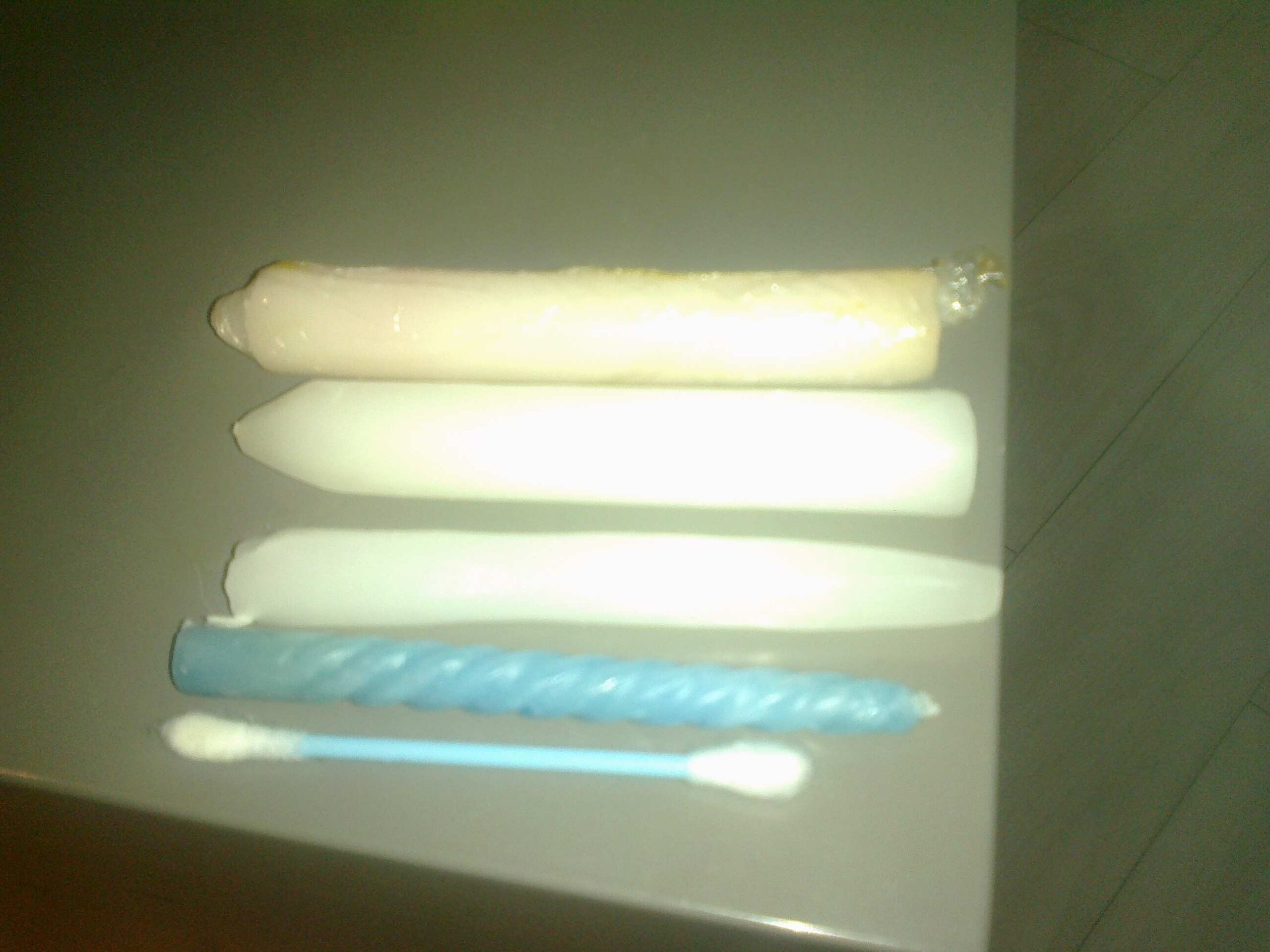
Women are advised to use a cotton swab before they start practicing with candles. In severe cases, taking in cotton swabs is a big challenge. The therapist wants women to understand that they control their vaginal muscles and can move on to bigger sized candles after they feel comfortable and stop contracting with the swab. The varying sizes of the candles matter to prepare women for the penis exercises as the last step of the therapy. Image taken by the author.
Exploring Freely after the Diagnosis
The diagnosis gives women legitimacy to explore their bodies and experiment with their sexualities. It is not only medical authority that allows women to explore their sexuality for treatment purposes. Women have multiple locations of power that they need to navigate and negotiate. The other institutionalized power that they need to negotiate is religion.
As a self-defined pious woman, Aysel wanted to make sure it was OK to use her candle-dildos for her treatment. As I had also heard from another participant, there was a religious hotline in Turkey, which one could call and ask about religious dilemmas. Aysel was aware of the hotline and called them to ask about her candle-dildos and the ablutions to be conducted right after every sexual act[4]. Aysel wondered if she needed to do the ablutions after her “homework” with the candles was finished because she noticed some vaginal discharge every time she practiced. The hodja, the religious authority at the end of the line told her that there was no need for ablutions since she used her dildos for treatment purposes. Even religious authority accepted the necessity and legitimacy of the treatment and granted permission to Aysel so that she could continue exploring her body and enjoying her exercises without worrying about religious requirements.
As this confusion indicates, Aysel did not see biomedicine as the only authority in her life. She was hesitant to readily accept what her therapist told her to do. By this phone call, she negotiated this way of treatment with the religious authority, which—as I understood from our interview—was one of the other major restrictive agents in her life. By doing so, she appropriated the sexual liberty granted by medical authority to her own belief system and legitimized the pleasure she was experiencing in this newly formed space in her life. Aysel was still a pious woman despite the excessive presence of sexual pleasure in her life during treatment.
All in all, vaginismus as a medical diagnosis and its associated therapy, give women the legitimacy to experience their bodies and sexualities in a way that was not acceptable before the diagnosis. Sexuality becomes central in these women’s lives. With exercises of self-exploration, they learn about their bodies and erogenous zones, as well as about expecting pleasure from sexual acts, at least during their exercises (their “homework”). The medical condition makes sexuality and sex talk more acceptable as it also gives these women a scientific language to discuss their bodies and sexuality even with a stranger. The treatment regimen—using home-made dildos—strangely makes women feel empowered as the presence of a disorder makes their sexual lives visible. The lack of penetration in their lives actually makes sexuality and sexual pleasure possible as they can freely explore and experiment with their bodies.
The ultimate goal for Aysel and others, however, is to mold the vagina in a way to become a “normal” regular heterosexual woman. According to their accounts, after penetration is achieved, women do not continue using their candles. They were even hesitant to talk to me post-treatment despite the close bond I thought we developed during their treatment. With penetration achieved, along with the treatment of the medical condition, sexuality becomes a private subject again and the legitimacy of sexual exploration is removed.
Even though it is for a short period of time, I find these women’s experiences valuable and transformative in a way similar to feminist consciousness-raising groups. While shaping and molding their candles, involving whoever they want in the process of making their dildos, and transforming their kitchens into homosocial DIY dildo-making spaces, these women weave in and out of sex talk, convert pots and utensils into dildo-making tools, change, and form their vaginas along with their candles. In doing so, they shortly “seize reproduction” (Murphy 2012) and also heteronormative phallocentric sex.

This image was taken during a group therapy session. For women who work with their husbands to make their candles, the sizes might be unrealistic. Since men know that women show these candles in their therapy sessions, the candle sizes turn into an effort to show their hefty masculinity through dildo/candle size. During my fieldwork, there were a couple of instances where the therapist had to talk to the husbands who were allowed into the process of dildo-making by their wives, about the ways in which they approach therapy. Image taken by the author.
Notes
[1] Women married to brothers are elti to each other. In Aysel’s case, they happen to live in the same building.
[2] All of the health care professionals I interviewed allowed me to use their real names in my research. However, thinking that the women with vaginismus who participated in this research could be identified through their connection to these professionals, I chose to use their initials instead of their full names.
[3] In Turkey, women usually manage the behavioral part of the therapy themselves. They do the muscle-loosening exercises at home as instructed by their therapists without the assistance of a therapist. However, in the US, physical therapists tend to help women with these exercises in the clinics.
[4] People practicing Islam have to wash their bodies thoroughly to get cleansed after every sexual activity and menstruation. The body should be washed so well that there should not be any dry spot on the body, even as small as the tip of a needle.
This post was curated by Contributing Editor Ritu Ghosh, and reviewed by Contributing Editor Thomson Chakramakkil.
References
Murphy, Michelle (2012). Seizing the Means of Reproduction: Entanglements of Feminism, Health, and Technoscience. Rutgers University Press.
Spector, Ilana P., and Michael P. Carey. “Incidence and Prevalence of the Sexual Dysfunctions: A Critical Review of the Empirical Literature.” Archives of Sexual Behavior 19, no. 4 (August 1990): 389–408. https://doi.org/10.1007/BF01541933.
